
By v | 19 October 2026 | 0 Comments
Why Use a Lithium-Based Curing Agent for Sealing and Curing Concrete?

Concrete surface deterioration — solved with Nano-Modified Lithium-Based Curing Agent.
1. Introduction to Concrete Surface Deterioration
1.1 The Inevitable Wear of Concrete Floors
Concrete is universally praised for its compressive strength and durability, making it the backbone of modern industrial and commercial construction. However, the surface of a concrete floor is continuously exposed to a barrage of destructive forces. Forklift traffic, heavy machinery, chemical spills, and even routine cleaning all take a toll over time.In warehouses, manufacturing plants, and logistics centers, the most common and frustrating symptom of this wear is surface degradation—specifically, dusting and sanding. Dusting occurs when the top layer of the concrete surface breaks down into fine particles. This not only creates a visually unappealing environment but also poses significant operational hazards. Airborne dust can damage sensitive machinery, contaminate stored goods, and create respiratory health risks for workers.
1.2 The Root Cause: Porosity and Weak Surface Matrix
To understand why concrete dusts and deteriorates, one must look at its microstructure. Concrete is inherently porous. During the mixing and curing process, excess water that is not consumed by cement hydration evaporates, leaving behind microscopic capillaries and pores. Additionally, the mechanical troweling process can draw weak cement paste and water to the top surface, creating a layer that is more porous and less durable than the bulk concrete below.When this weak, porous surface layer is subjected to friction—whether from foot traffic or forklifts—the bonds between the concrete particles break, releasing dust. Furthermore, these open pores act as highways for water, oils, and chemicals to penetrate deep into the slab, leading to efflorescence, freeze-thaw damage, and internal corrosion.
1.3 Why Nano-Modified Lithium-Based Curing Agent is the Modern Solution
For a long time, the construction industry relied on temporary fixes like waxes or surface sealers. Today, the focus has shifted to chemical densification. Nano-Modified Lithium-Based Curing Agent is at the forefront of this shift. It is an advanced concrete sealing and curing agent engineered specifically for surfaces prone to sanding, dusting, and cracking.Unlike surface coatings, this product penetrates deeply into the substrate. It reacts with the free lime (calcium hydroxide) naturally present in the concrete to form insoluble calcium silicate hydrate (C-S-H) gel. This reaction permanently seals the pore structure from within, turning a weak, dusty surface into a hard, dense, and impermeable shield. It is designed to work synergistically with our company‘s road repair mortar (TR-RP) to eliminate the common issue of ground pulling before construction, significantly improving the efficiency and durability of subsequent repair or coating systems.

Deep penetration — reacting with free lime to seal pores from within.
2. Understanding the Basics of Nano-Modified Lithium-Based Curing Agent
2.1 The Chemistry of Lithium Silicate
Nano-Modified Lithium-Based Curing Agent is a chemically reactive liquid based on nano-modified lithium silicate. The use of lithium as the alkali metal, rather than sodium or potassium, is a critical technical choice. Lithium ions have a much smaller atomic radius, allowing the molecules to penetrate deeper into the dense concrete matrix.Once inside the concrete, the lithium silicate reacts with the calcium hydroxide (free lime) in the pores. This chemical reaction produces calcium silicate hydrate (C-S-H) gel—the same binding phase that gives concrete its initial strength. The newly formed gel fills the microscopic voids and capillaries, creating a denser, harder, and dust-proof surface from the inside out.
2.2 Key Properties of Nano-Modified Lithium-Based Curing Agent
Nano-Modified Lithium-Based Curing Agent offers a combination of properties that make it ideal for demanding industrial and commercial floors:Prevents sand and dust: Deep penetration locks in surface particles and eliminates dusting permanently, without the need for waxing.
Resists alkali, seepage, and moisture: Seals capillaries to block water, oil, and mild chemical ingress, reducing efflorescence and surface sweating.
Hard and wear-resistant: Increases surface hardness and abrasion resistance, extending the service life of the concrete floor and resisting damage from heavy traffic.
Professional solution: Specifically designed for cement wall and floor dust, sand, and cracks, providing a reliable base for subsequent repair or coating systems.
Long-lasting and durable: The reactive treatment becomes an integral part of the concrete, forming a permanent seal that will not peel, flake, or delaminate.
Odorless and environmentally friendly: Water-based, low-VOC formulation with no harsh solvents, making it suitable for interior applications where air quality is a concern.
2.3 Comparison with Traditional Silicates
| Property | Nano-Modified Lithium-Based Curing Agent | Sodium or Potassium Silicates |
| Particle Size | Nano-scale, penetrates deeper | Larger, stays closer to the surface |
| Efflorescence Risk | Extremely low | High (alkali reaction leaves white salts) |
| ASR (Alkali-Silica Reaction) | Minimal | Higher risk of damaging the concrete |
| Surface Finish | Natural, matte, no film | Can leave a white, hazy residue |
| Chemical Stability | High | Moderate |
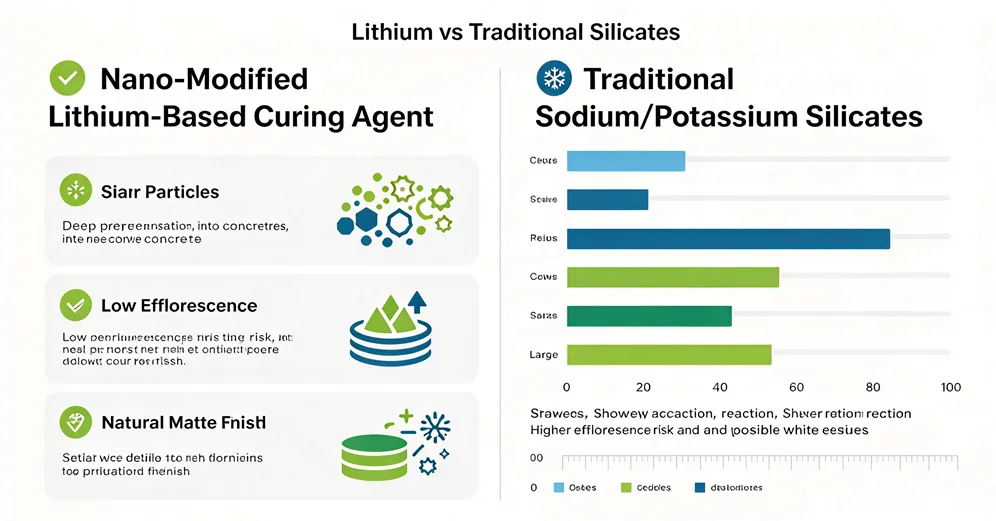
Lithium-based vs traditional silicates — deeper penetration and no efflorescence.
3. Why Traditional Curing Methods Fall Short
3.1 The Illusion of Temporary Surface Films
Traditional curing compounds often rely on forming a physical barrier—a film or a wax layer—on the surface. While this might temporarily lock in moisture or reduce dust, it is a temporary fix. This barrier is easily damaged by forklift traffic, heavy loads, or harsh cleaning chemicals. Once the film is scratched or worn away, the concrete underneath is exposed, and the dusting problem returns immediately.3.2 Poor Adhesion and "Ground Pulling"
If you plan to apply epoxy flooring, heavy-duty paint, or repair mortar, a dusty concrete surface is a major liability. Coatings require a strong, sound substrate to bond to. If they are applied over a weak, dusty layer, they will adhere to the dust rather than the concrete, leading to a phenomenon known as "ground pulling" or delamination. Traditional curing films often must be completely removed (frequently by expensive diamond grinding) before a coating can be applied, adding significant time and cost to the project.3.3 Environmental and Health Concerns
Many traditional floor treatments and sealers contain volatile organic compounds (VOCs) and harsh solvents. These can emit unpleasant odors and pose health risks to workers, especially in enclosed spaces like warehouses or factories with limited ventilation. As indoor air quality regulations become stricter, there is a growing need for odorless, environmentally safe alternatives.Nano-Modified Lithium-Based Curing Agent leaves no film. It strengthens the substrate itself, creating a perfect, stable base for epoxy coatings, polyurethane, or floor paint to adhere properly. It is water-based, odorless, and contains zero VOCs, making it safe for any indoor environment.
4. How Nano-Modified Lithium-Based Curing Agent Solves These Problems
4.1 Permanent Chemical Sealing
Because the C-S-H gel is formed inside the concrete pores, it becomes a permanent, integral part of the concrete structure. It cannot be peeled, scraped, or worn away by traffic. This chemical transformation creates a permanent dust-free surface that is significantly harder and more durable than the original concrete.4.2 Improved Coating Adhesion and Repair Efficiency
By solidifying the weak, dusty surface layer, Nano-Modified Lithium-Based Curing Agent prevents "ground pulling" when repair mortars or coatings are applied. It is highly recommended as a primer or pre-treatment step before applying TR-RP road repair mortar, plastering, or epoxy floors. The strengthened substrate ensures that the repair materials bond securely, extending the lifespan of the repair.4.3 Enhanced Moisture and Chemical Resistance
The dense, sealed surface drastically reduces the permeability of the concrete. Water, oils, and mild chemicals are blocked from penetrating the pores, which helps prevent freeze-thaw damage, efflorescence, and internal corrosion of reinforcing steel.
Ideal for warehouses, industrial workshops, and logistics centers.
5. Key Technical Specifications of Nano-Modified Lithium-Based Curing Agent
| Parameter | Specification Details |
| Product Name | Nano-Modified Lithium-Based Curing Agent |
| Active Ingredient | Lithium Silicate (Nano-modified) |
| Appearance | Clear to slightly cloudy, colorless liquid |
| Odor | Odorless (Environmentally friendly, Low-VOC) |
| Dilution Ratio | 1 : 2 to 1 : 5 (Concentrate : Water) |
| Coverage Rate | 80m² - 90m² per 20kg barrel (Depends on surface porosity) |
| Packaging Standard | 20kg / barrel (Plastic drum) |
| Shelf Life | 12 Months (Store in a cool, dry place, keep sealed) |
Application & Coverage Guide:
| Construction Step | Operation Details | Key Notes |
| 1. Surface Prep | Remove dust, peeling layers, and oil using a shovel or grinder. | Ensure the surface is clean, dry, and free of loose particles. |
| 2. Dilution | Mix with 2-5 times water. | Stir well. Use less water for porous surfaces and more for dense surfaces. |
| 3. Application | Apply evenly with a roller or mop. Re-apply after initial curing. | Keep the surface wet for 15-20 mins to ensure deep penetration. |
| 4. Curing & Polishing | Ventilate for 4 hours. Polish or apply topcoat after drying. | Avoid heavy foot traffic until the surface is fully dry. |
6. Matching Nano-Modified Lithium-Based Curing Agent to Your Application
6.1 Industrial Warehouses and Logistics Centers
For high-traffic areas with forklifts and heavy equipment, Nano-Modified Lithium-Based Curing Agent provides the necessary surface density and abrasion resistance to prevent dusting and wear, significantly reducing maintenance costs. It is the ideal solution for distribution centers where clean air and product protection are critical.6.2 Pre-Treatment for Epoxy or Repair Mortar
If you are planning to apply TR-RP repair mortar, plastering, or epoxy flooring, applying Nano-Modified Lithium-Based Curing Agent first will stabilize the substrate. It stops sanding and ensures the repair material bonds securely, preventing costly failures and rework.6.3 Commercial and Retail Spaces
The treatment leaves a natural, matte finish that enhances the concrete’s original look. It is easy to maintain and improves light reflectance, making the space brighter and cleaner. Because it is odorless and non-toxic, it can be applied during business hours with minimal disruption.6.4 Moisture Proofing for Walls and Panels
Beyond floors, this curing agent is also suitable for moisture proofing of walls, roofs, stones, and panels, effectively reducing water penetration and seepage issues.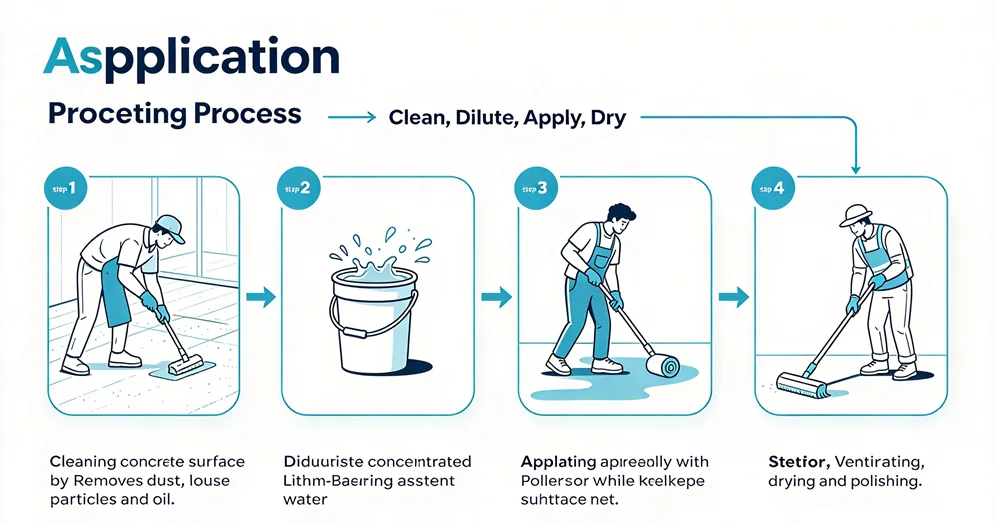
Application process — clean, dilute, apply, and dry.
7. Common Misconceptions About Lithium-Based Curing Agents
7.1 "A Curing Agent Only Retains Moisture"
Traditional curing compounds are used to prevent water evaporation during the initial curing of new concrete. However, Nano-Modified Lithium-Based Curing Agent is a sealing and hardening agent. It is used on both new and existing concrete to permanently densify the surface and prevent dusting.7.2 "It Will Leave a Glossy Film or Change the Color"
Nano-Modified Lithium-Based Curing Agent is clear and odorless. It will not leave a glossy film or change the color of the concrete. It leaves a natural, matte finish that enhances the original appearance.7.3 "I Need to Wax the Floor Afterward"
No waxing is required. The chemical reaction seals the pores permanently. Waxing can actually create a slippery, temporary layer that attracts dirt.7.4 "It's Too Expensive Compared to Wax"
While the upfront cost is higher than a bucket of wax, Nano-Modified Lithium-Based Curing Agent is permanent. When you factor in the labor cost of repeatedly waxing and stripping a floor, the lithium treatment pays for itself very quickly.7.5 "It Can't Be Used on New Concrete"
Yes, it can. It is highly effective on new concrete once the surface has cured enough to walk on (typically 7-14 days). Applying it early helps lock in moisture for proper hydration while simultaneously sealing the surface against dusting and damage.8. Quick Evaluation Checklist
Before applying Nano-Modified Lithium-Based Curing Agent, verify the following:Surface condition (remove dust, peeling layers, and oil)
Dilution ratio (1:2 to 1:5 depending on porosity)
Application method (roller or mop)
Keep surface wet for 15–20 minutes for deep penetration
Ventilation and drying (at least 4 hours before topcoat)
Coverage rate (80–90 m² per barrel)
9. Real-World Application Scenarios
9.1 Warehouse Floor Dusting Treatment
A logistics center had a severe dusting problem that was ruining packaged goods and creating a health hazard. They applied Nano-Modified Lithium-Based Curing Agent to the floor. The dusting stopped immediately, and the floor became hard enough to withstand heavy forklift traffic.9.2 Pre-Treatment for Epoxy Coating
A manufacturing plant wanted to apply a heavy-duty epoxy floor. However, the existing concrete was sandy and weak. By using Nano-Modified Lithium-Based Curing Agent as a primer, they hardened the substrate and prevented the epoxy from peeling off later.9.3 Repairing an Old Cement Wall
Before applying putty and paint, a contractor treated a dusty, sandy cement wall with the curing agent. The product penetrated deeply, locking the sand in place and providing a strong, stable base for the putty. The paint finish was smooth and durable, with no peeling.10. Frequently Asked Questions (FAQs)
Q1: What exactly is a lithium-based concrete curing agent?A lithium-based concrete curing agent is a chemically reactive liquid (usually lithium silicate) that penetrates the concrete surface. Unlike film-forming curing compounds that sit on top, this concrete sealing curing agent reacts with the free lime inside the concrete to create a harder, denser, and dust-proof surface from the inside out.
Q2: How does this product compare to standard sodium or potassium silicates?
Our nano-modified lithium-based curing agent offers superior performance. Lithium silicate particles are much smaller, allowing for deeper penetration into the concrete pores. It also significantly reduces the risk of "ASR" (Alkali-Silica Reaction) and efflorescence, which are common issues with sodium-based products.
Q3: Can this concrete curing agent be used on new concrete?
Yes. It is highly effective on new concrete once the surface has cured enough to walk on (typi
Leave a Reply
Your email address will not be published.Required fields are marked. *