
By v | 12 October 2026 | 0 Comments
Why Biomass-Derived Hard Carbon Is the Sustainable Anode for Sodium-Ion Batteries?
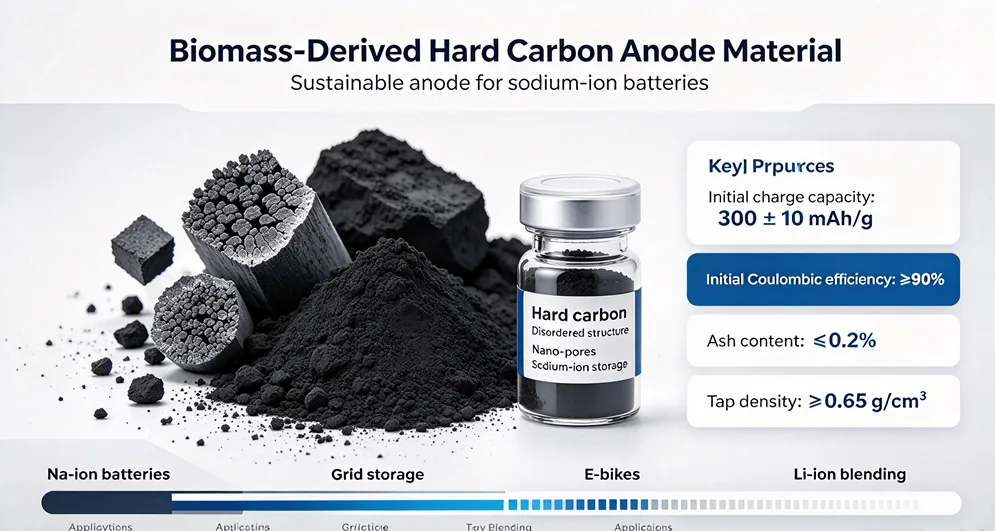
Biomass-Derived Hard Carbon Anode Material
1. Introduction: The Sustainability Challenge in Battery Materials
1.1 The Growing Demand for Sustainable Battery Materials
The global transition to clean energy is driving unprecedented demand for battery materials. Electric vehicles, grid-scale energy storage, and portable electronics all require high-performance, cost-effective, and sustainable battery solutions. However, many conventional battery materials rely on scarce or geopolitically sensitive resources, raising concerns about long-term supply security and environmental impact.Sodium-ion batteries have emerged as a promising alternative to lithium-ion batteries, particularly for stationary energy storage and low-speed electric vehicles. Sodium is abundant, widely distributed, and inexpensive compared to lithium. However, sodium-ion batteries require anode materials that can efficiently store sodium ions — and this is where hard carbon comes in.
1.2 What Makes Hard Carbon Special?
Hard carbon is a non-graphitizable carbon material with a disordered, turbostratic structure. Unlike graphite, which has an ordered layered structure, hard carbon has larger interlayer spacing and abundant nano-pores and defects. These structural features enable hard carbon to store sodium ions efficiently, making it the preferred anode material for sodium-ion batteries.Biomass-Derived Hard Carbon Anode Material takes this a step further by producing hard carbon from renewable biomass precursors. This approach not only delivers excellent electrochemical performance but also addresses the sustainability challenge by using widely available, low-cost, and renewable feedstock.
1.3 Why Biomass-Derived Hard Carbon?
Biomass-Derived Hard Carbon Anode Material is produced from widely available renewable precursors through high-temperature carbonization, purification, and surface modification processes. The disordered turbostratic structure, abundant nano-pores, and intrinsic defects enable efficient sodium and lithium storage, making it the preferred anode material for sodium-ion batteries.By precisely controlling carbonization temperature, heating rate, and purification steps, manufacturers can achieve tailored microstructures (interlayer spacing, closed pore ratio) and surface chemistry. Biomass-Derived Hard Carbon Anode Material offers abundant feedstock sources, controllable ash content, and well-developed pore structures, delivering excellent electrochemical performance.
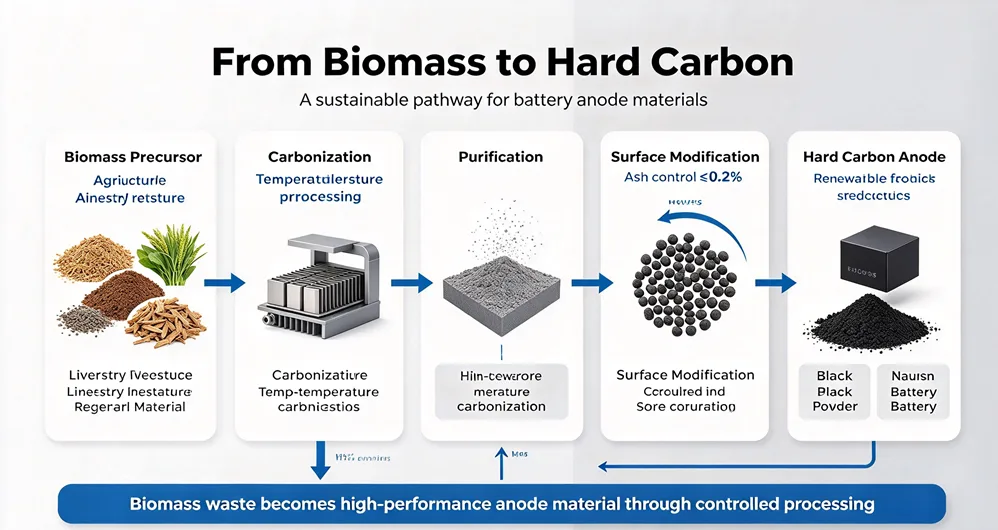
From biomass waste to high-performance anode
2. Understanding Biomass-Derived Hard Carbon
2.1 What Is Hard Carbon?
Hard carbon is a type of carbon material that cannot be graphitized even at high temperatures. It has a disordered, non-crystalline structure with regions of curved graphene-like layers that are randomly oriented. This structure creates larger interlayer spacing and abundant nano-pores and defects, which are essential for sodium-ion storage.The sodium storage mechanism in hard carbon involves several processes: adsorption of sodium ions on the surface and in defects, intercalation of sodium ions between the disordered graphene layers, and filling of sodium ions in closed pores. The combination of these mechanisms gives hard carbon its high reversible capacity and excellent rate capability.
2.2 How Is Biomass-Derived Hard Carbon Made?
Biomass-Derived Hard Carbon Anode Material is produced from renewable biomass precursors through a series of processing steps. The first step is carbonization, where the biomass is heated to high temperatures in an inert atmosphere to remove volatile components and form a carbon-rich residue. The second step is purification, where impurities such as ash and metals are removed. The third step is surface modification, where the surface chemistry and pore structure are tailored to optimize electrochemical performance.By precisely controlling the carbonization temperature, heating rate, and purification steps, manufacturers can achieve tailored microstructures with specific interlayer spacing, closed pore ratio, and surface chemistry. This control is essential for achieving high initial Coulombic efficiency and excellent cycling stability.
2.3 Key Advantages of Biomass-Derived Hard Carbon
Biomass-Derived Hard Carbon Anode Material offers several key advantages over conventional hard carbon materials.Abundant resources and cost advantage: Sourced from biomass waste or renewable materials, widely available and low-cost.
Rich pore structure and high sodium storage capacity: The unique disordered structure and nano-pores enable ultra-high reversible capacity with excellent rate capability from 0.1C to 2C.
Leading initial Coulombic efficiency (ICE): Through optimized carbonization and pore engineering, ICE of 85%–92% is achieved, with select grades reaching 92%–93%.
Exceptional cycling stability: Optimized interlayer spacing and disordered structure provide outstanding structural integrity, sustaining long-term charge–discharge cycles without collapse.
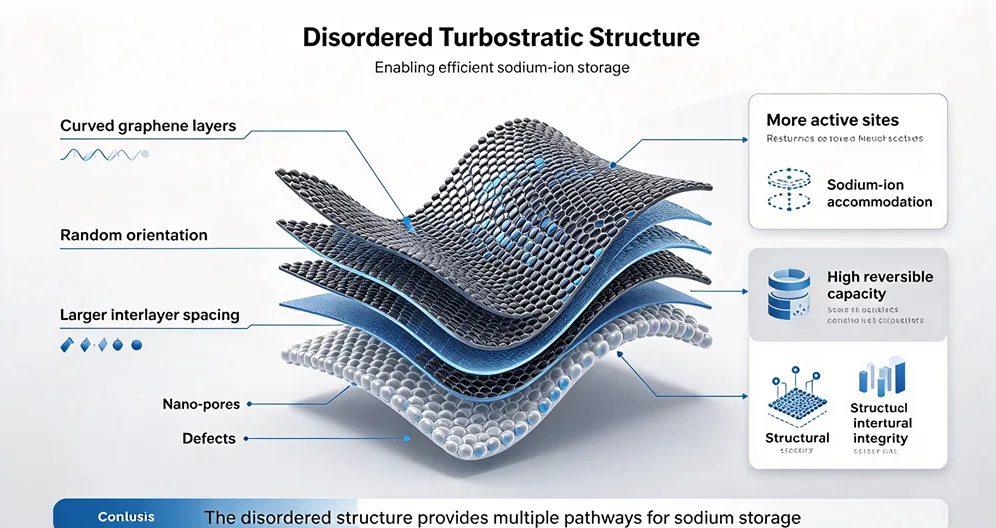
Disordered turbostratic structure
3. Why Sodium-Ion Batteries Need Hard Carbon Anodes
3.1 The Sodium-Ion Challenge
Sodium ions are larger than lithium ions, which makes them more difficult to store in conventional anode materials. Graphite, the standard anode for lithium-ion batteries, cannot store sodium ions effectively because its interlayer spacing is too small. This is why sodium-ion batteries require a different type of anode material.Hard carbon is the most promising anode material for sodium-ion batteries because its larger interlayer spacing and abundant nano-pores can accommodate sodium ions. The disordered structure of hard carbon also provides more active sites for sodium storage, leading to higher reversible capacity.
3.2 Why Hard Carbon Outperforms Other Anode Materials
Several anode materials have been explored for sodium-ion batteries, including graphite, soft carbon, and alloy-based materials. However, hard carbon offers the best combination of capacity, rate capability, cycling stability, and cost.Graphite cannot store sodium ions effectively due to its small interlayer spacing. Soft carbon has a more ordered structure and lower capacity than hard carbon. Alloy-based materials, such as tin and antimony, have high theoretical capacity but suffer from large volume changes during cycling, leading to rapid capacity fade.
Biomass-Derived Hard Carbon Anode Material overcomes the limitations of these alternative anode materials, delivering high capacity, excellent rate capability, and long cycling stability at a competitive cost.
3.3 The Sustainability Advantage
Conventional hard carbon is typically produced from synthetic precursors such as phenolic resins or petroleum-based pitch. These precursors are derived from fossil fuels and contribute to carbon emissions. Biomass-Derived Hard Carbon Anode Material uses renewable biomass precursors instead, reducing the carbon footprint of battery production.Biomass precursors are also widely available and low-cost, making Biomass-Derived Hard Carbon Anode Material an economically attractive option for large-scale energy storage applications.
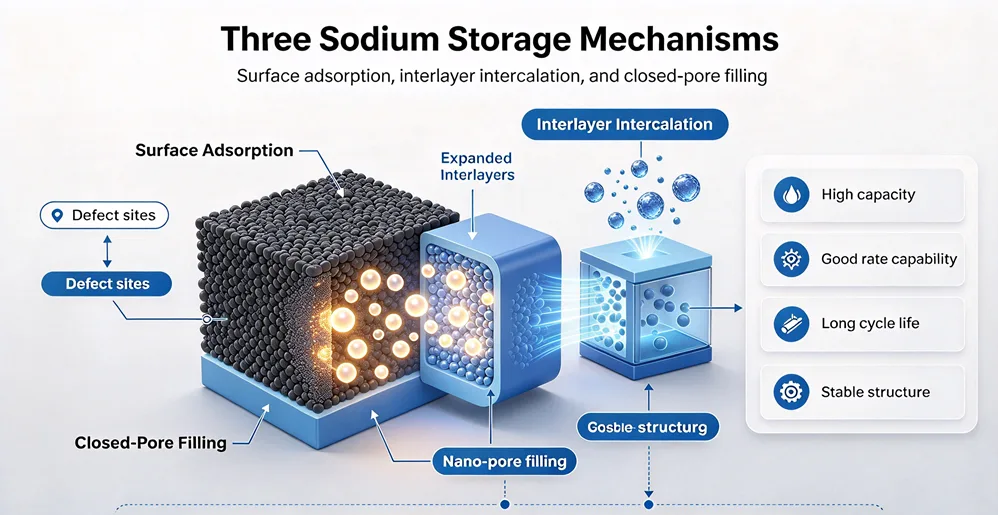
Three sodium storage mechanisms
4. How Biomass-Derived Hard Carbon Solves the Sustainability Problem
4.1 Renewable Feedstock
Biomass-Derived Hard Carbon Anode Material is produced from widely available renewable precursors such as agricultural waste, forestry residues, and other biomass materials. These feedstocks are abundant, low-cost, and renewable, reducing dependence on fossil fuel-derived precursors.4.2 Controllable Ash Content
Biomass precursors naturally contain ash and other impurities that can affect electrochemical performance. Through purification processes, the ash content of Biomass-Derived Hard Carbon Anode Material is controlled to ≤0.2%, ensuring consistent performance and long cycle life.4.3 Well-Developed Pore Structure
The carbonization and activation processes used to produce Biomass-Derived Hard Carbon Anode Material create a well-developed pore structure with abundant nano-pores and defects. This structure provides more active sites for sodium storage, leading to higher reversible capacity.4.4 Tailored Microstructure
By precisely controlling the carbonization temperature, heating rate, and purification steps, manufacturers can tailor the microstructure of Biomass-Derived Hard Carbon Anode Material to optimize interlayer spacing, closed pore ratio, and surface chemistry. This control enables the material to achieve high initial Coulombic efficiency and excellent cycling stability.4.5 Cost-Effective Production
The use of low-cost biomass precursors and scalable production processes makes Biomass-Derived Hard Carbon Anode Material a cost-effective option for sodium-ion batteries. This is particularly important for large-scale energy storage applications where cost per kWh is a critical factor.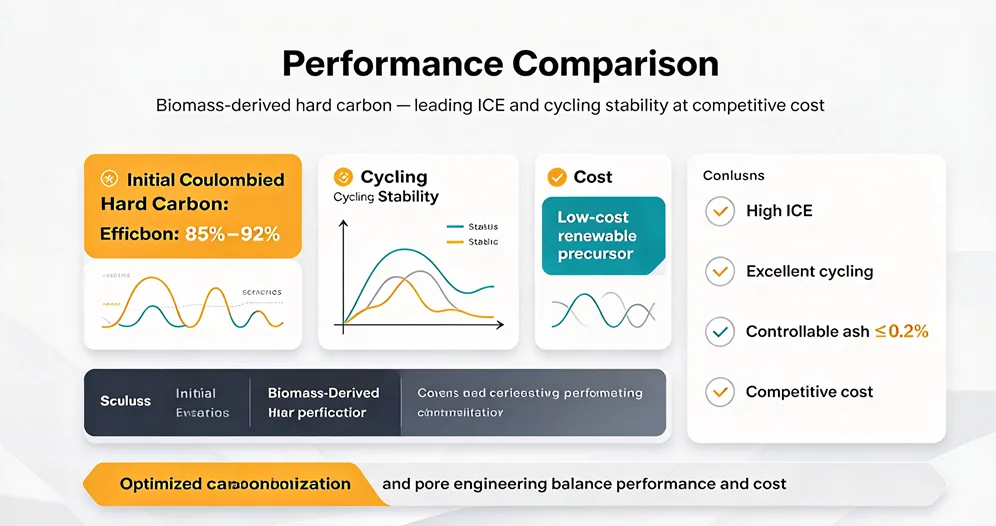
Biomass-derived hard carbon
5. Key Technical Specifications of Biomass-Derived Hard Carbon
| Parameter | Unit | Specification | Test Method / Instrument |
| Particle Size – D10 | µm | 2.0 – 4.0 | Laser Diffraction Particle Size Analyzer |
| Particle Size – D50 | µm | 6.0 – 8.0 | Laser Diffraction Particle Size Analyzer |
| Particle Size – D90 | µm | 10.0 – 14.0 | Laser Diffraction Particle Size Analyzer |
| Particle Size – D100 | µm | ≤ 25.0 | Laser Diffraction Particle Size Analyzer |
| Moisture | % | ≤ 0.5 | Moisture Analyzer |
| pH Value | – | 7.0 – 11.0 | pH Meter |
| Ash Content | % | ≤ 0.2 | Muffle Furnace Calcination |
| Tap Density | g/cm³ | ≥ 0.65 | Tap Density Tester |
| Compacted Density | g/cm³ | 1.0 ± 0.1 | Compaction Density Tester |
| Specific Surface Area (BET) | m²/g | ≤ 5 | BET Surface Area Analyzer |
| Initial Charge Capacity (0.1C/0.1C, 0–2.5 V) | mAh/g | 300 ± 10 | Neware Battery Test System |
| Initial Coulombic Efficiency | % | ≥ 90 | Neware Battery Test System |
6. Matching Biomass-Derived Hard Carbon to Your Application
6.1 Sodium-Ion Batteries for E-Bikes and Low-Speed EVs
Biomass-Derived Hard Carbon Anode Material is ideal for sodium-ion batteries used in e-bikes, low-speed electric vehicles, and other light electric vehicles. The material‘s high capacity, excellent rate capability, and long cycling stability meet the demanding requirements of these applications.6.2 Large-Scale Energy Storage Systems
Biomass-Derived Hard Carbon Anode Material is suitable for large-scale energy storage systems, including grid frequency regulation and commercial and industrial storage. The material’s low cost, long cycle life, and sustainable feedstock make it an attractive option for these applications.6.3 Cost-Sensitive Sodium-Ion Battery Applications
For cost-sensitive sodium-ion battery applications, Biomass-Derived Hard Carbon Anode Material offers an excellent balance of performance and cost. The use of low-cost biomass precursors and scalable production processes reduces the cost per kWh, making sodium-ion batteries more competitive with lithium-ion batteries.6.4 Lithium-Ion Battery Blending
In lithium-ion systems, Biomass-Derived Hard Carbon Anode Material is recommended for blending with synthetic or natural graphite anodes to improve fast-charging capability and cycle stability. The hard carbon component provides additional active sites for lithium storage, enhancing rate performance and reducing lithium plating.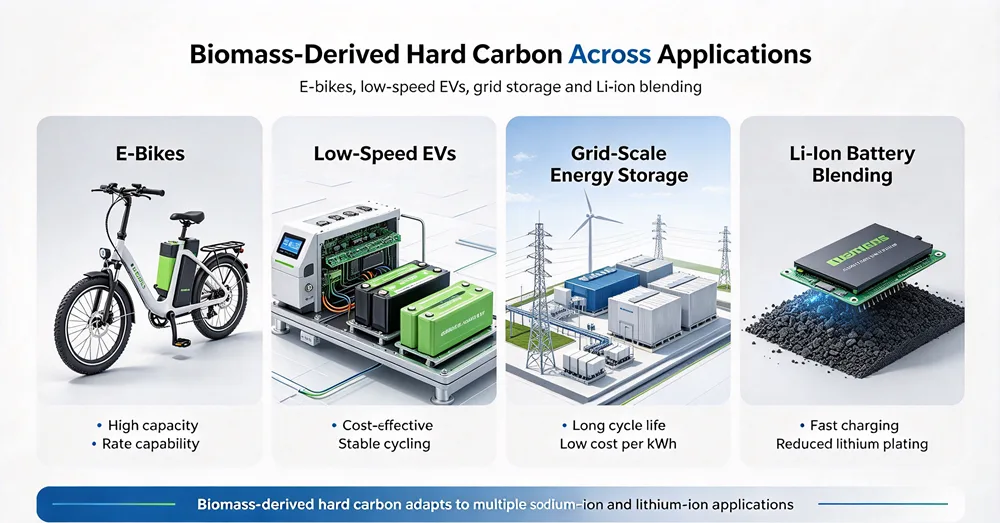
Biomass-derived hard carbon across applications
7. Common Misconceptions About Hard Carbon Anodes
7.1 "Hard Carbon Is the Same as Graphite"
Hard carbon and graphite are fundamentally different materials. Graphite has an ordered, layered structure and is primarily used for lithium-ion anodes. Hard carbon has a disordered, non-graphitizable structure with larger interlayer spacing, enabling high sodium storage. Biomass-Derived Hard Carbon Anode Material is specifically designed for sodium-ion batteries.7.2 "Hard Carbon Has Low Initial Coulombic Efficiency"
Conventional hard carbon materials often suffer from low initial Coulombic efficiency due to irreversible sodium loss during the first cycle. However, Biomass-Derived Hard Carbon Anode Material achieves ICE of 85%–92%, with select grades reaching 92%–93%, through optimized carbonization and pore engineering.7.3 "Biomass-Derived Materials Have Inconsistent Quality"
While biomass precursors can vary in composition, Biomass-Derived Hard Carbon Anode Material is produced through controlled carbonization, purification, and surface modification processes that ensure consistent quality and performance. The ash content is controlled to ≤0.2%, and the particle size distribution is tightly controlled.7.4 "Hard Carbon Is Only for Sodium-Ion Batteries"
While hard carbon is the preferred anode for sodium-ion batteries, it can also be used in lithium-ion batteries. Biomass-Derived Hard Carbon Anode Material is recommended for blending with graphite in lithium-ion systems to improve fast-charging capability and cycle stability.7.5 "Biomass-Derived Hard Carbon Is More Expensive"
Biomass-Derived Hard Carbon Anode Material uses low-cost, renewable biomass precursors, making it cost-competitive with conventional hard carbon materials. The scalable production process and abundant feedstock further reduce cost, making it an economically attractive option for large-scale energy storage.8. Quick Evaluation Checklist
Before selecting Biomass-Derived Hard Carbon Anode Material for your battery application, verify the following key parameters:Particle size distribution (D10, D50, D90, D100)
Moisture content (≤0.5%)
pH value (7.0–11.0)
Ash content (≤0.2%)
Tap density (≥0.65 g/cm³)
Compacted density (1.0 ± 0.1 g/cm³)
Specific surface area (≤5 m²/g)
Initial charge capacity (300 ± 10 mAh/g)
Leave a Reply
Your email address will not be published.Required fields are marked. *