
By v | 26 September 2026 | 0 Comments
Why Nano Aluminum Oxide Is Irreplaceable in Lithium Battery Separator Coatings
1. Introduction to Nano Aluminum Oxide in Lithium Battery Separators
1.1 What Is Nano Aluminum Oxide?
Nano Aluminum Oxide (Al₂O₃) is a high-performance nanopowder engineered specifically for battery and battery material applications. It features uniform and fine particle size, exceptionally high purity, and superior surface properties. The product is widely used in lithium batteries, alkaline batteries, solar cells, and other energy storage systems to enhance energy density, improve safety performance, and support energy-saving and environmentally friendly initiatives.Nano Aluminum Oxide is available in two primary grades. The α-phase grade (TR-L500G) has a larger particle size and ultra-high purity, primarily used for separator coatings. The γ-phase grade (TR-L30D) has a smaller particle size and higher surface area, designed for cathode material doping and additive applications.
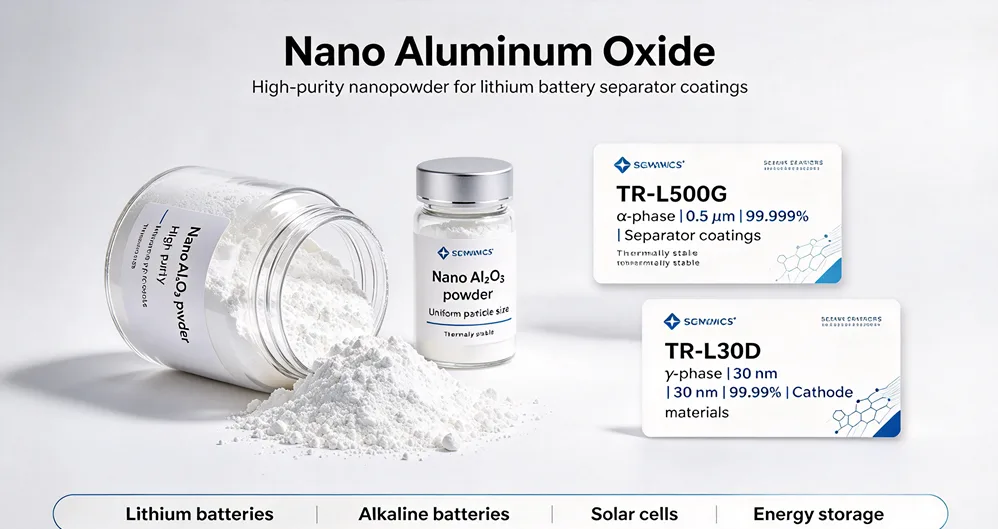
Nano Aluminum Oxide
1.2 Why Separator Coatings Matter in Lithium Batteries
The separator is one of the most critical components in a lithium battery. It physically separates the anode and cathode while allowing lithium ions to pass through during charge and discharge. If the separator fails — whether through shrinkage, melting, or puncture — the anode and cathode can come into direct contact, causing an internal short circuit. This can trigger thermal runaway, a chain reaction that leads to fire or explosion.Conventional polyolefin separators, typically made from polyethylene (PE) or polypropylene (PP), have a low melting point. At elevated temperatures, they can shrink or melt, compromising their ability to separate the electrodes. Coating the separator with a ceramic layer of Nano Aluminum Oxide creates a thermally resistant and electrically insulating barrier that maintains separation even at high temperatures.
1.3 The Cost of Choosing the Wrong Coating Material
A poorly chosen separator coating can fail in several ways. If the coating material lacks sufficient thermal stability, it may not prevent separator shrinkage at high temperatures. If the coating has poor adhesion to the separator substrate, it may delaminate during battery assembly or cycling. If the coating introduces impurities, it can degrade electrochemical performance and reduce cycle life.Nano Aluminum Oxide addresses these requirements with a combination of high purity, uniform particle size, excellent thermal stability, and strong adhesion to polyolefin substrates. Its proven performance in lithium battery separator coatings has made it a standard choice for battery manufacturers worldwide.
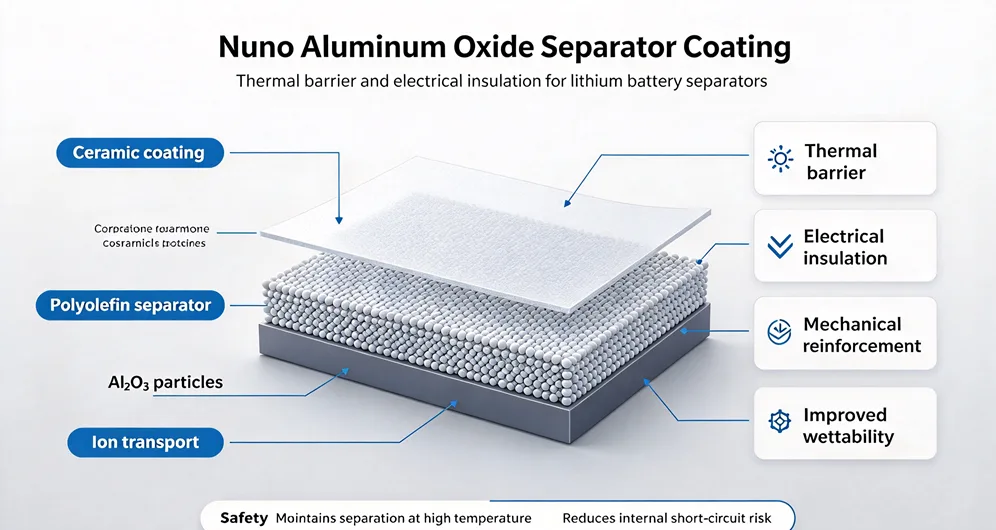
Nano Aluminum Oxide Separator Coating
2. Understanding the Basics of Nano Aluminum Oxide
2.1 Chemical Composition and Crystal Phases
Nano Aluminum Oxide is composed of aluminum oxide (Al₂O₃) in nanopowder form. The material is available in two crystal phases:α-phase (alpha): The most thermodynamically stable form of alumina, with high hardness, high thermal conductivity, and excellent chemical stability. TR-L500G is an α-phase product with a particle size of 0.5 μm and purity of 99.999%, primarily used for separator coatings.
γ-phase (gamma): A metastable form with higher surface area and smaller particle size. TR-L30D is a γ-phase product with a particle size of 30 nm and purity of 99.99%, designed for cathode material doping and additive applications.
The choice between α-phase and γ-phase depends on the application. For separator coatings, the α-phase is preferred because of its higher thermal stability and better adhesion. For cathode modification, the γ-phase is preferred because its higher surface area enables more effective interaction with the cathode material.
2.2 Key Properties of Nano Aluminum Oxide
Nano Aluminum Oxide offers a combination of properties that are particularly well-suited to separator coating applications.Excellent thermal insulation: When used as an electrode coating, it effectively isolates heat and prevents short circuits, significantly improving battery safety.
Excellent electrical insulation: The material acts as an electrical insulator, preventing direct contact between the anode and cathode.
High thermal stability: Nano Aluminum Oxide maintains its structural integrity at elevated temperatures, providing reliable separation even under thermal stress.
Uniform particle size: The uniform and fine particle size ensures consistent coating thickness and performance.
Exceptionally high purity: With purity levels up to 99.999%, the product minimizes the risk of impurity-induced performance degradation.
Strong adhesion: The material adheres well to polyolefin separators, ensuring the coating remains intact during battery assembly and cycling.
2.3 Advantages Over Other Coating Materials
Compared to other ceramic coating materials such as boehmite, silica, or zirconia, Nano Aluminum Oxide offers a favorable balance of performance and cost. Boehmite has good thermal stability but lower hardness. Silica has good thermal insulation but lower chemical stability. Zirconia offers excellent thermal stability but at a higher cost. Nano Aluminum Oxide provides a combination of thermal resistance, electrical insulation, chemical stability, and cost-effectiveness that makes it a preferred choice for separator coatings.、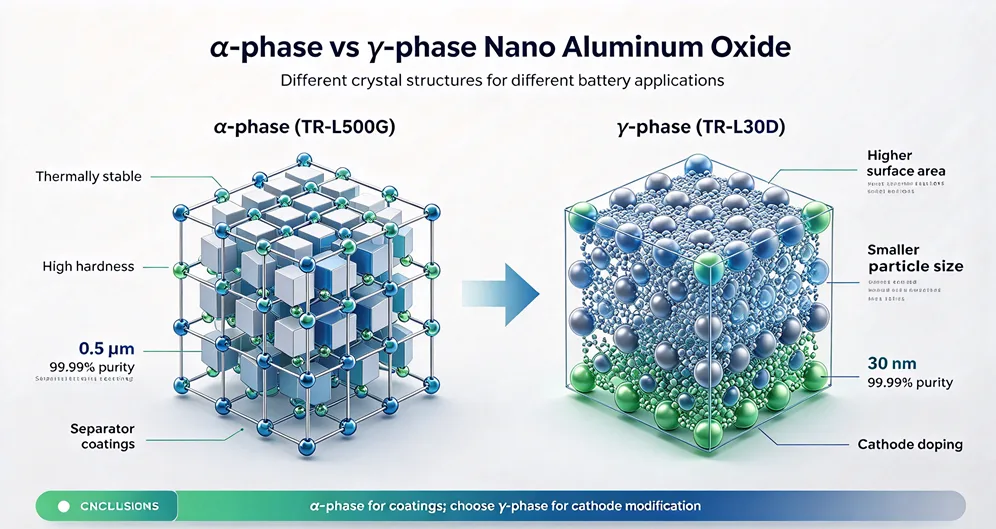
α-phase vs γ-phase Nano Aluminum Oxide
3. Step 1: Understand Why Separator Coatings Matter
3.1 The Role of the Separator in Lithium Batteries
The separator is a porous membrane that physically separates the anode and cathode while allowing lithium ions to pass through during charge and discharge. It must be chemically stable, mechanically strong, and thermally resistant to prevent internal short circuits.Conventional polyolefin separators have a low melting point (around 130–160°C for PE and 160–170°C for PP). At elevated temperatures, they can shrink or melt, allowing the electrodes to come into contact. Coating the separator with Nano Aluminum Oxide creates a ceramic barrier that maintains separation even at high temperatures.
3.2 How Ceramic Coatings Improve Safety
Ceramic-coated separators offer several safety improvements over uncoated separators.Thermal shrinkage resistance: The ceramic coating prevents the separator from shrinking at elevated temperatures, reducing the risk of internal short circuits.
Mechanical strength: The ceramic coating reinforces the separator, making it more resistant to puncture and damage during battery assembly.
Electrolyte wettability: The ceramic coating improves electrolyte wettability, enhancing ionic conductivity and battery performance.
Thermal runaway prevention: By maintaining separation at high temperatures, the ceramic coating reduces the risk of thermal runaway.
3.3 Why Nano Aluminum Oxide Is the Preferred Coating Material
Nano Aluminum Oxide is the preferred coating material for separator coatings because it offers the best combination of thermal stability, electrical insulation, chemical inertness, and cost-effectiveness. Its high purity and uniform particle size ensure consistent coating performance, while its strong adhesion to polyolefin separators ensures long-term reliability.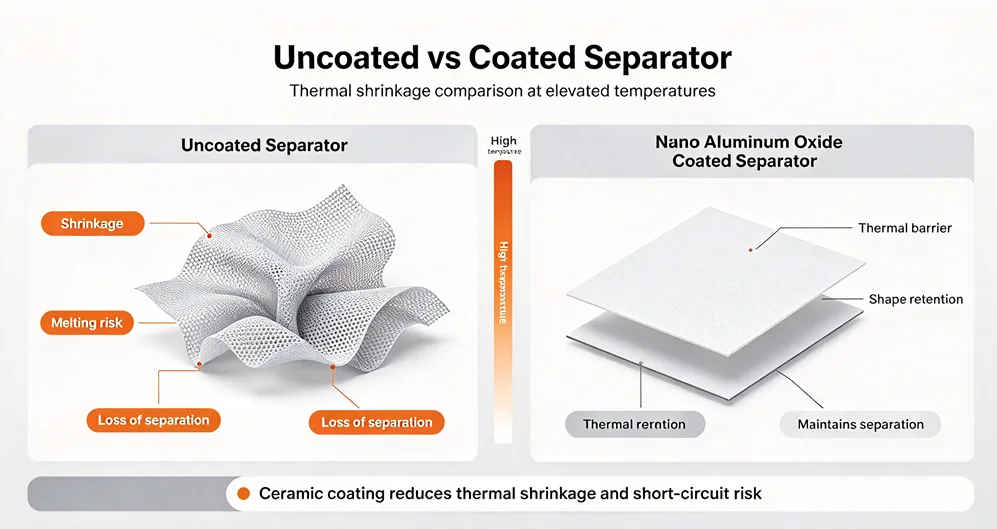
Uncoated vs Coated Separator
4. Step 2: Evaluate the Role of Nano Aluminum Oxide in Separator Coatings
4.1 Thermal Barrier Function
When a lithium battery experiences elevated temperatures — whether from overcharging, internal short circuits, or external heat — the separator must maintain its integrity. Nano Aluminum Oxide creates a thermally resistant barrier that prevents the polyolefin separator from shrinking or melting. This thermal barrier function is critical for preventing thermal runaway and ensuring battery safety.4.2 Electrical Insulation Function
Nano Aluminum Oxide is an electrical insulator. When coated on the separator, it prevents direct contact between the anode and cathode, even if the polyolefin substrate is damaged. This electrical insulation function provides a second layer of safety, reducing the risk of internal short circuits.4.3 Mechanical Reinforcement Function
The ceramic coating also reinforces the separator mechanically. Nano Aluminum Oxide particles form a rigid network on the separator surface, increasing its resistance to puncture and damage during battery assembly. This mechanical reinforcement function is particularly important for high-energy-density batteries, where the separator is thinner and more vulnerable.4.4 Electrolyte Compatibility
Nano Aluminum Oxide is chemically stable in the presence of lithium battery electrolytes. It does not react with the electrolyte or dissolve during battery cycling, ensuring long-term performance. The ceramic coating also improves electrolyte wettability, enhancing ionic conductivity and battery performance.5. Step 3: Compare Nano Aluminum Oxide with Other Coating Materials
5.1 Nano Aluminum Oxide vs. Boehmite
Boehmite (AlOOH) is a commonly used ceramic coating material for battery separators. It offers good thermal stability and electrolyte wettability. However, Nano Aluminum Oxide offers higher hardness and better mechanical reinforcement. The choice between the two depends on the specific requirements of the battery application.5.2 Nano Aluminum Oxide vs. Silica
Silica (SiO₂) is another ceramic coating material used in battery separators. It offers good thermal insulation but lower chemical stability than Nano Aluminum Oxide. Silica can react with certain electrolytes, particularly those containing HF. Nano Aluminum Oxide is more chemically stable and offers better long-term performance.5.3 Nano Aluminum Oxide vs. Zirconia
Zirconia (ZrO₂) offers excellent thermal stability and chemical inertness. However, it is more expensive than Nano Aluminum Oxide and has a higher density, which can reduce the energy density of the battery. Nano Aluminum Oxide offers a better balance of performance and cost.| Comparison Dimension | Nano Aluminum Oxide | Boehmite | Silica | Zirconia |
| Thermal stability | Excellent | Good | Good | Excellent |
| Chemical stability | Excellent | Good | Moderate | Excellent |
| Mechanical reinforcement | High | Moderate | Moderate | High |
| Cost | Moderate | Moderate | Low | High |
| Density | Low | Low | Low | High |
| Electrolyte compatibility | Excellent | Good | Moderate | Excellent |
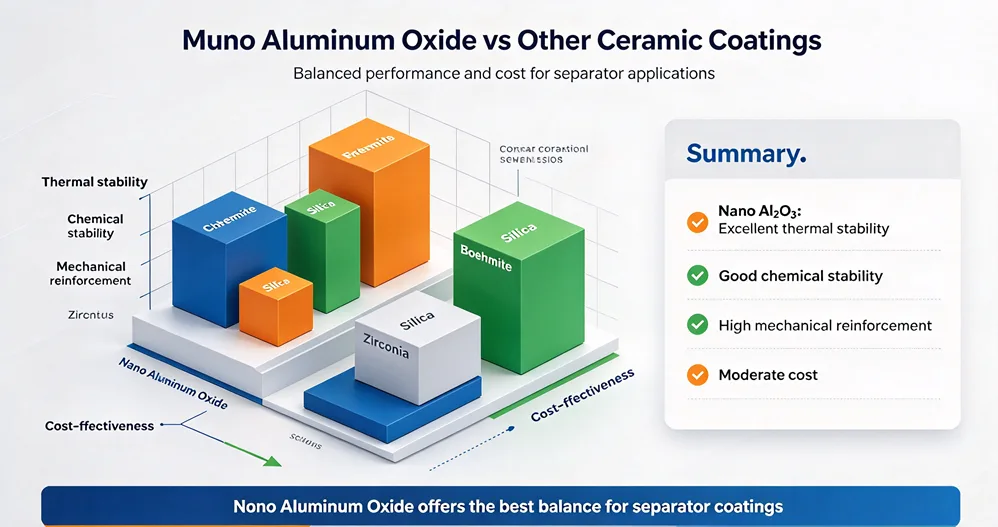
Nano Aluminum Oxide vs Other Ceramic Coatings
6. Step 4: Match Nano Aluminum Oxide Grades to Your Application
6.1 TR-L500G for Separator Coatings
TR-L500G is an α-phase Nano Aluminum Oxide with a particle size of 0.5 μm and purity of 99.999%. It is specifically designed for separator coatings. The larger particle size and ultra-high purity make it ideal for creating a uniform, thermally stable coating on polyolefin separators.6.2 TR-L30D for Cathode Materials
TR-L30D is a γ-phase Nano Aluminum Oxide with a particle size of 30 nm and purity of 99.99%. It is designed for cathode material doping and additive applications. The smaller particle size and higher surface area enable more effective interaction with cathode materials, improving structural stability and cycling performance.6.3 Other Applications
In addition to separator coatings and cathode materials, Nano Aluminum Oxide is also suitable for alkaline batteries, solar cells, and other advanced energy storage systems where enhanced safety and stability are required.7. Step 5: Consider Processing and Formulation Factors
7.1 Coating Formulation
Nano Aluminum Oxide is typically formulated into a slurry with a binder and solvent for coating onto the separator. The binder provides adhesion to the polyolefin substrate, while the solvent controls viscosity and coating thickness. The formulation must be optimized to ensure uniform coating and strong adhesion.7.2 Coating Thickness
The coating thickness affects both safety and electrochemical performance. A thicker coating provides better thermal and mechanical protection but increases the separator’s overall thickness and reduces energy density. A thinner coating preserves energy density but may provide less protection. The optimal thickness depends on the specific battery design and safety requirements.7.3 Adhesion and Dispersion
Uniform dispersion of Nano Aluminum Oxide particles in the coating slurry is essential for consistent coating performance. Poor dispersion can lead to agglomerates that reduce coating uniformity and adhesion. Proper mixing and dispersion techniques should be used to ensure a homogeneous coating.7.4 Drying and Curing
After coating, the separator is dried to remove the solvent and cure the binder. The drying process must be controlled to prevent cracking or delamination of the coating. The curing conditions affect the adhesion and mechanical properties of the coating.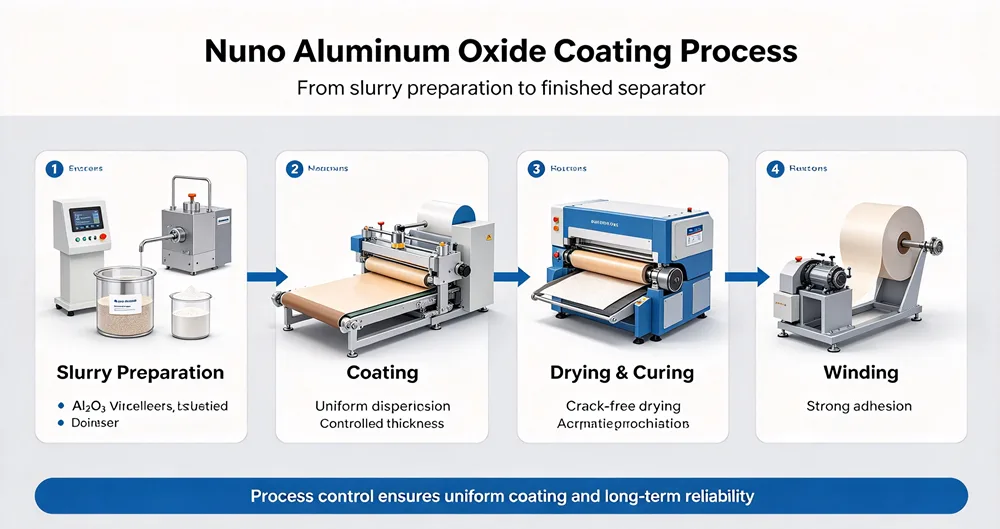
Nano Aluminum Oxide Coating Process
8. Step 6: Factor in Cost and Supplier Selection
8.1 Initial Cost vs. Performance
Leave a Reply
Your email address will not be published.Required fields are marked. *