
By v | 26 November 2026 | 0 Comments
Why Does Spherical Morphology Outperform Irregular Shapes in Achieving Low Viscosity and High Thermal Conductivity at High Filling Loads
A Mechanistic Guide to Particle Packing and Fluid Dynamics in Thermally Conductive Composites
In the formulation of thermal interface materials (TIMs), thermally conductive potting compounds, and thermally conductive plastics, engineers face a core contradiction: to increase thermal conductivity, inorganic filler loading must be significantly increased. However, as the loading approaches the maximum packing fraction, the viscosity of the system rises exponentially, causing the material to lose flowability and become impossible to dispense or mold. Spherical alumina has become the preferred filler for highly filled thermally conductive composites not merely because alumina itself has an intrinsic thermal conductivity of approximately 30 W/m·K, but because its spherical morphology offers unique advantages in fluid dynamics and particle packing. This article explains, from a mechanistic perspective, why spherical morphology outperforms irregular (angular, flake-like) shapes in achieving the unity of low viscosity and high thermal conductivity at high filling loads.
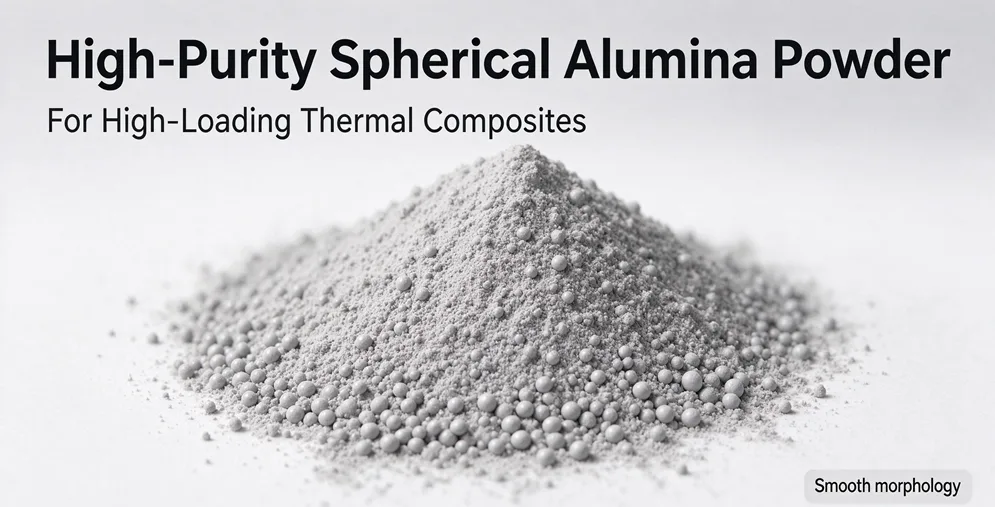
High-Purity Spherical Alumina Powder for Thermal Composites
1. The Core Contradiction in Highly Filled Systems: The Trade-Off Between Thermal Conductivity and Viscosity
1.1 The Formation of Thermally Conductive Networks
For a polymer composite to conduct heat effectively, filler particles must form continuous thermal pathways—a "thermal network." Heat transfer occurs through highly conductive particle contacts and the interstitial polymer layers. The denser and more interconnected this network is, the higher the macroscopic thermal conductivity. This is why formulators push filler loading to the absolute maximum, often exceeding 85 wt% or even 90 wt%.
1.2 The Viscosity Penalty of High Loading
However, the polymer matrix acts as a lubricant between particles. As filler content increases, the amount of free polymer available to separate particles diminishes. When the filler volume fraction approaches the maximum packing fraction (φmax), particles begin to lock together, leading to a sharp increase in viscosity. In extreme cases, the system undergoes a transition from a fluid to a paste or solid. In this regime, particle morphology plays a decisive role: irregular particles with high aspect ratios or sharp edges create mechanical interlocking, drastically lowering φmax and causing a viscosity spike.

Thermal Conductivity vs. Viscosity Trade-Off in Filled Polymers
2. Mechanism 1: Packing Efficiency and Free Volume
2.1 The Geometry of Random Close Packing
For spheres of uniform size, the theoretical maximum random close packing fraction is approximately 64 vol%. This limit exists because spheres can roll and slide over one another, achieving denser arrangements than irregular particles. When particles are irregular, their sharp corners and flat surfaces create friction and interlocking, preventing them from sliding into the voids between larger particles. This reduces φmax to 40–50 vol% for many angular fillers.
At high loadings, a higher φmax means that the system remains fluid at higher filler content. Because the viscosity increase is inversely proportional to the free volume (1 - φ/φmax), pushing φmax from 50 vol% to 64 vol% allows formulators to add substantially more filler before reaching the same viscosity limit.
At high loadings, a higher φmax means that the system remains fluid at higher filler content. Because the viscosity increase is inversely proportional to the free volume (1 - φ/φmax), pushing φmax from 50 vol% to 64 vol% allows formulators to add substantially more filler before reaching the same viscosity limit.
2.2 Bimodal or Multimodal Packing with Spheres
Spherical morphology also enables efficient bimodal or multimodal blending. Small spheres can fill the interstices between large spheres without disrupting the packing structure. Because their surfaces are smooth and non-interlocking, the flow behavior remains predictable. Irregular fillers, by contrast, cannot easily fill interstices because their irregular shapes bridge the gaps or create steric hindrance, leading to trapped voids and increased viscosity.
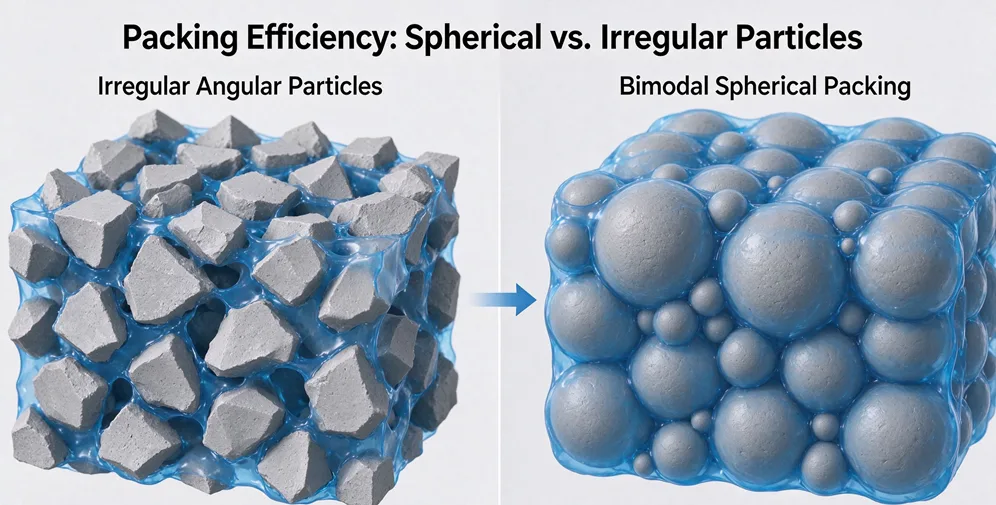
Packing Efficiency of Spherical vs. Irregular Particles
3. Mechanism 2: Fluid Dynamics and Interfacial Friction
3.1 Slip and Rolling Resistance
In a flowing suspension, the viscosity depends not only on the volume fraction of solids but also on particle-particle and particle-fluid interactions. Spheres have a continuous, smooth surface with no protrusions to interlock or tangle. Under shear, they easily slide and roll past one another, acting like microscopic ball bearings. This reduces the hydrodynamic friction and the apparent viscosity of the suspension.
Angular particles, conversely, collide edge-to-edge. The sharp corners can interlock under shear, requiring much higher shear stress to maintain flow. Furthermore, angular particles have a higher specific surface area than spheres of the same volume, meaning more polymer is immobilized at the interface, further reducing free volume and increasing viscosity.
Angular particles, conversely, collide edge-to-edge. The sharp corners can interlock under shear, requiring much higher shear stress to maintain flow. Furthermore, angular particles have a higher specific surface area than spheres of the same volume, meaning more polymer is immobilized at the interface, further reducing free volume and increasing viscosity.
3.2 Shear-Thinning Behavior
Formulations with spherical alumina typically exhibit milder shear-thinning behavior compared to irregular fillers. This is advantageous for both gravity casting (where low shear viscosity is critical) and dispensing (where consistent flow is required). The smooth, rolling flow of spheres ensures that the compound can penetrate narrow gaps and complex mold geometries without void formation.
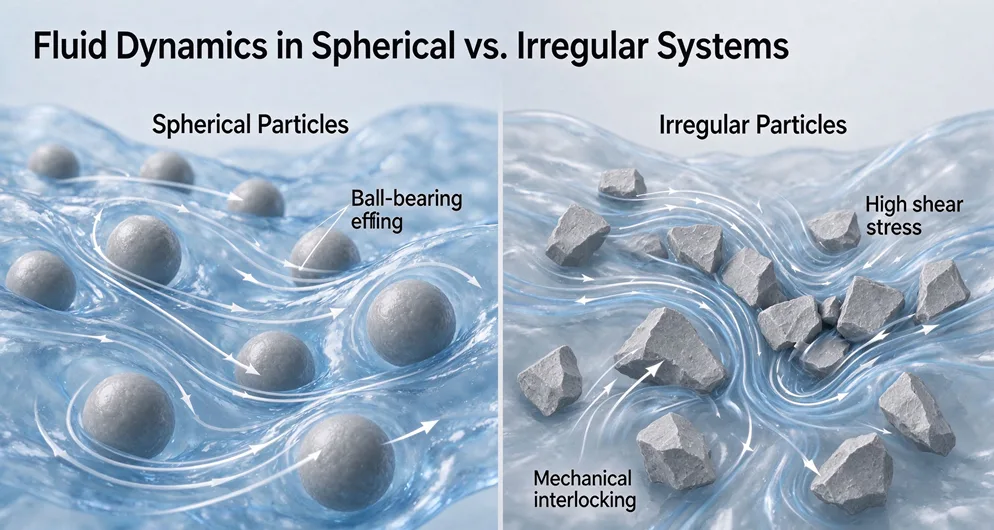
Fluid Dynamics of Spherical vs. Irregular Particles
4. Mechanism 3: Interfacial Area and Thermal Pathway
4.1 Specific Surface Area and Viscosity
Viscosity is heavily influenced by the specific surface area of the filler. Irregular particles with sharp edges and rough surfaces have a higher surface area-to-volume ratio than smooth spheres. Since the polymer layer adsorbed on the particle surface is immobilized and cannot flow, a larger surface area means less free polymer and higher viscosity.
4.2 Contact Area vs. Point Contact
For thermal conductivity, the nature of particle contact is crucial. Spheres typically make point-to-point contact. While this seems less efficient than the broad face-to-face contact of flakes, in practice, the high packing density of spheres (and the resulting shorter interparticle distances) more than compensates. Moreover, the forced point contacts of spheres under high loading create excellent stress concentration points, enhancing the integrity of the thermal network. Flake-like fillers, while offering high in-plane conductivity, are notorious for causing extreme viscosity increases and anisotropic properties.
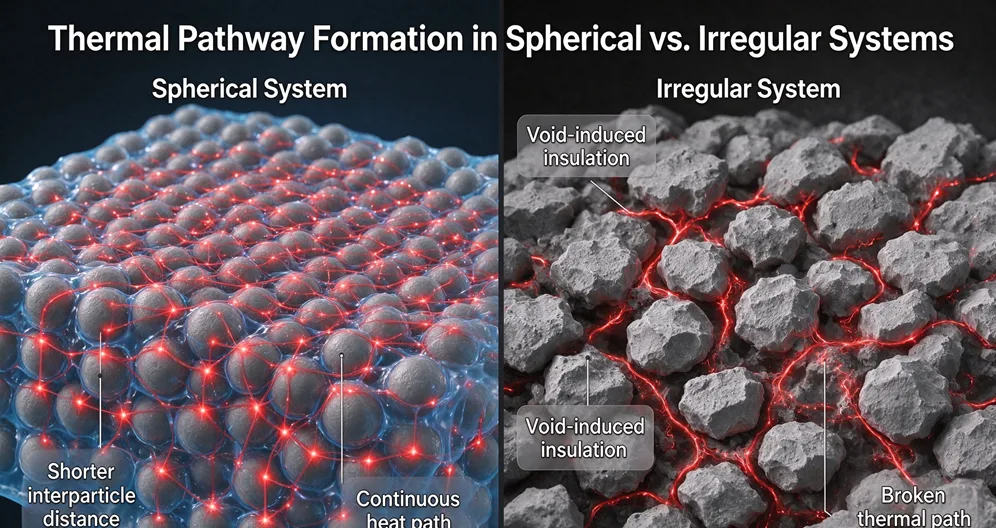
Thermal Pathway Formation in Spherical vs. Irregular Systems
5. Key Technical Specifications
|
Parameter
|
Spherical Alumina
|
Angular/Irregular Alumina
|
|
Morphology
|
Smooth, spherical
|
Sharp edges, irregular
|
|
Max packing fraction (single size)
|
~64 vol%
|
40–50 vol%
|
|
Viscosity at 80 wt% loading
|
Relatively low (pumpable)
|
Very high (paste-like)
|
|
Specific surface area
|
Low (minimizes resin demand)
|
High (immobilizes more resin)
|
|
Wear on processing equipment
|
Low (smooth rolling)
|
High (abrasive edges)
|
|
Thermal conductivity network
|
Uniform, isotropic
|
Prone to voids, localized
|
6. Common Misconceptions and Corrections
Misconception 1: "Spherical shape reduces thermal conductivity because of point contact." While point contacts seem less efficient, the ability of spheres to pack densely ensures that the distance between particles is minimized, which enhances heat transfer. Furthermore, high packing efficiency ensures fewer voids, which are thermal insulators.
Misconception 2: "Crushed (angular) alumina is cheaper and provides the same thermal performance." While the raw material cost might be lower, the higher viscosity at high loadings limits the maximum achievable filler content. The final composite will either have lower thermal conductivity (due to lower filler loading) or be unprocessable. Additionally, the abrasive nature of angular particles increases equipment wear.
Misconception 3: "Surface modification solves all viscosity problems with irregular fillers." Surface modification (e.g., silane treatment) improves interfacial compatibility, but it cannot overcome the mechanical interlocking and geometric limitations of irregular shapes. Spherical morphology and surface modification are complementary, not interchangeable.
7. Quick Evaluation Checklist
When evaluating fillers for high-loading thermal applications, confirm:
Morphology: Is the sphericity >0.9? (Check SEM images)
Packing fraction: What is the D50 and size distribution? (Bimodal blends with spheres are ideal)
Specific surface area: Is the BET area minimized to reduce resin demand?
Viscosity profile: How does viscosity behave at the target loading (e.g., 88 wt%)?
Equipment wear: Will the hardness and shape cause excessive wear on mixers and dispensers?
Thermal performance: Does the achieved packing density translate to the target thermal conductivity?
8. Real-World Application References
Power module potting scenario. In IGBT encapsulation, a silicone potting compound requires high thermal conductivity (>3 W/m·K) and low viscosity for void-free casting. By using a bimodal blend of spherical alumina (D50 40 μm and 10 μm) treated with a vinyl silane, the formulator achieved 90 wt% loading. The spherical shape kept the viscosity low enough for gravity casting, while the dense packing created a continuous thermal network, meeting the thermal and reliability requirements.
Thermal interface pads scenario. For high-performance TIM pads used in servers, silicone rubber is highly filled with spherical alumina. The smooth surface of the spheres allows for thin bond lines under low compression force, minimizing thermal resistance. Angular fillers would require higher compression to achieve the same bond line thickness, potentially damaging delicate electronic components.
Thermal interface pads scenario. For high-performance TIM pads used in servers, silicone rubber is highly filled with spherical alumina. The smooth surface of the spheres allows for thin bond lines under low compression force, minimizing thermal resistance. Angular fillers would require higher compression to achieve the same bond line thickness, potentially damaging delicate electronic components.
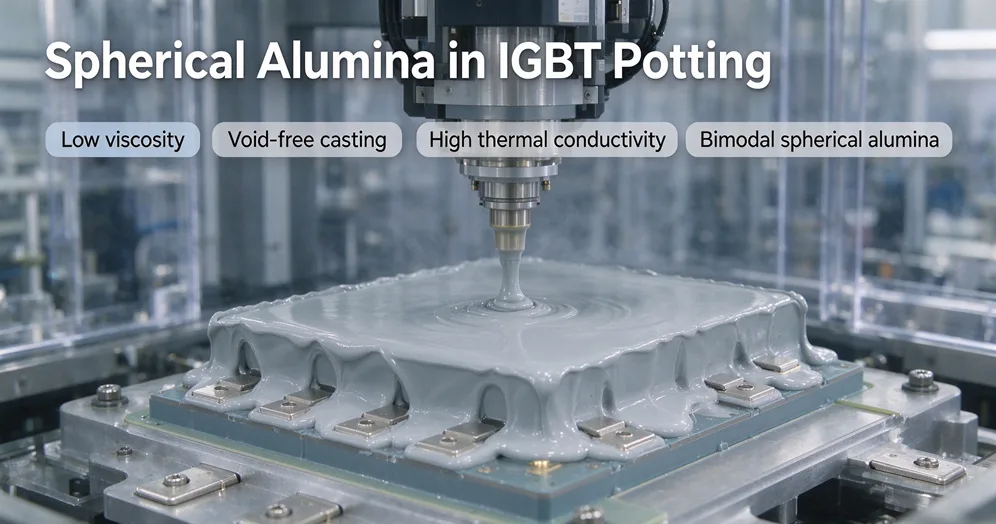
Spherical Alumina in High-Loading Thermal Applications
9. Frequently Asked Questions (FAQs)
Q1: Does spherical shape reduce thermal conductivity because of point contact between particles?
No. While the contact area between two perfect spheres is theoretically a point, in a highly filled composite, the immense number of contacts and the high packing density create a robust, multi-path thermal network. The reduction of voids and the minimization of interparticle distance far outweigh any theoretical disadvantage of point contact.
Q2: Can I mix spherical and irregular alumina to save cost?
Yes, but it must be done carefully. Adding irregular particles to a spherical matrix will disrupt the packing efficiency and increase viscosity. If cost reduction is necessary, use a coarser spherical fraction or optimize the particle size distribution of spherical powders rather than introducing angular fillers into a high-loading system.
Q3: Why does spherical alumina cause less wear on processing equipment?
Spherical particles roll over metal surfaces, whereas angular particles scratch and abrade them. This reduces maintenance costs and extends the life of mixers, pumps, and dispensing nozzles, especially in highly filled systems where metal-to-ceramic contact is intense.
Q4: How does surface modification interact with spherical morphology?
Surface modification (such as silane treatment) reduces the interfacial tension between the filler and the polymer, preventing agglomeration and improving wetting. When applied to spherical alumina, it enhances the "ball-bearing" effect by reducing friction between particles and the polymer matrix, further lowering viscosity.
Q5: What is the ideal particle size distribution for spherical alumina?
A bimodal or trimodal distribution is ideal. A typical starting point is a 7:3 or 8:2 ratio of large (e.g., 40–50 μm) to small (e.g., 10–15 μm) particles. This allows the small spheres to fill the interstices of the large spheres, maximizing the packing fraction and therefore the thermal conductivity, while keeping viscosity manageable.
Supplier
TRUNNANO is a trusted global chemical material supplier and manufacturer with over 12 years of experience in providing high-quality chemicals and nanomaterials, including boride powder, nitride powder, graphite powder, sulfide powder, and 3D printing powder. The company has a professional technical department and quality supervision department, a well-equipped laboratory with advanced testing equipment, and a dedicated after-sales customer service center. RBOSCHCO supplies spherical alumina powders worldwide, suitable for thermal interface materials, thermal potting compounds, and high-performance composites. The company offers comprehensive technical support, from product selection to application guidance. If you are looking for high-quality spherical alumina for highly filled thermal applications, please feel free to contact us.
Tags: spherical alumina, thermally conductive filler, high filling load, particle packing efficiency, viscosity control, thermal interface materials
Tags: spherical alumina, thermally conductive filler, high filling load, particle packing efficiency, viscosity control, thermal interface materials
Leave a Reply
Your email address will not be published.Required fields are marked. *