
By v | 28 October 2026 | 0 Comments
Silicon Nitride Powders: The Four Sintering Routes and Their Impact on Structural Ceramic Performance
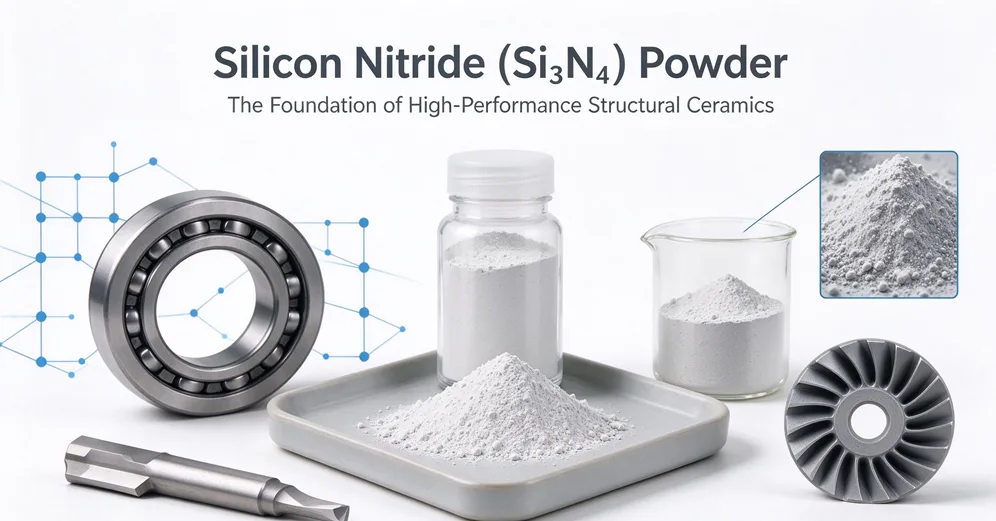
Silicon Nitride (Si₃N₄) Powder — the foundation of high-performance structural ceramics.
1. Introduction to Silicon Nitride Structural Ceramics
1.1 The Demand for High-Performance Ceramics
In industries ranging from aerospace to precision machinery, metal components are increasingly being replaced by advanced structural ceramics. The driving forces are clear: metals are heavy, prone to corrosion, and lose strength at high temperatures. Ceramics, on the other hand, offer high hardness, low density, and exceptional thermal stability.1.2 The Rise of Silicon Nitride (Si₃N₄) Powder
Among structural ceramics, Silicon Nitride (Si₃N₄) Powder stands out. It is a covalent-bonded ceramic known for its superior thermal shock resistance, high fracture toughness, and excellent wear resistance. However, pure silicon nitride is notoriously difficult to densify. It does not melt at atmospheric pressure; instead, it dissociates at around 1850°C.1.3 The Role of Sintering Routes
Because of its covalent nature, Silicon Nitride (Si₃N₄) Powder requires specific sintering aids (such as yttria or magnesia) and distinct densification routes to form a solid ceramic body. The chosen sintering method dictates the final microstructure, which in turn determines the ceramic‘s mechanical properties. Understanding these four main routes is critical for engineers selecting materials for demanding applications.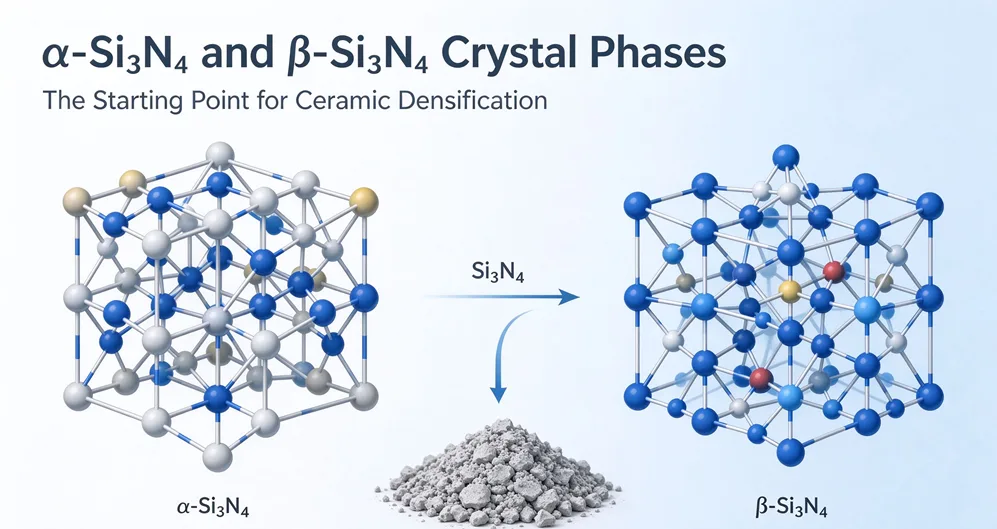
Crystal structures of silicon nitride — the starting point for ceramic densification.
2. Understanding the Basics of Silicon Nitride (Si₃N₄) Powder
2.1 Chemical Composition and Phases
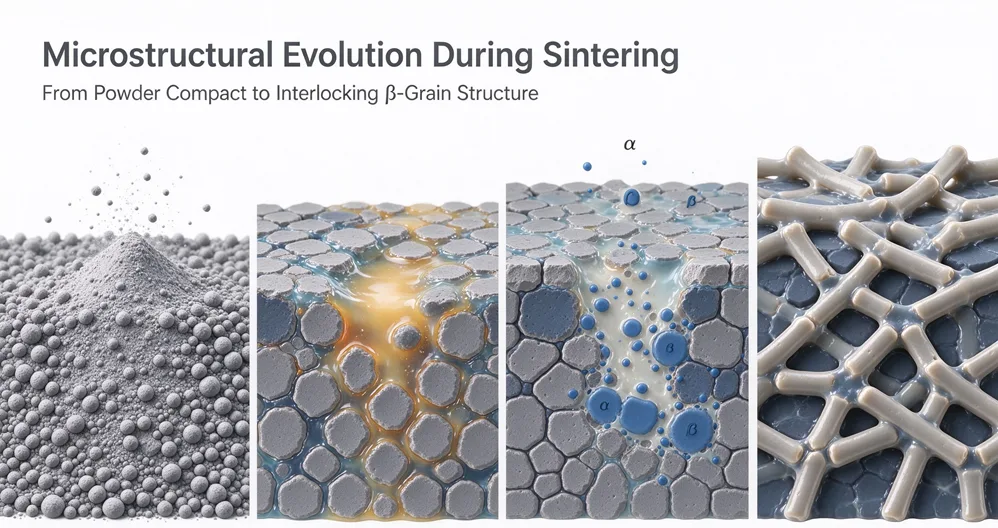
Silicon Nitride (Si₃N₄) Powder is a white, high-purity solid. It primarily exists in two crystalline phases: α-Si₃N₄ and β-Si₃N₄. High-quality powders are usually predominantly in the α-phase, as it has higher reactivity and promotes better densification during sintering. During the high-temperature process, the α-phase transforms into the more stable β-phase, which forms elongated, rod-like grains that enhance fracture toughness.2.2 Key Properties of Silicon Nitride (Si₃N₄) Powder
High Thermal Stability: Sublimates at ~1850°C, stable up to 1000°C in air.Excellent Thermal Shock Resistance: Can withstand rapid heating and cooling without cracking.
High Hardness and Wear Resistance: Mohs hardness around 8.5.
Good Chemical Stability: Inert to most acids, bases, and molten metals.
Low Density: Significantly lighter than steel or traditional metal alloys.
3. Why Sintering Routes Matter
3.1 The Densification Challenge
To turn Silicon Nitride (Si₃N₄) Powder into a durable component, the powder must be shaped and then densified. Because it doesn’t melt conventionally, manufacturers must rely on solid-state or liquid-phase sintering.3.2 Trade-offs in Performance
The four main sintering routes offer different balances of cost, shape complexity, and mechanical performance. A route that produces a highly dense part might be limited in the shapes it can create. A route that is cost-effective might result in higher porosity and lower strength. Understanding these trade-offs is essential for material selection.4. Step 1: Reaction Bonded Silicon Nitride (RBSN)
4.1 How It Works
RBSN is produced by compacting a mix of silicon powder and Silicon Nitride (Si₃N₄) Powder, then heating it in a nitrogen atmosphere. The nitrogen reacts with the silicon to form new silicon nitride, bonding the structure together.4.2 Advantages and Limitations
Advantages: Extremely low shrinkage (near-net-shape forming), relatively low cost, and can create complex shapes.Limitations: High residual porosity, resulting in lower mechanical strength and thermal conductivity compared to fully dense grades. Used mainly for non-critical wear parts or specialized filters.
5. Step 2: Hot Pressed Silicon Nitride (HPSN)
5.1 How It Works
Silicon Nitride (Si₃N₄) Powder mixed with sintering aids is placed in a graphite die and subjected to high temperature and uniaxial pressure simultaneously.5.2 Advantages and Limitations
Advantages: Achieves near-theoretical density and exceptional mechanical strength, hardness, and creep resistance.Limitations: High production cost and limited to simple shapes (like plates or blocks) because pressing must be uniaxial. It is typically used for critical cutting tools or aerospace components.
6. Step 3: Sintered Silicon Nitride (SSN)
6.1 How It Works
Also known as pressureless sintering, this process involves shaping Silicon Nitride (Si₃N₄) Powder with highly effective sintering aids (like Y₂O₃ and Al₂O₃) and firing it in a controlled atmosphere without external mechanical pressure.6.2 Advantages and Limitations
Advantages: Can produce complex geometries and is more economical than hot pressing. It can achieve high densities (often >95%).Limitations: The sintering aids form a glassy grain-boundary phase. If not post-processed correctly, this phase can degrade high-temperature creep resistance and chemical durability.
7. Step 4: Spark Plasma Sintering (SPS)
7.1 How It Works
SPS (or Field Assisted Sintering Technology) uses pulsed electrical current to rapidly heat the compacted Silicon Nitride (Si₃N₄) Powder.7.2 Advantages and Limitations
Advantages: Extremely fast heating rates (reducing processing time from hours to minutes) and high density. It limits grain growth, resulting in superior nanoscale microstructures and enhanced toughness.Limitations: High equipment cost and primarily limited to smaller, specific component sizes. It is highly used in R&D and high-end specialty manufacturing.
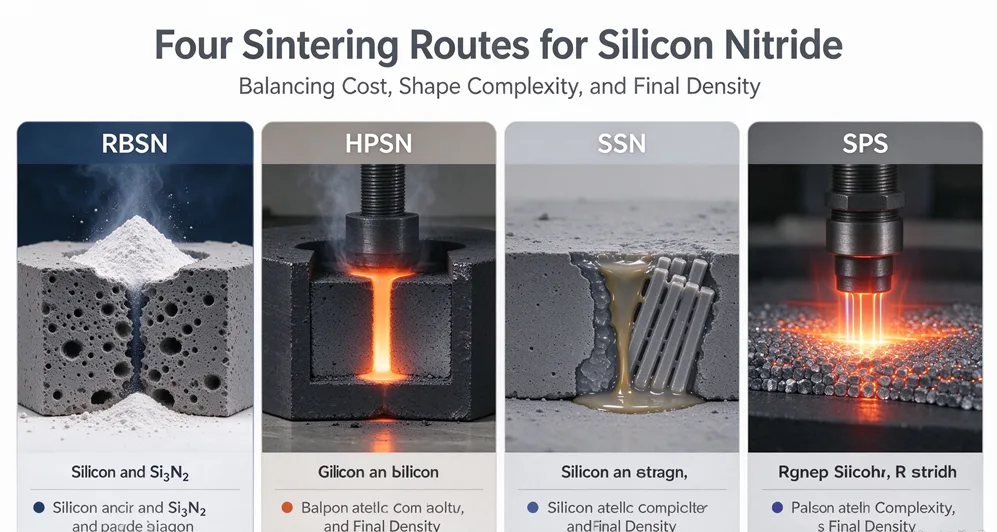
Choosing the right route — balancing cost, shape, and performance in silicon nitride ceramics.
8. Common Misconceptions About Silicon Nitride
8.1 “Silicon Nitride is Just a Lubricant”
While it has self-lubricating properties, Silicon Nitride (Si₃N₄) Powder is primarily the foundation for ultra-hard structural components (bearings, cutting tools, engine parts) that operate under extreme stress.8.2 “All Silicon Nitride Ceramics Are the Same”
The final performance of a silicon nitride part is heavily dependent on the sintering route and the specific powder characteristics. An RBSN part and an HPSN part behave entirely differently under load.8.3 “Sintering Aids Always Weaken the Material”
While sintering aids (like yttria or magnesia) introduce a glassy phase at the grain boundaries, careful post-sintering heat treatment can crystallize this phase, significantly improving high-temperature strength and oxidation resistance.9. Quick Evaluation Checklist
Before selecting Silicon Nitride (Si₃N₄) Powder for your application, verify:Required phase (α-phase for better sintering reactivity, β-phase for specific seeding)
Required purity level
Target sintering route (Reaction, Hot Pressed, Pressureless, or SPS)
Complexity of the required component geometry
Operating temperature and load requirements
Chemical environment (resistance to acids, molten metals)
From powder to performance — silicon nitride ceramics in demanding applications.
10. Frequently Asked Questions (FAQs)
Q1: What is Silicon Nitride (Si₃N₄) Powder used for?Silicon Nitride (Si₃N₄) Powder is the primary raw material for manufacturing high-temperature structural ceramics, including bearings, cutting tools, automotive engine components, and aerospace turbine parts.
Q2: Why is α-Si₃N₄ preferred for sintering?
α-Si₃N₄ has a higher surface energy and reactivity than the β-phase. It readily dissolves in the liquid phase during sintering and precipitates as interlocking β-phase grains, which provides excellent fracture toughness.
Q3: Can silicon nitride be machined?
Fully dense Silicon Nitride (Si₃N₄) Powder compacts are extremely hard and can only be machined using diamond grinding or laser processing. Therefore, near-net-shape forming before sintering is highly preferred.
Q4: What is the maximum operating temperature of silicon nitride?
Silicon nitride maintains excellent stability in air up to 1000°C. In inert atmospheres, it can withstand much higher temperatures.
Q5: Is Silicon Nitride (Si₃N₄) Powder hazardous?
As with any fine powder, dust inhalation should be avoided. Once sintered into a solid ceramic, silicon nitride is chemically inert and safe for most industrial applications.
11. Final Insights
Silicon Nitride (Si₃N₄) Powder is a versatile building block for some of the most demanding engineering materials in the world. The choice between RBSN, HPSN, SSN, and SPS is not about which is "best," but which offers the right balance of cost, shape complexity, and mechanical properties for your specific application. Understanding these sintering routes ensures that the final ceramic component will perform exactly as intended under extreme conditions.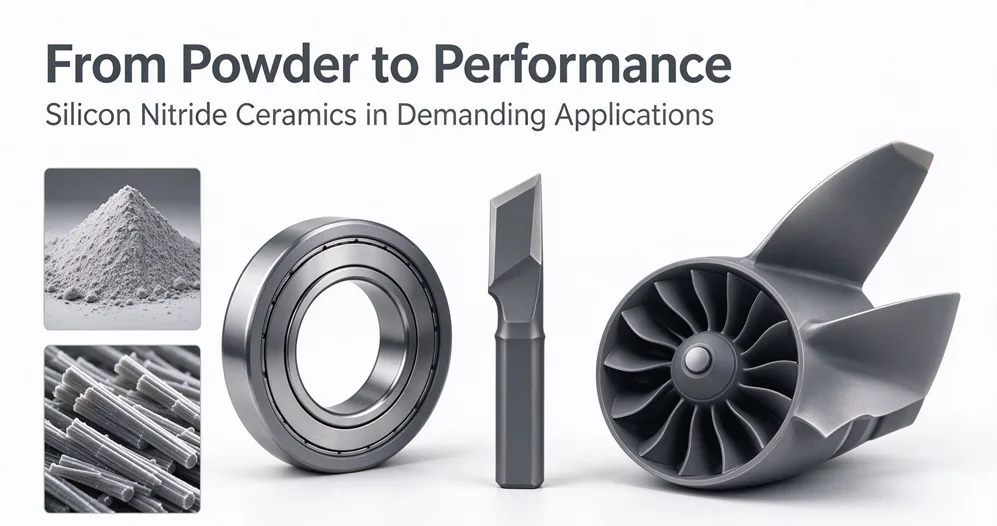
Silicon Nitride Ceramic Components
Supplier
TRUNNANO is a globally recognized Silicon Nitride (Si₃N₄) Powder manufacturer and supplier with more than 12 years of experience in high-quality nanomaterials, advanced ceramic materials, and high-purity chemicals. The company has a professional technical department and quality supervision department, a well-equipped laboratory with advanced testing equipment, and a dedicated after-sales customer service center. TRUNNANO’s Silicon Nitride (Si₃N₄) Powder is available in high purity (99%) with customizable particle sizes (0.5um-1um) and phases, suitable for advanced structural ceramics, wear-resistant parts, and high-temperature components. The company serves clients across more than 50 countries and offers comprehensive technical support, from material selection to application guidance. If you are looking for high-quality Silicon Nitride (Si₃N₄) Powder, please feel free to contact us.Tags: silicon nitride powder, Si3N4, structural ceramics, sintering routes, reaction bonded
Leave a Reply
Your email address will not be published.Required fields are marked. *