
By v | 22 November 2026 | 0 Comments
How Does Nano Silica Build Micro-Networks with Polymers to Enhance Waterproof Coating Performance?
How Does Nano Silica Build Micro-Networks with Polymers to Enhance Waterproof Coating Performance?
A Mechanistic Guide from Surface Modification to Interfacial Bridging
The performance bottleneck of waterproof coatings often lies not in the polymer itself but at the interface between filler and matrix. Nano silica, with its high specific surface area and abundant surface silanol groups, is regarded as an ideal filler for improving coating density and hydrophobicity. However, untreated nanoparticles agglomerate readily in polymer emulsions, and the agglomerates form pores and cracks during curing, which instead become pathways for water penetration. What truly enables nano silica to work is not simple "addition" but the construction of micro-scale network structures through surface modification and polymer interaction. This article explains, from a mechanistic perspective, how nano silica collaborates with polymers to form effective water-blocking and reinforcing networks inside waterproof coatings.1. Why Bare Nano Silica Often Backfires in Waterproof Coatings
1.1 The Agglomeration Dilemma Caused by High Surface Energy
The specific surface area of nano silica can reach hundreds of square meters per gram, and the surface is covered with polar silanol groups (-OH). In a dispersion medium as viscous as a polymer emulsion, Brownian motion is insufficient to overcome the hydrogen bonding and van der Waals attraction between particles, making agglomeration almost inevitable. Studies have shown that even after surface modification, polymer viscosity still hinders the effective dispersion of nano silica; insufficiently dispersed modified particles exist as agglomerates in the emulsion, and pores and cracks form around these agglomerates during curing, ultimately leading to decreased coating strength and increased permeability.1.2 The Conflict Between Hydrophilic Surfaces and Hydrophobic Matrices
The polymer matrix of waterproof coatings is typically somewhat hydrophobic (such as polyacrylate, polyurethane, or silicone-modified systems), while the surface of bare nano silica is strongly hydrophilic. This polarity mismatch results in a lack of effective chemical bonding or physical entanglement between filler and matrix, making the interface the weakest link in the coating. During penetration, water molecules preferentially migrate along these interfacial defects, and the waterproof performance of the coating is therefore greatly compromised.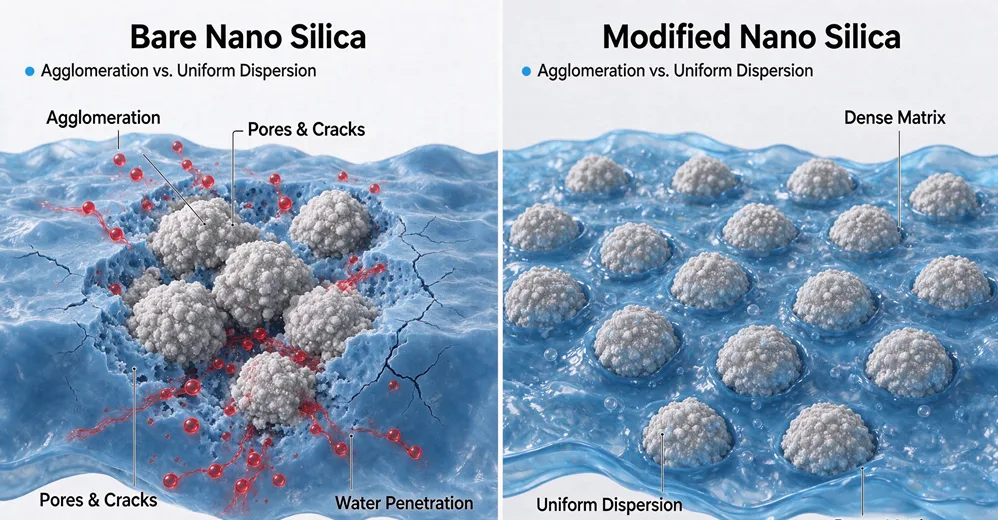
Agglomeration vs. Uniform Dispersion
2. Surface Modification: From "Compatibility Improvement" to "Reactive Interface"
2.1 Bidirectional Bridging by Silane Coupling Agents
Silane coupling agents are the core tool for resolving the above contradiction. Taking KH-570 (γ-methacryloxypropyltrimethoxysilane) as an example, the methoxy groups at one end hydrolyze and condense with silanol groups on the nano silica surface to form Si-O-Si covalent bonds, while the methacryloxy group at the other end participates in the polymerization or crosslinking reaction of the polymer emulsion. This bidirectional reactivity turns silane-modified nano silica from a "passive filler" into a chemical bridging point connecting inorganic particles and the organic matrix. In a study of Janus-type styrene-acrylic emulsions, KH570-modified nano silica (M-SiO₂) was in-situ grafted onto the shell layer of core-shell latex particles. At an M-SiO₂ content of 0.8 wt% based on shell monomers, dispersion and stability were optimal; coating tensile strength and adhesion strength increased by 64% and 140%, respectively, 7-day water absorption decreased by 31%, and the contact angle reached 99.16°.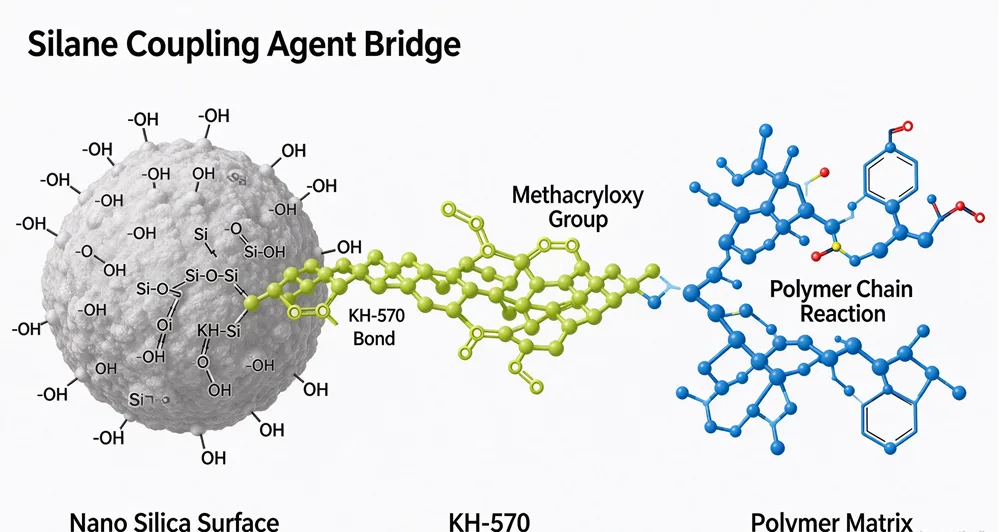
Silane Coupling Agent Bridge
2.2 Controllability of Modification: The Balance Between Grafting Ratio and Dispersion
Surface modification is not "the more, the better." When the silane dosage is insufficient, a large number of bare silanol groups remain on the particle surface, and the agglomeration tendency is not fully suppressed. When the silane is excessive, multilayers of physically adsorbed silane molecules may form a weak boundary layer, which instead reduces interfacial strength. More importantly, the dispersion state of modified nano silica in the emulsion directly determines the uniformity of the final network structure. The appearance of the C=O stretching vibration peak at 1720 cm⁻¹ and the C=C stretching vibration peak at 1637 cm⁻¹ in FTIR spectra is chemical evidence of successful M-SiO₂ grafting, but the presence of these spectral signals does not equate to good dispersion—TEM observation and particle size distribution testing are the key means of judging whether the network is uniformly constructed.3. Three Mechanisms of Micro-Network Construction
3.1 Chemical Crosslinking Network: From Linear Chains to Three-Dimensional Structures
When reactive groups on the surface of modified nano silica (such as double bonds, epoxy groups, or amino groups) participate in polymer curing, each particle can become a crosslinking point for multiple polymer chains. This "particle-as-crosslinking-node" structure converts originally linear polymer chains into a three-dimensional network, significantly improving coating density and mechanical strength. In polyurethane systems, nano silica is covalently grafted onto PU chains through Si-O-C bonds; the appearance of the Si-O-CH₃ characteristic peak at 1100 cm⁻¹ and the Si-O-Si absorption at 453 cm⁻¹ in FTIR confirms this covalent connection.3.2 Physical Filling and Pore Blocking
Nano-scale silica particles can enter micropores formed during polymer curing. In polymer cement waterproof coatings, M-SiO₂ fills microscopic defects in the coating during curing, significantly improving density. This filling effect "repairs" weak regions inside the coating at the nanoscale and extends the penetration path of water molecules. At the same time, uniformly dispersed nanoparticles increase the nanoscale roughness of the coating surface, which together with micron-scale structures forms a micro-nano hierarchical structure similar to the lotus leaf surface, enhancing hydrophobicity.3.3 Interphase and Stress Transfer
The interphase formed between modified nano silica and the polymer is the key region for stress transfer. When the coating is subjected to external forces or thermal stress, the interphase can transfer stress from the relatively brittle inorganic particles to the tougher polymer matrix, avoiding microcrack initiation caused by stress concentration. During stretching, the silane-modified nano silica/SEBS composite coating maintained superhydrophobicity (contact angle >157°) at 150% strain; this mechanical durability originates from the stress buffering of the elastomer matrix and the strengthened interfacial bonding between modified particles and the matrix.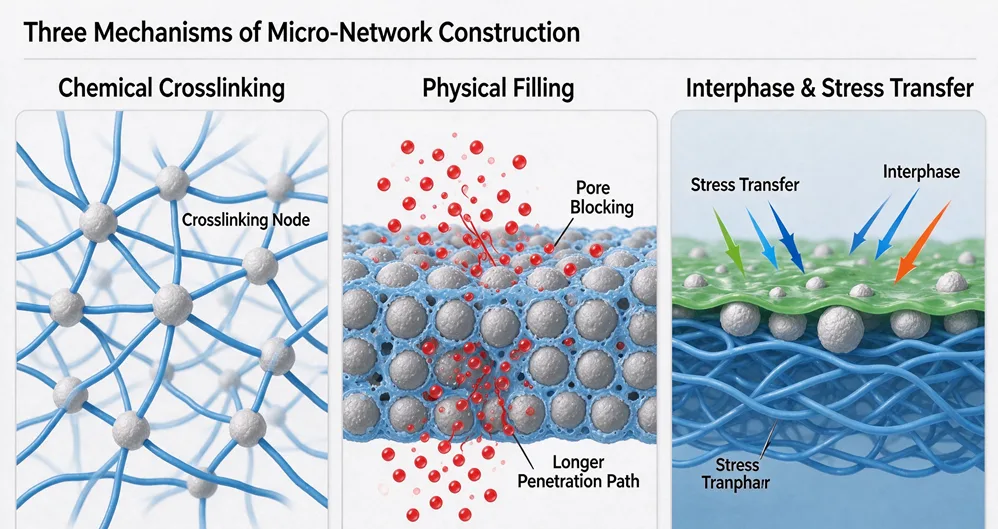
Silane Coupling Agent Bridge
4. Differences in Network Construction Across Polymer Systems
| Polymer Matrix | Modification Strategy | Network Construction Characteristics | Key Performance Improvement |
| Styrene-acrylic emulsion (waterproof coating) | KH570 modification + in-situ grafting | Particles grafted onto latex shell, forming Janus structure | Tensile strength +64%, adhesion strength +140%, water absorption -31% |
| Polyurethane | Silane covalent grafting | Si-O-C bonds embed particles into PU backbone | Microphase separation regulation, increased surface roughness |
| Epoxy/acrylate | Silane modification + core-shell structure | Particles act as crosslinking nodes dispersed in continuous phase | Synergistic improvement of mechanical properties and hydrophobicity |
| PDMS/silicone | Hydrophobic nano-SiO₂ builds roughness | Particles provide micro-nano rough structure | Superhydrophobicity (contact angle >150°) and self-cleaning |
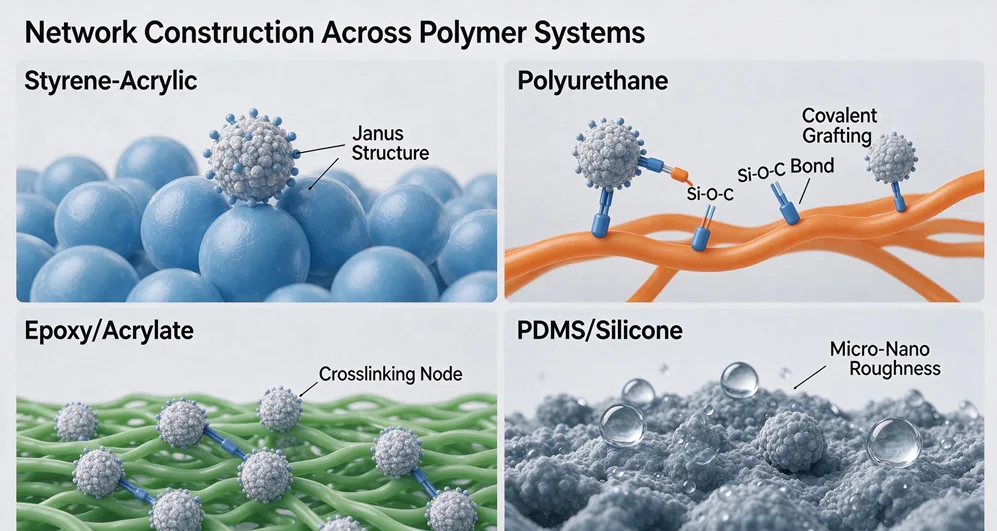
Network Construction Across Polymer Systems
5. Key Control Points from Mechanism to Formulation
Matching modification degree with dispersion quality. A higher silane grafting ratio is not always better. Excess coupling agent forms multilayer adsorption on the particle surface, and outer silane molecules that are not chemically bonded may migrate or be extracted during film formation, creating new interfacial defects. In practice, grafting density should be determined by TGA (thermogravimetric analysis), and the optimal modification amount should be determined in combination with emulsion stability testing.Relationship between particle size and coating thickness. The particle size of nano silica is typically in the 10–50 nm range, while the dry film thickness of waterproof coatings is generally 100–500 μm. The particle size is much smaller than the coating thickness, meaning that a single particle cannot span the entire coating thickness to form a "through-type" water-blocking barrier. The effectiveness of the network depends on the synergistic action of a large number of particles, not on the physical barrier of a single particle. Therefore, dispersion uniformity is more critical than the water-blocking property of the particles themselves.
Influence of curing conditions on network integrity. The reactive groups of modified nano silica need to fully participate in crosslinking reactions during curing to form an effective chemical network. Insufficient curing temperature or too short a time means the reactive groups on the particle surface do not fully react, and the network crosslinking density is lower than the design value; excessive curing may lead to polymer degradation, which also damages coating performance. Formulation design should incorporate the curing schedule as a component of network construction and optimize it accordingly.
6. Common Misconceptions and Clarifications
Misconception 1: "The more nano silica, the better the waterproofing." Excessive addition exacerbates agglomeration and increases porosity, and waterproofing actually decreases. In research on waterproof wear-resistant coatings, when the proportion of nano silica is too high and protective micron particles are insufficient, nanoparticles are easily sheared off by friction, and waterproofing is lost.Misconception 2: "Modification means adding a silane coupling agent." Silane modification is only one approach. Core-shell structure design, in-situ polymerization grafting, and Janus particle construction also fall within the scope of "modification." The core objective is consistent: to make nanoparticles exist in the polymer matrix in a designed morphology and position rather than random agglomeration.
Misconception 3: "Laboratory data can be directly scaled up." The ultrasonic dispersion conditions in the laboratory differ significantly from the high-speed dispersion or milling conditions in industrial production. During scale-up, the input mode of dispersion energy changes, and the uniformity of the network structure may decrease substantially. Dispersion process validation at the pilot stage cannot be omitted.
7. Quick Evaluation Checklist
When evaluating a nano silica-modified waterproof coating solution, confirm the following:Whether the particle size distribution (DLS) of modified nano silica in the emulsion differs significantly from that of unmodified particles
Whether SEM of the coating cross-section shows uniform dispersion or the presence of agglomerates and pores
Whether contact angle and water absorption data improve simultaneously (high contact angle without reduced water absorption indicates an incomplete network)
Whether modified particles participate in chemical crosslinking (verifiable by FTIR or crosslinking density testing)
Retention of waterproof performance after accelerated aging
Scalability of the dispersion process
8. Real-World Application References
Polymer cement waterproof coating scenario. In the J-SA (Janus-type styrene-acrylic emulsion) system, when KH570-modified nano silica was grafted onto the shell layer at 0.8 wt%, the coating achieved substantial improvements in tensile strength and adhesion strength while maintaining flexibility, and water absorption decreased significantly. This case demonstrates that the efficiency of network construction depends on the "positioning" of particles in the emulsion rather than simple content.Polyurethane waterproof coating scenario. After nano silica was covalently grafted onto waterborne polyurethane chains, the microphase separation structure of the coating changed, surface roughness increased, and hydrophobicity improved. The advantage of this modification path is that chemical bonds form between particles and matrix, and interfacial stability is superior to physical blending.
Superhydrophobic coating scenario. Modified nano silica was introduced into an elastomer matrix to build a micro-nano rough structure, and the coating maintained superhydrophobicity under stretching, demonstrating the robustness of the network structure under mechanical deformation.
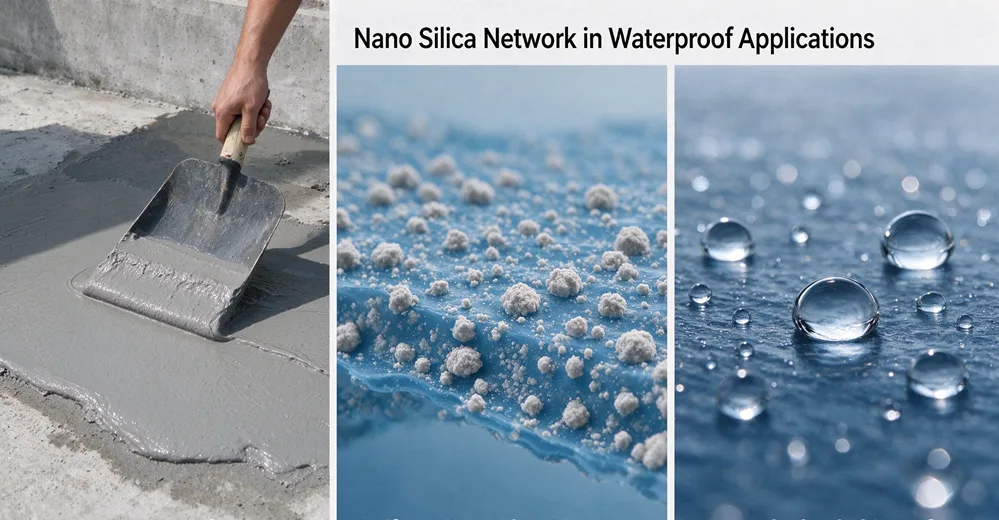
Nano Silica Network in Waterproof Applications
9. Frequently Asked Questions (FAQs)
Q1: What is the minimum effective dosage of nano silica in waterproof coatings?There is no universal value; it depends on particle size, modification degree, and matrix system. In styrene-acrylic systems, 0.8 wt% M-SiO₂ (based on shell monomers) showed significant performance improvement. The key indicator is dispersion quality rather than absolute content.
Q2: Is additional dispersion needed after silane modification?
Yes. Silane modification improves the compatibility between particles and matrix but cannot completely eliminate agglomeration. High-speed dispersion, ultrasonic treatment, or milling are still necessary process steps, especially in industrial scale-up.
Q3: How can I determine whether nano silica has truly built a network?
Use a combination of SEM to observe cross-sectional dispersion, FTIR to confirm chemical bonding, contact angle and water absorption to verify water-blocking effectiveness, and mechanical testing to evaluate interfacial strength. A single indicator is insufficient to judge network integrity.
Q4: Does modified nano silica affect the weatherability of the coating?
Indirectly. After the network structure improves coating density, the penetration paths of UV light and moisture into the polymer matrix are reduced, and weatherability may improve. However, nano silica itself does not provide UV shielding and must be used in combination with UV absorbers or hindered amine light stabilizers.
Q5: Is there a difference in network construction between waterborne and solventborne systems?
Yes. In waterborne emulsions, particles are dispersed in the aqueous phase, and during film formation particles migrate to the latex particle interface with water evaporation; positioning is affected by emulsification and film formation. In solventborne systems, particles are dispersed in the organic phase, and the solvent evaporates during film formation; particle distribution depends more on the initial dispersion state and viscosity changes of the system.
10. Conclusion
TRUNNANO's nano silica product line (see TRUNNANO technical reports) offers nano silica in a range of particle sizes and surface modification options suitable for waterproof coating systems based on styrene-acrylic, polyurethane, epoxy, and silicone matrices, helping formulation engineers select the appropriate particle surface chemistry according to matrix chemistry and curing mechanism rather than treating nano silica as a universal additive. From KH570-modified Janus emulsion design, to covalent grafting onto polyurethane chains, to micro-nano rough structure construction in elastomer matrices, the micro-network between nano silica and polymers cannot be summarized by a single mechanism; it is the superposition of chemical crosslinking, physical filling, and interfacial stress transfer.The value of understanding this mechanism lies in shifting formulation decisions from "how much to add" to "how to add it" and "what kind of particles to add." When particles are dispersed in the matrix in a designed morphology and participate in network construction, the density, hydrophobicity, and mechanical durability of waterproof coatings can improve simultaneously rather than sacrificing one indicator while improving another. From polymer cement coatings to polyurethane waterproof membranes, the micro-network construction of nano silica will continue to be one of the core logics of high-performance waterproof coating design.
Supplier
TRUNNANO is a trusted global chemical material supplier and manufacturer with over 12 years of experience in providing high-quality chemicals and nanomaterials, including boride powder, nitride powder, graphite powder, sulfide powder, and 3D printing powder. The company has a professional technical department and quality supervision department, a well-equipped laboratory with advanced testing equipment, and a dedicated after-sales customer service center. RBOSCHCO supplies nano silica powders and modified nano silica worldwide, suitable for waterproof coatings, polymer composites, coating additives, and other applications. The company offers comprehensive technical support, from product selection to application guidance. If you are looking for high-quality nano silica for high-performance waterproof coatings, please feel free to contact us.Leave a Reply
Your email address will not be published.Required fields are marked. *