
What is Wurtzite boron nitride and market?
Wurtzite Boron Nitride also called wBN, is the wurtzite form of boron nitride. It is a brand new super abrasive material that is operated with the help of detonation. It is the following step within the boron nitride era that embraces the well-known super abrasive - cubic boron nitride, as well as another substance called graphite which is similar in structure - hexagonal boron nitride.
Why is boron nitride so hard?
Boron Nitride (BN), often referred to as 'white graphite' due to its similar planar hexagonal structure and lubricious characteristics, is a hard ceramic material with high thermal conductivity and good thermal shock resistance. This new fabric has a polycrystalline structure that provides superior cutting residences and what’s more sharpens itself by cutting. Polycrystalline structure way masses of crystals are united chemically collectively that can work at the same time. Therefore we can come to this conclusion that the cloth removal rate and overall level of the Wurtzite Boron Nitride can’t be in comparison with the slicing qualities of different famous materials.

Wurtzite Boron Nitride
The exceptional hardness of w-BN originates from its wurtzite crystal structure, where boron and nitrogen atoms undergo sp³ hybridization to form tetrahedral structures, similar to cubic boron nitride and diamond. While w-BN and c-BN both feature strong tetrahedral bonding, they differ in their stacking sequences, which influences their mechanical properties. In w-BN and c-BN, the B and N atoms undergo sp³ hybridization to form tetrahedral structures, whereas in h-BN and r-BN, these atoms exhibit sp² hybridization within the plane, forming hexagonal ring structures that are similar to graphene. The sp³-bonded forms (w-BN and c-BN) are superhard materials with hardness second only to diamond, while the sp²-bonded forms (h-BN and r-BN) are soft, lubricious materials. As a precursor and the most stable BN polymorph, hexagonal boron nitride serves as the fundamental building block for synthesizing these superhard forms.
The journey from hexagonal boron nitride to its superhard polymorphs—wurtzite and cubic boron nitride—demonstrates the remarkable versatility of this material family, with hexagonal boron nitride serving as the gateway to advanced superhard materials.
Diamond was once assumed to be "the toughest substance available on earth". With the rapid development of science technology, now it has been proved that diamond is no longer the toughest mineral found on the planet. What’s more, the scientists have proposed that wurtzite boron nitride and mineral lonsdaleite, two kinds of man-made nanomaterials, will misplace the title of the diamond as the hardest substance found on earth. Then the two sorts of substance might be proved to be stronger than diamond!
What is harder than wurtzite boron nitride?
The scientists explain that the superior strength of w-BN and lonsdaleite is due to the materials' structural reaction to compression. "The carbon-carbon bonds in lonsdaleite are stronger than boron-nitrogen bonds in w-BN. This is also why diamond (with a cubic structure) is stronger than cubic boron nitride (c-BN)."
It is important to understand the relationship between w-BN and other BN polymorphs. Cubic boron nitride (c-BN) is a synthetic wide band gap crystalline compound with many excellent properties similar to diamond—extreme hardness (second only to diamond), high thermal conductivity, large electric resistivity, wide band gap, chemical inertness, and transparency from near ultraviolet to infrared. Unlike diamond, c-BN can be easily doped n-type using silicon and p-type using beryllium and magnesium. However, c-BN possesses a higher thermal stability in oxidizing environments and in contact with iron, cobalt, and nickel, making it promising as a tool coating for machining steel, cast iron, and ferrous alloys. Both c-BN and w-BN are synthesized through the high-pressure transformation of hexagonal boron nitride, with h-BN being the common precursor that makes these superhard materials possible.
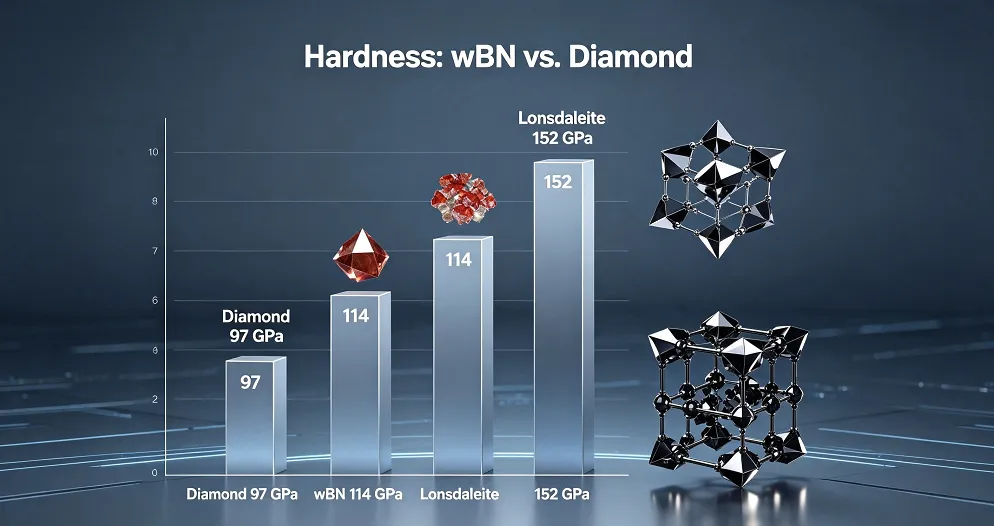
Hardness: wBN vs. Diamond
Wurtzite Boron Nitride with plate shape particles is used as a raw material for sintering coarse grit polycrystalline structure powders, which are later used for manufacturing traditional cutting and grinding tools. To begin with, despite wurtzite boron nitride has a similar structure to diamond, it’s made up of different atoms. Secondly, we know the mineral lonsdaleite or hexagonal diamond is made from carbon atoms parallel to diamond, but they may be arranged in some special shapes. What’s more, we can only discover the existence of these materials in meteorites in microscopic portions. Thirdly, when excessive pressures are imposed on lonsdaleite and another substance named wurtzite boron nitride by using a two-stage shear deformation, they will flip their atomic bonds triggering much stronger materials than these unpressurized materials. While under equal conditions, Lonsdaleite (hexagonal diamond) is 57% more powerful with 152 GPa. Wurtzite Boron Nitride is 18 % stronger with 114 GPa. On the contrary, diamond is only 97 GPa for reference.

Wurtzite Boron Nitride
Wurtzite Boron Nitride Market
The Global Wurtzite Boron Nitride Market is an in-depth study and analysis of the market size, share, growth, trend, outlook, overview, production, manufacture, Key companies analysis, classifications, applications, and expert’s opinions, among others with the extent of information filled in the report. Wurtzite Boron Nitride report provides key information about the market with a detailed SWOT analysis, including invaluable facts and figures, expert opinions, and the latest developments across the globe.
The United States Wurtzite Boron Nitride Market Research Report provides a detailed market overview along with the analysis of the industry’s gross margin, cost structure, consumption value and sale price. The key companies of the United States Wurtzite Boron Nitride market, manufacturers, distributors along with the latest development trends and Forecasts are detailed in the Report.
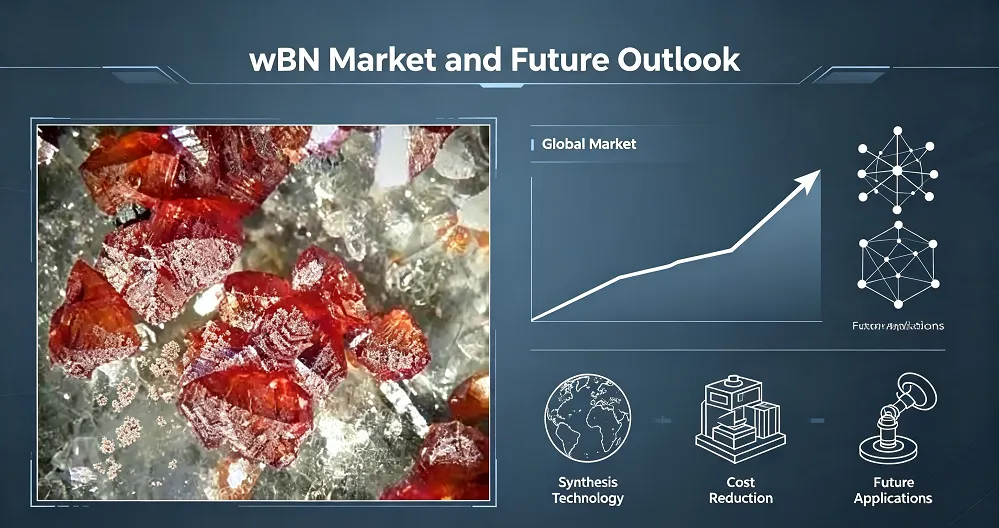
wBN Market and Future Outlook
Advantages and Limitations of Wurtzite Boron Nitride
Understanding the strengths and weaknesses of w-BN is essential for selecting the appropriate material for specific applications.
Advantages:
Superior Hardness: w-BN is 18% harder than diamond, offering exceptional wear resistance and cutting performance.
Thermal Stability: w-BN maintains its mechanical properties at high temperatures, with oxidation resistance up to approximately 1300°C in air.
Self-Sharpening: The polycrystalline structure provides self-sharpening properties during cutting, maintaining cutting efficiency over extended periods.
Chemical Inertness: w-BN is resistant to most acids and chemicals, ensuring stable performance in aggressive environments.
High Thermal Conductivity: The material effectively dissipates heat during cutting operations, preventing thermal damage to workpiece and tool.
Limitations:
Limited Availability: w-BN is not commercially produced in large quantities, limiting its widespread adoption.
High Production Cost: The specialized synthesis conditions require significant energy input and advanced equipment, making w-BN more expensive than conventional abrasives.
Synthesis Challenges: Producing phase-pure w-BN with consistent quality remains technically challenging.
Competition from c-BN: Cubic boron nitride has more established production and application history, making it the default choice for many superhard applications.
Size Limitations: Current production methods typically yield fine powder particles, limiting applications requiring larger single crystals.
Future Outlook: As synthesis technologies improve and production scales increase, the cost of w-BN is expected to decline, making it more competitive for mainstream industrial applications. Research continues on developing novel synthesis methods and expanding the application range of w-BN.
TRUNNANO (Luoyang Trunnano Tech Co., Ltd ) is a professional Boron Nitride manufacturer with over 12 years of experience in chemical products research and development. If you are looking for high-quality Boron Nitride, please feel free to contact us and send an inquiry.