
Why Silica Aerogel Thermal Insulation Coating Outperforms Traditional Insulation Materials?
Building energy consumption continues to rise globally, and insulation performance is one of the most effective ways to reduce energy waste. Traditional insulation materials such as rock wool, expanded polystyrene, and extruded polystyrene have served the construction industry for decades, but they come with inherent limitations: they are thick, heavy, and often require complex installation procedures. Silica Aerogel Thermal Insulation Coating represents a fundamentally different approach to thermal insulation. By incorporating silica aerogel — a material with exceptionally low thermal conductivity — into a coatable paste, this product delivers insulation performance that traditional materials cannot match, in a fraction of the thickness. This article explores why Silica Aerogel Thermal Insulation Coating outperforms traditional insulation materials, covering its working principle, key performance advantages, application areas, and practical usage guidance. Whether you are working on new construction, renovating an older building, or insulating industrial equipment, understanding the capabilities of Silica Aerogel Thermal Insulation Coating can help you achieve better thermal performance with less material and lower installation complexity.
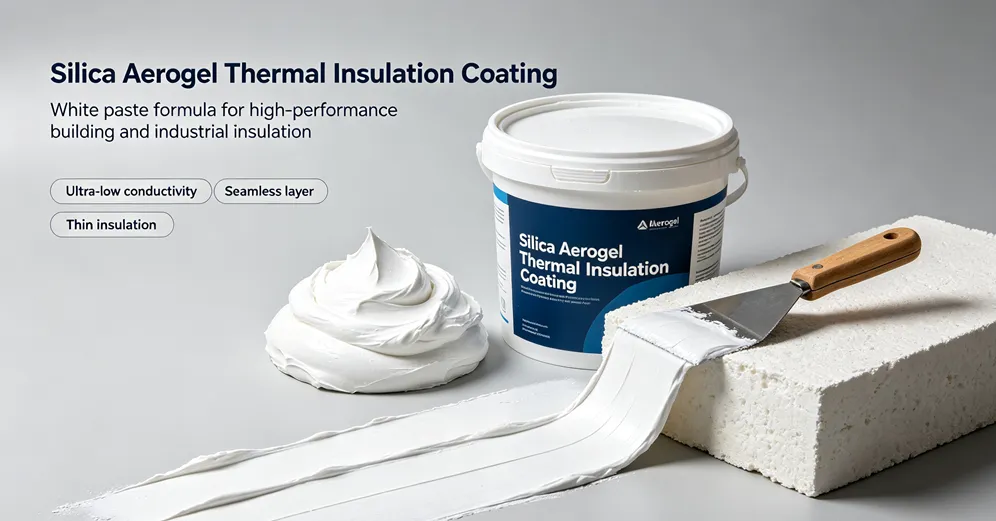
Silica Aerogel Thermal Insulation Coating
What Is Silica Aerogel Thermal Insulation Coating?
Silica Aerogel Thermal Insulation Coating is a high-performance insulation material made from silica aerogel particles suspended in a binding agent. Silica aerogel is a nanoporous solid with extremely high porosity, giving it exceptionally low thermal conductivity. When formulated into a coating, the aerogel particles retain their nanoporous structure, providing outstanding insulation performance in a thin, lightweight layer.The product is supplied as a white paste. It can be applied by scraping, smearing, or spraying, making it suitable for a wide range of surfaces including flat walls, curved roofs, irregular equipment, and pipelines. The coating forms a continuous, seamless insulation layer that adheres strongly to the substrate, eliminating the thermal bridges that often occur with board-type insulation materials.
The thermal conductivity of Silica Aerogel Thermal Insulation Coating is significantly lower than traditional insulation materials, which is the foundation of its superior insulation performance. The coating also offers excellent fire resistance, providing an additional layer of safety compared to organic insulation materials.
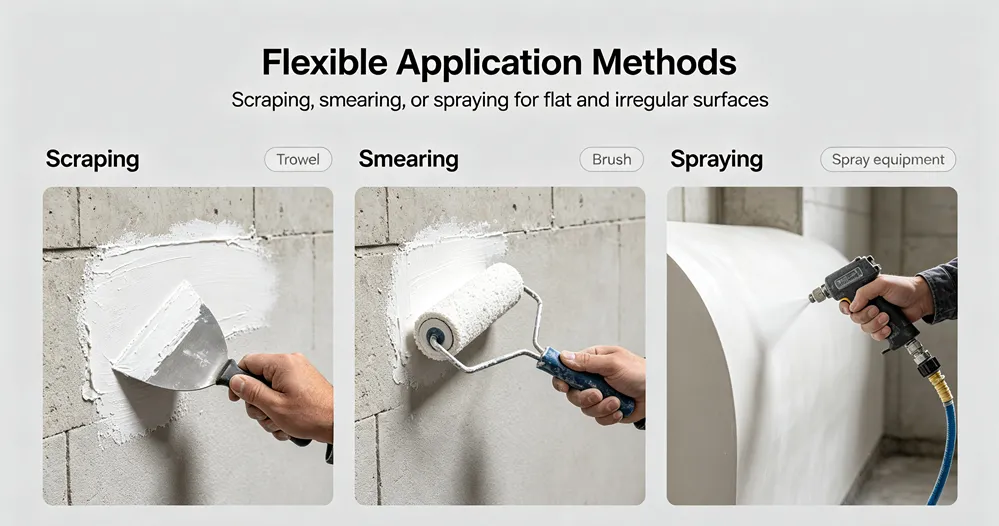
Flexible Application Methods
How Silica Aerogel Thermal Insulation Coating Works
The insulation mechanism of Silica Aerogel Thermal Insulation Coating is based on the unique structure of silica aerogel. At the nanoscale, aerogel consists of a network of interconnected silica particles with pores that are extremely small — smaller than the mean free path of air molecules. This means that gas molecules inside the pores cannot move freely and collide with each other to transfer heat.This structure suppresses all three modes of heat transfer. First, gas convection is eliminated because the pores are too small for air circulation. Second, solid conduction is minimized because the silica network is highly porous and the solid pathways for heat flow are extremely tortuous. Third, radiation heat transfer is reduced because the pore walls absorb and re-emit thermal radiation at lower intensities.
When applied to a surface, Silica Aerogel Thermal Insulation Coating forms a continuous layer that maintains this nanoporous structure. Heat attempting to pass through the coating encounters the same suppression mechanisms at every point, resulting in overall thermal conductivity that is significantly lower than traditional insulation materials. This is why a thin layer of Silica Aerogel Thermal Insulation Coating can achieve insulation performance equivalent to much thicker layers of conventional materials.
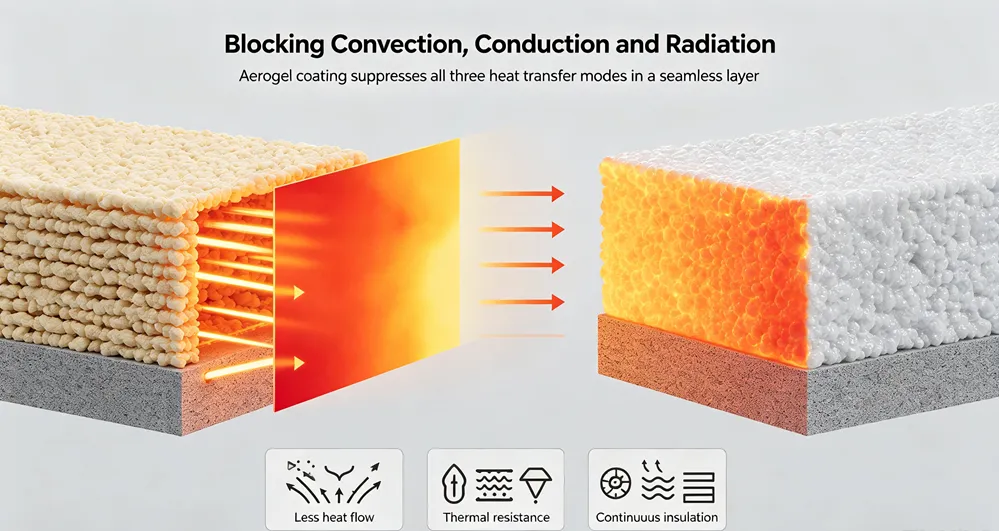
Blocking Convection, Conduction and Radiation
Key Performance Advantages Over Traditional Insulation Materials
Silica Aerogel Thermal Insulation Coating offers several advantages over traditional insulation materials, particularly in applications where thickness, weight, and installation complexity are limiting factors.Ultra-Low Thermal Conductivity — The thermal conductivity of Silica Aerogel Thermal Insulation Coating is significantly lower than rock wool, expanded polystyrene, and extruded polystyrene. This means that for the same insulation performance, the aerogel coating requires less thickness and less material.
Thin and Lightweight — Traditional insulation materials typically require considerable thickness to achieve adequate insulation. Silica Aerogel Thermal Insulation Coating achieves comparable performance with a much thinner layer. This makes it ideal for applications where space is limited, such as interior wall insulation or retrofitting older buildings with restricted cavity depth.
Seamless Application — Unlike board-type insulation materials, which must be cut and fitted with seams and joints, Silica Aerogel Thermal Insulation Coating is applied as a continuous layer. This eliminates thermal bridges at seams and edges, improving overall insulation performance. The coating can be applied to complex shapes, curved surfaces, and irregular equipment without the need for custom fabrication.
Excellent Adhesion — The coating bonds strongly to concrete, masonry, metal, and other substrates. This prevents delamination and ensures long-term performance even under thermal cycling and weather exposure.
Fire Resistance — Silica Aerogel Thermal Insulation Coating is non-combustible or flame-retardant, providing a significant advantage over organic insulation materials such as polystyrene, which can melt and release toxic fumes in a fire.
Chemical Stability — The coating does not react chemically with acids, alkalis, or corrosive substances. This makes it suitable for industrial applications where chemical exposure is a concern.
Moisture Resistance — Silica aerogel is hydrophobic, meaning it repels water. This prevents moisture absorption, which can degrade the insulation performance of traditional materials over time.
Environmental Safety — Silica Aerogel Thermal Insulation Coating does not contain or produce harmful VOC components, carcinogenic substances, or other harmful polymers. It is environmentally friendly and safe for workers and building occupants.
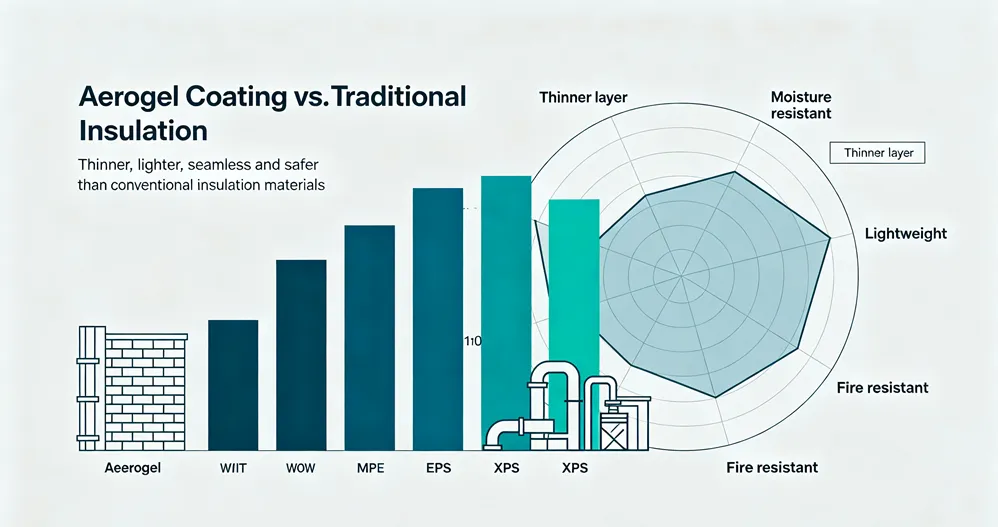 Aerogel Coating vs. Traditional Insulation
 Aerogel Coating vs. Traditional Insulation
Silica Aerogel Thermal Insulation Coating vs. Traditional Insulation Materials
| Comparison Dimension | Silica Aerogel Thermal Insulation Coating | Rock Wool | Expanded Polystyrene (EPS) | Extruded Polystyrene (XPS) |
| Thermal Conductivity | Significantly lower | Higher | Higher | Comparable |
| Typical Thickness for Equivalent Performance | Much thinner | Much thicker | Much thicker | Much thicker |
| Weight | Lightweight paste | Heavy boards | Lightweight boards | Lightweight boards |
| Application Method | Scrape, smear, spray | Cut and fit | Cut and fit | Cut and fit |
| Seamless Coverage | Yes | No | No | No |
| Fire Resistance | Excellent | Good | Limited | Limited |
| Moisture Resistance | Hydrophobic | Absorbs moisture | Closed-cell | Closed-cell |
| Complex Surface Adaptability | Excellent | Poor | Poor | Poor |
| Renovation Suitability | Excellent | Limited | Limited | Limited |
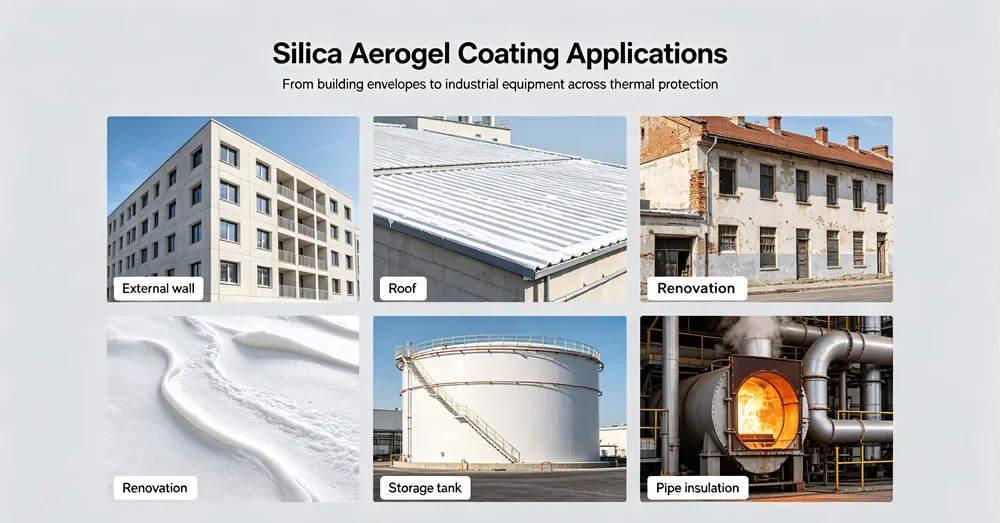
Silica Aerogel Coating Applications
Applications of Silica Aerogel Thermal Insulation Coating
Silica Aerogel Thermal Insulation Coating is suitable for a wide range of building and industrial applications.Building Applications
External Wall Insulation — For new residential buildings and commercial structures, the coating provides effective thermal insulation without the thickness and weight of traditional board materials.Roof Insulation — Applied to roof surfaces to reduce heat gain in summer and heat loss in winter.
Old Building Renovation — The coating can be applied directly to existing walls without major structural changes, making it ideal for energy-efficient retrofits.
Basement Moisture and Mildew Proofing — The hydrophobic nature of the coating prevents moisture penetration while providing thermal insulation.
Grain and Oil Warehouse Insulation — Maintains stable internal temperatures for stored products.
Industrial Applications
Petrochemical Storage Tanks — Insulates tanks to maintain temperature and reduce energy loss.High-Temperature Furnaces and Ladles — Withstands high temperatures while providing thermal protection.
Power Plant Steam Turbines and Kilns — Reduces heat loss from high-temperature equipment.
Special-Shaped Equipment and Pipelines — The coating can be applied to irregular shapes that are difficult to insulate with traditional materials.
Dyeing Vats and Setting Machines — Improves thermal efficiency in textile processing.
How to Apply Silica Aerogel Thermal Insulation Coating
Applying Silica Aerogel Thermal Insulation Coating is straightforward and can be done using standard tools and equipment.Surface Preparation
The substrate must be clean, dry, and free from dust, oil, and loose material. For best adhesion, the surface should be sound and structurally stable.Application Methods
The coating can be applied by:Scraping — For flat surfaces, using a trowel or scraper.
Smearing — For general application, using a brush or roller.
Spraying — For large surfaces or irregular shapes, using conventional spray equipment.
Curing
After application, the coating should be allowed to cure under normal ambient conditions. Proper curing ensures full development of adhesion and thermal performance.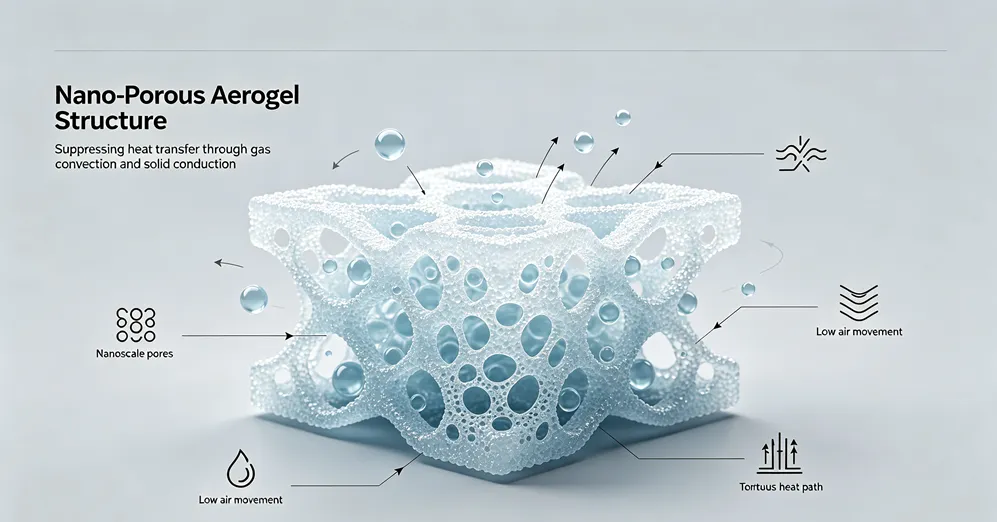
Nano-Porous Aerogel Structure
Why Choose Silica Aerogel Thermal Insulation Coating?
Silica Aerogel Thermal Insulation Coating represents a significant advancement in thermal insulation technology. By harnessing the unique properties of silica aerogel, this coating delivers insulation performance that traditional materials cannot match, in a thin, lightweight, and easy-to-apply format. For building owners, architects, and industrial operators looking to improve energy efficiency, reduce installation complexity, and extend the life of their insulation systems, Silica Aerogel Thermal Insulation Coating offers a compelling solution.Whether you are insulating a new building, renovating an old structure, or protecting industrial equipment, Silica Aerogel Thermal Insulation Coating provides the performance and reliability you need. With its ultra-low thermal conductivity, seamless application, fire resistance, and moisture resistance, this coating outperforms traditional insulation materials across a wide range of applications.
Supplier
TRUNNANO is a trusted global ilica Aerogel Thermal Insulation Coating supplier and manufacturer with over 12 years of experience in providing high-quality chemicals and nanomaterials, including boride powder, nitride powder, graphite powder, sulfide powder, and 3D printing powder. The company has a professional technical department and quality supervision department, a well-equipped laboratory with advanced testing equipment, and a dedicated after-sales customer service center. TRUNNANO supplies Silica Aerogel Thermal Insulation Coating worldwide, suitable for building insulation, industrial equipment, pipelines, storage tanks, and other thermal protection applications. The company offers comprehensive technical support, from product selection to application guidance. If you are looking for a high-performance Silica Aerogel Thermal Insulation Coating, please feel free to contact us.Tags: silica aerogel thermal insulation coating, aerogel coating, thermal insulation coating