What is surfactant?
Surfactants are a special class of chemicals that possess both hydrophilic (water-attracting) and lipophilic (oil-attracting) properties. They can significantly reduce the surface tension of liquids and are widely used in numerous fields such as daily chemicals, industry, pharmaceuticals, agriculture, construction materials, and environmental protection. As the "core assistants" in chemical formulations, surfactants play an irreplaceable role in emulsification, dispersion, wetting, foaming, solubilization, and cleaning.

surfactant
Types of surfactants
| Category | Main Characteristics | Representative Products | Advantages and Application Fields |
|---|---|---|---|
| Anionic Surfactants | Hydrophilic group carries a negative charge; strong detergency, good foaming properties | Sodium dodecyl sulfate (SDS), fatty acid salts, sulfonates, etc. | Suitable for detergents, shampoos, toothpaste, industrial cleaners, etc. Low cost, excellent oil and grease removal. |
| Cationic Surfactants | Hydrophilic group carries a positive charge; exhibits antibacterial, antistatic, and softening properties | Quaternary ammonium compounds (e.g., CTAB), imidazoline derivatives, etc. | Used in fabric softeners, disinfectants, hair conditioners, antistatic agents, textile auxiliaries, etc. |
| Nonionic Surfactants | No charge; hydrophilic group often consists of polyoxyethylene chains; resistant to hard water, low irritation | Fatty alcohol polyoxyethylene ethers (AEO), alkylphenol polyoxyethylene ethers (OP series), Span/Tween series, etc. | Suitable as emulsifiers, dispersants, wetting agents, pesticide adjuvants, cosmetics, etc. Good compatibility and high stability. |
| Amphoteric Surfactants | Carry both positive and negative charges; mild, low irritation, combine cleaning and conditioning functions | Betaine types, amino acid types, etc. | Mainly used in high-end personal care products, baby products, cosmetics, pharmaceuticals, etc., offering both cleansing and conditioning properties. |
| Specialty & Functional Surfactants | Possess special structures or functions, such as fluorocarbon, silicone, polymeric surfactants, etc. | Fluorocarbon surfactants, silicone surfactants, Gemini surfactants, etc. | Used in high-end industrial fields like specialty coatings, firefighting foams, petroleum extraction, textile finishing, electronic cleaning, etc. |
What is surfactant used for?
Daily Chemicals & Personal Care: Shampoos, body washes, facial cleansers, toothpaste, skincare products, etc.
Industrial Cleaning & Metal Treatment: Pre-treatment for electroplating, degreasers, cutting fluids, equipment cleaners.
Textile Dyeing & Printing: Pre-treatment auxiliaries, leveling agents, softeners, antistatic agents.
Agriculture & Pesticides: Pesticide emulsifiers, spray adjuvants, foliar fertilizer additives.
Building Materials & Construction: Concrete foaming agents, superplasticizers, coating dispersants, gypsum additives.
Petroleum & Energy: Enhanced oil recovery agents, demulsifiers, drilling fluid additives.
Environmental Protection & Water Treatment: Flocculation aids, sludge dewatering agents, surfactants for wastewater treatment.
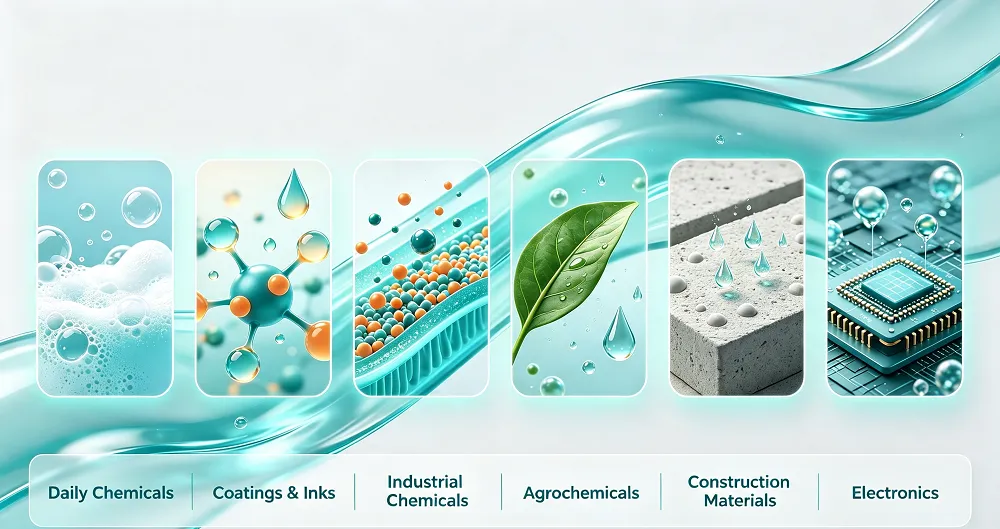
Applications of Surfactant
What are industrial surfactants?
Surfactants are one of many different compounds that make up a detergent. They are added to remove dirt from skin, clothes and household articles particularly in kitchens and bathrooms. They are also used extensively in industry. The term surfactant comes from the words surface active agent.

Application of surfactant in the field of personal care
Company profile
Luoyang Trunnano Tech Co., Ltd is professional in cladding of metal solutions for 10 years+, which is a professional company with supply and marketing integration.
We provides different kinds of surfactants, such as anionic surfactants, sodium lauryl sulfate, sodium laureth sulfate, sodium lauroyl sarcosinate,etc.
The company has a professional technical department and Quality Supervision Department, a well-equipped laboratory, and equipped with advanced testing equipment and after-sales customer service center.Send us an email or click on the needed products to send an inquiry.

Payment term
T/T, Western Union, Paypal, Credit Card etc.
Shipment term
By air, by sea, by express, as customers request.
Storage conditions
1) Store in a dry environment at room temperature.
2) Avoid damp and high temperature.
3) Use immediately after opening the inner packing bag.

FAQ
Q1
What impact do surfactants have on the environment?
Re: Surfactants may enter the water body during use and cause toxic effects on aquatic organisms. Therefore, choosing environmentally friendly and biodegradable surfactants is of great significance for reducing environmental pollution.
Q2
How to choose the right surfactant?
Re: Selecting a suitable surfactant requires consideration of many factors, such as the specific requirements of the application field, the performance characteristics of the surfactant, cost, etc. Generally speaking, surfactants with an appropriate hydrophile-lipophile balance value (HLB value) should be selected based on specific needs.
Q3
Are surfactants harmful to humans?
Re: Some surfactants may cause irritation or allergic reactions to human skin, eyes, etc. Therefore, when using products containing surfactants, you should pay attention to product instructions and warnings and follow correct usage.
Q4
What are the applications of surfactants in the food industry?
Re: In the food industry, surfactants are mainly used as emulsifiers, stabilizers, thickeners and anti-foaming agents. They can help improve the texture, mouthfeel and stability of food, and improve its processing performance and shelf life.
Q5
How do surfactants affect interfacial tension?
Re: Surfactant molecules adsorb at the interface and arrange themselves so that the hydrophilic groups face the water phase and the hydrophobic groups face the oil phase. This arrangement reduces the interfacial tension, making it easier for the two phases to mix and emulsify.