
Why Does Titanium Dioxide Have Two Crystal Forms? — Anatase vs. Rutile Explained
For engineers and formulators, understanding the difference between anatase and rutile is critical. It’s the difference between a coating that lasts decades and one that fails in months. Between a catalyst that works and one that doesn’t.
This article explains why TiO₂ has two crystal forms, how anatase and rutile compare in performance, and how to choose the right one for your application.
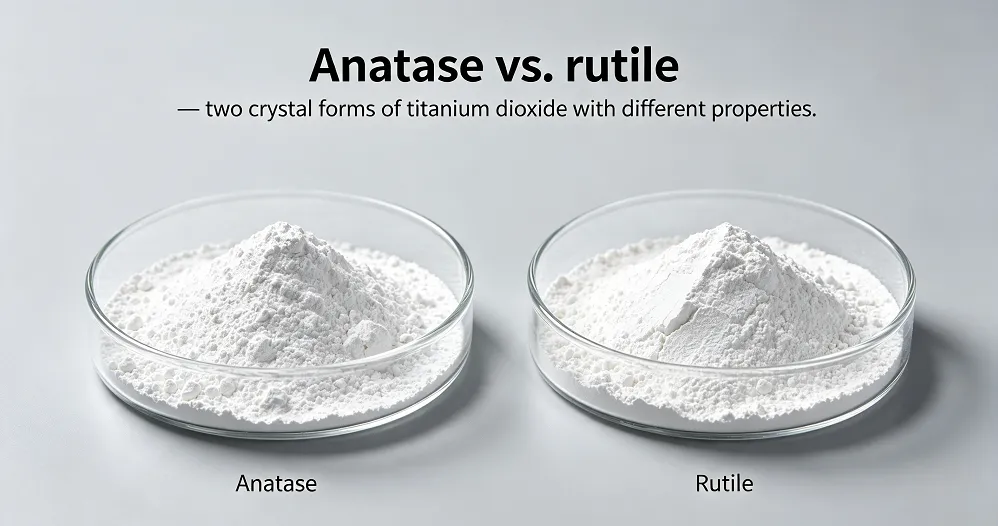
Anatase vs. rutile — two crystal forms of titanium dioxide with different properties.
What Are Anatase and Rutile?
Anatase and rutile are both naturally occurring minerals composed of titanium dioxide. Both have the same chemical formula—TiO₂. The difference lies in their crystal structures.
Anatase has a more open lattice structure. Rutile has a denser, more tightly packed structure. Anatase is the less stable form at high temperatures. When heated, it undergoes an irreversible transformation and becomes rutile. This transformation is one-way—you can’t convert rutile back to anatase by cooling.
Rutile, by contrast, is the thermodynamically stable form of TiO₂. It’s the form most often used in industrial applications that require long-term durability.
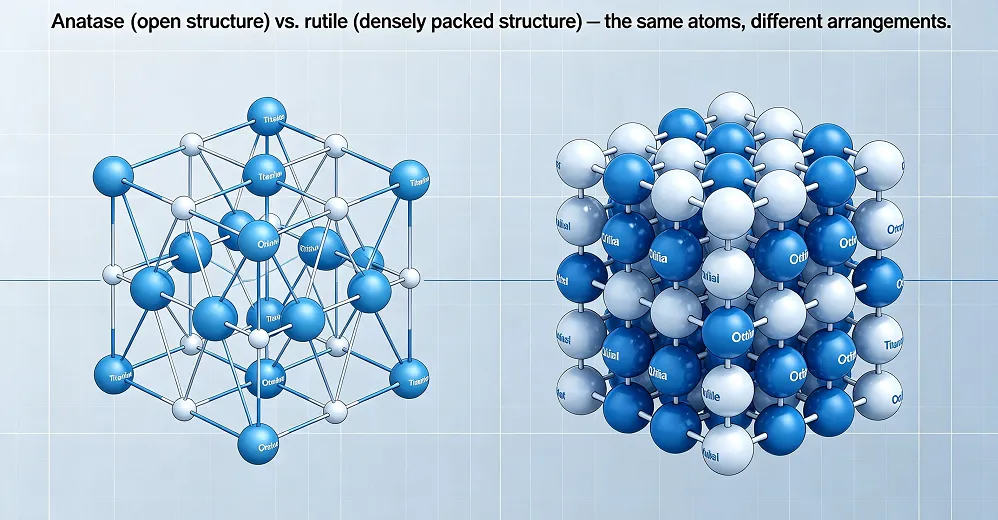
Anatase vs. Rutile: Performance Differences
The structural differences between anatase and rutile translate directly into performance differences. Here's how anatase and rutile compare across key properties:|
Property
|
Anatase
|
Rutile
|
|---|---|---|
|
Crystal Structure
|
Open lattice
|
Dense, tightly packed
|
|
Density
|
Lower
|
Higher
|
|
Refractive Index
|
Moderate
|
Higher
|
|
Hiding Power
|
Moderate
|
Superior
|
|
Weather Resistance
|
Moderate
|
Excellent
|
|
Photocatalytic Activity
|
High
|
Low
|
|
UV Absorption
|
Moderate
|
Strong
|
|
Thermal Stability
|
Transforms to rutile at high temperature
|
Stable
|
|
Band Gap
|
Wider
|
Narrower
|
Refractive index and hiding power. The higher refractive index of rutile means it scatters light more effectively. This gives rutile superior hiding power—a key advantage in paints and coatings, where less pigment is needed to achieve the same opacity. Rutile has a clear advantage in hiding power over anatase at the same pigment loading.
Weather resistance. Rutile's dense crystal structure makes it more resistant to UV degradation. It doesn't chalk or break down when exposed to sunlight. Anatase, by contrast, is more photoreactive, which can lead to degradation of the organic binders in paints and coatings. For outdoor applications, rutile is the clear winner.
Photocatalytic activity. Anatase has a wider band gap than rutile, which means it generates more reactive species when exposed to UV light. This makes anatase highly effective for photocatalysis—the breakdown of organic pollutants under light. Anatase is significantly more photocatalytically active than rutile. The more open crystal structure of anatase allows photogenerated electrons and holes to reach the surface more readily, where they can participate in reactions.
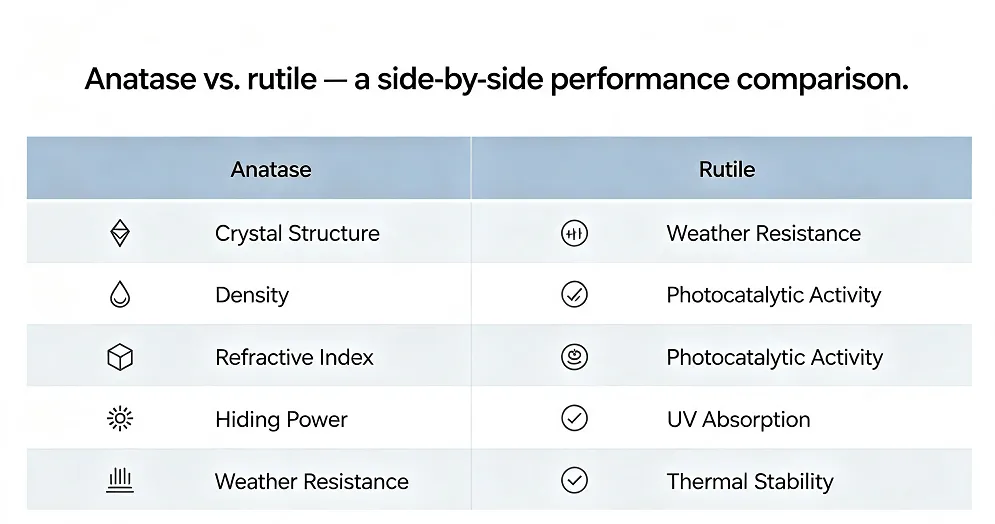
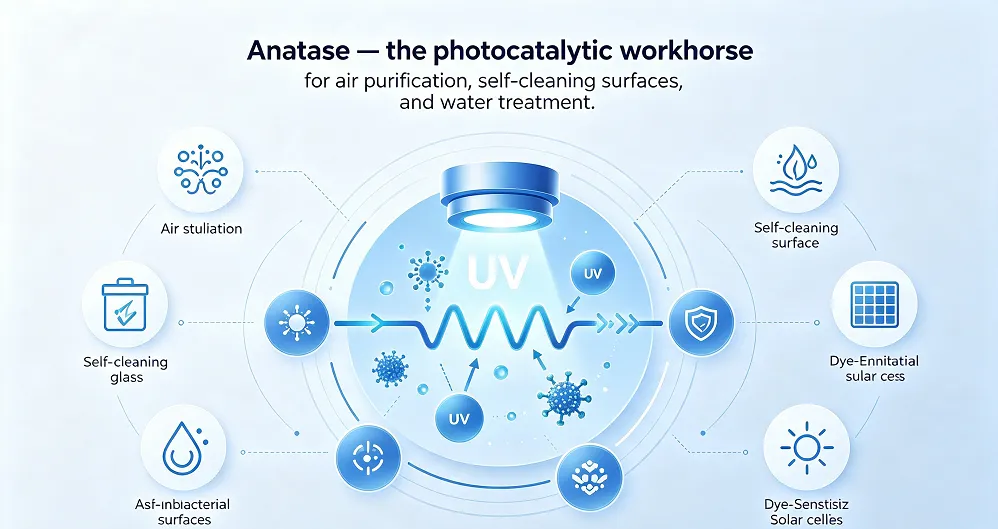
Why Anatase Excels in Photocatalysis and Air Purification
Anatase’s open crystal structure gives it a distinct advantage in photocatalysis. When exposed to UV light, it generates reactive species that break down organic pollutants, kill bacteria, and decompose VOCs.
Key applications of anatase include:
Air purification — Coatings that break down VOCs, formaldehyde, and NOx.
Water treatment — Degradation of organic contaminants like dyes and pesticides.
Self-cleaning surfaces — Glass and tiles that decompose organic matter when exposed to light.
Antibacterial surfaces — Passive, chemical-free antimicrobial protection.
Dye-sensitized solar cells (DSSC) — A next-generation photovoltaic technology.
The photocatalytic activity of anatase is the basis of real products used in buildings, vehicles, and infrastructure worldwide.
Why Rutile Dominates Pigment, Coatings, and UV Protection Applications
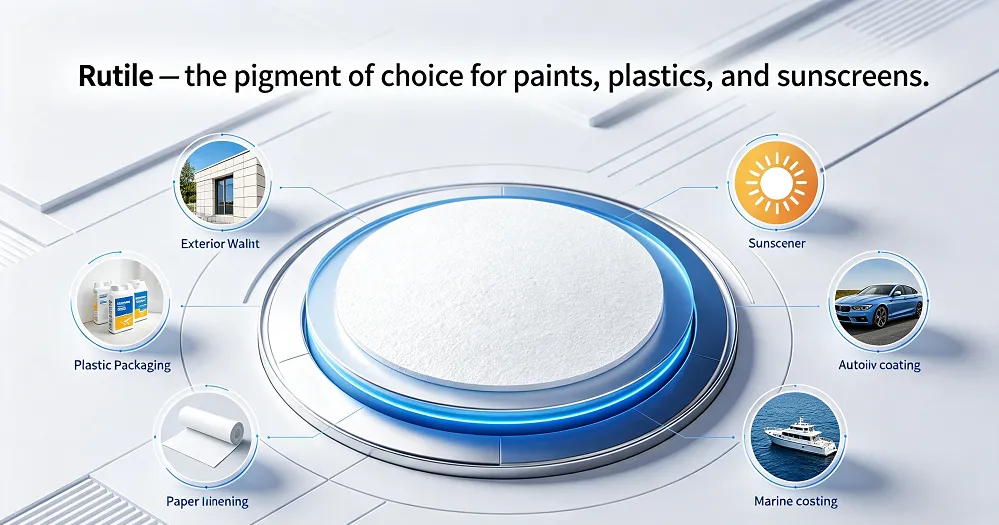
Rutile's dense crystal structure gives it a different set of advantages. Its higher refractive index means it scatters light more effectively, making it the premier white pigment for paints, coatings, plastics, and paper.Superior hiding power. Rutile's refractive index is among the highest of any white pigment. This means it scatters light efficiently, providing excellent opacity with less material. Manufacturers can achieve the same whiteness and coverage with less pigment, reducing material costs and improving formulation flexibility.
UV protection. Rutile absorbs UV radiation, protecting the underlying substrate from degradation. This makes it the preferred choice for exterior paints, where long-term weatherability is critical. Rutile also serves as a physical UV filter in sunscreens, providing broad-spectrum protection.
Weather resistance. The dense crystal structure of rutile is more resistant to the photocatalytic degradation that can affect anatase. In exterior coatings, rutile doesn't break down the organic binders that hold the paint film together. This means paints formulated with rutile last longer and maintain their appearance over time.
Chemical stability. Rutile is chemically inert and resists attack by acids, alkalis, and most solvents. This makes it suitable for a wide range of demanding applications, from marine coatings to industrial floor paints.
Rutile dominates the titanium dioxide pigment market for good reason. Its combination of hiding power, durability, and chemical stability is unmatched by any other white pigment. When you see a white wall, a white plastic part, or a white paper product, you're almost certainly looking at rutile titanium dioxide at work.
Mixed Crystal (Gas-Phase) TiO₂: Combining Anatase and Rutile
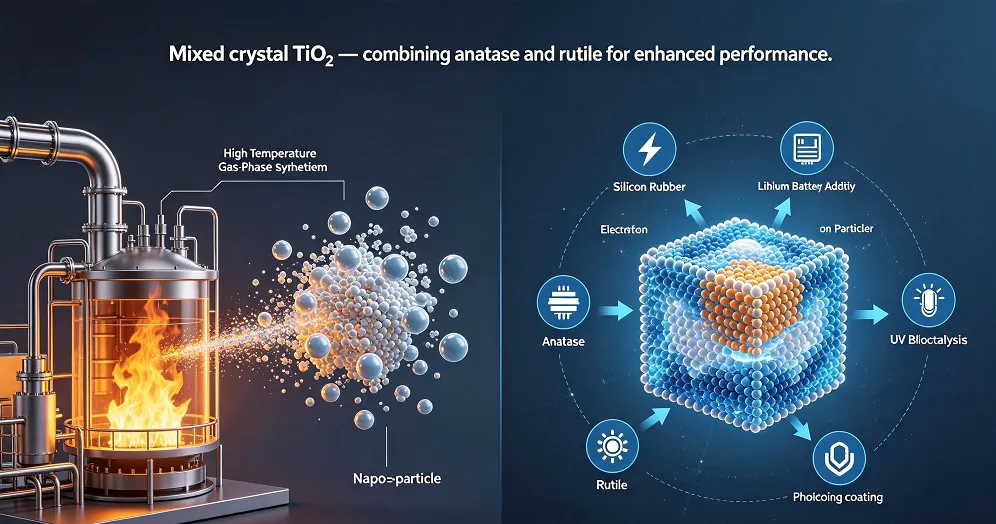
Fumed titanium dioxide, produced via a high-temperature gas-phase process, offers a mixed crystal structure containing both anatase and rutile. This combination is a deliberate engineering choice that leverages both crystal forms.
TRUNNANO’s TR-AT 50 is a typical example. The anatase provides high photocatalytic activity, while the rutile contributes stability and improved electron transfer.
Synergistic effect. When anatase and rutile coexist, the interface between them acts as a junction where photogenerated electrons transfer from anatase to rutile. This reduces charge recombination and increases photocatalytic efficiency.
Applications of mixed crystal TiO₂ include:
Silicone rubber reinforcement — Improves thermal stability and mechanical strength.
Lithium battery additives — High purity and controlled particle size enhance cathode performance.
Photocatalysis — Enhanced performance in air purification, water treatment, and self-cleaning coatings.
UV-blocking coatings — Combines photocatalytic self-cleaning with UV protection.
How to Choose Between Anatase and Rutile
Choosing between anatase, rutile, and mixed crystal TiO₂ depends on your application:| Application | Recommended Form | Reason |
| Interior paints, paper | Anatase | High whiteness, lower cost |
| Exterior paints, automotive finishes | Rutile | Excellent weather resistance |
| Photocatalysis, air purification | Anatase or mixed crystal | High photocatalytic activity |
| Sunscreens, cosmetics | Rutile | Strong UV absorption, safe |
| Silicone rubber reinforcement | Mixed crystal (gas-phase) | Good dispersion, thermal stability |
| Lithium battery additives | Rutile (battery grade) | Electrochemical stability |
For exterior applications where durability is critical, rutile is the clear choice. Its superior weather resistance, hiding power, and UV protection justify the higher cost.
For photocatalysis and self-cleaning applications, anatase or mixed crystal TiO₂ is required. The high photocatalytic activity of anatase is essential for breaking down organic pollutants.
For cosmetic and personal care products, rutile is the preferred choice because of its strong UV absorption and safety profile.
For silicone rubber reinforcement and battery additives, gas-phase mixed crystal products offer the best combination of purity, dispersion, and performance.
Supplier
TRUNNANO is a globally recognized chemical material supplier and manufacturer with over 12 years of expertise in providing super high-quality chemicals and nanomaterials. The company has a professional technical department and quality supervision department, a well-equipped laboratory with advanced testing equipment, and a dedicated after-sales customer service center. TRUNNANO supplies high-quality fumed nanoscale titanium dioxide (anatase, rutile, and mixed crystal grades) for photocatalysis, silicone rubber, coatings, and energy storage applications. The company serves clients across more than 50 countries and offers comprehensive technical support,from material selection to application guidance. If you are looking for high-quality fumed titanium dioxide, please feel free to contact us.Tags: fumed titanium dioxide, anatase, rutile, TiO₂ nanoparticles, photocatalysis, titanium dioxide crystal structure