
By v | 11 August 2026 | 0 Comments
Why Does Titanium Dioxide Have Two Crystal Forms? — Anatase vs. Rutile Explained
Titanium dioxide (TiO₂) is everywhere. It's in the paint on your walls, the sunscreen on your skin, the plastic packaging around your food, and even the self-cleaning glass on modern skyscrapers. But here's the catch: not all titanium dioxide is the same. Depending on how its atoms are arranged, it can exist as two entirely different materials—one optimized for hiding colors, the other for breaking down pollutants. Same chemical formula, two completely different personalities.
This isn't a manufacturing quirk. It's a fundamental difference in crystal structure. Titanium dioxide has two primary crystal forms: anatase and rutile. Both are pure TiO₂. Both are white powders. But their atomic arrangements are different—and that difference determines everything from how they scatter light to how they react with their environment.
For engineers, formulators, and materials scientists, understanding the difference between anatase and rutile isn't academic. It's the difference between a coating that lasts decades and one that fails in months. Between a catalyst that works and one that doesn't. Between a product that meets specifications and one that doesn't.
This article explains why titanium dioxide has two crystal forms, how anatase and rutile differ in performance, and how to choose the right one for your application.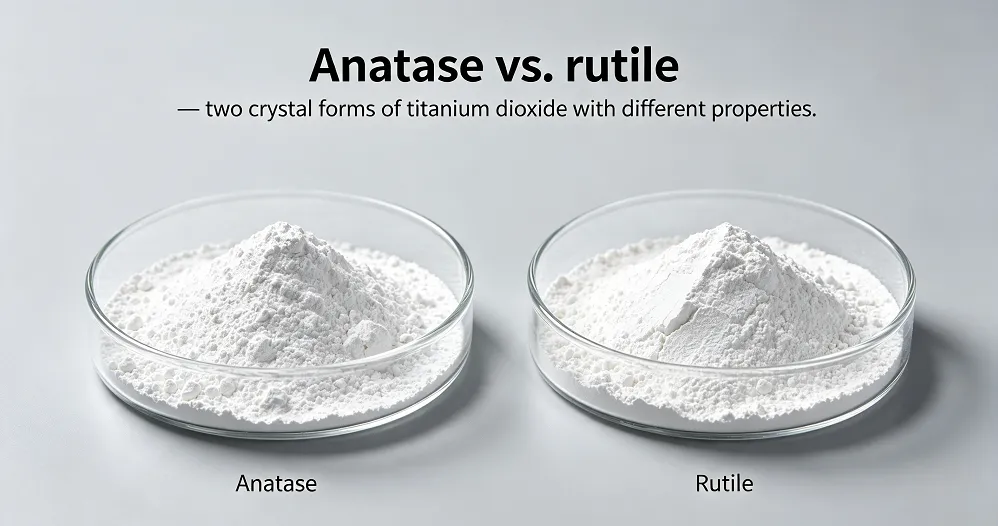
In simple terms, both are built from the same building blocks. The titanium and oxygen atoms are arranged differently in space. Anatase has a more open lattice structure. Rutile has a denser, more tightly packed structure.
Anatase is the less stable form at high temperatures. When heated above a certain temperature, anatase undergoes an irreversible transformation and becomes rutile. This transformation is one-way—you can't convert rutile back to anatase by cooling.
Rutile, by contrast, is the thermodynamically stable form of titanium dioxide. It's the most common natural form of TiO₂ and the form most often used in industrial applications that require long-term durability.
In terms of crystal habit, anatase crystals are typically octahedral, while rutile crystals are prismatic or needle-like. This difference in crystal shape is a direct reflection of the different internal arrangements of atoms. The more open structure of anatase gives it a lower density compared to rutile.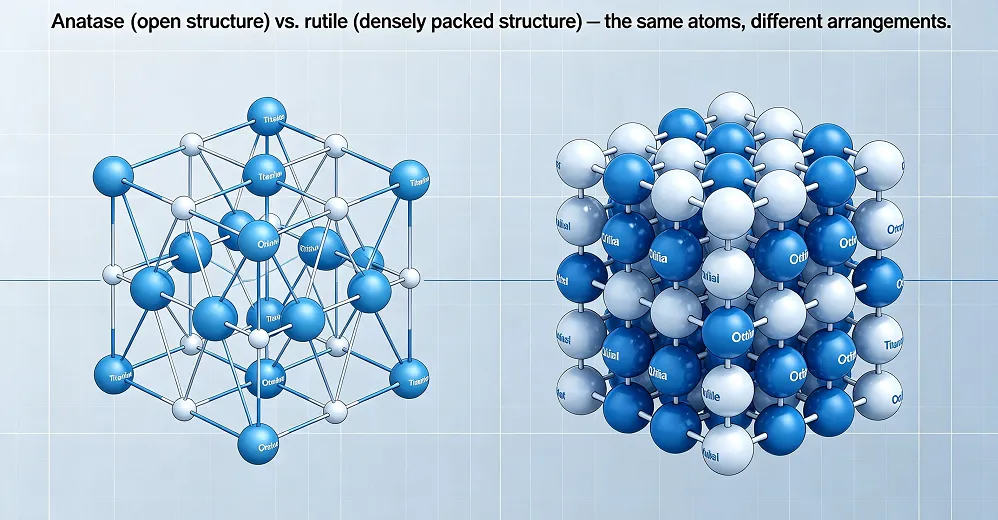
Refractive index and hiding power. The higher refractive index of rutile means it scatters light more effectively. This gives rutile superior hiding power—a key advantage in paints and coatings, where less pigment is needed to achieve the same opacity. Rutile has a clear advantage in hiding power over anatase at the same pigment loading.
Weather resistance. Rutile's dense crystal structure makes it more resistant to UV degradation. It doesn't chalk or break down when exposed to sunlight. Anatase, by contrast, is more photoreactive, which can lead to degradation of the organic binders in paints and coatings. For outdoor applications, rutile is the clear winner.
Photocatalytic activity. Anatase has a wider band gap than rutile, which means it generates more reactive species when exposed to UV light. This makes anatase highly effective for photocatalysis—the breakdown of organic pollutants under light. Anatase is significantly more photocatalytically active than rutile. The more open crystal structure of anatase allows photogenerated electrons and holes to reach the surface more readily, where they can participate in reactions.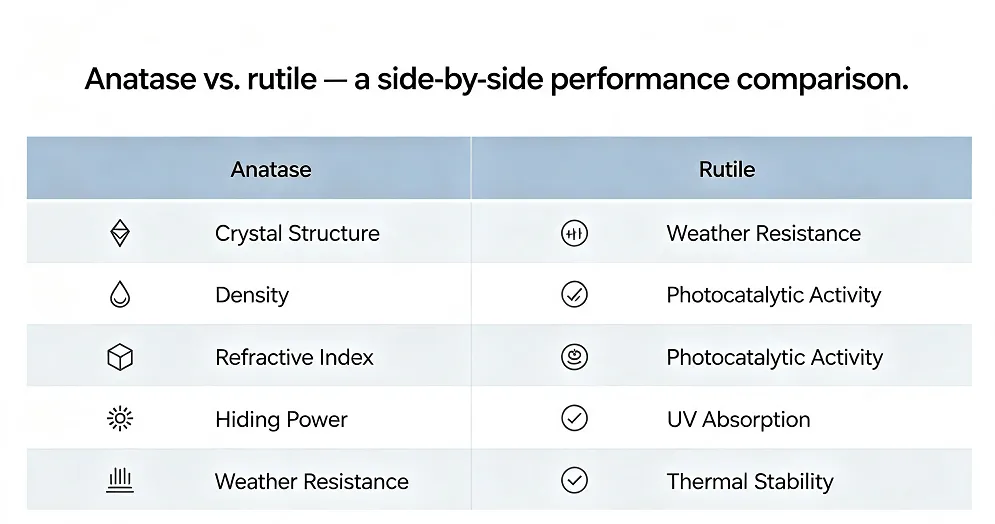
This property makes anatase the material of choice for applications that require surface reactions:
Air purification. Anatase-based photocatalytic coatings can break down VOCs, formaldehyde, and nitrogen oxides (NOx) in indoor and outdoor environments. In buildings with poor ventilation, these coatings continuously improve air quality without requiring energy-intensive mechanical systems.
Water treatment. Photocatalytic processes using anatase can degrade organic contaminants in wastewater, including dyes, pesticides, and pharmaceutical residues that conventional treatment methods can't remove.
Self-cleaning surfaces. Anatase coatings on glass, tiles, and building facades decompose organic matter when exposed to light. Urban buildings stay cleaner without frequent washing, reducing maintenance costs and water consumption.
Antibacterial surfaces. Anatase coatings kill bacteria and fungi under light exposure. In healthcare facilities, public transportation, and food processing plants, these coatings provide passive, chemical-free antimicrobial protection.
Dye-sensitized solar cells (DSSC). Anatase's high surface area and electron mobility make it a key component in dye-sensitized solar cells, a next-generation photovoltaic technology.
The photocatalytic activity of anatase isn't just a laboratory curiosity—it's the basis of real products used in buildings, vehicles, and infrastructure around the world. When you see a building with self-cleaning glass, there's a good chance anatase titanium dioxide is doing the work.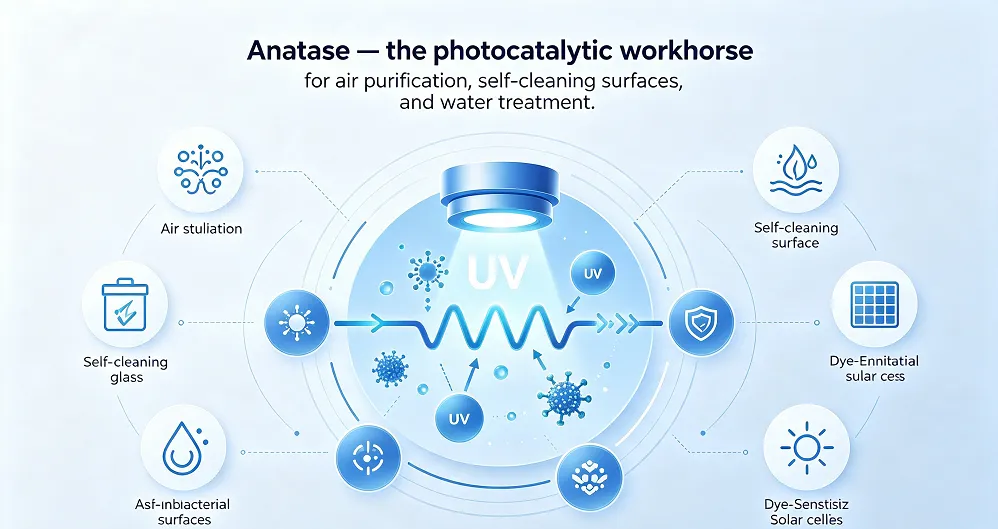
Superior hiding power. Rutile's refractive index is among the highest of any white pigment. This means it scatters light efficiently, providing excellent opacity with less material. Manufacturers can achieve the same whiteness and coverage with less pigment, reducing material costs and improving formulation flexibility.
UV protection. Rutile absorbs UV radiation, protecting the underlying substrate from degradation. This makes it the preferred choice for exterior paints, where long-term weatherability is critical. Rutile also serves as a physical UV filter in sunscreens, providing broad-spectrum protection.
Weather resistance. The dense crystal structure of rutile is more resistant to the photocatalytic degradation that can affect anatase. In exterior coatings, rutile doesn't break down the organic binders that hold the paint film together. This means paints formulated with rutile last longer and maintain their appearance over time.
Chemical stability. Rutile is chemically inert and resists attack by acids, alkalis, and most solvents. This makes it suitable for a wide range of demanding applications, from marine coatings to industrial floor paints.
Rutile dominates the titanium dioxide pigment market for good reason. Its combination of hiding power, durability, and chemical stability is unmatched by any other white pigment. When you see a white wall, a white plastic part, or a white paper product, you're almost certainly looking at rutile titanium dioxide at work.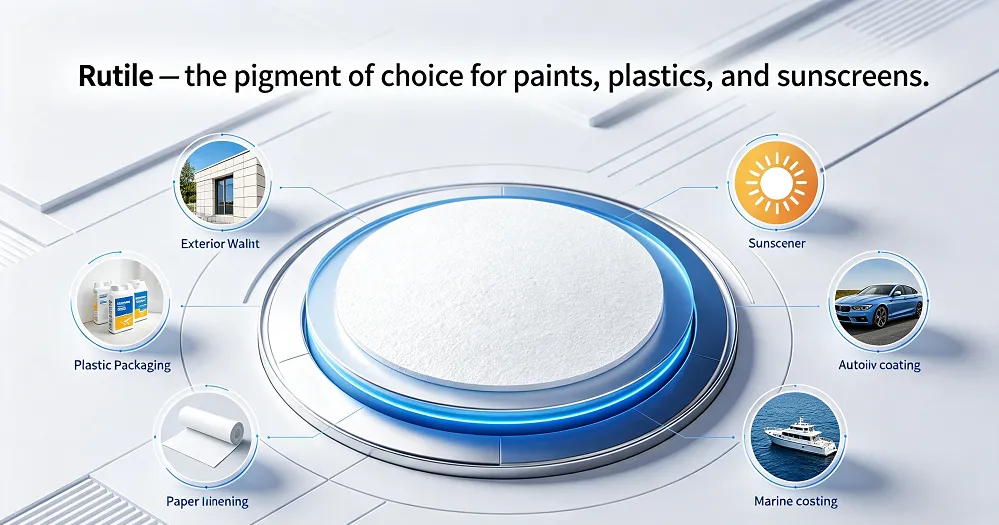
TRUNNANO's TR-AT 50 is a typical example of this mixed crystal type, with anatase and rutile existing together in a ratio that has been optimized for photocatalytic performance. The anatase provides high photocatalytic activity, while the rutile contributes stability and improved electron transfer. The interface between anatase and rutile creates what researchers call a synergistic effect.
Synergistic effect. When anatase and rutile coexist in the same particle, something remarkable happens. The interface between the two phases acts as a junction where photogenerated electrons can transfer from anatase to rutile. This transfer reduces charge recombination and increases the overall efficiency of photocatalytic reactions. The mixed crystal structure effectively separates the charge carriers, allowing more of them to participate in useful reactions rather than recombining.
Research has shown that mixed-phase TiO₂ materials exhibit enhanced reactivity for both oxidation reactions and photoreduction processes. Studies on flame-synthesized TiO₂ nanoparticles have confirmed that mixed anatase-rutile phases exhibit much higher activity in photocatalytic reactions than either phase alone.
The specific anatase-to-rutile ratio in products like TR-AT 50 closely matches the composition that academic research has identified as providing the best photocatalytic performance. This is not an arbitrary formulation—it is the result of decades of research into the optimal balance between anatase and rutile.
Applications of mixed crystal TiO₂.
This isn't a manufacturing quirk. It's a fundamental difference in crystal structure. Titanium dioxide has two primary crystal forms: anatase and rutile. Both are pure TiO₂. Both are white powders. But their atomic arrangements are different—and that difference determines everything from how they scatter light to how they react with their environment.
For engineers, formulators, and materials scientists, understanding the difference between anatase and rutile isn't academic. It's the difference between a coating that lasts decades and one that fails in months. Between a catalyst that works and one that doesn't. Between a product that meets specifications and one that doesn't.
This article explains why titanium dioxide has two crystal forms, how anatase and rutile differ in performance, and how to choose the right one for your application.
Anatase vs. rutile — two crystal forms of titanium dioxide with different properties.
What Are Anatase and Rutile?
Anatase and rutile are both naturally occurring minerals composed of titanium dioxide. Both have the same chemical formula—TiO₂. The difference lies in their crystal structures.In simple terms, both are built from the same building blocks. The titanium and oxygen atoms are arranged differently in space. Anatase has a more open lattice structure. Rutile has a denser, more tightly packed structure.
Anatase is the less stable form at high temperatures. When heated above a certain temperature, anatase undergoes an irreversible transformation and becomes rutile. This transformation is one-way—you can't convert rutile back to anatase by cooling.
Rutile, by contrast, is the thermodynamically stable form of titanium dioxide. It's the most common natural form of TiO₂ and the form most often used in industrial applications that require long-term durability.
In terms of crystal habit, anatase crystals are typically octahedral, while rutile crystals are prismatic or needle-like. This difference in crystal shape is a direct reflection of the different internal arrangements of atoms. The more open structure of anatase gives it a lower density compared to rutile.
Anatase (open structure) vs. rutile (densely packed structure) — the same atoms, different arrangements.
Anatase vs. Rutile: Performance Differences
The structural differences between anatase and rutile translate directly into performance differences. Here's how anatase and rutile compare across key properties:|
Property
|
Anatase
|
Rutile
|
|---|---|---|
|
Crystal Structure
|
Open lattice
|
Dense, tightly packed
|
|
Density
|
Lower
|
Higher
|
|
Refractive Index
|
Moderate
|
Higher
|
|
Hiding Power
|
Moderate
|
Superior
|
|
Weather Resistance
|
Moderate
|
Excellent
|
|
Photocatalytic Activity
|
High
|
Low
|
|
UV Absorption
|
Moderate
|
Strong
|
|
Thermal Stability
|
Transforms to rutile at high temperature
|
Stable
|
|
Band Gap
|
Wider
|
Narrower
|
Refractive index and hiding power. The higher refractive index of rutile means it scatters light more effectively. This gives rutile superior hiding power—a key advantage in paints and coatings, where less pigment is needed to achieve the same opacity. Rutile has a clear advantage in hiding power over anatase at the same pigment loading.
Weather resistance. Rutile's dense crystal structure makes it more resistant to UV degradation. It doesn't chalk or break down when exposed to sunlight. Anatase, by contrast, is more photoreactive, which can lead to degradation of the organic binders in paints and coatings. For outdoor applications, rutile is the clear winner.
Photocatalytic activity. Anatase has a wider band gap than rutile, which means it generates more reactive species when exposed to UV light. This makes anatase highly effective for photocatalysis—the breakdown of organic pollutants under light. Anatase is significantly more photocatalytically active than rutile. The more open crystal structure of anatase allows photogenerated electrons and holes to reach the surface more readily, where they can participate in reactions.
Anatase vs. rutile — a side-by-side performance comparison.
Why Anatase Excels in Photocatalysis and Air Purification
Anatase's open crystal structure gives it a distinct advantage in photocatalysis. When exposed to UV light, anatase generates electron-hole pairs that can break down organic pollutants, kill bacteria, and decompose volatile organic compounds (VOCs). The open lattice allows photogenerated charge carriers to reach the surface more efficiently, where they can participate in oxidation reactions.This property makes anatase the material of choice for applications that require surface reactions:
Air purification. Anatase-based photocatalytic coatings can break down VOCs, formaldehyde, and nitrogen oxides (NOx) in indoor and outdoor environments. In buildings with poor ventilation, these coatings continuously improve air quality without requiring energy-intensive mechanical systems.
Water treatment. Photocatalytic processes using anatase can degrade organic contaminants in wastewater, including dyes, pesticides, and pharmaceutical residues that conventional treatment methods can't remove.
Self-cleaning surfaces. Anatase coatings on glass, tiles, and building facades decompose organic matter when exposed to light. Urban buildings stay cleaner without frequent washing, reducing maintenance costs and water consumption.
Antibacterial surfaces. Anatase coatings kill bacteria and fungi under light exposure. In healthcare facilities, public transportation, and food processing plants, these coatings provide passive, chemical-free antimicrobial protection.
Dye-sensitized solar cells (DSSC). Anatase's high surface area and electron mobility make it a key component in dye-sensitized solar cells, a next-generation photovoltaic technology.
The photocatalytic activity of anatase isn't just a laboratory curiosity—it's the basis of real products used in buildings, vehicles, and infrastructure around the world. When you see a building with self-cleaning glass, there's a good chance anatase titanium dioxide is doing the work.
Anatase — the photocatalytic workhorse for air purification, self-cleaning surfaces, and water treatment.
Why Rutile Dominates Pigment, Coatings, and UV Protection Applications
Rutile's dense crystal structure gives it a different set of advantages. Its higher refractive index means it scatters light more effectively, making it the premier white pigment for paints, coatings, plastics, and paper.Superior hiding power. Rutile's refractive index is among the highest of any white pigment. This means it scatters light efficiently, providing excellent opacity with less material. Manufacturers can achieve the same whiteness and coverage with less pigment, reducing material costs and improving formulation flexibility.
UV protection. Rutile absorbs UV radiation, protecting the underlying substrate from degradation. This makes it the preferred choice for exterior paints, where long-term weatherability is critical. Rutile also serves as a physical UV filter in sunscreens, providing broad-spectrum protection.
Weather resistance. The dense crystal structure of rutile is more resistant to the photocatalytic degradation that can affect anatase. In exterior coatings, rutile doesn't break down the organic binders that hold the paint film together. This means paints formulated with rutile last longer and maintain their appearance over time.
Chemical stability. Rutile is chemically inert and resists attack by acids, alkalis, and most solvents. This makes it suitable for a wide range of demanding applications, from marine coatings to industrial floor paints.
Rutile dominates the titanium dioxide pigment market for good reason. Its combination of hiding power, durability, and chemical stability is unmatched by any other white pigment. When you see a white wall, a white plastic part, or a white paper product, you're almost certainly looking at rutile titanium dioxide at work.
Rutile — the pigment of choice for paints, plastics, and sunscreens.
Mixed Crystal (Gas-Phase) TiO₂: Combining Anatase and Rutile
Fumed titanium dioxide, produced through a high-temperature gas-phase process, offers something different: a mixed crystal structure containing both anatase and rutile phases. This combination is not accidental—it's a deliberate engineering choice that takes advantage of both crystal forms.TRUNNANO's TR-AT 50 is a typical example of this mixed crystal type, with anatase and rutile existing together in a ratio that has been optimized for photocatalytic performance. The anatase provides high photocatalytic activity, while the rutile contributes stability and improved electron transfer. The interface between anatase and rutile creates what researchers call a synergistic effect.
Synergistic effect. When anatase and rutile coexist in the same particle, something remarkable happens. The interface between the two phases acts as a junction where photogenerated electrons can transfer from anatase to rutile. This transfer reduces charge recombination and increases the overall efficiency of photocatalytic reactions. The mixed crystal structure effectively separates the charge carriers, allowing more of them to participate in useful reactions rather than recombining.
Research has shown that mixed-phase TiO₂ materials exhibit enhanced reactivity for both oxidation reactions and photoreduction processes. Studies on flame-synthesized TiO₂ nanoparticles have confirmed that mixed anatase-rutile phases exhibit much higher activity in photocatalytic reactions than either phase alone.
The specific anatase-to-rutile ratio in products like TR-AT 50 closely matches the composition that academic research has identified as providing the best photocatalytic performance. This is not an arbitrary formulation—it is the result of decades of research into the optimal balance between anatase and rutile.
Applications of mixed crystal TiO₂.
Leave a Reply
Your email address will not be published.Required fields are marked. *