
Breaking the Limits of Materials: An In-Depth Analysis of the Technical Advantages and Application Prospects of Si3N4-SiC Ceramics
In the industrial sector driven by the pursuit of extreme performance, material innovation is the core driving force behind technological progress. Silicon nitride-silicon carbide ceramics, as high-performance composite ceramics, are redefining the material selection criteria for demanding operating conditions such as high temperature, wear resistance, and corrosion resistance with their exceptional comprehensive performance. Today, we will delve into the technical details and fully analyze the extraordinary features of this cutting-edge material.

Silicon nitride and silicon carbide composite ceramic brick
1. Material Design Philosophy: Not a Simple Mixture, but a Microscopic "Weaving"
Unlike traditional materials or simple mixtures, silicon nitride-SiC ceramics represent a sophisticated material design philosophy.
1.1 Synergistic Composite Structure
This material utilizes high-hardness, high-strength silicon carbide particles as the aggregate, fulfilling the primary role of wear resistance and load-bearing. Simultaneously, silicon nitride, generated by an in-situ reaction, serves as the binder phase, firmly "stitching" the hard silicon carbide particles together.
1.2 Key Toughening Microstructure
The secret of its exceptional performance lies deep within the microscopic world. During the reaction sintering process, silicon nitride forms rod-shaped or columnar β-Si3N4 crystals, not a disordered structure. These crystals interweave and intertwine between SiC particles, forming a three-dimensional network. This structure effectively bridges, deflects, and pins microcracks, consuming significant energy to prevent crack propagation, thereby achieving a qualitative leap from brittleness to toughness. This is known as the "heterogeneous toughening" effect.
2. Decoding Core Performance: Analyzing Strength from Parameters
Let's examine its impressive performance in detail, analyzing its specific technical parameters.
2.1 Excellent Mechanical Strength and Hardness
2.1.1 Room-temperature flexural strength ≥165 MPa
This data indicates the material's extremely high mechanical strength at room temperature, capable of withstanding heavy loads and severe mechanical shock.
A Mohs hardness of 9, second only to diamond (10), gives the material unparalleled wear resistance, enabling it to outlast traditional metals in applications such as slurry pump flow components and wear-resistant nozzles.
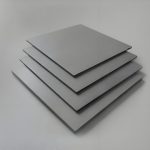
Silicon nitride and silicon carbide composite ceramic plate
2.1.2 Elastic modulus of 250 GPa
A high elastic modulus means minimal deformation when subjected to stress, resulting in extremely high stiffness, ensuring components maintain precise dimensions and shape under load.
2.2 Excellent High-Temperature Performance and Thermal Stability
This is one of the most notable advantages of silicon nitride-bonded silicon carbide ceramics.
2.2.1 Undiminished High-Temperature Strength
Its flexural strength remains as high as 175 MPa at 1200°C, even exceeding its strength at room temperature. This means it can maintain its structural integrity in most high-temperature industrial furnaces for extended periods without failure due to strength loss.
A maximum operating temperature of 1500°C (higher in inert atmospheres) makes it an ideal choice for linings and kiln furniture in high-temperature kilns (such as sintering and heat treatment furnaces).
2.2.2 Excellent thermal shock stability
The scientific basis for this stability lies in two key physical parameters: a low coefficient of thermal expansion (4.7×10⁻⁶/K) and a high thermal conductivity (20-38 W/m·K). The former means minimal dimensional change when the material is heated or cooled; the latter ensures rapid heat transfer within the material, preventing significant local temperature differences. The combination of these two factors minimizes thermal stress during rapid heating and cooling, enabling the material to withstand drastic temperature fluctuations without cracking.
2.3 Excellent Chemical Resistance
Technical documentation indicates that the material is resistant to corrosion from molten non-ferrous metals (such as aluminum, zinc, copper, and magnesium) and various acid and alkali solutions. This is due to the inherent chemical inertness of SiC and Si3N4. Whether used as a lining in aluminum electrolytic cells or handling corrosive media in chemical environments, it demonstrates a long service life.
| Category | Unit | Reaction-sintered silicon carbide | Recrystallized silicon carbide | Silicon nitride and silicon carbide composites |
| Content | % | 90 | 99 | 75 |
| Density | kg/dm3 | 3.02 | 2.7 | 2.75 |
| Porosity | Vol% | ≤0.1 | 15 | 11 |
| Hardness | Kg/mm2 | 2400 | 1800 - 2000 | 2500 |
| Flexural Strength (point) - 20°C | Mpa | 250 | 80 - 100 | 165 |
| Flexural Strength (point) - 1200°C | Mpa | 280 | 90 - 110 | 175 |
| Elastic Modulus | GPa | 330 | 280 | 250 |
| Fracture Toughness | MPa/m1/2 | 3.3 | 1.8 - 2.0 | 4 |
| Thermal Conductivity - 20°C | W/(m∗K) | 120 | 100 | 38 |
| Thermal Conductivity - 1200°C | W/(m∗K) | 45 | 35 | 20 |
| Operating Temperature (Air) | ∘C | 1380 | 1650 | 1500 |
| Coefficient of Thermal Expansion (20 - 1200°C) | K−1∗10−6 | 4.5 | 4.6 | 4.7 |
Parameter comparison table of Reaction-sintered silicon carbide, Recrystallized silicon carbide and Silicon nitride and silicon carbide composites
3. Cleverly Utilizing "Defects": Controllable Porosity
In dense ceramics, pores are often considered defects. However, in silicon nitride-bonded silicon carbide ceramics, porosity is cleverly designed and controlled.
3.1 Technical Parameters
Porosity can be controlled within a range of 11% to 18%.
3.2 Positive Effects
These evenly distributed micropores are not entirely harmful. They effectively relieve thermal and mechanical stresses within the material, acting as a miniature buffer system, further enhancing the material's thermal shock resistance. Furthermore, moderate porosity helps reduce workpiece weight and facilitates better heat transfer in kiln furniture applications.
3.3 Design Balance
Through precise process control, technicians have found the optimal balance between porosity (which benefits thermal shock resistance) and density/strength (which requires densification).
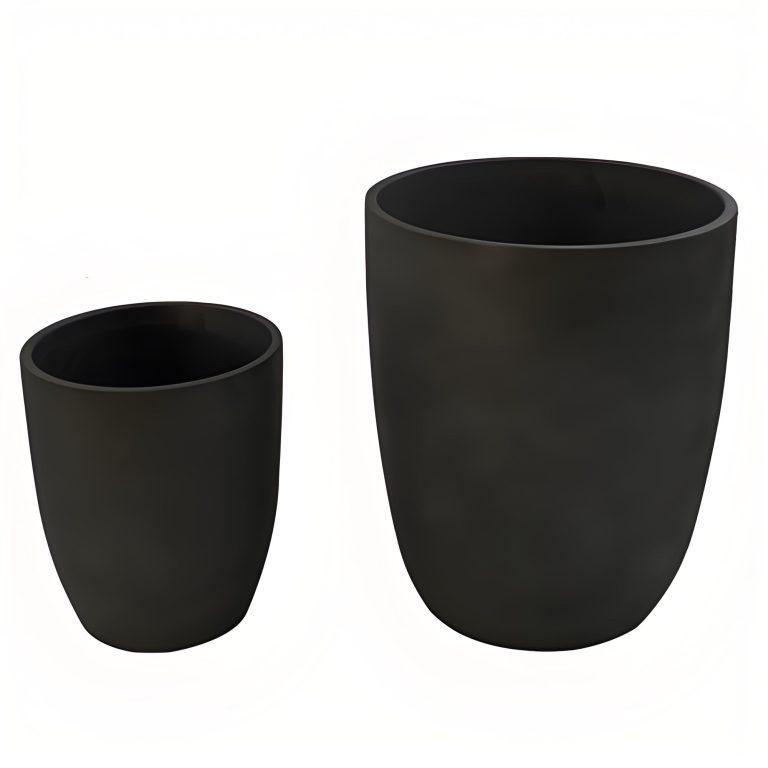
Silicon nitride and silicon carbide composite ceramic crucible
4. Advanced Manufacturing Process: Reaction Sintering Technology
Such exceptional performance is inseparable from the advanced manufacturing process—reaction sintering.
4.1 Raw Material Preparation and Forming
SiC particles of a specific particle size distribution, silicon powder (Si), and a small amount of sintering aid are uniformly mixed and formed into the desired shape through techniques such as pressing.
4.2 In-situ nitridation
This is the core of the process. The green body is sintered in a nitrogen atmosphere at 1300-1420°C. The molten silicon powder reacts with nitrogen: 3Si + 2N₂ → Si₃N₄, forming a silicon nitride binder phase in situ.
4.3 Process Advantages
This process results in minimal green body dimensional variation (<1%), enabling the production of large, complex workpieces with high yields and consistent performance.
5. Wide Range of Applications
5.1 Metallurgical Industry
Blast furnace linings, aluminum electrolytic cell linings, zinc retorts, etc., resist corrosion from molten metal and slag.
5.2 Ceramics and Refractory Industry
Kiln slabs, rollers, saggers, etc., reduce kiln furniture weight, increase energy consumption, and extend service life.
5.3 Environmental Protection and Energy
Waste incinerator linings and coal gasifier components, resist high-temperature corrosion and erosion.
5.4 Wear-Resistant Components
Slurry pump flow components, cyclones, and wear-resistant nozzles, designed for moderately abrasive and impact conditions.

Silicon nitride and silicon carbide composite ceramic ring
6. Supplier
TRUNNANO is a globally recognized silicon carbide and silicon nitride composite ceramic products manufacturer and supplier of compounds with more than 12 years of expertise in the highest quality nanomaterials and other chemicals. The company develops a variety of powder materials and chemicals. Provide OEM service. If you need high quality silicon nitride-silicon carbide ceramic products, please feel free to contact us. You can click on the product to contact us.
Tags: Silicon nitride and silicon carbide composite ceramic, Si3N4 and SiC, advanced ceramic