1. Introduction to Sodium-Ion Layered Oxide Cathodes
1.1 What Are Layered Oxide Cathode Materials?
Layered oxide cathode materials for sodium-ion batteries have the general formula NaₓTMO₂, where TM represents one or more transition metals such as manganese, iron, nickel, cobalt, or copper. These materials feature a two-dimensional layered structure that allows sodium ions to intercalate and deintercalate during charge and discharge .
The layered structure provides high theoretical capacities and operating voltages, making layered oxides one of the most commercially viable cathode routes for sodium-ion batteries. They are also compatible with existing lithium-ion battery manufacturing equipment, which means battery makers can adopt them without major retooling .
1.2 Why the Industry Is Watching Layered Oxides
The sodium-ion battery market has moved from laboratory curiosity to commercial reality. China’s sodium-ion battery shipments reached 7 GWh in 2025, with projections exceeding 200 GWh by 2030—nearly 100% annual growth . This rapid expansion has created intense interest in cathode materials that can deliver the right balance of performance, cost, and manufacturability.
Layered oxides offer a compelling combination. They provide higher energy density than polyanionic compounds, which dominated early sodium-ion deployments for stationary storage. They also leverage established manufacturing infrastructure, reducing barriers to scale-up .
1.3 Why Sodium-Ion Layered Oxide Cathode Materials Matter Now
The industrialization of sodium-ion batteries is accelerating, and layered oxides are at the center of this transition. From ton-scale production of classic ternary systems to advanced high-entropy and single-crystal designs, the material family has expanded rapidly to address different application requirements .
Understanding the current state of layered oxide industrialization—what has been achieved, what challenges remain, and where the technology is headed—is essential for battery manufacturers, material suppliers, and investors navigating this fast-moving market.
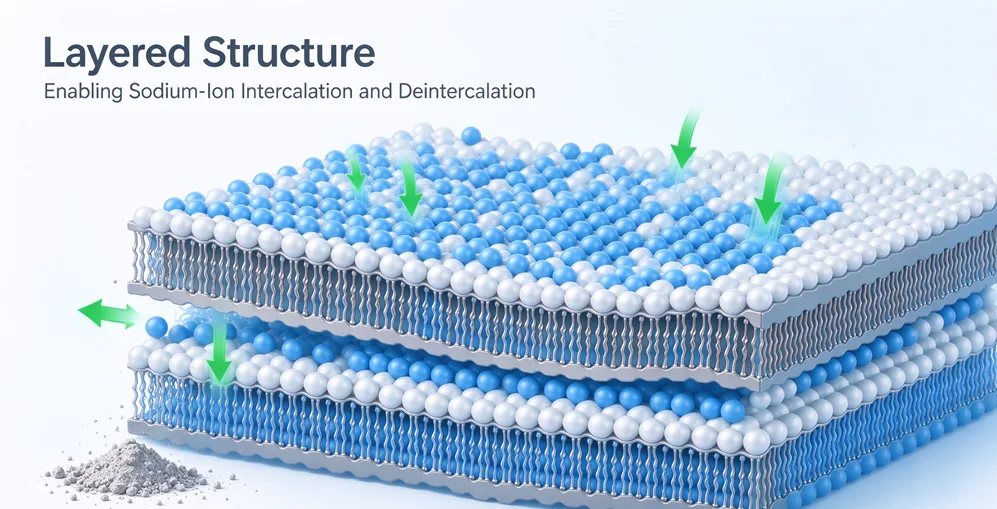
Layered structure — enabling sodium-ion intercalation and deintercalation.
2. Understanding the Basics of Layered Oxide Cathode Materials
2.1 Crystal Structures: O3, P2, and Biphasic Systems
Layered oxide cathodes are classified by the coordination environment of sodium ions and the stacking sequence of oxygen layers. The two primary structures are O3-type (octahedral sodium sites) and P2-type (prismatic sodium sites) .
O3-type materials offer high capacity but suffer from multiple phase transitions during cycling, which can compromise structural integrity. P2-type materials provide better rate capability and cycling stability but often undergo a detrimental P2-O2 phase transition at high voltage, leading to volume changes and capacity decay .
Biphasic (P2/O3) designs combine the strengths of both structures. By engineering the phase ratio, manufacturers can balance capacity, rate performance, and cycling stability. TRUNNANO’s P2/O3 biphasic series, for example, delivers 145–155 mAh/g with 80% capacity retention after 100 cycles .
2.2 Key Challenges in Layered Oxide Commercialization
Despite their promise, layered oxides face several technical hurdles that have slowed widespread adoption. Structural instability during cycling, particularly at high voltages, leads to capacity fade. Air sensitivity complicates storage and handling. And transition metal dissolution can degrade performance over time .
The industry has responded with a range of modification strategies. Elemental doping stabilizes the crystal lattice. Surface coatings protect against air and electrolyte attack. Biphasic designs suppress harmful phase transitions. High-entropy compositions distribute strain across multiple elements, improving structural integrity .
2.3 The Evolving Product Landscape
TRUNNANO’s layered oxide portfolio illustrates the breadth of the current product landscape. The company offers six core series: classic ternary (O3/P2/biphasic), high-nickel single-crystal, high-entropy and biphasic synergy, Cu/Ti-based low-cost, Li-doped high-capacity, and P3-type high-entropy .
Each series targets a specific application. The Cu/Ti-based system, for example, eliminates cobalt and nickel entirely, keeping costs down while maintaining air stability—a clear choice for large-scale grid storage. The Li-doped series pushes capacity to 200–210 mAh/g via oxygen redox activation, targeting high-energy applications .
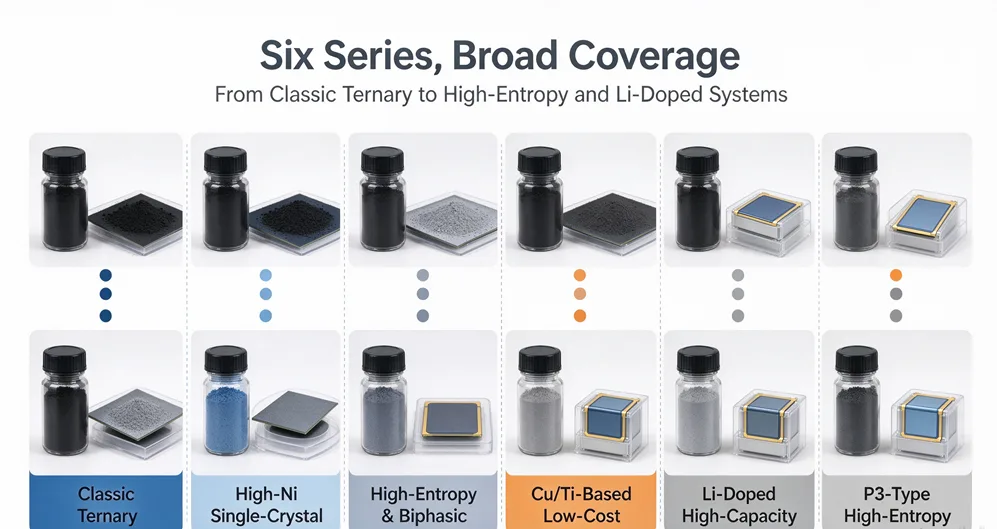
Six series, broad coverage — from classic ternary to high-entropy and Li-doped systems.
3. Why Layered Oxides Matter for Sodium-Ion Industrialization
3.1 Compatibility with Existing Manufacturing
One of the strongest arguments for layered oxides is their compatibility with lithium-ion production lines. Battery manufacturers can adopt layered oxide cathodes without major retooling, reducing capital expenditure and accelerating time-to-market .
This compatibility is particularly important as the industry scales. The transition from lithium to sodium involves significant investment, and materials that minimize disruption to existing processes have a clear advantage.
3.2 Cost and Resource Advantages
Sodium is far more abundant and cheaper to source than lithium. Layered oxides can be formulated without cobalt or nickel, further reducing cost and supply chain risk. The Cu/Ti-based series, for example, is Co/Ni-free while maintaining air stability .
For grid-scale storage, where cost per kWh is the dominant metric, these cost advantages are decisive. Layered oxides offer a path to sodium-ion batteries that are competitive with lithium iron phosphate (LFP) on cost while avoiding lithium supply constraints.
3.3 Performance Trajectory
The performance of layered oxides has improved dramatically. Early materials suffered from rapid capacity fade and poor rate capability. Current generation materials achieve 145–168 mAh/g with 80% retention after 100 cycles, and high-entropy designs are pushing cycle life beyond 2,000 cycles .
TRUNNANO’s high-nickel single-crystal series reaches 168 mAh/g, with the single-crystal structure helping to prevent micro-cracking over time—a key factor for long-term durability .
Layered oxide series comparison — balancing capacity, cycle life, and cost.
4. How the Industry Is Advancing Layered Oxide Cathodes
4.1 From Laboratory to Ton-Scale Production
The industrialization of layered oxides has moved beyond laboratory-scale synthesis. TRUNNANO’s classic ternary series is already running at ton-scale, with production capacity designed to meet growing demand through 2030 .
Other players are also scaling. Zhenhua New Material has established a dedicated sodium-ion cathode production line with approximately 5,000 tons per year capacity, and its existing nickel-cobalt-manganese (NCM) lines can be adapted to produce sodium-ion cathodes . Minmetals New Energy has finalized its layered oxide formulation and achieved ton-level supply .
4.2 Advanced Modification Strategies
The industry has developed a toolbox of modification strategies to address layered oxide limitations. Elemental doping locks crystal structures in place. Biphasic designs combine the strengths of different phases. Surface coatings protect against air exposure. High-entropy formulations suppress phase transitions. Single-crystal processing removes grain boundaries—a common source of cracking .
These approaches work together. A high-entropy biphasic material, for example, might use entropy stabilization to suppress phase changes while the biphasic structure balances capacity and rate performance. The result is a material that performs better than either strategy alone.
4.3 Manufacturing Process Innovation
Beyond material composition, the industry is innovating in manufacturing processes. Spray-drying has emerged as a scalable synthesis route that ensures homogeneous cation distribution and controlled particle morphology . Argonne National Laboratory has demonstrated upscaling of layered cathode synthesis with precise control of P2/O3 phase ratio and sodium stoichiometry, along with reduced calcination temperature and duration .
These process innovations are critical for reducing cost and improving consistency at scale. They also enable the production of materials with tailored particle size, surface area, and tap density—parameters that battery manufacturers need to optimize for their specific cell designs.
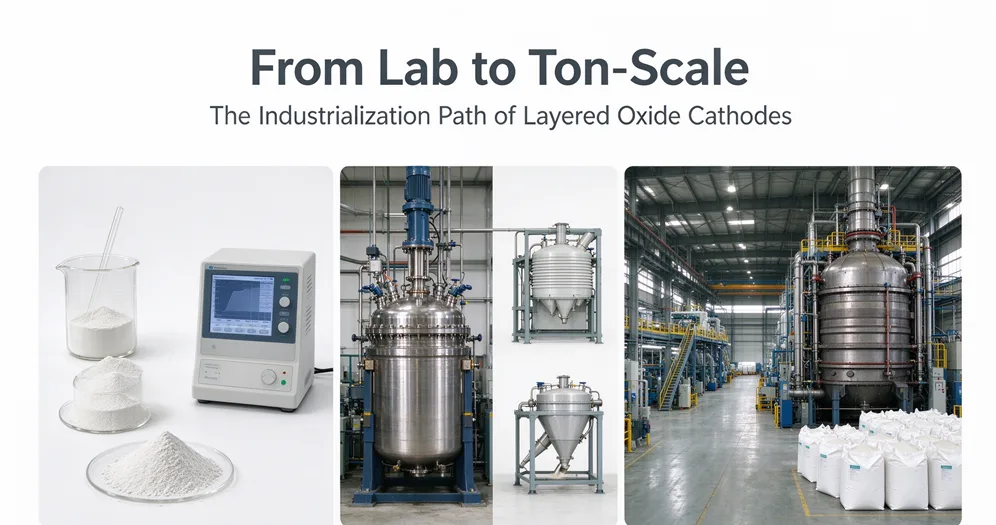
From lab to ton-scale — the industrialization path of layered oxide cathodes.
5. Key Technical Specifications of Layered Oxide Cathode Series
| Series |
Key Metric |
Best For |
What Makes It Different |
| Classic Ternary (O3/P2/Biphasic) |
Ton-scale production |
General storage |
Proven performance, ready to scale |
| High-Ni Single-Crystal |
168 mAh/g |
High-end power batteries |
Single-crystal structure resists cracking |
| High-Entropy & Biphasic Synergy |
2,000+ cycles |
Long-duration storage |
Entropy stabilization for better thermal stability |
| Cu/Ti-Based Low-Cost |
Co/Ni-free |
Grid storage |
Lower cost, air-stable |
| Li-Doped High-Capacity |
200–210 mAh/g |
High-energy applications |
Oxygen redox activation boosts capacity |
| P3-Type High-Entropy |
Fast charging |
Rate-critical applications |
High sodium-ion diffusion speed |
6. Matching Layered Oxide Cathodes to Your Battery Application
6.1 Grid-Scale Energy Storage
For large-scale photovoltaic and wind power storage, grid peak shaving, and frequency regulation, the Cu/Ti-based low-cost series is the clear choice. Its Co/Ni-free composition keeps costs down while maintaining air stability—critical for large-scale deployment where price per kWh is the dominant metric .
The high-entropy and biphasic synergy series is also suitable for long-duration storage, with cycle life exceeding 2,000 cycles and improved thermal stability .
6.2 Low-Speed Electric Vehicles and Two-Wheelers
For electric two-wheelers, three-wheelers, and low-speed four-wheel vehicles, the classic ternary and high-nickel series offer a balance of energy density, safety, and cost. The high-nickel single-crystal series, with 168 mAh/g capacity, is particularly suited for higher-end power battery applications .
6.3 Portable Electronics
For power banks, outdoor power supplies, and portable medical equipment, the Li-doped high-capacity series delivers the high capacity these applications demand, with 200–210 mAh/g via oxygen redox activation .
6.4 Fast-Charging Applications
The P3-type high-entropy series features larger interlayer spacing and faster sodium-ion diffusion, making it a strong candidate for fast-charging scenarios .
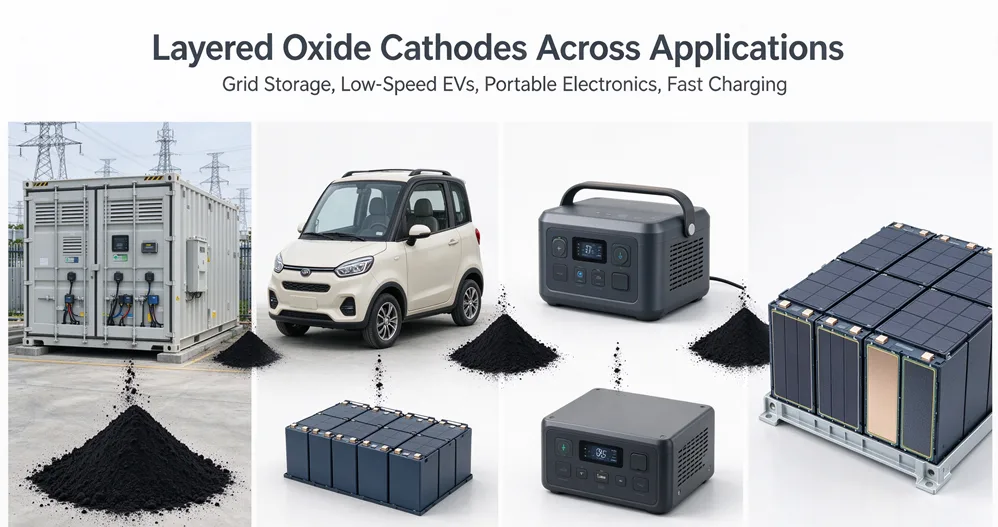 Layered oxide cathodes across applications — grid storage, low-speed EVs, portable electronics, and fast charging.
7.2 “Layered Oxides Cannot Match Lithium-Ion Performance”
Layered oxide sodium-ion cathodes do not aim to match the energy density of high-nickel NCM or NCA lithium-ion cathodes. Instead, they target applications where cost, safety, and resource availability matter more than absolute energy density. For grid storage and low-speed mobility, layered oxide sodium-ion batteries offer a compelling value proposition .
7.3 “Air Sensitivity Makes Layered Oxides Impractical”
Early layered oxide materials were highly air-sensitive, requiring special handling. Current generation materials have addressed this through surface coatings and composition optimization. The Cu/Ti-based series, for example, is specifically designed for air stability .
7.4 “High-Entropy Materials Are Too Complex to Manufacture”
High-entropy layered oxides require precise control of multiple elements, which might seem challenging at scale. However, TRUNNANO’s high-entropy series is produced via mature high-temperature solid-state and sol-gel processes, enabling ton-scale production with excellent batch-to-batch consistency .
7.5 “Layered Oxides Are Only for Low-End Applications”
The high-nickel single-crystal series delivers 168 mAh/g with a structure designed to resist micro-cracking—performance that is competitive with many lithium-ion cathode materials for power battery applications . The Li-doped series pushes capacity to 200–210 mAh/g, targeting high-energy applications .
8. Quick Evaluation Checklist
Before selecting Sodium-Ion Layered Oxide Cathode Materials for your application, verify the following key parameters:
Crystal structure (O3, P2, or biphasic)
Specific capacity requirement (145–210 mAh/g depending on series)
Cycle life requirement (100 cycles to 2,000+ cycles)
Rate capability requirement
Operating voltage range (2.0–4.2 V typical)
Air stability and handling requirements
Cost target (Co/Ni-free options available)
Particle size and tap density requirements
Compatibility with existing manufacturing processes
Supplier production capacity and technical support
9. Real-World Application Scenarios
9.1 Grid-Scale Energy Storage Deployment
A renewable energy storage project selected the Cu/Ti-based low-cost series for its sodium-ion battery system. The Co/Ni-free composition reduced material costs while maintaining the air stability needed for large-scale deployment. The project demonstrated that sodium-ion batteries can provide cost-effective grid storage without relying on lithium or cobalt .
9.2 Low-Speed Electric Vehicle Battery
A manufacturer of low-speed electric vehicles used the high-nickel single-crystal series for its battery packs. The 168 mAh/g capacity and single-crystal structure provided the energy density and durability needed for daily commuting, while the sodium-ion chemistry eliminated dependence on lithium supply chains .
9.3 Long-Duration Storage with High-Entropy Materials
A long-duration energy storage project selected the high-entropy and biphasic synergy series. The material’s cycle life exceeding 2,000 cycles and improved thermal stability made it suitable for daily cycling in stationary storage applications .
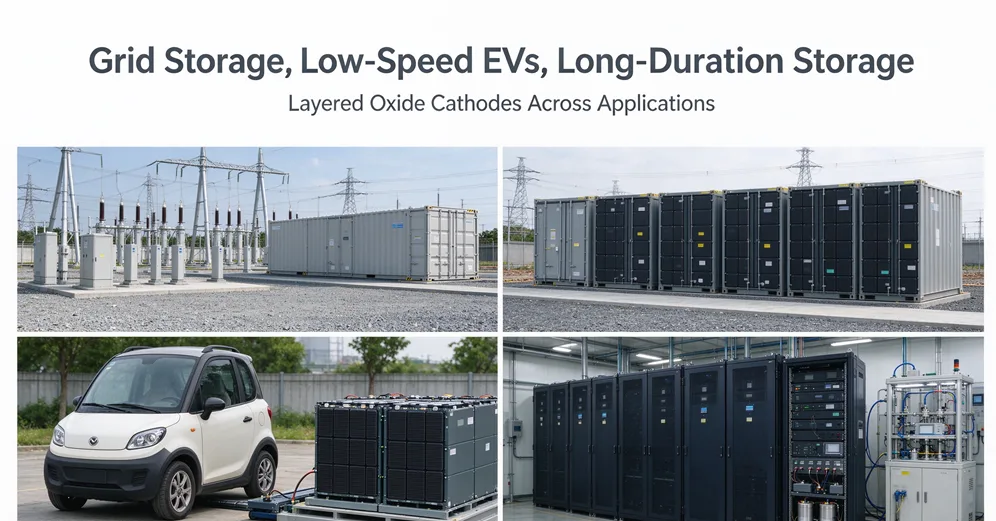
Layered oxide cathodes across applications — grid storage, low-speed EVs, and long-duration storage.
10. Frequently Asked Questions (FAQs)
Q1: What are sodium-ion layered oxide cathode materials?
Sodium-ion layered oxide cathode materials have the general formula NaₓTMO₂, where TM represents transition metals such as manganese, iron, nickel, or copper. They feature a two-dimensional layered structure that allows sodium ions to intercalate and deintercalate during charge and discharge .
Q2: How do layered oxides compare to polyanionic compounds?
Polyanionic compounds offer better cycle life and safety, making them preferred for stationary storage. Layered oxides provide higher energy density and better rate capability, making them suitable for low-speed EVs and power batteries. The two families serve different applications rather than competing directly .
Q3: What is the typical capacity of layered oxide cathodes?
Capacity varies by series. Classic ternary and biphasic materials deliver 145–155 mAh/g. High-nickel single-crystal reaches 168 mAh/g. Li-doped high-capacity series achieves 200–210 mAh/g .
Q4: Are layered oxides air-sensitive?
Early materials were highly air-sensitive. Current generation materials address this through surface coatings and composition optimization. The Cu/Ti-based series is specifically designed for air stability .
Q5: What is the production status of layered oxides?
TRUNNANO’s classic ternary series is running at ton-scale. Other manufacturers have established dedicated production lines or adapted existing NCM lines for sodium-ion cathode production .
Q6: What modification strategies are used to improve layered oxides?
Common strategies include elemental doping, biphasic structure design, surface coatings, high-entropy formulations, and single-crystal processing. These approaches address structural instability, phase transitions, and air sensitivity .
Q7: What applications are layered oxides best suited for?
Layered oxides are best suited for applications requiring higher energy density than polyanionics can provide, including low-speed electric vehicles, two-wheelers, power batteries, and portable electronics. Cost-optimized series like Cu/Ti-based materials are also suitable for grid storage .
Q8: How does TRUNNANO support layered oxide customers?
TRUNNANO offers material customization, performance optimization, and process adaptation support. The company’s in-house R&D center and existing production facilities enable faster scale-up and reliable delivery .
11. What Layered Oxide Cathodes Mean for the Future of Sodium-Ion Batteries
Sodium-Ion Layered Oxide Cathode Materials represent one of the most commercially viable paths for sodium-ion battery industrialization. Their compatibility with existing manufacturing, high energy density, and continuous performance improvements make them essential for applications where polyanionics fall short.
The industrialization progress is real. Ton-scale production is underway. Performance has improved dramatically. And the product landscape has expanded to cover a wide range of applications, from cost-sensitive grid storage to high-performance power batteries.
For battery manufacturers, Sodium-Ion Layered Oxide Cathode Materials offer a way to enter the sodium-ion market with proven materials and established supply chains. For the industry as a whole, they represent a critical enabler of the transition away from lithium dependence.
 TRUNNANO Sodium-Ion Layered Oxide Cathode Materials — driving sodium-ion battery industrialization.