Product Overview
The VE-O3-006 is a high-capacity layered oxide cathode material designed for sodium-ion batteries, featuring a valence-engineered modified O3 system with the chemical composition NaNi₀.₅Fe₀.₂₅Mn₀.₂₅O₂ and a P2/O3 biphasic crystal structure. This material delivers an outstanding initial specific capacity of 168 mAh/g, representing one of the highest capacity outputs in our layered oxide portfolio. Engineered through advanced valence state engineering, it achieves an optimal balance between high energy density and long-term cycling stability, making it an ideal cathode choice for high-performance sodium-ion battery applications including energy storage systems, low-speed electric vehicles, e-bikes, and portable electronic devices.

VE-O3-006
Our comprehensive layered oxide portfolio covers the full spectrum of crystal structures—O3-type, P2-type, P2/O3 biphasic, single-crystal, and high-entropy variants—alongside diversified low-cost and high-performance modified systems based on Cu, Cr, Ti, and Mn chemistries, enabling tailored solutions for every application scenario.
Product Features
Exceptional High Capacity
With an initial specific discharge capacity of 168 mAh/g, this material delivers industry-leading energy density, significantly enhancing battery runtime and overall performance.
Valence Engineering Modification
Advanced valence state engineering optimizes the electrochemical activity of transition metal ions, maximizing capacity output while maintaining structural stability during cycling.
P2/O3 Biphasic Synergistic Structure
The biphasic design leverages the high capacity of the O3 phase and the structural stability of the P2 phase, delivering a balanced performance profile with excellent capacity retention.
High-Voltage Operation
Supports an operating voltage range of 2.0 – 4.2 V, enabling higher energy density output compared to lower-voltage cathode materials.
Excellent Cycling Stability
Maintains 80% capacity retention after 100 cycles, demonstrating reliable long-term performance suitable for extended-use applications.
Industry-Standard Manufacturing
Produced via mature high-temperature solid-state and sol-gel processes, enabling ton-scale production with excellent batch-to-batch consistency and controlled manufacturing costs.
Comprehensive Crystal Structure Engineering
Our capabilities span O3-type, P2-type, P2/O3 biphasic, single-crystal, and high-entropy designs, enabling precise structural tailoring for diverse application requirements.
Technical Parameters
Material Specifications
|
Parameter |
Specification |
|---|---|
|
Product Code |
VE-O3-006 |
|
Material System |
Valence-Engineered Modified O3 System |
|
Chemical Composition |
NaNi₀.₅Fe₀.₂₅Mn₀.₂₅O₂ |
|
Crystal Structure |
P2/O3 Biphasic |
|
Operating Voltage Range |
2.0 – 4.2 V |
|
Initial Specific Capacity |
168 mAh/g |
|
Cycling Stability |
80% retention after 100 cycles |
|
Rate Capability |
80% capacity at 1C |
|
Technical Highlights |
168 mAh/g discharge capacity, long-cycle compatibility |
Physical Properties
|
Parameter |
Specification |
|---|---|
|
Appearance |
Black powder |
|
Particle Size D50 |
5 – 20 μm (customizable) |
|
Specific Surface Area (BET) |
1 – 5 m²/g (customizable) |
|
Tap Density |
1.8 – 2.8 g/cm³ (customizable) |
|
Moisture Content |
≤ 500 ppm |
|
Magnetic Foreign Particles |
≤ 100 ppb |
Applications
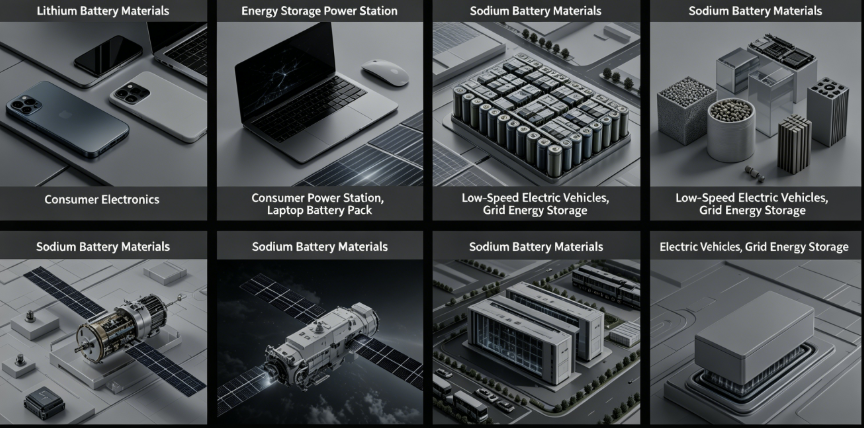
Grid-Scale Energy Storage Systems
Ideal for large-scale photovoltaic/wind power storage, grid peak shaving, and frequency regulation applications where high energy density, long cycle life, and high safety are paramount.
Low-Speed Electric Vehicles
Suited for electric two-wheelers, three-wheelers, and low-speed four-wheel vehicles, delivering high energy density, fast-charging capability, and excellent low-temperature adaptability.
Portable Electronic Devices
Perfect for power banks, outdoor power supplies, and portable medical equipment, offering high voltage platform, high specific capacity, and extended cycle life.
Specialty Applications
Customizable formulations available for extreme environments including low-temperature, high-temperature, and high-safety scenarios such as military, aerospace, and deep-sea applications.
Package
Standard Packaging
Vacuum-sealed moisture-barrier packaging using aluminum-laminated film or PE bags, placed inside sturdy cartons.
Packaging dimensions and weights are customizable based on customer requirements.
Storage & Handling
Store in a dry, cool, well-ventilated environment away from moisture, heat, and contaminants.
Avoid exposure to strong acids, alkalis, and oxidizing agents.
Handle with care during transport to prevent packaging damage.
Recommended shelf life: 12 months from date of manufacture under sealed, proper storage conditions.
After opening, unused material should be immediately resealed and stored in a dry environment.
FAQ
Q1: What makes VE-O3-006 achieve such a high specific capacity of 168 mAh/g?
The high capacity is achieved through advanced valence engineering that optimizes the electrochemical activity of transition metal ions, combined with the synergistic P2/O3 biphasic structure. The specific nickel-rich composition (NaNi₀.₅Fe₀.₂₅Mn₀.₂₅O₂) maximizes sodium-ion storage capability.
Q2: What is the advantage of the P2/O3 biphasic structure in this material?
The biphasic structure combines the high capacity of the O3 phase with the enhanced structural stability and cycling performance of the P2 phase. This synergy enables the material to deliver exceptional capacity (168 mAh/g) while maintaining good cycling stability.
Q3: What is the recommended operating voltage range for optimal performance?
The recommended operating voltage range is 2.0 – 4.2 V vs. Na⁺/Na. Operating within this window maximizes capacity output while ensuring stable cycling performance.
Q4: Can this material be used in both sodium-ion and lithium-ion batteries?
This material is specifically designed and optimized for sodium-ion battery systems. It is not recommended for lithium-ion battery applications.
Q5: What customization options are available for this product?
We offer comprehensive customization including elemental composition, crystal structure, particle size distribution, specific surface area, tap density, and performance optimization for specific application requirements. Please contact our technical sales team for detailed discussions.
Q6: How does the cycling stability compare to standard O3-type materials?
The P2/O3 biphasic design provides enhanced structural stability compared to conventional O3-type materials, resulting in improved capacity retention over extended cycling while maintaining the high capacity advantages of the O3 phase.