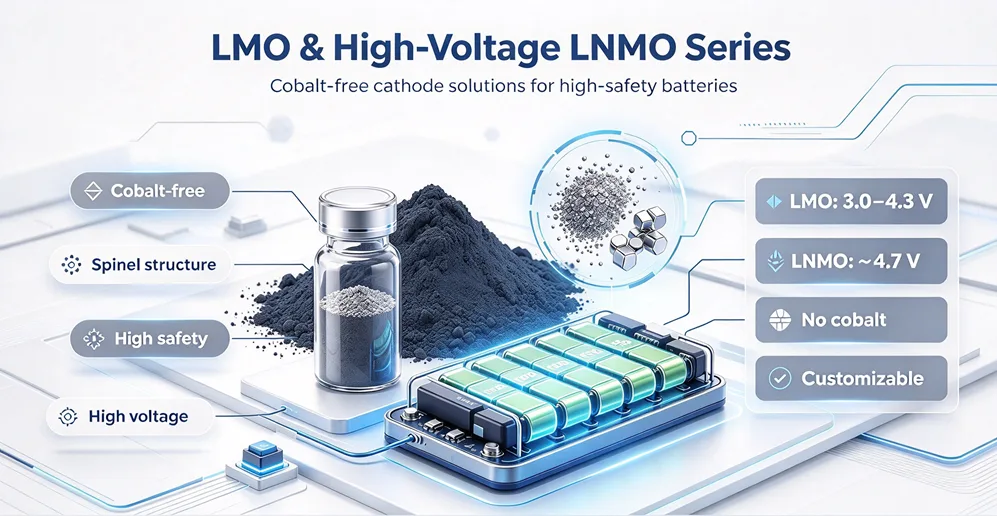
 LMO & High-Voltage LNMO Series
1. Introduction to Cobalt-Free Cathode Materials
1.1 The Cobalt Problem
Cobalt is one of the most problematic elements in lithium-ion battery supply chains. It is expensive, geographically concentrated, and associated with environmental and ethical concerns in mining. As the demand for lithium-ion batteries continues to grow — driven by electric vehicles, energy storage, and consumer electronics — the pressure to reduce or eliminate cobalt from cathode materials has intensified .
The battery industry has responded with several cobalt-free cathode chemistries. Among them, spinel-structured lithium manganese oxide (LMO) and high-voltage lithium nickel manganese oxide (LNMO) stand out for their combination of safety, cost-effectiveness, and high-voltage operation .
1.2 What Is the LMO & High-Voltage LNMO Series?
The LMO & High-Voltage LNMO Series consists of advanced spinel-structured lithium-ion battery cathode materials based on a dual-system core: over-lithiated lithium manganese oxide (LMO) and high-voltage lithium nickel manganese oxide (LNMO). Both materials crystallize in the cubic spinel structure with space group Fd-3m, offering a unique combination of high safety, excellent rate capability, cobalt-free chemistry, and high energy density .
The series covers micro-over-lithiated conventional lithium manganese oxide and 4.7 V-class high-voltage lithium nickel manganese oxide. It is designed to meet the growing demand for cost-effective, high-performance, and sustainable cathode materials across a wide range of lithium-ion battery applications .
1.3 Why the LMO & High-Voltage LNMO Series?
The LMO & High-Voltage LNMO Series offers a combination of advantages that make it suitable for demanding battery applications.
Cobalt-free chemistry: Eliminates cobalt from the cathode, reducing raw material cost and supply chain risk .
High safety: The spinel structure provides intrinsic thermal stability and excellent tolerance to abuse conditions .
High-voltage operation: LNMO operates at an average voltage of approximately 4.7 V, enabling high energy density .
Excellent rate capability: Optimized particle morphology enables superior rate performance .
Customizable specifications: Particle size, surface area, and tap density can be tailored to customer requirements .
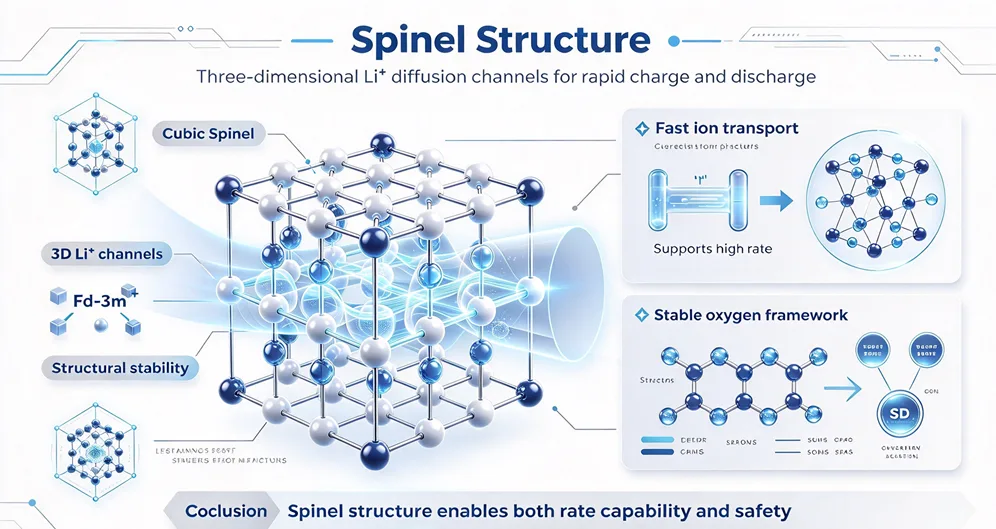
Spinel structure — three-dimensional Li⁺ diffusion channels for rapid charge and discharge.
2. Understanding the Basics of Spinel LMO and LNMO
2.1 Over-Lithiated LMO
Over-lithiated LMO (Li₁₋₀.₆Mn₁₋₉.₄O₄ type) is a manganese-based cathode material with a spinel structure. The over-lithiated design provides excellent rate performance, structural stability, and safety. The anti-Jahn-Teller effect suppression further enhances structural integrity during cycling .
Conventional LMO has been limited by capacity fade, particularly at elevated temperatures. The over-lithiated design addresses this by stabilizing the crystal structure and suppressing Mn dissolution .
2.2 High-Voltage LNMO
High-Voltage LNMO (LiNi₀.₅Mn₁.₅O₄) is a nickel-manganese spinel cathode that operates at approximately 4.7 V vs. Li/Li⁺. This high operating voltage enables higher energy density than conventional LMO, making LNMO an attractive cobalt-free alternative for high-energy applications .
LNMO has attracted significant research attention as a promising next-generation cathode material due to its high voltage, cobalt-free composition, and low cost .
2.3 Key Properties of the LMO & High-Voltage LNMO Series
| Property |
LMO (Over-Lithiated) |
LNMO (High-Voltage) |
| Crystal Structure |
Cubic Spinel, Fd-3m |
Cubic Spinel, Fd-3m |
| Operating Voltage |
3.0–4.3 V |
~4.7 V |
| Initial Specific Capacity |
~110 mAh/g |
~138 mAh/g |
| Cycle Stability |
100 cycles @ 96% retention |
100 cycles @ 94% retention |
| Rate Performance |
1C @ 95% retention |
1C @ 92% retention |
| Cobalt Content |
None |
None |
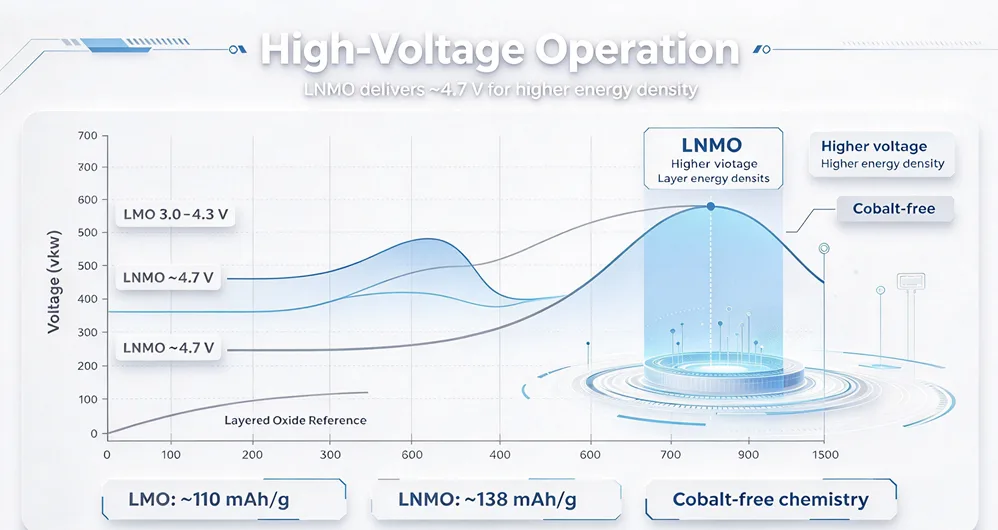
High-voltage operation — LNMO delivers ~4.7 V for higher energy density.
3. Why Cobalt-Free High-Voltage Cathodes Matter
3.1 Supply Chain and Cost
Cobalt is one of the most expensive and supply-constrained elements in lithium-ion battery cathodes. The Democratic Republic of Congo accounts for the majority of global cobalt production, creating supply chain concentration risks. Reducing cobalt content reduces both cost and supply chain vulnerability .
LMO & High-Voltage LNMO Series eliminates cobalt entirely, addressing both cost and supply chain concerns. This makes the series particularly attractive for cost-sensitive applications and for manufacturers seeking to reduce their exposure to cobalt price volatility.
3.2 Safety
High-nickel layered oxides (NCM, NCA) offer high energy density but have lower thermal stability. At elevated temperatures, these materials can release oxygen and trigger thermal runaway. Spinel-structured materials like LMO and LNMO have intrinsically better thermal stability .
The spinel structure provides a more stable oxygen framework, reducing the risk of oxygen release and thermal runaway. This makes LMO & High-Voltage LNMO Series suitable for applications where safety is a critical requirement.
3.3 Energy Density
The high operating voltage of LNMO (approximately 4.7 V) enables higher energy density than conventional LMO. When paired with appropriate high-voltage electrolytes, LNMO can deliver energy densities that approach those of cobalt-containing layered oxides, while maintaining the safety and cost advantages of cobalt-free chemistry .
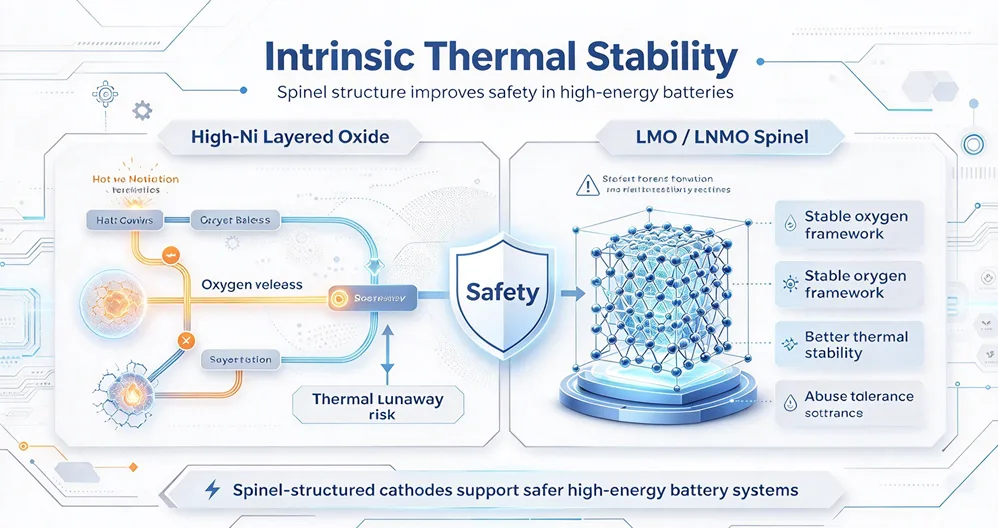
Spinel structure — intrinsic thermal stability for safer batteries.
4. How the LMO & LNMO Series Solves Key Challenges
4.1 High-Temperature Cycling Degradation
Conventional LMO suffers from capacity fade at elevated temperatures due to Mn dissolution and the Jahn-Teller effect. The over-lithiated design of the LMO & High-Voltage LNMO Series suppresses the Jahn-Teller effect and stabilizes the crystal structure, reducing capacity fade at elevated temperatures .
4.2 Electrolyte Catalytic Decomposition
High-voltage LNMO can catalyze electrolyte decomposition at the cathode-electrolyte interface, leading to performance degradation. The LMO & High-Voltage LNMO Series uses advanced surface coating and interface engineering to improve compatibility with electrolytes, suppress metal dissolution, and extend cycle life .
4.3 Rate Capability
The spinel structure provides three-dimensional lithium-ion diffusion pathways, enabling excellent rate capability. The LMO & High-Voltage LNMO Series achieves 1C capacity retention of 95% for LMO and 92% for LNMO, making it suitable for high-power applications .
4.4 Customization
Particle size (D50), specific surface area, and tap density can be tailored to meet specific customer requirements. This flexibility allows battery manufacturers to optimize the cathode material for their specific cell design and manufacturing process .
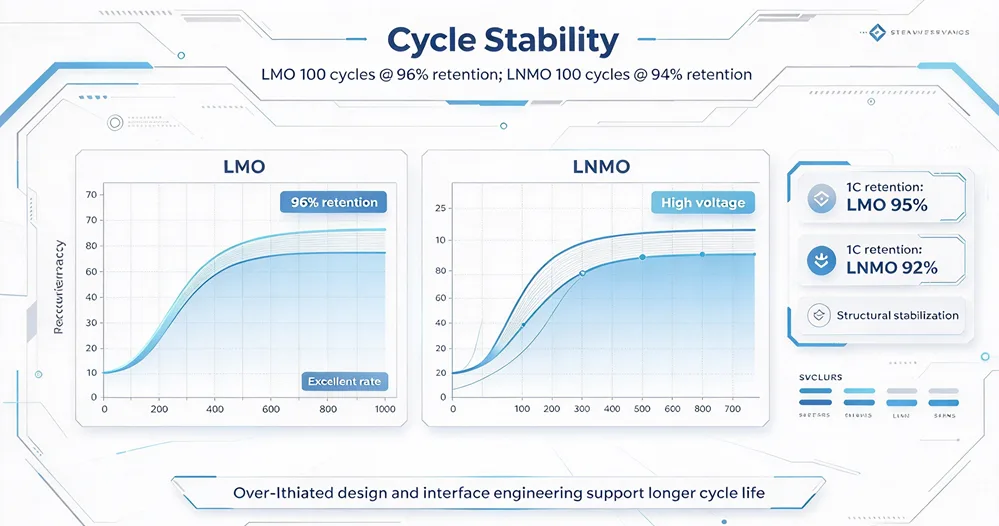
Cycle stability — LMO 100 cycles @ 96% retention; LNMO 100 cycles @ 94% retention.
5. Key Technical Specifications of LMO & LNMO Series
| Item |
LMO (Over-Lithiated) |
LNMO (High-Voltage) |
| Chemical Composition |
Li₁₋₀.₆Mn₁₋₉.₄O₄ type |
LiNi₀.₅Mn₁.₅O₄ |
| Crystal Structure |
Cubic Spinel, Fd-3m |
Cubic Spinel, Fd-3m |
| Operating Voltage (V) |
3.0–4.3 |
3.5–4.9 |
| Initial Specific Capacity (mAh/g) |
~110 |
~138 |
| Cycle Stability |
100 cycles @ 96% retention |
100 cycles @ 94% retention |
| Rate Performance |
1C @ 95% retention |
1C @ 92% retention |
| Cobalt Content |
None |
None |
6. Matching LMO & LNMO to Your Battery Application
6.1 xEV & Transportation
LMO & High-Voltage LNMO Series is suitable for economy pure electric passenger vehicles, two-wheel electric vehicles (e-bikes, e-scooters), high-voltage passenger vehicle power batteries, electric buses, and light commercial vehicles.
6.2 Power Tools & Industrial
The series is also suitable for high-end power tools, cordless garden equipment, and industrial power tools requiring high rate and safety .
6.3 Energy Storage
LMO & High-Voltage LNMO Series is suitable for economy pure electric passenger vehicles, two-wheel electric vehicles (e-bikes, e-scooters), high-voltage passenger vehicle power batteries, electric buses, and light commercial vehicles.
6.4 Specialty & High-End
The series is also used in high-end 3C digital products and high-voltage, cobalt-free battery systems .
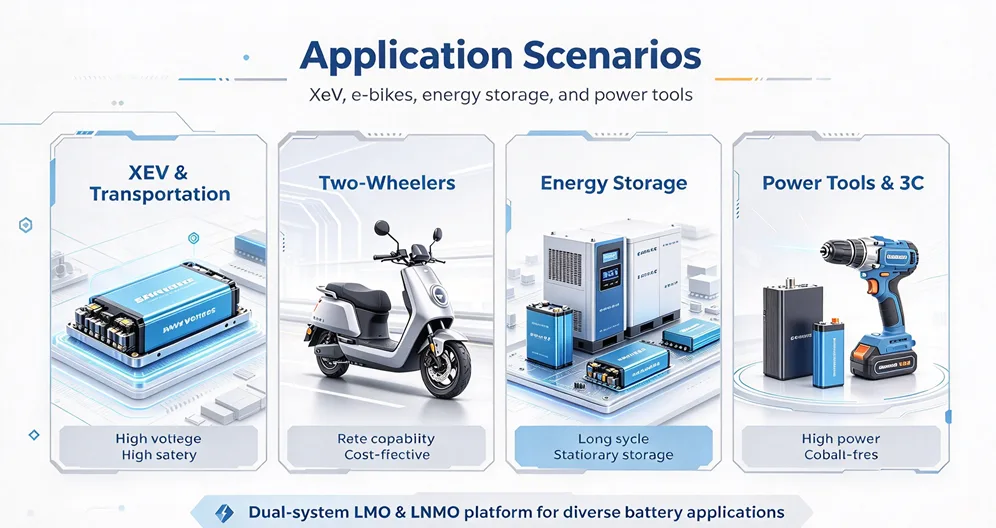
LMO & LNMO Series across applications — EVs, e-bikes, energy storage, and power tools.
7. Common Misconceptions About Spinel Cathodes
7.1 “Spinel Cathodes Have Low Energy Density”
While conventional LMO has lower energy density than layered oxides, the high-voltage LNMO in the LMO & High-Voltage LNMO Series operates at approximately 4.7 V, enabling significantly higher energy density. When paired with appropriate high-voltage electrolytes, LNMO can approach the energy density of cobalt-containing layered oxides .
7.2 “LMO Has Poor High-Temperature Performance”
Conventional LMO does suffer from high-temperature capacity fade. However, the over-lithiated design of the LMO & High-Voltage LNMO Series suppresses the Jahn-Teller effect and stabilizes the crystal structure, significantly improving high-temperature performance .
7.3 “Cobalt-Free Means Lower Performance”
Cobalt-free cathode materials have historically lagged behind cobalt-containing materials in energy density. However, the LMO & High-Voltage LNMO Series demonstrates that cobalt-free chemistry can deliver competitive performance, particularly in applications where safety and cost are prioritized .
7.4 “Spinel Cathodes Are Only for Low-End Applications”
The LMO & High-Voltage LNMO Series is suitable for a wide range of applications, from economy vehicles to high-voltage passenger vehicle batteries and energy storage systems. The high-voltage LNMO variant is particularly suited for high-energy-density applications .
7.5 “LNMO Is Too Difficult to Manufacture”
While LNMO does require careful control of synthesis conditions and electrolyte compatibility, the LMO & High-Voltage LNMO Series is produced with precise control over lithium content, Mn²⁺/Mn⁴⁺ ratio, crystal phase structure, and surface coating technology. This ensures consistent quality and reliable performance .
8. Quick Evaluation Checklist
Before selecting LMO & High-Voltage LNMO Series for your battery application, verify the following key parameters:
Operating voltage requirements (LMO: 3.0–4.3 V; LNMO: 3.5–4.9 V)
Initial specific capacity requirements (LMO: ~110 mAh/g; LNMO: ~138 mAh/g)
Cycle life requirements (LMO: 96% @ 100 cycles; LNMO: 94% @ 100 cycles)
Rate capability requirements (LMO: 95% @ 1C; LNMO: 92% @ 1C)
Electrolyte compatibility (especially for high-voltage LNMO)
Particle size and tap density requirements
Application type (xEV, power tools, energy storage, 3C)
Supplier quality and technical support
9. Real-World Application Scenarios
9.1 High-Voltage Passenger Vehicle Battery
A battery manufacturer selected LMO & High-Voltage LNMO Series for a high-voltage passenger vehicle battery pack. The LNMO cathode delivered approximately 4.7 V operating voltage, enabling higher energy density while maintaining cobalt-free chemistry. The over-lithiated LMO provided excellent rate capability and safety .
9.2 E-Bike Battery
An e-bike manufacturer used LMO & High-Voltage LNMO Series in its battery packs. The LMO cathode provided excellent rate performance and safety, while the cobalt-free chemistry reduced cost and supply chain risk. The battery delivered reliable performance for daily commuting .
9.3 Residential Energy Storage System
A residential energy storage manufacturer selected LMO & High-Voltage LNMO Series for its home energy storage systems. The cathode material provided long cycle life and high safety, making it suitable for stationary storage applications where cost and reliability are critical .
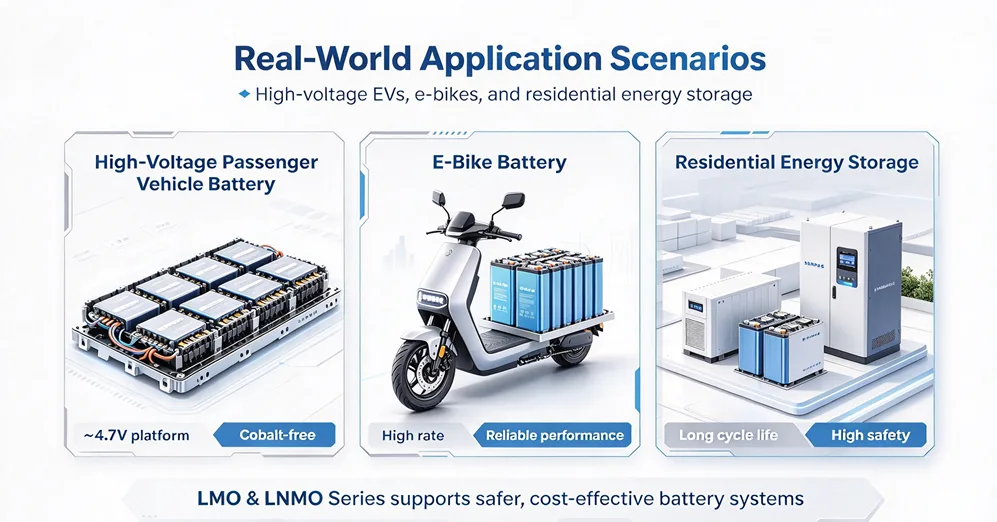
LMO & LNMO Series across applications — EVs, e-bikes, and residential energy storage.
10. Frequently Asked Questions (FAQs)
Q1: What is the difference between LMO and LNMO in this series?
LMO (over-lithiated lithium manganese oxide) operates at 3.0–4.3 V and delivers approximately 110 mAh/g. It offers excellent rate capability and safety. LNMO (high-voltage lithium nickel manganese oxide) operates at approximately 4.7 V and delivers approximately 138 mAh/g. It offers higher energy density for high-voltage applications .
Q2: Are these materials cobalt-free?
Yes. Both