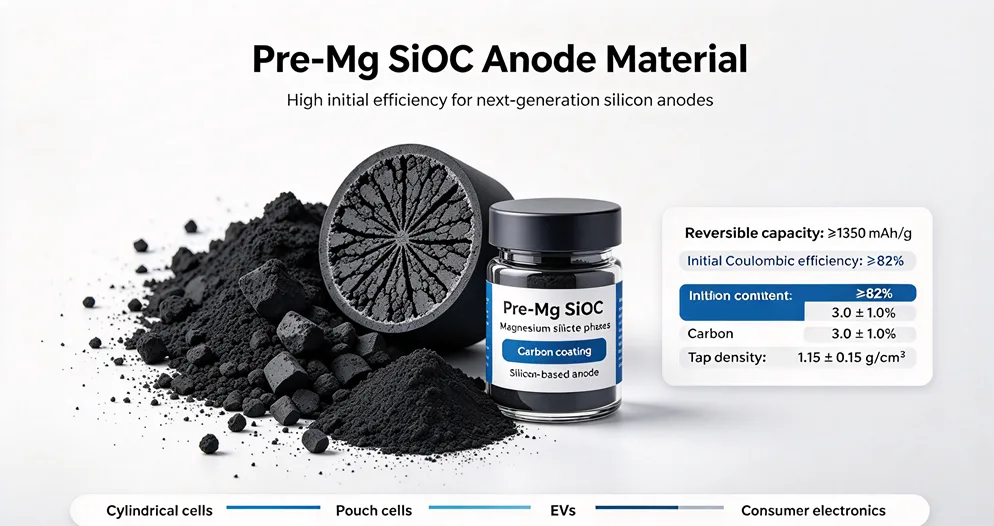
Pre-Mg SiOC Anode Material — high initial efficiency for next-generation silicon anodes.
1. Introduction to Pre-Mg SiOC Anode Material
1.1 What Is Pre-Mg SiOC Anode Material?
Pre-Mg SiOC Anode Material is a next-generation lithium-ion battery anode material prepared from silicon oxide through pre-magnesium treatment and carbon composite processing. By introducing magnesium during the manufacturing process, stable phases such as magnesium silicate are pre-formed inside the material, significantly improving the initial Coulombic efficiency .
Pre-Mg SiOC Anode Material belongs to the second-generation silicon-oxygen anode material route. Compared with conventional first-generation SiOx anodes, it achieves a marked breakthrough in first-cycle efficiency, offering a high-performance, process-friendly anode solution for high-energy-density battery systems .
1.2 Why Initial Coulombic Efficiency Matters
Silicon-based anode materials offer significantly higher theoretical capacity than graphite anodes. However, conventional SiOx anodes suffer from a critical limitation: low initial Coulombic efficiency (ICE). During the first charge cycle, irreversible reactions between lithium ions and the amorphous SiO₂ phase consume a large amount of lithium, forming inactive lithium silicates and Li₂O that cannot be extracted in subsequent cycles .
This irreversible lithium loss means that a significant portion of the cathode‘s lithium inventory is consumed during the first cycle, reducing the effective energy density of the full cell. To compensate, battery manufacturers must either use excess cathode material or accept lower cell capacity — both of which are costly and inefficient.
Pre-Mg SiOC Anode Material addresses this challenge by pre-forming stable magnesium silicate phases within the material, minimizing irreversible lithium consumption and significantly improving ICE .
1.3 Why Pre-Mg SiOC Anode Material?
Pre-Mg SiOC Anode Material offers a combination of advantages that make it suitable for next-generation lithium-ion batteries.
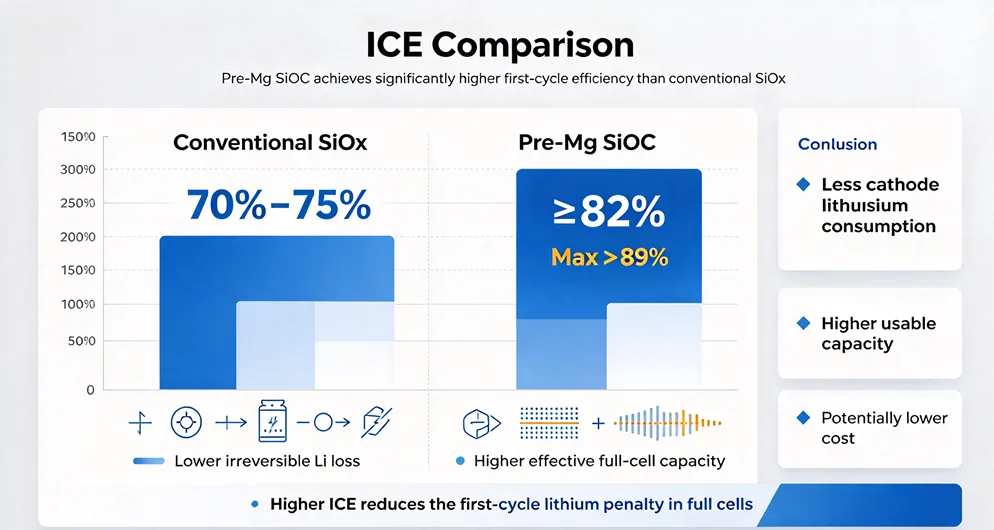
Significantly improved initial efficiency: Pre-formed magnesium silicate stable phases minimize irreversible lithium consumption. ICE is notably higher than conventional SiOx anodes, with typical values of 80%–83% and maximum values exceeding 89% .
Effective volume expansion buffering: The magnesium silicate phase provides mechanical support, and the open porous structure effectively accommodates volume changes during lithiation .
Enhanced conductivity via carbon coating: The surface carbon coating improves electronic conductivity, suppresses direct electrolyte attack, and promotes formation of a stable SEI film .
Excellent processing compatibility: Uniform particle size distribution and a wide slurry formulation window. Compatible with various binder systems including PVDF, PAA, and CMC/SBR .
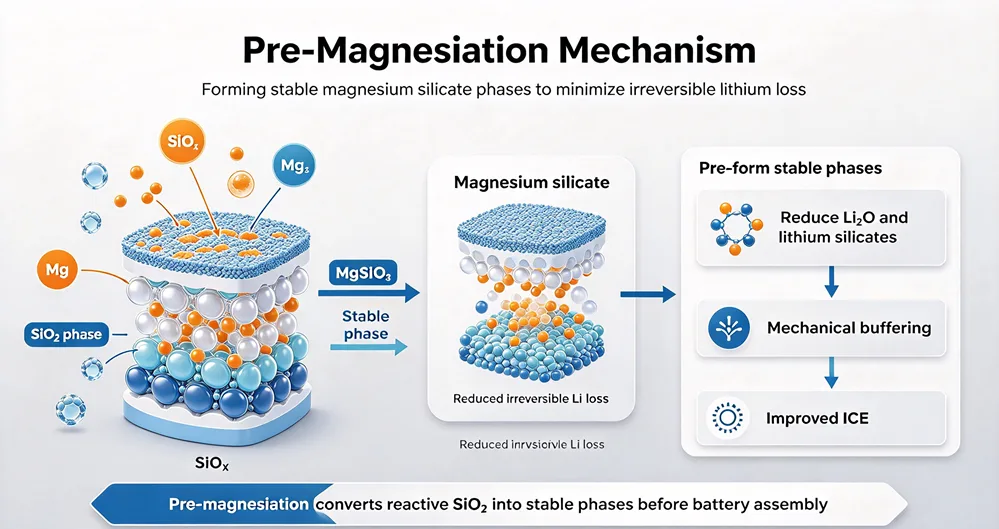
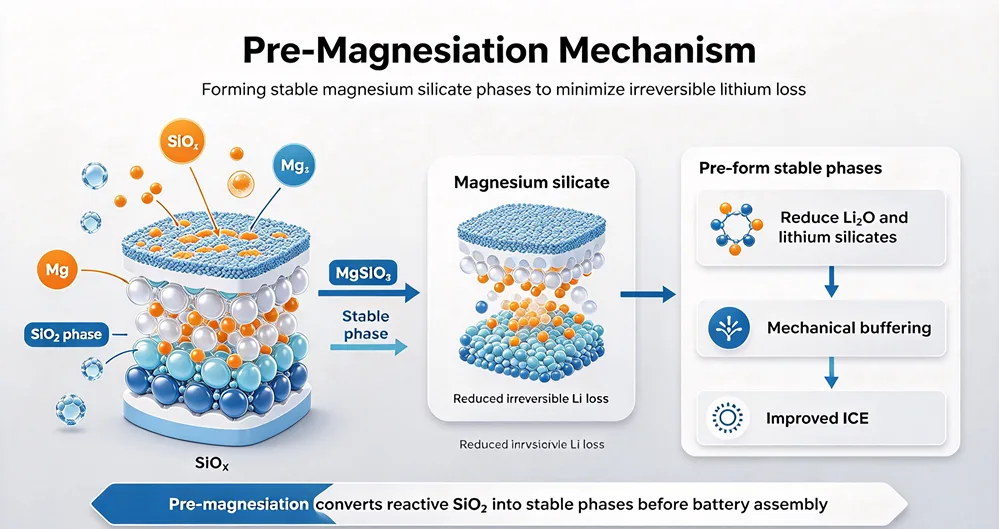 Pre-magnesiation — forming stable magnesium silicate phases to minimize irreversible lithium loss.
2. Understanding the Basics of Pre-Mg SiOC
2.1 The Chemistry of Silicon Oxide Anodes
Silicon oxide (SiOₓ) anodes are promising candidates for high-energy-density lithium-ion batteries due to their high specific capacity, which significantly surpasses that of graphite anodes (372 mAh/g). The theoretical capacity of SiOₓ is around 2600 mAh/g, though practical capacities are typically lower .
However, SiOₓ suffers from a fundamental problem: during the first lithiation, the amorphous SiO₂ phase reacts irreversibly with lithium to form Li₂O and lithium silicates (Li₂SiO₃, Li₄SiO₄). These products are electrochemically inactive, trapping lithium ions that cannot be extracted in subsequent cycles .
2.2 How Pre-Mg Treatment Works
The pre-magnesium treatment addresses this problem by introducing magnesium into the SiOₓ structure before battery assembly. During high-temperature processing, magnesium reacts with the SiO₂ phase to form stable magnesium silicate phases (MgSiO₃, Mg₂SiO₄). This reaction preempts the irreversible reaction with lithium, effectively “pre-consuming” the oxygen binding sites that would otherwise trap lithium .
The magnesium silicate phases also serve a second function: they act as a mechanical buffer that accommodates the volume expansion of silicon during cycling. This is critical because silicon undergoes large volume changes (up to 300%) during lithiation and delithiation, which can cause particle cracking and capacity fade .
2.3 Key Properties of Pre-Mg SiOC Anode Material
Pre-Mg SiOC Anode Material offers a combination of properties that make it suitable for high-energy-density battery applications.
| Parameter |
Unit |
Specification |
| Moisture content |
% |
≤ 0.5 |
| D10 |
µm |
3.5 ± 0.5 |
| D50 |
µm |
6.0 ± 1.0 |
| D90 |
µm |
9.5 ± 1.5 |
| Tap density |
g/cm³ |
1.15 ± 0.15 |
| Specific surface area |
m²/g |
3.0 ± 0.5 |
| Carbon content |
% |
3.0 ± 1.0 |
| Reversible capacity |
mAh/g |
≥ 1350 |
| Initial Coulombic efficiency |
% |
≥ 82 |
3. Why Initial Coulombic Efficiency Matters
3.1 The Energy Density Impact
In a lithium-ion full cell, the cathode is the lithium source. During the first charge, lithium ions migrate from the cathode to the anode. If the anode irreversibly consumes a large portion of these lithium ions, the effective capacity of the cell is reduced.
For a conventional SiOx anode with ICE of ~75%, roughly 25% of the cathode‘s lithium is lost during the first cycle. To achieve the target cell capacity, the manufacturer must either oversize the cathode (adding cost and weight) or accept a lower capacity. Improving ICE to 82%–89% significantly reduces this penalty, enabling higher effective energy density .
3.2 The Blending Ratio Constraint
Because of their low ICE, conventional SiOx anodes must be blended with graphite at relatively low ratios (typically 5%–10% SiOx). Higher SiOx content would cause excessive first-cycle lithium loss. Pre-Mg SiOC Anode Material with higher ICE allows higher SiOx content in the blend, increasing the overall capacity of the anode .
3.3 The Cost of Pre-Lithiation
Pre-lithiation is an alternative approach to improving ICE. However, pre-lithiation using lithium metal or stabilized lithium powder (SLMP) is expensive and requires special handling due to the reactivity of lithium. Pre-Mg SiOC Anode Material uses magnesium instead, which is more cost-effective and easier to handle, while still achieving significant ICE improvement .
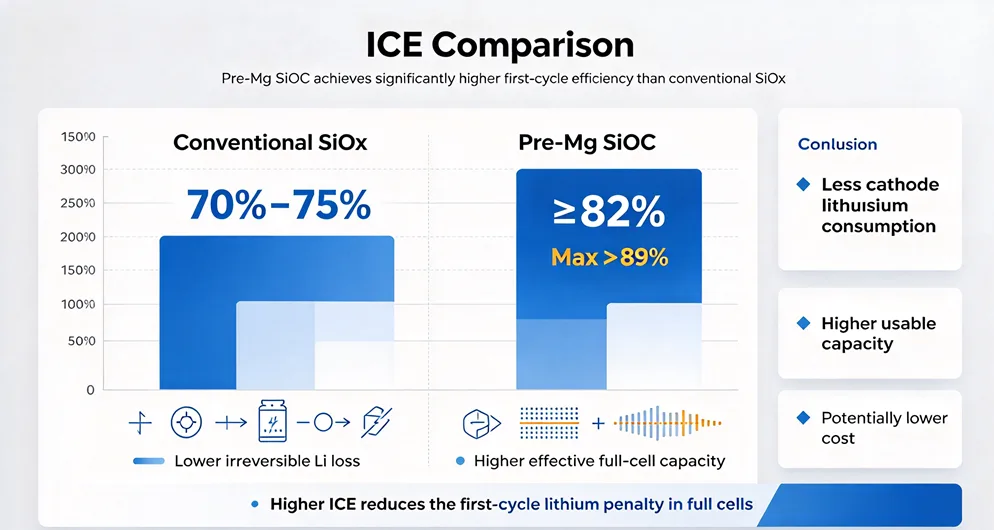 ICE comparison — Pre-Mg SiOC achieves significantly higher first-cycle efficiency than conventional SiOx.
4. How Pre-Mg SiOC Solves the First-Cycle Efficiency Problem
4.1 Pre-Formation of Magnesium Silicate
The core mechanism of Pre-Mg SiOC Anode Material is the pre-formation of magnesium silicate phases during material synthesis. Magnesium reacts with the SiO₂ phase in SiOₓ at high temperature to form MgSiO₃ or Mg₂SiO₄. These phases are electrochemically inactive and do not consume lithium during the first cycle .
By converting the problematic SiO₂ phase into stable magnesium silicate, the material eliminates the primary source of irreversible lithium loss. This is why Pre-Mg SiOC Anode Material achieves ICE of 82% or higher, compared to 70%–75% for conventional SiOx .
4.2 Volume Expansion Buffering
The magnesium silicate phase also provides mechanical reinforcement. Research shows that the MgSiO₃ or Mg₂SiO₄ phases form a strong bonding network that reduces the volume expansion of the material and improves cycling stability .
The open porous structure of Pre-Mg SiOC Anode Material further accommodates volume changes during lithiation and delithiation, ensuring particle integrity and electrode cohesion .
4.3 Carbon Coating for Conductivity
The surface carbon coating on Pre-Mg SiOC Anode Material improves electronic conductivity and suppresses direct electrolyte attack on the anode. It also promotes the formation of a stable SEI film, which is critical for long-term cycling stability .
4.4 Processing Compatibility
Pre-Mg SiOC Anode Material has uniform particle size distribution and a wide slurry formulation window. It is compatible with various binder systems including PVDF, PAA, and CMC/SBR, and works well when blended with graphite anode materials .
 Cycling stability — Pre-Mg SiOC maintains capacity over extended cycling.
5. Key Technical Specifications of Pre-Mg SiOC Anode
| Parameter |
Unit |
Specification |
Test Method |
| Moisture content |
% |
≤ 0.5 |
Electronic moisture analyzer |
| D10 |
µm |
3.5 ± 0.5 |
Malvern laser diffraction |
| D50 |
µm |
6.0 ± 1.0 |
Malvern laser diffraction |
| D90 |
µm |
9.5 ± 1.5 |
Malvern laser diffraction |
| Tap density |
g/cm³ |
1.15 ± 0.15 |
Tap density tester |
| Specific surface area |
m²/g |
3.0 ± 0.5 |
BET surface area analyzer |
| Carbon content |
% |
3.0 ± 1.0 |
Infrared carbon-sulfur analyzer |
| Reversible capacity |
mAh/g |
≥ 1350 |
LAND battery test system |
| Initial Coulombic efficiency |
% |
≥ 82 |
LAND battery test system |
6. Matching Pre-Mg SiOC to Your Battery Application
6.1 Cylindrical Cells
Pre-Mg SiOC Anode Material is primarily suited for cylindrical battery cell formats. The material‘s high capacity and improved ICE make it ideal for high-energy-density cylindrical cells used in electric vehicles and power tools .
6.2 Pouch Cells
Pre-Mg SiOC Anode Material is also suitable for pouch cell formats, which are commonly used in consumer electronics and electric vehicles. The material’s processing compatibility and stable cycling performance make it suitable for high-volume pouch cell production .
6.3 Blending with Graphite
Pre-Mg SiOC Anode Material can be blended with graphite anode materials to balance capacity and cycling stability. The higher ICE of Pre-Mg SiOC Anode Material allows higher blending ratios than conventional SiOx, enabling higher overall anode capacity .
6.4 High-Energy-Density Applications
For applications requiring high energy density, such as electric vehicles and premium consumer electronics, Pre-Mg SiOC Anode Material offers a compelling solution. Its high reversible capacity (≥1350 mAh/g) and improved ICE enable higher cell energy density than conventional graphite anodes .
 Pre-Mg SiOC across applications — cylindrical cells, pouch cells, EVs, and consumer electronics.
7. Common Misconceptions About Silicon-Based Anodes
7.1 "All Silicon Anodes Have Low ICE"
Conventional SiOx anodes do suffer from low ICE, typically around 70%–75%. However, Pre-Mg SiOC Anode Material achieves ICE of 82% or higher through pre-magnesium treatment. This is a significant improvement that makes silicon-based anodes more practical for high-energy-density applications .
7.2 "Pre-Magnesium Treatment Is the Same as Pre-Lithiation"
Pre-magnesium treatment and pre-lithiation are different approaches to improving ICE. Pre-lithiation introduces lithium into the anode before battery assembly, while pre-magnesium treatment introduces magnesium to form stable magnesium silicate phases. Pre-Mg SiOC Anode Material offers advantages in cost and handling compared to pre-lithiated materials .
7.3 "Silicon Anodes Cannot Be Used in Large-Format Cells"
Pre-Mg SiOC Anode Material is specifically designed for cylindrical and pouch cell formats, which include large-format cells used in electric vehicles. The material‘s improved ICE and cycling stability make it suitable for these applications