Overview of Spinel-phase cathode materials for lithium-ion batteries
This product series consists of advanced spinel-structured lithium-ion battery cathode materials based on a dual-system core: lithium-rich/over-lithiated lithium manganese oxide (LMO) and high-voltage lithium nickel manganese oxide (LNMO). Both materials crystallize in the cubic spinel structure with space group Fd-3m, offering a unique combination of high safety, excellent rate capability, cobalt-free chemistry, and high energy density.
The series covers micro-over-lithiated conventional lithium manganese oxide and 4.7 V-class high-voltage lithium nickel manganese oxide. It is designed to meet the growing demand for cost-effective, high-performance, and sustainable cathode materials across a wide range of lithium-ion battery applications, including economy electric vehicles, two-wheelers, power tools, high-voltage passenger vehicle batteries, and energy storage systems.
With precise control over lithium content, Mn²⁺/Mn⁴⁺ ratio, crystal phase structure, and surface coating technology, this product line addresses key engineering challenges such as high-temperature cycling degradation of conventional LMO and electrolyte catalytic decomposition in high-voltage LNMO systems.

Battery Material Powder
Features and Advantages of Spinel-phase cathode materials for lithium-ion batteries
1. Dual-System Spinel Platform
Over-lithiated LMO (Li₁₋₀.₆Mn₁₋₉.₄O₄ type): Provides excellent rate performance, structural stability, and safety.
High-Voltage LNMO (LiNi₀.₅Mn₁.₅O₄): Delivers a high operating voltage of 3.5–4.9 V, enabling higher energy density and cobalt-free battery design.
2. High Safety
The spinel structure offers intrinsic thermal stability and excellent tolerance to abuse conditions. The over-lithiated design and anti-Jahn-Teller effect suppression further enhance structural integrity during cycling.
3. Excellent Rate Capability
Optimized particle morphology and crystal orientation enable superior rate performance:
LMO: 1C @ 95% capacity retention
LNMO: 1C @ 92% capacity retention
4. Cobalt-Free and Cost-Effective
The LNMO system eliminates cobalt, reducing raw material cost and supply chain risk while maintaining high energy density. This makes it ideal for cost-sensitive and sustainable battery applications.
5. High-Voltage Operation
LNMO operates at an average voltage of approximately 4.7 V vs. Li/Li⁺, enabling high energy density when paired with appropriate high-voltage electrolytes.
6. Long Cycle Life
LMO: 100 cycles @ 96% capacity retention
LNMO: 100 cycles @ 94% capacity retention
7. Customizable Specifications
Particle size (D50), specific surface area, and tap density can be tailored to meet specific customer requirements.
8. Advanced Surface Modification
State-of-the-art surface coating and interface engineering improve compatibility with electrolytes, suppress metal dissolution, and extend cycle life, especially at elevated temperatures.
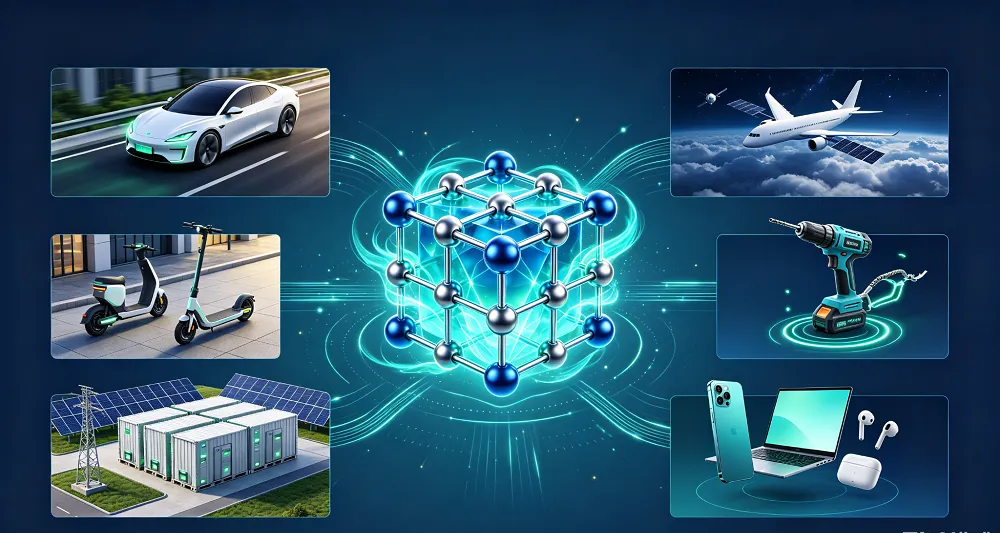
Applications of LMO & High-Voltage LNMO Series for High-Safety, Cobalt-Free, High-Energy-Density Batteries
Applications
This cathode material series is suitable for a wide range of lithium-ion battery applications:
xEV & Transportation
Economy pure electric and hybrid passenger vehicles
Two-wheel electric vehicles (e-bikes, e-scooters)
High-voltage passenger vehicle power batteries
Electric buses and light commercial vehicles
Power Tools & Industrial
High-end power tools
Cordless garden equipment
Industrial power tools requiring high rate and safety
Energy Storage
Conventional energy storage power stations
Backup power and emergency power supplies
Residential and commercial ESS
Specialty & High-End
Military and aerospace batteries
High-end 3C digital products
High-voltage, cobalt-free battery systems
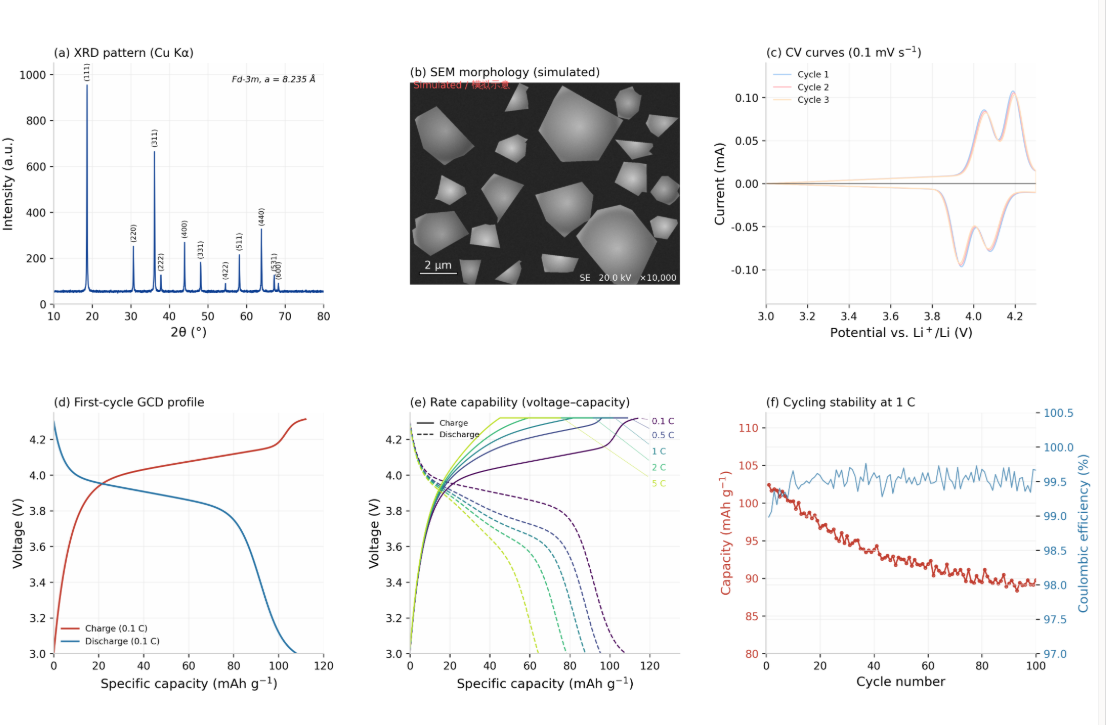
Li₁.₀₆Mn₁.₉₄O₄ characterization
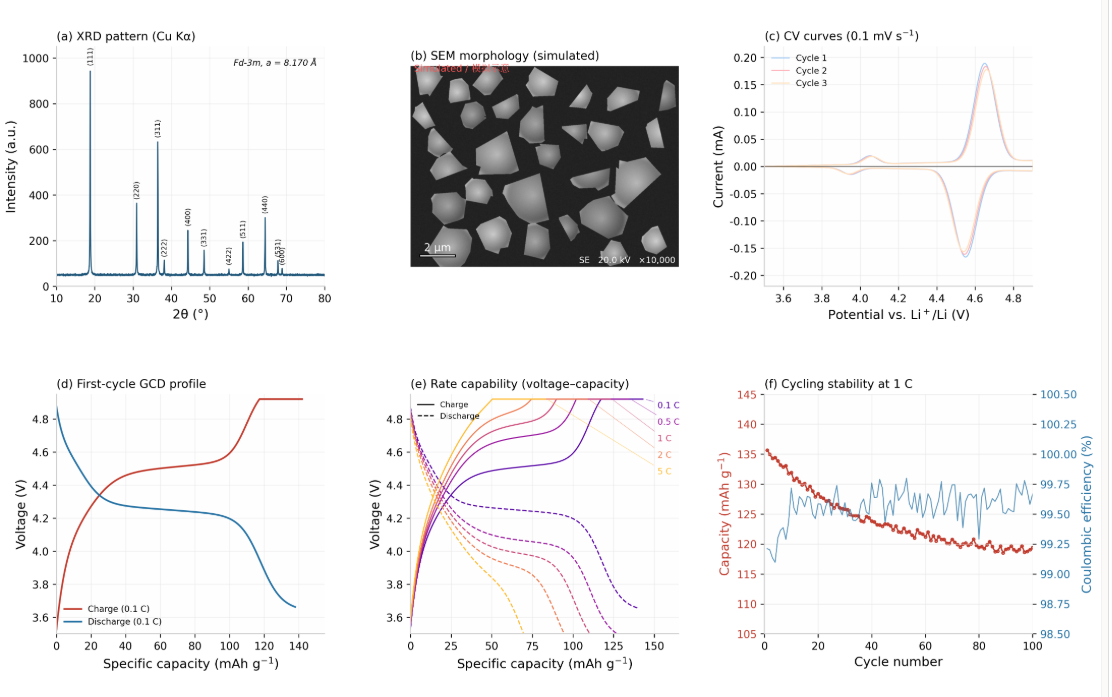
LiNi₀.₅Mn₁.₅O₄ characterization
Parameter Tables
Table 1: Technical Specifications
|
Item |
LMO (Over-Lithiated) |
LNMO (High-Voltage) |
|---|---|---|
|
Chemical Composition |
Li₁₋₀.₆Mn₁₋₉.₄O₄ |
LiNi₀.₅Mn₁.₅O₄ |
|
Crystal Structure |
Cubic Spinel, Fd-3m |
Cubic Spinel, Fd-3m |
|
Operating Voltage (V) |
3.0–4.3 |
3.5–4.9 |
|
Initial Specific Capacity (mAh/g) |
110 |
138 |
|
Cycle Stability |
100 cycles @ 96% |
100 cycles @ 94% |
|
Rate Performance |
1C @ 95% |
1C @ 92% |
|
Key Features |
Over-lithiated, anti-distortion, excellent rate, safety |
Ni-Mn synergy, high voltage, cobalt-free, high energy density |
Table 2: Physical and Quality Specifications
|
Parameter |
Typical Value |
Customization |
|---|---|---|
|
Product Form |
Powder solid |
— |
|
Particle Size (D50) |
2–20 μm |
Available |
|
Specific Surface Area |
1–5 m²/g |
Available |
|
Tap Density |
1.5–2.8 g/cm³ |
Available |
|
Moisture Content |
≤ 500 ppm |
— |
|
Magnetic Impurities |
≤ 100 ppb |
— |
Table 3: Electrochemical Performance Summary
|
Material |
Voltage Range (V) |
Initial Capacity (mAh/g) |
1C Retention |
100-Cycle Retention |
|---|---|---|---|---|
|
LMO |
3.0–4.3 |
110 |
95% |
96% |
|
LNMO |
3.5–4.9 |
138 |
92% |
94% |
Production Process Flow and Technology
1. Raw Material Selection and Precursor Preparation
High-purity manganese, nickel, and lithium sources are selected and mixed according to precise stoichiometric ratios. Precursors are prepared via co-precipitation or solid-state routes to ensure uniform elemental distribution.
2. Calcination and Crystal Phase Control
The precursors undergo controlled calcination at optimized temperatures and atmospheres to form the cubic spinel structure (Fd-3m). For LNMO, the ordered/disordered phase ratio is carefully tuned to balance rate capability and cycling stability.
3. Over-Lithiation and Anti-Jahn-Teller Design
For LMO, controlled over-lithiation and precise Mn²⁺/Mn⁴⁺ ratio regulation suppress the Jahn-Teller effect, reducing Mn dissolution and improving high-temperature performance.
4. Surface Coating and Interface Engineering
Advanced surface coating technologies (e.g., oxide, phosphate, or polymer-based coatings) are applied to improve electrolyte compatibility, suppress side reactions, and enhance cycle life.
5. Particle Size and Morphology Control
Particle size distribution and morphology are optimized through milling, classification, and spray-drying processes to achieve the desired D50 and specific surface area.
6. Quality Control and Impurity Management
Strict control of moisture, magnetic impurities, and metal dissolution ensures consistent battery performance and safety. Each batch is tested for XRD, SEM, CV, GCD, rate capability, and cycling stability.
7. Scale-Up and Consistency
The production process is designed for scalable manufacturing with high batch-to-batch consistency, making it suitable for large-scale battery production.
Company Profile
Luoyang Trunnano Tech Co., Ltd supply high purity and super fine battery materials, such as silicon anode, silicon carbon anode, silicon oxide anode, etc. Send us an email or click on the needed products to send an inquiry.
Payment Term
T/T, Paypal, Western Union, Credit Card etc.

Shipment Term
By sea, by air, by express, as customers request.
Quality Assurance and Customization
XRD Analysis: Confirms phase purity and crystallinity.
SEM Morphology: Ensures uniform particle size and shape.
Electrochemical Testing: CV, GCD, rate, and cycling tests verify performance.
Customization Options: Particle size (D50), specific surface area, tap density, and coating type can be tailored.
Batch Consistency: Strict quality control from raw materials to final product.
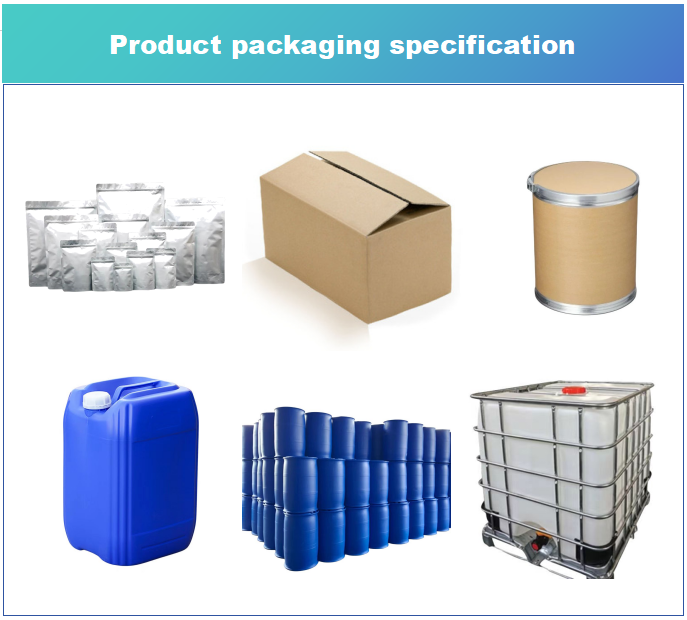
Packaging, Storage, and Delivery
Packaging: Sealed aluminum-laminated bags or drums with inert gas protection.
Storage: Store in a dry, cool, and ventilated area. Avoid moisture and direct sunlight.
Shelf Life: Recommended use within 12 months under proper storage conditions.
Delivery: Flexible shipping options by air, sea, or express, with complete export documentation.
Compliance and Safety
Safety: Non-flammable solid powder. Avoid inhalation and contact with eyes.
Handling: Use appropriate personal protective equipment (PPE).
Transport: Classified as non-dangerous goods under normal transport conditions.
5 FAQs
1. What is the difference between LMO and LNMO in this series?
LMO (over-lithiated lithium manganese oxide) offers a lower operating voltage (3.0–4.3 V), excellent rate capability, and high safety, making it ideal for cost-sensitive and high-power applications. LNMO (high-voltage lithium nickel manganese oxide) operates at 3.5–4.9 V, providing higher energy density and cobalt-free chemistry, suitable for high-voltage and high-energy applications.
2. Are these materials cobalt-free?
Yes. The LNMO system is completely cobalt-free, reducing cost and supply chain risk. The LMO system is also cobalt-free and manganese-based.
3. What is the cycle life of these cathode materials?
Under standard test conditions:
LMO: 100 cycles @ 96% capacity retention
LNMO: 100 cycles @ 94% capacity retention
Actual cycle life depends on electrolyte, electrode design, and operating conditions.
4. Can you customize particle size and surface area?
Yes. We offer customizable D50 (2–20 μm), specific surface area (1–5 m²/g), and tap density (1.5–2.8 g/cm³) to meet specific battery design requirements.
5. What are the recommended applications for LNMO?
LNMO is ideal for high-voltage lithium-ion batteries, including high-voltage passenger vehicle power batteries, high-end power tools, military/aerospace batteries, and high-end 3C digital products. It is particularly suitable for applications requiring high energy density and cobalt-free chemistry.