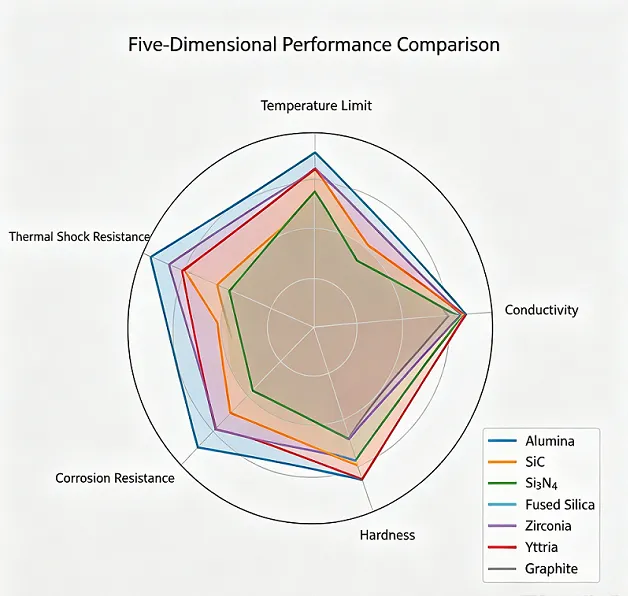
Ceramic crucibles are standard containers for high-temperature processing, but using a ceramic crucible is not the same as using the right one. A common mistake is focusing solely on temperature resistance while ignoring other variables — resulting in premature ceramic crucible failure, melt contamination, and runaway production costs. So what should you actually consider when selecting a ceramic crucible? This article breaks down the selection logic across three dimensions — operating conditions, service life, and cost-effectiveness — for twelve ceramic crucible materials.
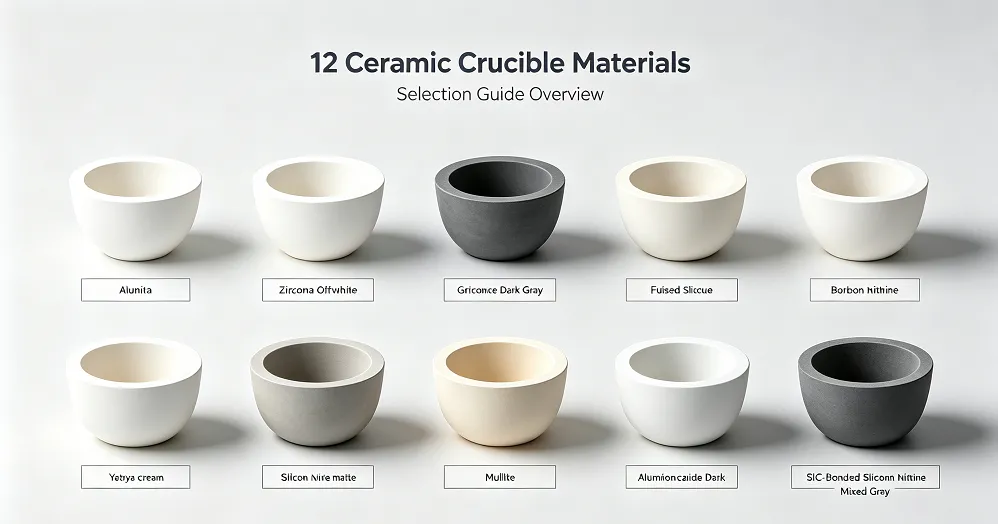
Temperature is the first threshold. Zirconia crucibles can reach approximately 2700°C for precious metal melting. Alumina crucibles have a melting point of approximately 2072°C and can withstand short-term transient thermal shocks approaching 3000°C in inert atmospheres, but long-term continuous use must be controlled below 1600–1750°C. Aluminum nitride and boron carbide crucibles can be used up to approximately 2200°C in inert atmospheres; silicon carbide and silicon nitride crucibles have practical upper limits in the 1600–1750°C range; mullite crucibles can withstand temperatures above 1750°C; fused silica crucibles are recommended for continuous use below 1450°C; graphite crucibles perform well in medium-temperature vacuum applications; yttria crucibles offer excellent chemical inertness toward reactive metals. Note that "maximum withstand temperature" does not equal "long-term safe operating temperature" — many materials lose significant strength near their limits.
Thermal conductivity determines temperature uniformity and response speed. Alumina crucibles offer thermal conductivity of approximately 165–185 W/m·K. Silicon carbide crucibles also offer excellent conductivity. Fused silica and boron nitride crucibles have lower conductivity, offering insulating properties. Higher conductivity means faster heating and more uniform temperature distribution, but greater heat loss.
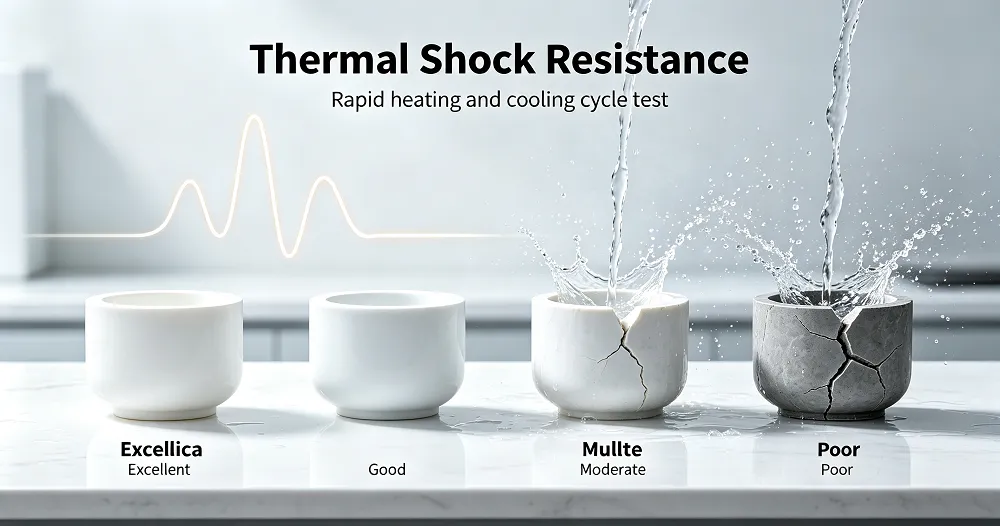
Thermal expansion affects thermal shock resistance. Fused silica crucibles have extremely low expansion, approaching zero, giving excellent thermal shock resistance. Alumina crucibles match well with single-crystal silicon — a key advantage in semiconductor applications. Mullite crucibles perform reliably under rapid heating and cooling. Boron carbide crucibles have poor thermal shock resistance and are susceptible to cracking. Graphite crucibles exhibit good thermal shock resistance due to high conductivity and low expansion.
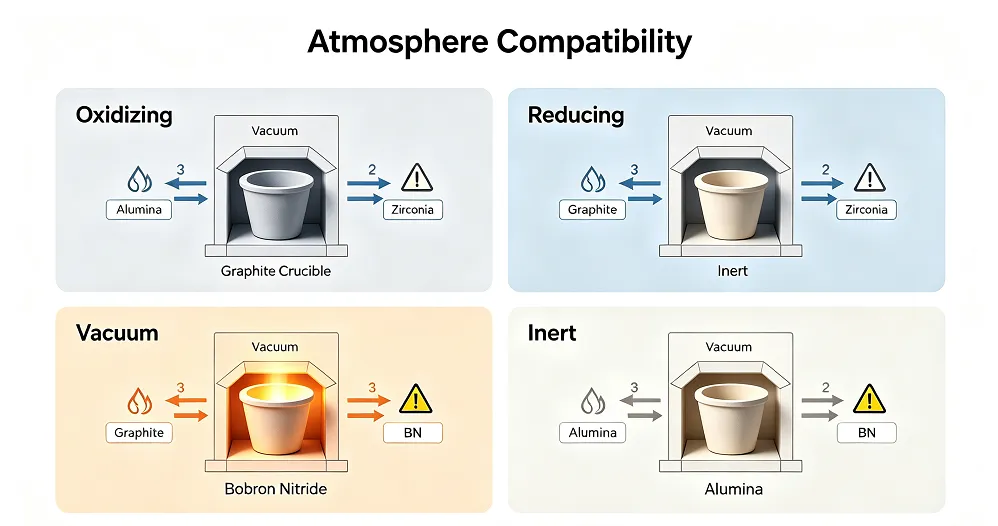
Melt composition determines whether a ceramic crucible will "fail." Chemical reactions with molten metals, wettability, and contamination risk are the core criteria. Typical examples include: alumina crucibles are incompatible with strong alkalis; fused silica crucibles are vulnerable to alkaline attack; silicon carbide crucibles have poor resistance to strong oxidizing acids; yttria crucibles offer excellent chemical inertness toward reactive metals such as titanium. Temperature limit, atmosphere compatibility, and melt compatibility must all be satisfied simultaneously — missing any one is a potential risk.
The same ceramic crucible material often comes in different purity grades, and purity differences directly affect high-temperature performance and contamination resistance. Taking alumina crucibles as an example: 95% alumina, 99% alumina, and 99.5% alumina are all used in industry, but their application scenarios differ significantly. 95% alumina is lower in cost and suitable for general-purpose melting with less stringent purity requirements; 99% alumina offers significantly improved high-temperature strength and creep resistance, suitable for more demanding processes; 99.5% or higher purity alumina is used in semiconductor and optical glass applications where contamination is a critical concern. Fused silica crucibles also have purity grades — solar-grade silica requires approximately 99.99% purity, while semiconductor-grade fused silica crucibles require inner layer purity of 99.998% or higher. When selecting a material, purity grade determines the ceramic crucible's high-temperature stability, corrosion resistance, and contamination risk to the melt. For the same ceramic crucible material, higher purity means better performance, but cost also increases significantly — the key is finding the purity grade that matches your process requirements, rather than blindly pursuing the "highest purity."
Thermal shock resistance is the critical factor in rapid heating and cooling conditions. Mullite crucibles have good thermal shock stability, withstanding 12 or more thermal cycles at 1100°C water quenching without cracking. Fused silica and silicon nitride crucibles are also known for thermal shock resistance, performing reliably under frequent temperature cycling. Boron carbide crucibles have poor thermal shock resistance and are highly susceptible to cracking under rapid temperature changes; heating and cooling rates must be strictly controlled during use. The requirements for thermal shock resistance differ significantly between intermittent production with frequent furnace opening/closing and continuous production. In processes requiring frequent temperature cycling, thermal shock resistance is often more important than high temperature resistance alone.
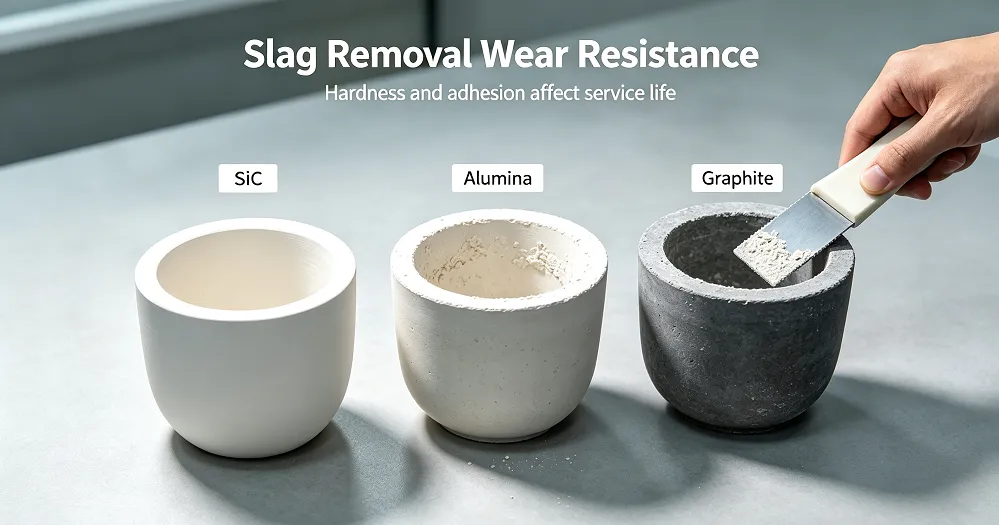
Hardness and wear resistance determine a ceramic crucible's durability during charging, slag removal, and electromagnetic stirring. Silicon carbide crucibles are among the hardest ceramic crucible materials available and are widely recognized in industry as a representative of high-hardness materials. High-hardness ceramic crucible materials are suitable for high-wear conditions — impacts during charging, scraping during slag removal, and fluid erosion from electromagnetic stirring all cause continuous mechanical wear on the crucible wall. The higher the hardness, the better the resistance to such wear. Low-hardness ceramic crucible materials may not have the advantage in wear resistance, but they often offer other irreplaceable properties — such as excellent thermal shock resistance, chemical inertness, or machinability. Hexagonal boron nitride (h-BN) crucibles are a typical example: low hardness but good machinability, and non-wetting to most melts, offering unique value in specific applications; cubic boron nitride (c-BN), however, is not suitable for crucible applications. Graphite crucibles have low hardness but good self-lubricating properties, making them suitable for specific processes with less demanding wear requirements.
Purchase price is not the total cost. A lower-priced ceramic crucible may require more frequent replacement, cause greater production losses during furnace downtime, and demand more manual labor for cleaning — these costs often exceed the purchase price itself. The correct approach is to evaluate from a total cost of ownership perspective.
Maintenance costs vary by material. Alumina crucibles do not easily adhere to molten metals, reducing cleaning frequency. Silicon carbide crucibles are non-wetting to aluminum alloys. Hexagonal boron nitride (h-BN) crucibles are chemically inert with non-wetting characteristics. Graphite crucibles have self-lubricating properties, making slag removal easier. Brittle materials carry higher breakage risk, requiring more careful handling. These differences significantly impact long-term costs.
Contamination-related scrappage is the largest hidden cost. Alumina crucibles have extremely low vapor pressure in vacuum, making them ideal for vacuum aluminum evaporation. Yttria crucibles offer excellent inertness toward reactive metals like titanium. Fused silica crucibles dominate semiconductor silicon pulling, requiring inner layer purity of 99.9% or higher — trace impurities cause wafer defects. Graphite crucibles do not introduce metal impurities in vacuum/inert atmospheres. In precious metal melting, contamination can scrap an entire furnace charge, with losses far exceeding the crucible's cost. A slightly more expensive high-purity crucible is often more economical than a cheaper one — because it avoids a single contamination incident.
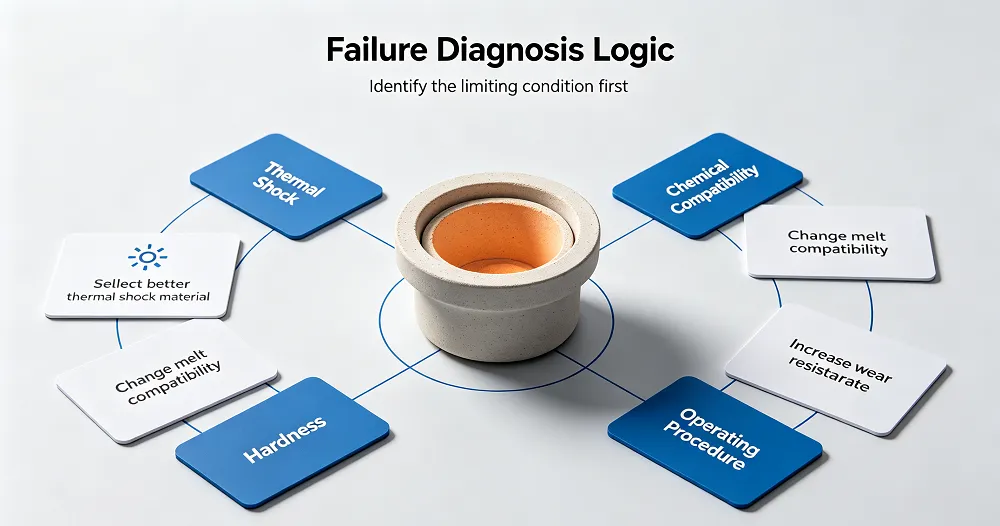
Failure Diagnosis Logic
The essence of cost-effectiveness is not "cheapest," but "best value" — choosing the solution with the lowest total cost of ownership while meeting process requirements.
Understanding common failure modes helps with rapid diagnosis and selection adjustment:
Cracking: Through-wall cracks during heating/cooling — caused by poor thermal shock resistance (e.g., boron carbide crucibles) or excessive heating/cooling rates. Solutions: select materials with better thermal shock resistance (fused silica, silicon nitride, or mullite crucibles) and optimize heating programs.
Spalling: Surface flaking and wall thinning — caused by reactions between the crucible surface and melt/atmosphere forming a layer that spalls due to thermal stress. Solutions: select more compatible materials (alumina crucibles for most environments) or reduce operating temperatures.
Perforation: Localized corrosion penetration at one point — caused by violent reactions between melt and crucible material (e.g., fused silica crucibles with alkaline melts, or silicon carbide crucibles with strong oxidizing acids). Solutions: avoid incompatible combinations or apply protective coatings.
Adhesion: Melt sticks firmly to the inner wall, making slag removal difficult — caused by the crucible material being wetted by the melt. Solutions: select non-wetting materials (silicon carbide or silicon nitride crucibles for aluminum alloys, h-BN crucibles for many melts) or apply anti-adhesion coatings.
Premature failure: Failure far below expected service life from multiple causes — insufficient thermal shock resistance, excessive heating/cooling rates, uneven support, or localized overheating. Solutions: systematically investigate both selection and operational factors, prioritizing the most critical limiting conditions (thermal shock resistance, chemical compatibility, or hardness).
| Ceramic Crucible Material | Temperature Limit | Thermal Conductivity | Hardness | Corrosion Resistance | Thermal Shock Resistance |
|---|---|---|---|---|---|
| Aluminum Nitride | High (~2200°C inert) | Extremely high | Moderate | High | Moderate |
| Alumina | High (short-term transient ~3000°C inert / long-term 1600–1750°C oxidizing) | High (165–185 W/m·K) | High | Extremely high | Reliable |
| Boron Carbide | High (~2200°C inert) | Low | Extremely high | High | Poor |
| Boron Nitride (h-BN) | High (inert) / Low (air) | Moderate | Low | High | Moderate |
| Fused Silica | Low (continuous <1450°C) | Low | Low | High (99.9% purity, but alkali-sensitive) | Extremely high |
| Silicon Carbide | High (1600–1650°C) | Extremely high | Extremely high | Moderate (weak against strong oxidizing acids) | Good |
| Silicon Nitride | High (1650–1750°C) | Moderate-high | High | Good | Extremely high |
| Mullite | High (>1750°C) | Moderate-low | High | Good | Excellent |
| SiC‑Bonded Si₃N₄ | High (1650–1750°C) | Moderate-high | High | Good | Good |
| Zirconia | Extremely high (~2700°C) | Low | Moderate | High | Good |
| Yttria | High (>2400°C) | Moderate | Moderate | Extremely high (to reactive metals) | Moderate |
| Graphite | Medium-high (~3000°C vacuum/inert) | Extremely high | Low | Low (oxidizes in air) | Good (in vacuum) |