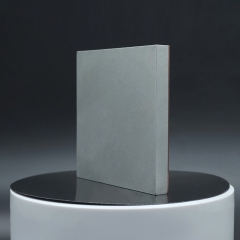
What is Stainless Steel/Steel Clad Plate:
Stainless steel/steel clad plate is made of base steel plate and multilayer steel plate as raw materials, and the surface is smooth and flat after polishing and other treatments. The composite layer is firmly bonded, the mechanical properties are good, the compound layer is resistant to the corrosion of atmosphere, acid, alkali and other media, which can meet the corrosion resistance requirements of the side of the structure in contact with the corrosive medium, and the base layer can meet the requirements of the structure for rigidity and weldability.

TRUNNANO Stainless Steel/Steel Clad Plate
Feature of Stainless Steel/Steel Clad Plate:
Stainless steel/steel clad plate has both multilayer functionality and base layer strength and toughness performance, and Stainless steel/steel clad plate, as a resource-saving product, can reduce precious metal consumption and reduce costs. Achieve the perfect combination of low cost and high performance, with good social benefits.
The standard method of producing clad steel is the roll cladding method. Carbon steel and stainless steel form a metallurgical bond during heating and rolling.
Hot roll bonding is a commonly used process in our stainless steel clad plate factory. During this process, clean sheets of carbon steel and stainless steel are placed on each other, (single-sided cladding), or sandwiched between two stainless steel sheets (double-sided cladding). The composite sheets are hot rolled together.
The stainless steel cladding process results in a bond between the two metals. Another manufacturing method is explosive bonding. The metals bond during the explosion due to the plastic deformation of the strong collision. Explosive bonding after the hot rolling process can improve the bond between carbon steel and stainless steel.
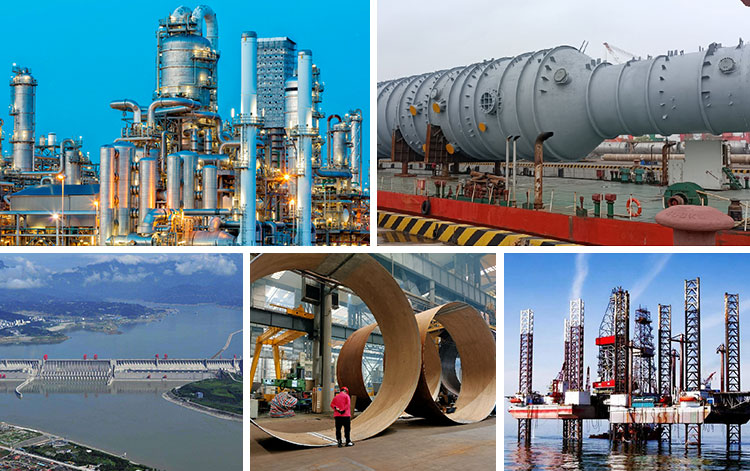
Composite carbon steels are used in chemical processes, oil refining, offshore oil production and many other applications. It is also used in generator sets where high temperatures and stress corrosion are present.
Specification of Stainless Steel/Steel Clad Plate
| Parameter | Specification |
| Base Material | |
| Steel Grade | ASTM A516 Gr.60/70, A285 Gr.C, A387 Gr.11/22 |
| Thickness Range | 6mm - 150mm |
| Width | 1500mm - 3500mm |
| Length | 3000mm - 12000mm |
| Clad Material | |
| Stainless Steel Grade | 304/304L, 316/316L, 321, 347H, 904L |
| Clad Thickness | 2mm - 8mm |
| Bonding Properties | |
| Bonding Method | Explosion/Roll Bonding |
| Shear Strength | ≥ 140 MPa |
| Bond Integrity | Min. 99% bonded area |
| Mechanical Properties | |
| Tensile Strength | As per base material specification |
| Yield Strength | As per base material specification |
| Elongation | ≥ 20% |
| Bend Test | No separation at 180° bend |
| Surface Quality | |
| Surface Finish | 2B, No.1, No.4 |
| Surface Defects | Free from blisters, scales, pits |
| Testing Requirements | |
| Ultrasonic Test | 100% bond testing |
| Shear Test | Per ASTM A264 |
| Side Bend Test | Required |
| Dye Penetrant Test | For clad surface |
| Tolerances | |
| Thickness | ±0.3mm (clad layer) |
| Width | +10mm/-0mm |
| Length | +15mm/-0mm |
| Flatness | ≤ 3mm/m |
| Chemical Composition | |
| Carbon Content | As per grade specification |
| Chromium Content | As per grade specification |
| Nickel Content | As per grade specification |
| Molybdenum Content | As per grade specification |
| Heat Treatment | |
| Stress Relief | As required by application |
| Temperature Range | 550-650°C |
| Holding Time | Min. 2 hours/25mm thickness |
Applications of Stainless Steel/Steel Clad Plate:
Petrochemical, pressure vessels, Add transmission pipeline, heat exchanger, Vacuum salt production,papermaking,Beer,medicine,food,Waterpower, power station, aerospace and other fields.
1. Chemical processing: Equipment exposed to harsh chemicals, such as reactor vessels, piping, and heat exchangers.
2. Power generation: Boilers, turbines, and heat exchangers in power plants due to its high resistance to corrosion and high temperature.
3. Marine and offshore: Shipbuilding, oil rigs, and other marine structures for corrosion resistance and improved durability in harsh environments.
4. Aerospace: Aircraft components, such as engine parts, for its high strength and durability.
5. Nuclear: Nuclear reactors and fuel storage containers for its high resistance to radiation and ability to withstand harsh conditions.
Applications of Stainless Steel/Steel Clad Plate
Grade of Stainless Steel/Steel Clad Plate:
S11306,S11348,S30408,S30403,S32168,S31603,S31703,S22053,S39042,Q245R,Q345R,15CrMoR,16Mn,15CrMo,14Cr1MoR,16MnDR,
09MnNiDR,20MnMo,SA516Gr50,SA516Gr60,SA516Gr70
Standard of Stainless Steel/Steel Clad Plate:
ASME(ASTM) SA-263,SA-264
Package of Stainless Steel/Steel Clad Plate:
According to product characteristics and customer needs.
Remark of Stainless Steel/Steel Clad Plate:
Please provide detailed technical requirements to facilitate communication and determine the solution.
Stainless Steel/Steel Clad Plate supplier-TRUNNANO:
Luoyang Tongrun Nano Technology Co. Ltd. (TRUNNANO) is a trusted global chemical material supplier & manufacturer with over 12-year-experience in providing super high-quality clad plate, clad rod, clad tube, etc.
If you are looking for high-quality Stainless Steel/Steel Clad Plate, please feel free to contact us and send an inquiry.
FAQs of Stainless Steel/Steel Clad Plate:
Does Gold Ion Plated Stainless Steel Tarnish?
Gold ion plated stainless steel generally does not tarnish easily. Gold is a noble metal, meaning it is resistant to corrosion and oxidation. However, the durability of the gold plating can vary depending on the thickness and quality of the plating. Over time, with exposure to moisture, chemicals, and abrasive materials, the plating can wear off, revealing the underlying stainless steel.
Can You Plate Stainless Steel?
Yes, stainless steel can be plated with various metals, including gold, silver, nickel, and chromium. Plating stainless steel can enhance its appearance, improve its corrosion resistance, and add functional properties like increased hardness or electrical conductivity. The process typically involves cleaning the stainless steel surface, activating it with a chemical solution, and then applying the desired metal through electroplating or electroless plating.
How to Remove Gold Plating from Stainless Steel
To remove gold plating from stainless steel, you can use several methods:
Chemical Stripping: Use a commercial metal stripping solution designed for gold plating. Follow the manufacturer's instructions carefully. This method involves soaking the item in the solution until the plating dissolves.
Electrolysis: Set up an electrolytic cell with a stainless steel cathode and an anode made of a sacrificial metal (like copper). Submerge the gold-plated item in a solution of sodium hydroxide and water. Apply a direct current to strip the gold plating.
Mechanical Abrasion: Use fine-grit sandpaper or a polishing wheel to gradually remove the gold plating. This method is labor-intensive and may scratch the underlying stainless steel.
How to Clean Gold Plated Stainless Steel
To clean gold plated stainless steel, follow these steps:
Gentle Cleaning: Use a soft cloth or microfiber towel to wipe the surface gently. Avoid using abrasive materials that can scratch the gold plating.
Mild Soap Solution: If needed, create a mild soap solution with warm water and a few drops of dish soap. Dip a soft cloth into the solution and wring it out so it is damp, not dripping. Wipe the surface gently.
Rinse Thoroughly: Rinse the item with clean water to remove all soap residue.
Dry Completely: Use a clean, soft cloth to dry the item completely. Ensure no water spots are left behind.
Polishing: For a brighter finish, use a specialized gold polish or a soft polishing cloth. Apply the polish gently and buff the surface to a shine.