Introduction of Silicon Carbide Rods
Silicon Carbide Rod, usually refers to a non-metallic high temperature electric heating element made of high purity green hexagonal silicon carbide as the main raw material, through a specific process such as high temperature siliconization and recrystallization sintering. This material exhibits excellent physical and chemical properties at high temperatures, such as high temperature resistance, oxidation resistance, corrosion resistance and other characteristics. Silicon carbide rods as electric heating elements, can be used in an oxidizing atmosphere in the normal use of temperature up to 1450 ℃, and its surface will be in high temperature conditions to form a layer of protective silicon dioxide film, this film helps to slow down the aging process of the silicon carbide rods and to extend their service life.
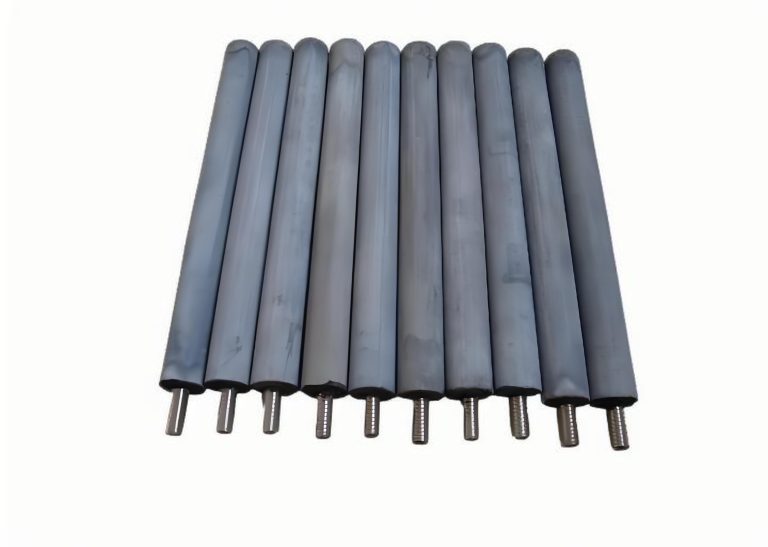
Silicon Carbide Bar
Features of Silicon Carbide Rods
High temperature resistance: Silicon carbide rods can withstand extremely high operating temperatures, the surface temperature of the heating section in air can reach up to 1450℃.
Good chemical stability: In addition to reacting with alkaline substances at high temperatures, silicon carbide rods are very stable for most acids and are not easily eroded.
Rapid warming ability: due to its large specific resistance, when the current passes through, the silicon carbide rod can quickly generate heat to realize rapid warming.
Longer service life: under proper use conditions, silicon carbide rods have a long continuous service life; however, intermittent use may shorten their life.
Easy to install and maintain: The design of silicon carbide rods allows them to be installed and maintained with relative ease.
Hard and brittle: Although hard, they are also relatively fragile and therefore need to be handled carefully to avoid breakage.
Noting: As temperatures rise above 1600°C, the protective layer of silica that forms may begin to melt or peel off, accelerating the rate of oxidation of the silicon carbide rods. Therefore, care should be taken during design and use to control the maximum operating temperature from exceeding this threshold.
Specifications of Silicon Carbide Rods
|
Parameter |
Specification Details |
|
Material |
Silicon Carbide (SiC) |
|
Grade |
Various grades available (e.g., Sintered SiC, Reaction-Bonded SiC, Recrystallized SiC) |
|
Purity |
≥ 98% SiC |
|
Hardness (Vickers) |
~2500-3000 HV |
|
Density |
~3.10 to 3.21 g/cm³ (varies by grade) |
|
Flexural Strength |
400-700 MPa (depending on grade and manufacturing process) |
|
Compressive Strength |
2500-4000 MPa (depending on grade and manufacturing process) |
|
Elastic Modulus |
400-450 GPa |
|
Thermal Conductivity |
120-270 W/m·K (varies by grade and temperature) |
|
Coefficient of Thermal Expansion (CTE) |
4.5-4.7 x 10^-6 /°C (at room temperature) |
|
Temperature Resistance |
Up to 1600°C in air, higher in inert atmospheres |
|
Corrosion Resistance |
Excellent resistance to most acids, alkalis, and molten metals |
|
Electrical Conductivity |
Can be electrically conductive or insulating (depends on doping and grade) |
|
Magnetic Properties |
Non-magnetic |
|
Fracture Toughness |
3.5-5.0 MPa·m^0.5 (depending on grade) |
|
Abrasion Resistance |
Excellent, minimizes wear in abrasive environments |
|
Dimensional Stability |
High, minimal thermal expansion and contraction |
|
Surface Finish |
Available in various finishes (ground, polished, etc.) |
|
Length Range |
Typically from 50 mm to 3000 mm (custom lengths available upon request) |
|
Diameter Range |
Typically from 5 mm to 200 mm (custom diameters available upon request) |
|
Tolerance |
±0.1 mm to ±0.5 mm (varies by size and application requirements) |
|
Applications |
Furnace components, kiln furniture, nozzles, heat exchangers, wear-resistant parts, etc. |
|
Manufacturing Process |
Sintering, reaction bonding, recrystallization, hot pressing, etc. |
|
Coating Options |
Available, e.g., TiN, DLC, ceramic coatings (for enhanced properties) |
Applications of Silicon Carbide Rods
Industrial heating equipment: one of the core components in high-temperature heating devices such as tunnel kilns, roller kilns, glass furnaces, vacuum furnaces, muffle furnaces and smelting furnaces. These installations rely on the high-performance heating solutions provided by silicon carbide rods.
Semiconductor manufacturing: Silicon carbide rods are used as a high-temperature processing link in certain specialized process steps, such as a heating source in diffusion furnaces.
Scientific Research: Used in laboratory environments to support a variety of high-temperature experiments, including, but not limited to, research in materials science, chemical synthesis and more.
Ceramics and glass production: for firing high quality ceramic parts and processing glass products.
Powder Metallurgy: To provide the necessary heat input for the sintering process of pressed metal powders.
Analytical Laboratory: For sample analysis work requiring precise temperature control.
Other applications in high-temperature environments: Any task involving prolonged exposure to high temperatures may be an ideal application scenario for silicon carbide rods.
Packing and Storage
The product is in powder form and should be stored in a cool, ventilated place. Avoid inhalation when using it and keep away from open flames, heat sources, etc.

Company Profile
Company Profile
Luoyang Tongrun Nano Technology Co. Ltd. (TRUNNANO) is a trusted global chemical material supplier & manufacturer with over 12-year-experience in providing super high-quality chemicals and nanomaterials, including boride powder, nitride powder, graphite powder, sulfide powder, 3D printing powder, etc.
The company has a professional technical department and Quality Supervision Department, a well-equipped laboratory, and equipped with advanced testing equipment and after-sales customer service center.
If you are looking for high-quality Silicon Carbide Rods please feel free to contact us or click on the needed products to send an inquiry.
Payment Term
T/T, Western Union, Paypal, Credit Card etc.

Packaging
Shipment Term
By air, by sea, by express, as customers request.
FAQs of Silicon Carbide rods
Question 1: What is the maximum operating temperature for silicon carbide rods?
Answer: Silicon carbide rods can withstand operating temperatures up to 1450°C in air and maintain stable performance over this temperature range. When the temperature is further increased to about 1600°C, the protective film of silica formed on the surface may start to melt or fall off, which will lead to a faster oxidation rate of the silicon carbide rods, thus affecting their service life. Therefore, in practice, you should try to avoid letting the silicon carbide rods exceed this temperature limit. In addition, if they are used in reducing atmospheres or other special environments, different temperature resistance limits need to be considered.
Question 2: What is the oxidation resistance mechanism of silicon carbide rods?
Answer: When a silicon carbide rod is heated above 800°C, an oxidation reaction occurs on its surface, producing a dense protective film of silicon dioxide (SiO2). As the temperature continues to rise to between 1000 and 1300°C, this protective film becomes thicker, effectively isolating the oxygen in the air and reducing the oxidation rate of the silicon carbide rod. However, once the temperature reaches above 1600°C, the protective film of silica may peel off due to the excessively high temperature, causing the silicon carbide rods to be exposed to air again, which in turn accelerates the oxidation process. In order to prolong the service life of silicon carbide rods, the construction of resistance furnaces or industrial electric furnaces should be reasonably designed to ensure that they are installed in the correct position and to prevent problems caused by localized high temperatures or other electrical faults.
Question 3: How to choose the right type and specification of silicon carbide rods?
Answer: Choosing the right type and size of silicon carbide rods depends on the specific heating requirements and technical parameters. First, determine the maximum power and maximum temperature required, and use this as the basis for calculating the required load density. Then, depending on the channel size, determine the geometric parameters such as rod diameter (commonly 35 mm), length of heat generation and cold end length. For straight rods, the cold end length needs to match the thickness of the furnace wall; the length of the heat generator should be adapted to the width of the material channel. In addition, the type of connection (e.g. star or triangular) and whether single-ended wiring is required (H- or U-bars are preferred) should also be considered. Finally, based on this information, reference is made to similar successful cases to finalize the actual power and corresponding load density of each rod, and then calculate the number of silicon carbon rods required. At the same time, it is also important to consider that different shapes of silicon carbide rods (e.g., 3-section rods, 5-section rods, U-shaped rods, H-shaped rods, and gun-shaped rods) are suitable for different occasions, such as 5-section rods for places with high homogenization requirements.
Question 4: How to prevent damage caused by overheating during the use of Silicon Carbide rods?
Answer: In order to prevent damage to silicon carbide rods due to overheating, a series of precautions must be taken to ensure that their operating temperatures remain within safe limits. First, when designing the heating system, the specifications and number of silicon carbide rods should be selected reasonably according to the actual demand to avoid exceeding its rated power or temperature range. Secondly, attention should be paid to the spacing between the silicon carbide rods and the distance from the furnace wall when installing, to ensure enough space for heat dissipation and reduce the possibility of local hot spot formation. Further, the parameters of the electronic control system, such as voltage and current, should be monitored and adjusted regularly to maintain a stable heating process, and the temperature changes in the furnace can be monitored in real time by setting temperature sensors, so that cooling measures can be taken immediately once an abnormal rise is found. In addition, since the surface of the silicon carbide rods will form a layer of silica protective film, when the temperature exceeds 1600°C, this protective film may melt or peel off, accelerating the aging of the silicon carbide rods, so it is necessary to strictly control the maximum operating temperature does not exceed this threshold. Finally, for intermittent use of the occasion, it is recommended to use the preheating method to start the equipment, which can effectively reduce the temperature difference brought about by the thermal stress impact, and then protect the silicon carbide rod from damage.
Question 5: How do I maintain and care for the silicon carbide rods to ensure their optimal performance?
Answer: Proper maintenance and care measures are essential to ensure that silicon carbide rods maintain optimal performance throughout their life cycle:
Regular Inspection and Cleaning: Silicon carbide rods and their surroundings should be inspected regularly to remove any dust or other contaminants that may have accumulated. Particularly during cooling after use, timely cleaning of surface deposits can prevent them from hardening and affecting subsequent heating efficiency. It is also necessary to keep electrode contact areas clean and free of oil, as this helps to reduce contact resistance and minimize energy loss.
Monitor operating parameters: Closely monitor heating system parameters such as voltage, current, power output, etc. to ensure that they are within the recommended range. If unusual fluctuations are detected, adjust the settings or find the cause. For example, when the current suddenly increases, it may be due to load imbalance caused by the damage of some silicon carbon rods; on the contrary, if the current decreases, it may be due to the disconnection of some rods or the increase of resistance. By tracking and analyzing these indicators, it is possible to warn of potential problems in advance and take preventive measures to avoid larger failures.
Reasonable arrangement of the replacement cycle: Although the silicon carbide rods have a long service life, with the growth of the use of time, its electrical characteristics and mechanical strength will gradually decline. Therefore, it is important to establish a reasonable replacement schedule. Generally speaking, the timing of replacement can be determined by combining the actual working conditions with the guiding recommendations provided by the manufacturer. It is important to note that before replacing an old rod, always disconnect the power supply and make sure all safety precautions are in place before proceeding. In addition, when installing the new rods, pay attention to the correct placement to avoid localized overheating or stress concentration due to improper installation.
Optimize furnace design: Good furnace structure design also helps to extend the life of silicon carbide rods. For example, an appropriate increase in furnace space can make the heat distribution more uniform, reducing the pressure of local hot spots; the selection of suitable insulation materials can also effectively isolate the outside cold air intrusion, to protect the internal components from the damage caused by temperature differences.