Overview
P3-028 is a high-performance P3-type sodium cobalt oxide (NaCoO₂) cathode material engineered specifically for sodium-ion battery applications. As a member of the layered oxide family, this material features a distinctive P3 crystal structure characterized by enlarged interlayer spacing that facilitates rapid sodium-ion transport.
With its optimized lattice architecture, P3-028 delivers outstanding rate capability and high reversible capacity, making it an excellent choice for energy storage systems requiring fast charge/discharge performance. The material demonstrates exceptional cycling stability and maintains structural integrity over extended operation.

Key Features
|
Parameter |
Specification |
|---|---|
|
Product Code |
P3-028 |
|
Material System |
P3-Type Classical System |
|
Chemical Composition |
NaCoO₂ |
|
Crystal Structure |
O3-Type |
|
Operating Voltage |
2.0 – 4.0 V |
|
Initial Specific Capacity |
130 mAh/g |
|
Cycling Stability |
100 cycles @ 90% retention |
|
Rate Capability |
1C @ 90% retention |


Technical Highlights
Large Interlayer Spacing: The P3-type structure provides expanded interlayer galleries that significantly reduce the energy barrier for sodium-ion insertion and extraction.
High Sodium-Ion Diffusion Coefficient: Optimized crystal chemistry ensures rapid ion transport kinetics, enabling superior rate performance even at high current densities.
Excellent Rate Capability: Maintains 90% capacity retention at 1C rate, making it ideal for fast-charging applications.
Stable Cycling Performance: Delivers 90% capacity retention after 100 cycles, ensuring reliable long-term operation.
Well-Established Crystal Structure: O3-type layered architecture provides a stable framework for reversible sodium intercalation/deintercalation.
Applications
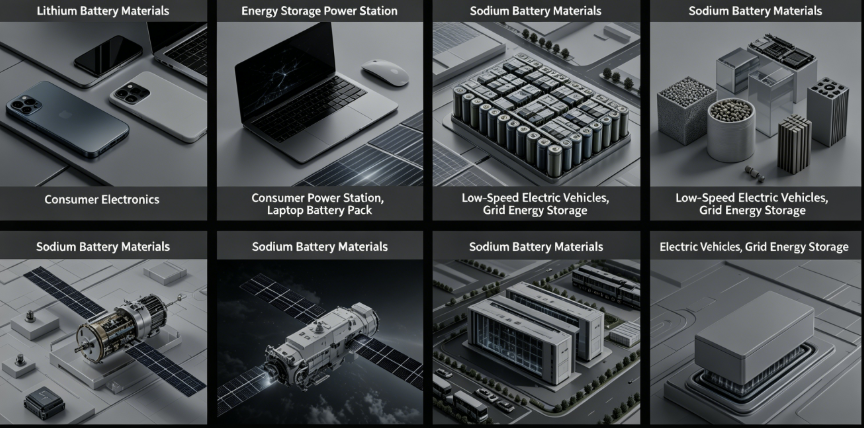
High-Power Sodium-Ion Batteries: Ideal for applications requiring fast charge/discharge capability
Grid-Scale Energy Storage Systems: Suitable for large-scale stationary storage with frequent cycling demands
Low-Speed Electric Vehicles: Provides balanced energy density and power performance for two-wheelers and four-wheelers
Portable Power Stations: Enables rapid charging for consumer and industrial portable energy solutions
Why Choose P3-028?
The P3-type structure of sodium cobalt oxide offers distinct advantages over other layered oxide cathodes. The enlarged interlayer spacing not only accelerates sodium-ion diffusion but also accommodates volume changes during cycling with minimal structural strain. This results in a cathode material that combines high power capability with excellent cycle life, striking an optimal balance between rate performance and durability.
Packaging
Standard packaging: Vacuum-sealed aluminum-plastic film packaging with inert gas protection. Customized packaging solutions are available upon request.
About Us
TRUNNANO is a leading supplier of high-performance battery materials for lithium-ion and sodium-ion batteries. Our portfolio includes nano cathodes, silicon-carbon anodes, hard carbon, and specialty additives. With strict quality control and consistent purity, we deliver reliable solutions for 3C electronics, power tools, and energy storage systems. Committed to innovation, TRUNNANO drives the future of energy storage with cutting-edge materials and dedicated customer support.
FAQs
1. What does "P3-type" mean in sodium-ion cathode materials?
P3-type refers to a specific layered crystal structure where sodium ions occupy prismatic sites between oxide layers. In the P3 structure, the interlayer spacing is larger than in conventional O3-type structures, which significantly enhances sodium-ion diffusion kinetics and improves rate capability. This structural feature makes P3-type materials particularly suitable for high-power applications.
2. How does the rate performance of P3-028 compare with other sodium cathode materials?
P3-028 demonstrates excellent rate capability, maintaining 90% of its initial capacity at 1C rate. This performance is attributed to its large interlayer spacing and high sodium-ion diffusion coefficient, which enable rapid ion transport even under high current densities. The P3-type structure provides superior high-rate performance compared to many O3-type counterparts.
3. What is the recommended voltage range for P3-028?
The recommended operating voltage range is 2.0 – 4.0 V. Within this window, the material delivers optimal reversible capacity and cycling stability while maintaining structural integrity.
4. What is the typical initial specific capacity of P3-028?
The typical initial specific capacity is 130 mAh/g, which is competitive among P3-type layered oxide cathodes. This capacity is achieved through optimized synthesis conditions that maximize sodium-ion storage while maintaining crystal structure stability.
5. Is P3-028 suitable for large-scale production and commercialization?
Yes, P3-028 is synthesized via well-established high-temperature solid-state methods that are scalable and cost-effective. The material exhibits excellent batch-to-batch consistency, making it suitable for commercial-scale sodium-ion battery production.