
How is silicon dioxide produced?
Silica is an inorganic compound with the chemical formula of SiO2. Silicon atoms and oxygen atoms are arranged in long-range order to form crystalline silica, and short-range order or long-range disorder arrangement to form amorphous silica.

preparation method of Silicon dioxide powder
As far as industrial production is concerned, the main preparation methods include the gas phase method with silicon tetrachloride as raw materials, the precipitation method with sodium silicate and inorganic acid as raw materials, the sol-gel method with silicate as raw materials, and the microemulsion method.
1. Gas-phase method
Gas phase method is the main method for industrialized production of nano-SiO₂ in developed countries, and the nano-SiO₂ produced by this method has been widely used in various fields.
The production principle of the gas phase method is to directly use gas or change reactants into a gas by various means so that they will undergo physical and chemical changes in the gaseous state and then condense and grow into nanoparticles during cooling.
The specific process is: using organosilane halide as a raw material; it is hydrolyzed at high temperatures (generally as high as 1200~1600℃) in the flame of hydrogen and oxygen to produce smoky SiO₂ with extremely fine particles. Smoky SiO₂ is integrated with larger particles in the concentrator and then collected in the deacidification furnace through the cyclone separator for deacidification, and the finished nano-SiO₂ can be obtained. The particle size of nano-SiO₂ obtained by this method is generally between 7 and 40 nm, and the prepared product has high purity, good dispersibility, and small particle size, but it requires higher equipment, a complex process, high energy consumption, and high production cost.
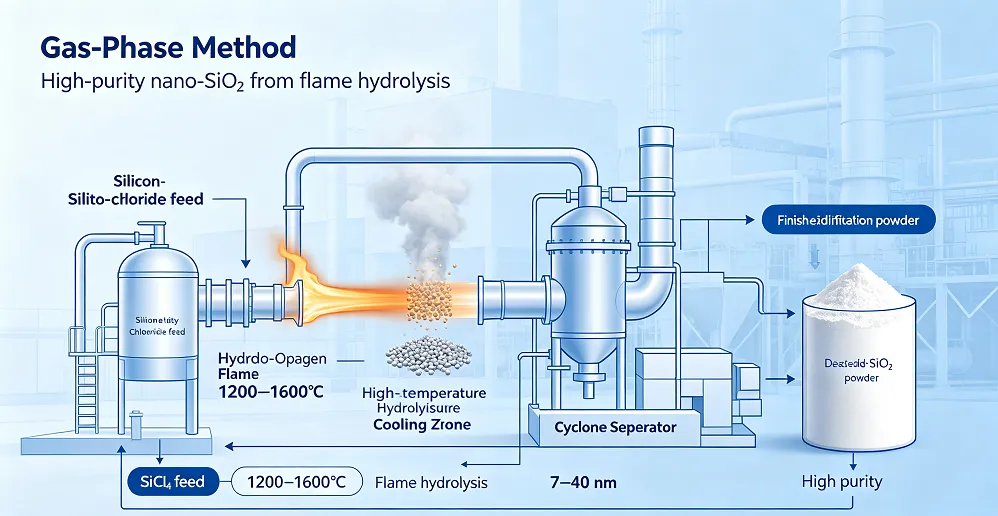
Gas-Phase Method
2. Precipitation Method
Nano-SiO₂ is obtained from silicate through an acidification reaction. This method has a simple preparation process, low energy consumption, wide sources of raw materials, and low price, but the particle size of the product is affected by factors such as the type, concentration, and stirring speed of the acidifier. Moreover, the morphology of the prepared products is difficult to control, the pore size distribution is wide, aggregate particles are easy to form, and the quality is not as good as that of the products prepared by the gas phase method and sol-gel method, so they usually cannot show the proper characteristics of nano-materials, and are often used as ordinary fillers for polymer reinforcement and toughening.
SiO₂ prepared by the precipitation method has not only high water absorption but also weak heat resistance and electrical properties compared with the gas phase method. When it is extruded, it is easy to be accompanied by the foaming phenomenon, which makes it difficult for hot air to be vulcanized. Compared with the gas phase method, the reinforcement effect is poor.
3. Sol-Gel Method
The sol-gel method is a wet-chemical route that typically uses silicon alkoxides such as tetraethyl orthosilicate (TEOS) as precursors, which undergo hydrolysis and condensation reactions in a solvent medium, usually in the presence of an acid or base catalyst. By adjusting parameters such as pH, temperature, water-to-precursor ratio, aging time, and drying conditions, this method can produce silicon dioxide powders with high purity, uniform particle size, and controlled porosity. The sol-gel process allows for the incorporation of functional dopants or organic groups into the silica matrix, enabling hybrid materials for sensing, catalysis, drug delivery, and optical coatings. However, the method involves relatively long processing times, higher raw material costs, and challenges in scaling up to industrial volumes, limiting its use mainly to specialty applications.
4. Microemulsion Method
The microemulsion method utilizes thermodynamically stable dispersions of water, oil, and surfactant to create nanoscale water droplets that act as micro-reactors for the precipitation of silica precursors. By confining the hydrolysis and condensation reactions within these droplets, the method provides exceptional control over particle size, narrow size distribution, and well-defined spherical morphology. This approach is attractive for preparing ultra-fine silicon dioxide powders with tailored surface properties for applications in catalysis, bioseparation, and advanced nanocomposites. However, the method requires large amounts of organic solvents and surfactants, increasing production costs and posing environmental and recycling challenges, thus restricting its use to laboratory-scale research and niche industrial production.
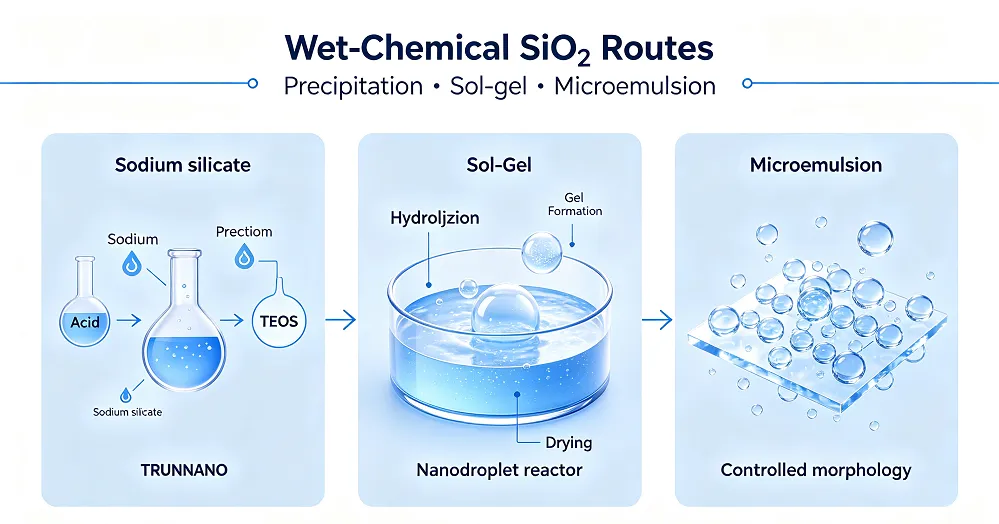
Wet-Chemical SiO₂ Routes
5. Summary of Preparation Methods
Each of the above methods has its own advantages and limitations. The gas-phase method produces the highest purity and finest primary particles but at the highest cost and with the most complex equipment requirements. The precipitation method is the most economical and scalable, though its product quality and reinforcement performance are inferior to those of the gas-phase and sol-gel routes. The sol-gel method offers excellent purity and structural control but is limited by high material costs and scale-up difficulties. The microemulsion method provides the finest size control but is hindered by high solvent usage and low throughput. In practice, the selection of a specific preparation method depends on the target application, required product specifications, production volume, and economic considerations. For bulk industrial fillers, precipitation is the preferred choice; for high-performance nano-silica, the gas-phase method dominates; and for functional or specialty materials, sol-gel and microemulsion methods are more suitable.

Compare SiO₂ Preparation Routes
Silicon dioxide powder particle size and purity will affect the product's price, and the purchase volume can also affect the cost of Silicon dioxide powder. A large amount of large amount will be lower. The price of Silicon dioxide powder can be found on our company's official website.
Silicon dioxide powder supplier
Luoyang Tongrun Nano Technology Co. Ltd. (TRUNNANO) Luoyang City, Henan Province, China, is a reliable and high-quality global chemical material supplier and manufacturer. It has more than 12 years of experience providing ultra-high quality chemicals and nanotechnology materials, including Silicon dioxide powder, nitride powder, Silicon dioxide powder, sulfide powder, and 3D printing powder. If you are looking for high-quality and cost-effective Silicon dioxide powder, you are welcome to contact us or inquire any time.