
Comprehensive Guide on Chromium Oxide (Cr2O3): Preparation Methods, Properties, and Diverse Applications in Advanced Industries
Chromium oxide (Cr2O3) is an inorganic compound of chromium and oxygen ions. Its chemical formula is Cr2O3, with a molecular weight of 151.99 grams per mole. It is a solid with a green color, a melting point of 2435 ° C, a boiling point of 4000 ° C, and a density of 5.22 grams per cubic centimeter. Chromium oxide is relatively rare and mainly exists in minerals such as chromite and chromite.

Chromium oxide
Chromium is an important metal element with good corrosion resistance, high-temperature strength, and wear resistance. Chromium oxide is one of the most important oxides of chromium and has a wide range of applications. The following will introduce the physical and chemical properties, preparation methods, and application fields of chromium oxide.
Physical properties
Appearance and color: Chromium oxide is a green solid with a polyhedral structure and a certain degree of transparency. Commercial products typically present as deep green powder with a hexagonal crystal system or amorphous olive-green powder form, exhibiting a metallic luster. This chromium oxide color makes the compound valuable as a pigment.
Density: The density of chromium oxide is 5.22 g/cm³. This high density contributes to the robustness of this compound in various industrial applications requiring material stability.
Melting point and boiling point: The melting point of chromium oxide is 2435°C, and the boiling point is 4000°C. These exceptionally high thermal thresholds make this compound suitable for high-temperature applications such as refractory materials and high-temperature coatings.
Thermal expansion coefficient: Chromium oxide's thermal expansion coefficient is 5.94 × 10⁻⁶/°C. This low coefficient allows for stable dimensional performance of this oxide under temperature fluctuations.
Thermal conductivity: The thermal conductivity of chromium oxide is 0.128 W/m·K, providing moderate heat transfer capabilities in thermal management applications.

Chromium oxide
Chemical properties
Solubility: Chromium oxide is insoluble in water and most acids but soluble in concentrated sulfuric acid and hydrofluoric acid. This selective solubility enables the use of this compound in specific chemical processing and purification operations.
Chemical reaction: Chromium oxide can react with alkaline substances to produce corresponding chromium salts. This oxide can undergo a reduction reaction with hydrogen gas at high temperatures, generating chromium and water vapor. In addition, chromium oxide also has good oxidizing properties and can react with metals such as aluminum and silicon at high temperatures, making this compound useful in thermite-type reactions and metallurgical processes.
Preparation method
Oxidation method: Chromium oxide can be prepared by heating chromium or chromium compounds to high temperatures and reacting with oxygen. Common methods include the calcination of chromate and the calcination of sodium chromate.This method is widely employed in industrial-scale production due to its simplicity and cost-effectiveness.
Hydrolysis method: Chromium oxide can be prepared by hydrolyzing chromium chloride or chromium nitrate. This wet-chemical route offers better control over particle morphology and is suitable for producing high-purity materials.
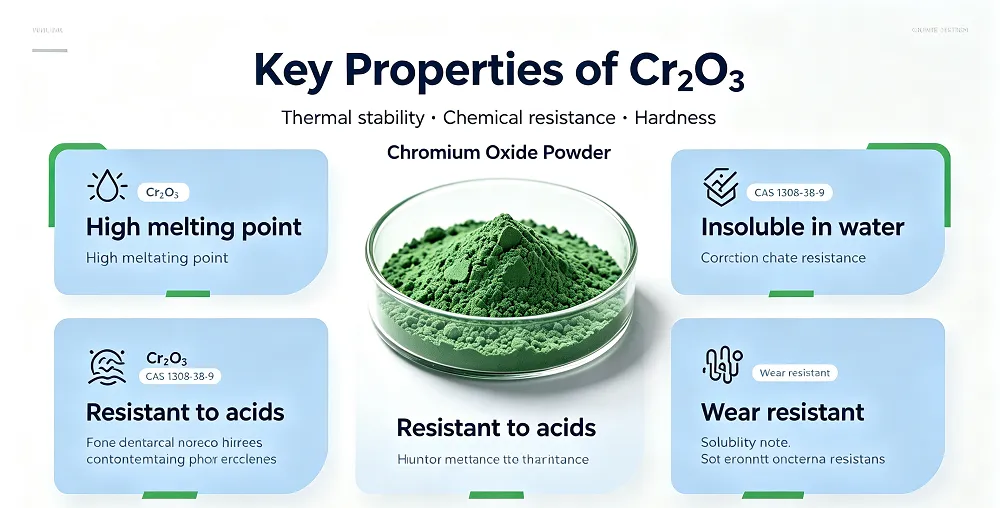
Chromium Oxide Cr₂O₃ Powder
Application field
Manufacturing ceramics: Chromium oxide has good wear and corrosion resistance and is often used to manufacture ceramic materials. This compound can be added to the glaze to enhance the hardness and wear resistance of the ceramic surface. Additionally, chromium oxide is utilized in the production of refractory bricks and high-temperature sealing materials, leveraging the exceptional thermal stability of this oxide.
Pigments: Due to its bright green color, chromium oxide is widely used in manufacturing pigments. This compound is used in pigments, paints, plastics, and rubber fields. Chromium oxide is particularly valued in enamel, ceramic, glass, leather, building materials, and camouflage coatings, where the excellent lightfastness, chemical resistance, and thermal stability of this pigment ensure long-lasting performance.
Steel metallurgy: Chromium oxide is widely used in the steel metallurgy industry. This compound can be added to stainless steel to improve its corrosion and heat resistance. Furthermore, chromium oxide is utilized in smelting chromium metal and chromium carbide, as well as in the production of various chromium-containing alloys.
Glass manufacturing: Chromium oxide can be used to manufacture green glass. This compound can be added to glass raw materials in the glass manufacturing process to produce a unique green color. In optical glass applications, chromium oxide contributes to specific light absorption characteristics.
Electronic materials: Chromium oxide has good electrical and thermal properties, so this compound can manufacture electronic materials. Chromium oxide can manufacture electronic components such as capacitors, resistors, and thermistors. Chromium oxide thin films also find applications in solar cells, integrated circuits, sensors, and photovoltaic materials, capitalizing on the tunable bandgap and semiconductor characteristics of this oxide.
Other applications: Chromium oxide can manufacture ceramic fibers, high-temperature sealing materials, high-temperature coatings, metal surface treatment agents, and other fields.
| Industry | Role of Chromium Oxide (Cr₂O₃) | Key Property Utilised |
|---|---|---|
| Pigments & Coatings | Green pigment in paints, plastics, rubber, and camouflage coatings | Color stability, lightfastness, chemical resistance |
| Ceramics | Additive in glazes, refractory bricks, and high-temperature sealing materials | Wear resistance, corrosion resistance, thermal stability |
| Steel Metallurgy | Additive to stainless steel; used in smelting chromium metal and alloys | Corrosion resistance, heat resistance |
| Glass Manufacturing | Colorant for green glass and optical glass applications | Colour stability, heat resistance |
| Electronics | Thin films for solar cells, sensors, capacitors, and integrated circuits | Semiconductor properties, tunable bandgap |
| Advanced Materials | Nanostructured oxides for biomedical and environmental applications | Biocompatibility, surface reactivity |
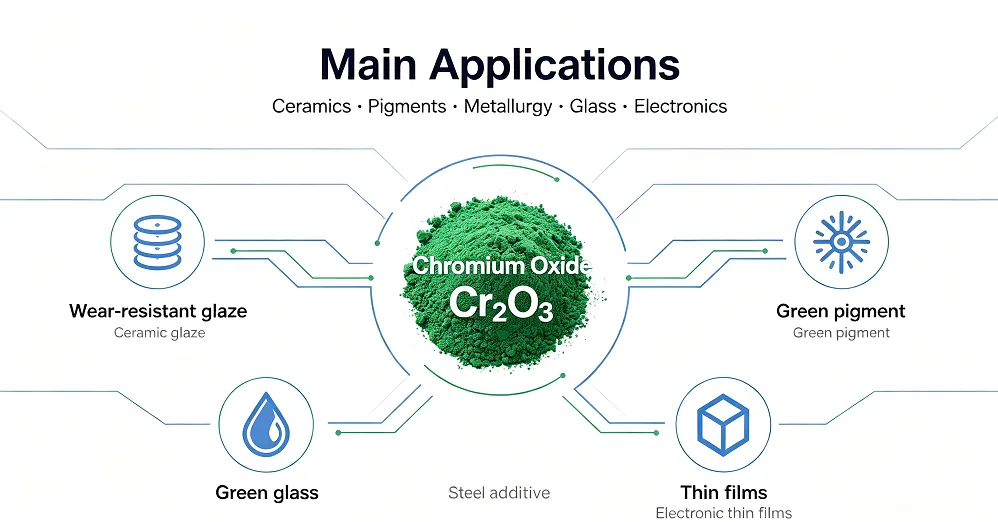
Chromium Oxide Main Applications
Future Perspectives
The future development of chromium oxide materials is focused on several promising directions:
Nanostructure engineering – Precise control of synthesis parameters (temperature, pressure, dopants, etc.) will enable the production of nanoparticles with tailored morphologies and sizes, optimizing magnetic, optical, and electrochemical properties for specific applications.
Doping and compositional modification – Doping with transition metal ions such as cobalt (Co), nickel (Ni), or manganese (Mn) effectively tunes the band structure and electrochemical properties of chromium oxide, expanding its utility in energy-related applications.
Thin film device development – Advanced deposition techniques such as reactive magnetron sputtering, atomic layer deposition (ALD), and pulsed laser deposition (PLD) can produce high-quality chromium oxide films to meet the demanding requirements of solar cells, sensors, integrated circuits, and next-generation electronic devices.
Biomedical expansion – Chromium oxide nanomaterials show potential in antibacterial therapy and non-enzymatic glucose detection for antibiotic-resistant bacterial infections and diabetes management. Further research is needed to evaluate biocompatibility and enable clinical translation.
Sustainability and circular economy – Development of more sustainable synthesis routes, including greener precursors, lower processing temperatures, and recyclable solvents, aligns with global sustainability goals.
Integration with other advanced materials – The integration of chromium oxide with other functional materials, such as carbon nanomaterials (graphene, carbon nanotubes) and other metal oxides, may produce hybrid composites with synergistic properties, opening new application frontiers in energy storage, catalysis, and sensing.

Future and Supply
Comparison Table: Chromium Oxide (Cr₂O₃) vs. Other Common Metal Oxides
|
|---|
FAQ: Frequently Asked Questions About Chromium Oxide (Cr₂O₃)
Q: What is the formula for chromium oxide?
A: The chemical formula for chromium oxide is Cr₂O₃, which is also called chromium iii oxide or chromium(3) oxide. If you search for "chromium iii oxide formula" or "chromium (iii) oxide formula", this is the same compound. There is also chromium ii oxide (CrO), but Cr₂O₃ is the most common and stable oxide of chromium.
Q: What is the oxidation number of chromium in Cr₂O₃?
A: In Cr₂O₃, the oxidation number of each chromium atom is +3. Since oxygen has an oxidation number of -2, and there are three oxygen atoms (total -6), the two chromium atoms must have a total of +6, giving each chromium an oxidation number of +3. This is why the compound is also called chromium(iii) oxide or chromium 3 oxide.
Q: What is the oxidation number of chromium in K₂Cr₂O₇?
A: In potassium dichromate (K₂Cr₂O₇), the oxidation number of chromium is +6. This is a much higher oxidation state compared to Cr₂O₃ (+3). The question "What is the oxidation number of chromium in k2cr2o7? " is very common because chromium exhibits multiple oxidation states ranging from 0 to +6.
Q: What is the empirical formula of an oxide of chromium?
A: For chromium oxide (Cr₂O₃), the empirical formula is the same as the molecular formula: Cr₂O₃. The ratio of chromium to oxygen atoms is 2:3. Other chromium oxides include CrO (chromium(II) oxide) and CrO₃ (chromium trioxide), but Cr₂O₃ is the most stable and commercially important chromium oxide.
Q: What is the molar mass of chromium oxide?
A: The molar mass of chromium oxide (Cr₂O₃) is approximately 151.99 g/mol. This value is calculated by adding two chromium atoms (2 × 51.996) and three oxygen atoms (3 × 16.00). Knowing the chromium oxide molar mass is essential for stoichiometric calculations in synthesis, ceramic formulations, and pigment production.
Q: What are the properties of chromium oxide?
A: Chromium oxide (Cr₂O₃) has a green color, a high melting point of 2435°C, and a density of 5.22 g/cm³. This compound is insoluble in water and most acids but dissolves in concentrated sulfuric acid. The chromium oxide crystal structure is hexagonal, and the oxide exhibits high hardness (Mohs 8–9), making it suitable for abrasive and refractory applications.
Q: How is chromium oxide prepared?
A: Chromium oxide can be prepared by two main methods. The oxidation method involves heating chromium or chromium compounds with oxygen at high temperatures. The hydrolysis method involves hydrolyzing chromium chloride or chromium nitrate, offering better control over particle size and purity. The calcination of sodium chromate is a common industrial route for producing chromium oxide.
Q: What is chromium oxide used for?
A: Chromium oxide has diverse uses. This compound is used as a green pigment in paints, plastics, and ceramics (the chromium oxide color is highly stable). Chromium oxide is also added to stainless steel to improve corrosion resistance, used in glass manufacturing to produce green glass, and applied in electronic materials such as capacitors and sensors. Additionally, this oxide serves as an abrasive, a refractory material, and a catalyst in various chemical reactions.
Q: Is chromium oxide toxic?
A: Chromium oxide (Cr₂O₃) is considered relatively low in toxicity compared to hexavalent chromium compounds (Cr⁶⁺). However, inhalation of fine chromium oxide dust can cause respiratory irritation, and some chromium compounds are classified as carcinogenic. Proper safety measures, including dust masks and ventilation, are recommended when handling chromium oxide powder.
Q: What is the difference between chromium oxide and chromium trioxide?
A: Chromium oxide (Cr₂O₃) is chromium(III) oxide with chromium in the +3 oxidation state, appearing as a green solid. Chromium trioxide (CrO₃) is chromium(VI) oxide with chromium in the +6 oxidation state, appearing as a dark red to purple crystalline solid. CrO₃ is highly toxic, carcinogenic, and strongly oxidizing, while Cr₂O₃ is more stable and less hazardous.
Q: Is chromium oxide soluble in water?
A: No, chromium oxide is insoluble in water. This compound is also insoluble in most acids but dissolves in concentrated sulfuric acid and hydrofluoric acid. The insolubility of this oxide in water makes it suitable as a stable pigment and refractory material that does not leach out in aqueous environments.
Q: What color is chromium oxide?
A: The chromium oxide color is green. This compound ranges from olive-green to deep green depending on particle size and purity. Because this green color is highly stable against heat, light, and chemicals, chromium oxide is widely used as a pigment in paints, ceramics, glass, and camouflage coatings.
High-quality chromium oxide powder supplier
TRUNNANO is a trusted global chemical materials supplier and manufacturer with over 12 years of experience in ultra-high quality nanomaterials and chemicals. The company develops a variety of powder materials and chemicals. Provide OEM services. If you are looking for chromium oxide powder, please contact us. You can click on the product to contact us.