In extreme industrial environments characterized by high temperatures, heavy loads, and oxidative atmospheres, conventional lubricants—such as liquid oils, greases, and graphite—fail to maintain stable lubricating performance, leading to severe mechanical wear, energy loss, and equipment failure. Molybdenum disulfide (MoS₂) powder has emerged as a premier high-temperature lubricating material, owing to its unique crystal structure, exceptional thermal stability, and superior tribological properties. This article systematically analyzes the intrinsic advantages of MoS₂ powder for high-temperature lubrication, including its layered crystal structure, outstanding thermal and chemical stability, adaptability to extreme conditions, and long service life. By comparing it with traditional lubricants and exploring its industrial applications, this paper demonstrates why MoS₂ powder is the optimal choice for high-temperature lubrication scenarios, providing theoretical and practical guidance for its widespread use in aerospace, automotive, metallurgy, and mechanical engineering.
High-temperature lubrication is a critical technical challenge in modern industrial manufacturing and extreme engineering applications. Scenarios such as aerospace engine components, high-speed train bearings, metallurgical furnace transmission parts, and heavy-duty mechanical equipment often operate at temperatures exceeding 300°C, even up to 1000°C, accompanied by high loads, vacuum, or oxidative environments. Traditional liquid lubricants (mineral oils, synthetic oils) undergo thermal decomposition, volatilization, and carbonization at high temperatures, losing their lubricating effect; polymer greases soften, melt, or oxidize rapidly, failing to form a stable lubricating film; graphite, a common solid lubricant, relies on adsorbed water vapor for lubricity and loses its effectiveness above 450°C in air due to oxidation into carbon dioxide. These limitations have spurred the demand for high-performance solid lubricants that can withstand extreme temperatures and harsh conditions.
Molybdenum disulfide (MoS₂), a typical layered transition metal dichalcogenide, has been widely recognized as a "king of solid lubricants" since its industrial application in the mid-20th century. Natural MoS₂ exists as molybdenite, and synthetic MoS₂ powder with high purity and uniform particle size has become a core material for high-temperature lubrication. Unlike traditional lubricants, MoS₂ powder maintains stable chemical and physical properties at ultra-high temperatures, forming a durable lubricating film on friction surfaces to reduce wear and friction coefficient. This article focuses on the intrinsic properties of MoS₂ powder, compares its performance with other lubricants, and elaborates on its unique advantages in high-temperature lubrication, revealing the fundamental reasons for its irreplaceability in extreme working conditions.
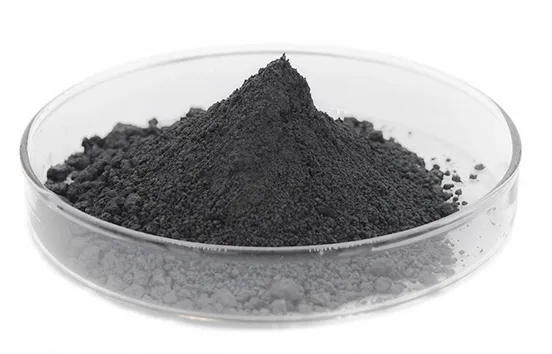
Molybdenum Disulfide Mos2
The excellent lubricating performance of MoS₂ powder originates from its hexagonal layered crystal structure. Each MoS₂ unit cell consists of a close-packed plane of molybdenum (Mo) atoms sandwiched between two layers of sulfur (S) atoms, forming a "S-Mo-S" sandwich monolayer structure. Within the monolayer, Mo and S atoms are connected by strong covalent bonds, giving the crystal high mechanical strength and stability; between adjacent monolayers, weak van der Waals forces act, resulting in low interlayer shear strength
When subjected to external shear stress during friction, the weak van der Waals bonds between MoS₂ layers easily break, allowing the layers to slide relative to each other with minimal resistance. This interlayer sliding mechanism endows MoS₂ with an extremely low friction coefficient (0.03–0.15 under dry friction conditions). More importantly, this layered structure remains stable at high temperatures: even at 800°C, the intralayer covalent bonds do not break, and the interlayer sliding mechanism is not damaged, ensuring continuous lubrication. In contrast, graphite’s layered structure depends on the adsorption of water molecules or gases to reduce interlayer friction; once desorbed at high temperatures, its lubricity drops sharply. The inherent layered structure of MoS₂ is independent of external media, making it inherently suitable for high-temperature and vacuum environments.
Thermal stability is the core indicator for evaluating high-temperature lubricants, and MoS₂ powder exhibits outstanding thermal resistance unmatched by most traditional lubricants. Pure MoS₂ has a melting point of up to 2375°C, and its thermal decomposition temperature in inert or vacuum environments exceeds 1370°C—meaning it does not decompose, volatilize, or undergo phase transitions at temperatures below 1000°C, maintaining its solid state and lubricating properties.
In atmospheric environments (oxidative conditions), MoS₂ undergoes slow oxidation to form molybdenum trioxide (MoO₃) and sulfur dioxide (SO₂) only when the temperature exceeds 400°C, and the oxidation rate remains extremely low below 540°C. The formed MoO₃ film is dense and adherent, acting as a protective layer to further inhibit internal MoS₂ oxidation, delaying performance degradation. In contrast, synthetic hydrocarbon oils completely decompose above 200°C, and graphite oxidizes rapidly above 450°C, losing 50% of its mass within hours. Even high-temperature greases can only operate stably below 250°C. The ultra-high thermal stability of MoS₂ powder allows it to maintain structural integrity and lubricating function in long-term high-temperature environments, meeting the lubrication needs of continuous operation equipment.
High-temperature industrial environments are often accompanied by corrosive gases (e.g., oxygen, sulfur dioxide, water vapor) and chemical pollutants, which can corrode lubricants and friction surfaces, accelerating lubrication failure. MoS₂ powder exhibits excellent chemical inertness: it is insoluble in water, dilute acids, and most organic solvents, and does not react with oxygen, alkalis, or metal materials at room temperature to high temperatures.
At high temperatures, even in weakly oxidative or corrosive atmospheres, MoS₂ does not undergo chemical corrosion or deterioration. Its inert surface prevents chemical adsorption with friction pair materials, avoiding the formation of hard abrasive particles that cause abrasive wear. In contrast, liquid lubricants are prone to oxidative deterioration at high temperatures, producing acidic substances that corrode metal surfaces; graphite reacts with active metals at high temperatures to form carbides, damaging both the lubricant and equipment. The chemical stability of MoS₂ powder ensures that it does not pollute the friction environment or corrode equipment components during high-temperature service, extending the service life of mechanical parts.
In addition to high temperatures, industrial lubrication scenarios often involve high loads, vacuum, radiation, and low-temperature coupling conditions, and MoS₂ powder shows excellent adaptability to these extreme environments. Under high static or dynamic loads (up to 1000 MPa), MoS₂ powder can be compacted into a dense, uniform lubricating film on the friction surface, preventing direct contact between metal surfaces and avoiding adhesive wear and abrasive wear. This high-load resistance is critical for heavy machinery operating at high temperatures, as traditional lubricants are squeezed out of the friction gap under high loads, losing lubrication.
In aerospace vacuum or low-pressure environments, MoS₂ powder does not volatilize or outgas, avoiding contamination of precision instruments and maintaining stable lubrication. It also exhibits good radiation resistance, maintaining performance under high-energy radiation, making it suitable for nuclear industry and aerospace applications. Additionally, MoS₂ powder retains its lubricity at ultra-low temperatures (-200°C), forming a "wide temperature range" lubrication system that covers both high and low temperature extremes—an advantage no single traditional lubricant can match.

Molybdenum Disulfide Lubricant
To further clarify the advantages of MoS₂ powder in high-temperature lubrication, a comparative analysis with mainstream traditional lubricants (liquid oils, graphite, polytetrafluoroethylene (PTFE), boron nitride (BN)) is conducted from the perspectives of service temperature, friction coefficient, thermal stability, and service life
Liquid lubricants (mineral and synthetic oils) rely on fluid viscosity to form a lubricating film, but their performance deteriorates sharply at high temperatures: volatilization reduces film thickness, thermal decomposition produces carbon deposits, and oxidative deterioration increases acidity. MoS₂ powder, as a solid lubricant, does not volatilize or decompose at high temperatures, forming a fixed lubricating film on the friction surface. Even under high loads, it is not squeezed out, ensuring continuous lubrication. For example, in automotive exhaust gas recirculation (EGR) valves operating at 400–500°C, MoS₂ powder replaces synthetic oil, reducing wear rate by 90% and extending component life by 5 times.
Graphite is the most widely used traditional solid lubricant, but its lubricity depends on adsorbed water molecules or gases. In high-temperature, dry, or vacuum environments, these adsorbates desorb, causing the friction coefficient to rise sharply and lubrication failure. MoS₂’s lubricity stems from its inherent layered structure, independent of external media, maintaining a low friction coefficient above 500°C. In metallurgical continuous casting rollers operating at 600°C, MoS₂ powder lubricates 3 times longer than graphite and reduces wear by 70%.
PTFE has a low friction coefficient at room temperature but softens and exhibits cold flow at high temperatures, failing under heavy loads. Hexagonal BN has high thermal stability but poor adhesion to metal surfaces, requiring binders for application, increasing process complexity. MoS₂ powder has strong adhesion to metal surfaces, forming a self-lubricating film without additional binders; it maintains mechanical strength at high temperatures without cold flow, adapting to high-load and high-temperature coupling conditions.

Graphite
The unique advantages of MoS₂ powder have led to its widespread use in high-temperature lubrication across various industries, solving critical technical bottlenecks in extreme environments.
Aerospace engine components (turbine blades, bearings, fuel nozzles) operate at 300–800°C, high vacuum, and high rotational speeds, requiring ultra-stable lubrication. MoS₂ powder is prepared as high-temperature lubricating coatings or added to high-temperature alloys as a self-lubricating phase. For example, MoS₂-based composite coatings on rocket engine bearings maintain a friction coefficient of 0.05 at 600°C, ensuring stable operation of launch vehicles. In satellite solar panel drive mechanisms, MoS₂ powder lubricates in vacuum and alternating high-low temperatures, with a service life exceeding 15 years.
In high-temperature components of fuel vehicles (turbocharger bearings, brake systems, clutch plates), MoS₂ powder replaces traditional greases, resisting 400–500°C high temperatures and reducing brake wear. In electric vehicle battery thermal management systems, MoS₂ powder lubricates high-temperature transmission gears, avoiding liquid lubricant leakage and improving safety. High-speed train axle bearings operating at 300–400°C use MoS₂ composite lubricants, reducing maintenance frequency by 80%.
Metallurgical furnace rollers, continuous casting molds, and steel rolling equipment operate at 500–1000°C, with high dust and heavy loads. MoS₂ powder is mixed with high-temperature binders to form lubricating coatings, preventing adhesion between steel billets and molds, reducing surface defects, and extending mold life by 3–5 times. In mining heavy-duty conveyor bearings, MoS₂ powder lubricates at 400°C, avoiding liquid lubricant freezing in low-temperature mines and high-temperature deterioration.
Precision instrument gears and high-temperature bearings in the nuclear industry require non-volatile, radiation-resistant lubricants. MoS₂ powder does not outgas in vacuum, resisting high-energy radiation, and is used in nuclear reactor control rod mechanisms and precision aerospace instruments, ensuring long-term stable operation without maintenance.

Industrial Applications of MoS₂ Powder
To further enhance the high-temperature lubrication performance of MoS₂ powder, researchers have conducted in-depth optimization studies, addressing its minor limitations (e.g., reduced performance in high-humidity environments and accelerated oxidation above 600°C).
MoS₂ powder is compounded with high-temperature materials (hexagonal BN, graphene, tungsten disulfide (WS₂), metal oxides) to prepare composite lubricants. For example, MoS₂/BN composites exhibit excellent lubricity at 800°C in air, with oxidation resistance increased by 40%. MoS₂/graphene composites combine the low friction of MoS₂ with the high thermal conductivity of graphene, dissipating friction heat and extending service life.
Nano-sized MoS₂ powder (particle size 10–100 nm) has a larger specific surface area and more active sites, forming a denser lubricating film on friction surfaces. Nano-MoS₂ has better dispersion and high-temperature stability than micron-sized powder, reducing friction coefficient by 30% at 500°C and showing excellent anti-wear properties.
Advanced coating processes (plasma spraying, magnetron sputtering, sol-gel) are used to prepare MoS₂-based high-temperature lubricating coatings, with strong adhesion to metal substrates and resistance to high-temperature peeling. These coatings operate stably at 800°C, meeting the lubrication needs of ultra-high-temperature equipment.
The selection of MoS₂ powder for high-temperature lubrication is determined by its intrinsic physical and chemical properties and superior performance compared to traditional lubricants. Its unique layered crystal structure provides an inherent low-friction mechanism; exceptional thermal and chemical stability ensure no decomposition or deterioration at 500–800°C; strong adaptability to high loads, vacuum, and corrosion makes it suitable for extreme environments; and wide industrial applications validate its practical value.
Unlike liquid lubricants, graphite, and polymer materials that fail in high-temperature scenarios, MoS₂ powder maintains stable lubricating performance, reducing equipment wear, extending service life, and lowering maintenance costs. With the development of advanced manufacturing, aerospace, and new energy industries, the demand for high-temperature lubrication will continue to rise. Through composite modification and nanostructuring, MoS₂ powder’s high-temperature performance will be further enhanced, solidifying its position as the preferred high-temperature lubricant. In summary, MoS₂ powder is an irreplaceable and optimal choice for solving high-temperature lubrication challenges in extreme industrial environments.
Luoyang Tongrun Nano Technology Co. Ltd. (TRUNNANO) Luoyang City, Henan Province, China, is a reliable and high-quality global MoS₂ powder supplier and manufacturer. It has more than 12 years of experience providing ultra-high quality chemicals and nanotechnology materials, including Hexagonal boron nitride, nitride powder, MoS₂ powder, sulfide powder, and 3D printing powder. If you are looking for high-quality and cost-effective MoS₂ powder, you are welcome to contact us or inquire any time.