In today's technological wave driven by the pursuit of high performance, miniaturization, and high reliability, a key material is quietly pushing the boundaries of multiple industries—Aluminum Nitride (AlN) Powder. This seemingly unremarkable white powder, with its near-perfect combination of properties, has become the material bridge connecting ideal designs to real-world products, sparking a profound transformation, especially in the fields of advanced ceramics and high-power electronics.

Aluminum Nitride Powder
The Exceptional Properties of Aluminum Nitride Powder
The reason Aluminum Nitride powder can become a "revolutionary" lies in its series of nearly perfect physical and chemical properties for engineering applications. These characteristics allow it to stand out in demanding environments.
1. Exceptional Thermal Conductivity
This is AlN's most notable feature. Its theoretical thermal conductivity is as high as 270-320 W/(m·K), which is 7-10 times that of Alumina (Al₂O₃). Among common ceramic materials, it is second only to expensive diamond and Boron Nitride. More crucially, AlN possesses excellent electrical insulation, making it the "holy grail" material for solving the heat dissipation challenges of high-power electronic devices. As the power density of electronic devices continues to rise and heat has nowhere to go, AlN provides a critical solution.
2. Excellent Thermodynamic and Electrical Properties
The Coefficient of Thermal Expansion (CTE) of AlN closely matches that of semiconductor materials like Silicon (Si) and Gallium Arsenide (GaAs). This match is vital; it ensures that the ceramic substrate and the chip remain firmly bonded during severe temperature cycling, avoiding failures like delamination, cracking, or performance degradation caused by thermal stress. Simultaneously, AlN has excellent dielectric strength and high resistivity, ensuring safe and reliable operation in high-voltage environments.
3. Outstanding Chemical and Mechanical Stability
Ceramic bodies sintered from AlN powder exhibit excellent corrosion resistance, withstanding attacks from most molten metals (like aluminum, copper) and salts. Their high mechanical strength and hardness ensure structural integrity and long service life under complex operating conditions.
As clearly shown in the table above, AlN achieves the best balance in terms of thermal conductivity, CTE matching semiconductors, and non-toxicity, which is the fundamental logic behind its revolutionary applications.
Evolution of Aluminum Nitride Powder-Driven Electronics Industry
The electronics industry is the primary application field for AlN powder, and its influence runs through the entire chain from chip packaging to end systems.
1. High-End Chip Packaging and Thermal Management Substrates
With the computing power explosion in chips for 5G, AI, and autonomous driving, the heat generated per unit area has increased dramatically. Traditional Alumina substrates are no longer sufficient. AlN ceramic substrates (such as DPC, DBC, AMB substrates) have become the preferred choice for core components like IGBT modules, laser diodes/LEDs, and RF modules due to their exceptional heat transfer capabilities. They act like efficient "heat movers," keeping the chip junction temperature within a safe range, directly enhancing the device's power density, reliability, and lifespan.
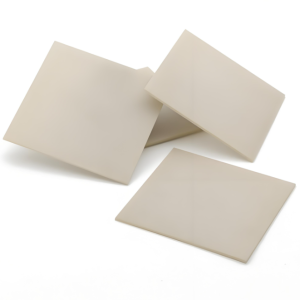
Aluminum Nitride Ceramics
2. Critical Consumables in Semiconductor Manufacturing
AlN's high-temperature resistance and corrosion resistance make it an ideal material for Electrostatic Chucks (ESCs) and etching rings in semiconductor manufacturing. In plasma environments, AlN components perform stably with low contamination risk, which is crucial for ensuring chip manufacturing yield and precision.
3. The Foundation of Next-Generation Wireless Communication
In 5G/6G communication base stations and millimeter-wave devices, AlN ceramic packaging with low dielectric constant and low loss can significantly reduce signal transmission delay and loss, improving communication quality and efficiency. It supports the development of faster and more stable global wireless networks.
3. Reshaping the Advanced Ceramics Industry
AlN powder not only upgrades existing industries but also fosters entirely new high-end ceramic applications.
1. High-Performance Structural Ceramics
Utilizing AlN's high-temperature strength, thermal shock resistance, and wear resistance, it can be used to manufacture high-temperature resistant components, crucibles, and wear parts for semiconductor equipment and aerospace fields. In these extreme environments, AlN ceramics demonstrate irreplaceable value.
2. Functional Composite Materials
AlN powder can be used as a high-performance filler added to polymer or metal matrices to create composite thermal pads, thermal greases, or packaging materials with high thermal conductivity and high insulation. These are widely used in new energy vehicle battery management, flexible circuits, and other fields.
3. Optics and Protective Applications
High-purity, dense AlN ceramics have good infrared transmittance and can be used to manufacture infrared windows and sensor housings. Its high hardness and chemical stability are also suitable for special protective applications.
Addressing Challenges and Future Outlook
Despite its significant advantages, the large-scale application of AlN still faces two major challenges: sintering difficulty and cost. AlN has low sintering activity, typically requiring sintering aids (like Y₂O₃) and high-temperature inert atmospheres, resulting in a narrow process window and extremely high requirements for the purity, particle size, and oxygen content of the raw powder. This directly leads to its higher cost compared to traditional alumina ceramics.
However, technological progress is continuously breaking through these barriers:
Innovations in Powder Preparation Processes: Methods like Self-propagating High-temperature Synthesis (SHS) and plasma processes are producing finer, purer, and more sinterable AlN powder.
Advanced Sintering Technologies: The application of techniques like Spark Plasma Sintering and Hot Pressing lowers sintering temperatures and improves product density and performance.
Market Demand Drives Scalability: With surging demand for high-power-density devices in fields like new energy vehicles, photovoltaic inverters, and rail transportation, market growth is driving AlN production towards scalability, thereby reducing costs.
Conclusion
The "revolutionary" nature of Aluminum Nitride powder is no exaggeration. Through breakthroughs in materials science, it precisely addresses the era's urgent needs for efficient heat dissipation, high reliability, and high performance. From lighting an LED chip to powering an electric vehicle to ensuring the stable operation of a data center, AlN is omnipresent. It is not merely an "accelerator" for the upgrading of the advanced ceramics and electronics industries; it is the "key" unlocking the future of the trillion-dollar high-power electronics and third-generation semiconductor industries. Choosing and mastering this key material means seizing a crucial initiative in the next round of technological competition. And this material-driven revolution has only just begun.
supplier
Luoyang Tongrun Nano Technology Co. Ltd. (TRUNNANO) Luoyang City, Henan Province, China, is a reliable and high-quality global chemical material supplier and manufacturer. It has more than 12 years of experience providing ultra-high quality chemicals and nanotechnology materials, including Hexagonal boron nitride, nitride powder, Hexagonal boron nitride powder, sulfide powder, and 3D printing powder. If you are looking for high-quality and cost-effective Hexagonal boron nitride powder, you are welcome to contact us or inquire any time.