What is Cuprous Oxide Cu2O?
Cuprous oxide, the chemical formula is Cu2O, is a univalent copper oxide, bright red powder solid, almost insoluble in water, in acidic solution disproportionation into bivalent copper and copper elemental, gradually oxidized in wet air into black copper oxide.
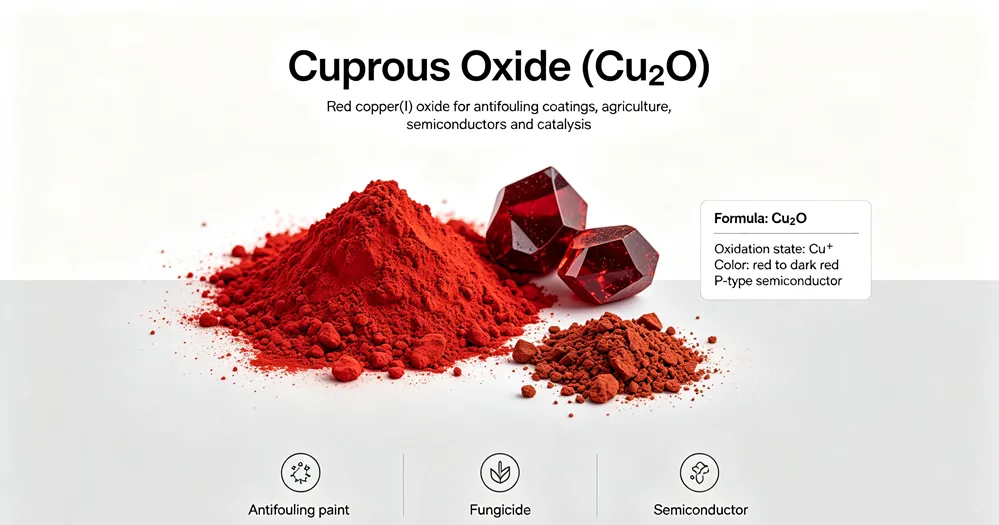
Cuprous Oxide (Cu₂O)
Cuprous oxide (Cu₂O) is one of the two stable oxides of copper, the other being cupric oxide (CuO). While Cu₂O contains copper in the +1 oxidation state, CuO contains copper in the +2 state. This difference in oxidation state leads to distinct chemical behaviors: Cu₂O is a red or dark red crystalline powder, while CuO is black. Cu₂O has a cubic crystal structure and is a p-type semiconductor with a direct bandgap of approximately 2.1 eV, making it valuable for photovoltaic and optoelectronic applications. The compound is practically insoluble in water but dissolves in acids and ammonia solutions. Its distinctive red color makes it valuable as a pigment in ceramics and glass manufacturing. The material's ability to undergo reversible redox reactions is key to its catalytic and electrochemical performance. The global demand for cuprous oxide is driven by its widespread applications in antifouling paints, fungicides, catalysts, and electronic materials. Recent research has focused on the development of nanostructured Cu₂O for enhanced performance in energy storage, sensing, and environmental remediation applications. The compound's low cost and abundance of copper make it an economically attractive material for large-scale industrial applications.
Cuprous oxide is commonly used as pigment, fungicide, and antifouling agent in Marine coatings. Rectifier diodes based on this material were used in industry as early as 1924, long before silicon became the standard. Copper oxide (I) is also responsible for the positive pink color of Benedict's test.
Cu₂O vs CuO
What is Cupric and Cuprous Oxide?
Copper is a red-orange metal with high conductivity to heat and electricity. It shares this ability with silver and gold because each of these elements has a "free-agent" electron that can negotiate chemical bonds with any available atom around it. All the other electrons are tightly bound to their group, but this one is susceptible to transfer.
When copper is exposed to a water molecule (two hydrogens and one oxygen), this free electron is transferred to a neighboring oxygen atom, binding it into a single molecule. If only one copper atom is bound to the oxygen molecule, it is called copper oxide. If two copper atoms bond with one oxygen atom, it is cuprous oxide. Copper oxide is considered "fully oxidized" while cuprous oxide remains active.
The key to cuprous oxide is its active state, which makes it very effective as a fungicide. It's still producing reactive oxygen, highly reactive molecules. These are unstable molecules that can cause damage to cellular structures.
The use of cuprous oxide in antifouling paints is one of its most important and well-established applications. When incorporated into ship-bottom paints, Cu₂O gradually releases copper ions that are toxic to barnacles, algae, and other marine organisms, preventing their attachment to ship hulls. This application significantly reduces fuel consumption by maintaining a smooth hull surface and minimizing drag. The use of Cu₂O in rectifier diodes dates back to the 1920s, when copper oxide rectifiers were used in early radio and electronic equipment. Although largely replaced by silicon-based devices, Cu₂O continues to be studied for its semiconductor properties in photovoltaic cells and photodetectors. The pink color of Benedict's test, used for detecting reducing sugars, is due to the formation of Cu₂O precipitate.
The antifungal and antimicrobial properties of cuprous oxide are attributed to its ability to release copper ions (Cu⁺) and generate reactive oxygen species (ROS). These reactive species can damage microbial cell membranes, interfere with essential enzymatic functions, and disrupt cellular processes. The effectiveness of Cu₂O as a fungicide is due to its gradual release of copper ions in the presence of moisture, providing long-lasting protection against fungal growth. The use of Cu₂O in agriculture as a fungicide and seed dressing agent helps protect crops from fungal diseases, improving yields and quality. The development of new Cu₂O-based formulations with controlled release properties continues to expand its application range in agriculture and horticulture.
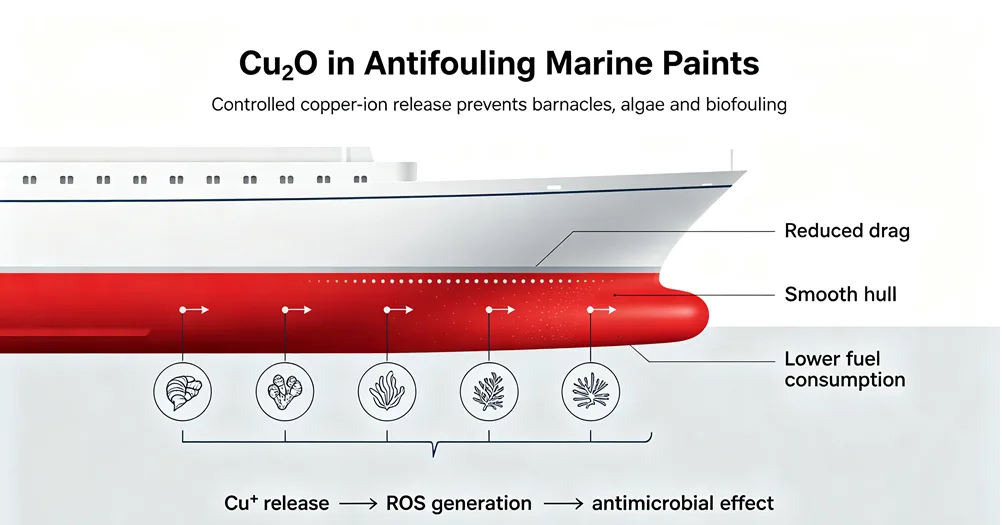
Cu₂O in Antifouling Marine Paints
Antifouling paint for ships and ship bottoms; It is an effective control of corrosion.
Paint for glass and porcelain.
Used as p-type semiconductor material for the manufacture of photocells for light meters and for the manufacture of rectifiers.
Used as a fungicide and seed dressing agent.
Cuprous oxide is commonly used as a catalyst in the production of other chemicals. Used for manufacturing zinc chloride, ferrous chloride, etc. It is also used as a UV absorber in surface treatment products.
Cuprous oxide is one of the most common oxides in batteries, accounting for 9% to 15% of all batteries. It is also used in metal production, construction and construction, and in the production of plastics and other organic compounds. It is an ingredient in some paints and is used as an oxidant in many metal plating processes.
Used in industrial and construction industries as ultra-high purity reagents, catalysts and effective preservatives. It is particularly suitable for manufacturing and process control, as well as the construction industry. It is also used in water treatment, particularly for purifying water to remove dissolved particles and for polymerization of specific polymers.
Used as a catalyst in metallurgy, the process is important for steel production. Catalysts act as reducing agents in the oxidation of iron.
Used as pigments and flame retardants, and as a flux in metal smelting.
In the electronics industry, cuprous oxide is used as a p-type semiconductor material for the manufacture of photocells, light meters, and rectifiers. Its direct bandgap of approximately 2.1 eV makes it suitable for photovoltaic applications, including solar cells. The use of Cu₂O in gas sensors takes advantage of its electrical resistance changes upon exposure to gases such as carbon monoxide and nitrogen dioxide. In catalysis, Cu₂O is used for various chemical reactions, including the synthesis of organic compounds and the degradation of pollutants. The use of Cu₂O in water treatment is based on its ability to adsorb heavy metals and organic contaminants. In the construction industry, Cu₂O is used as a pigment and preservative in paints and coatings. The development of new Cu₂O-based materials for energy storage, sensing, and environmental remediation continues to expand its application range. The versatility of cuprous oxide in these diverse applications reflects its unique combination of properties and its importance in modern industry.
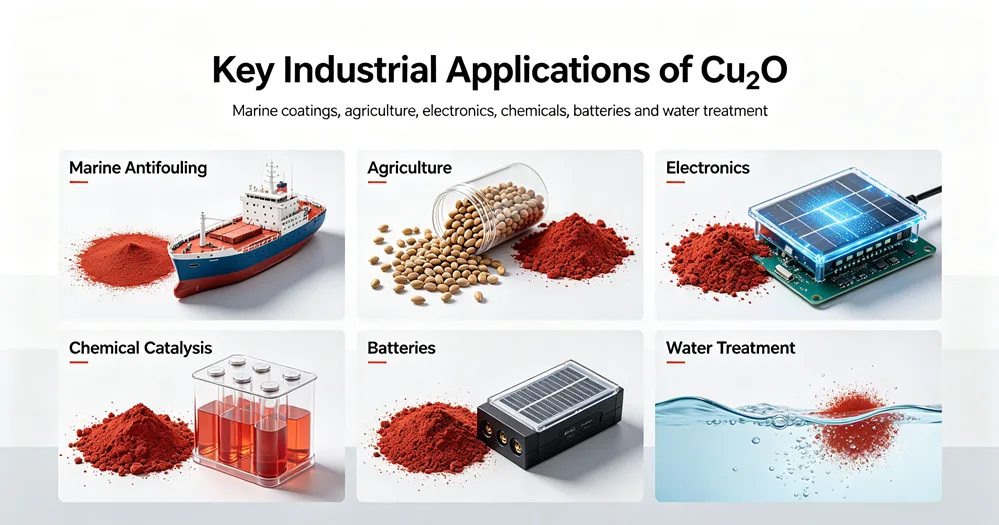
Key Industrial Applications of Cu₂O
Key Applications of Cuprous Oxide by Industry
| Industry |
Application |
Key Benefits |
| Marine |
Antifouling paints for ship hulls |
Prevents marine growth, reduces drag, saves fuel |
| Agriculture |
Fungicide, seed dressing agent |
Protects crops from fungal diseases |
| Electronics |
p-Type semiconductor, photocells, rectifiers, gas sensors |
Direct bandgap, photovoltaic properties |
| Chemical |
Catalyst for organic synthesis, zinc chloride production |
Catalytic activity, selectivity |
| Batteries |
Electrode material, oxidant in metal plating |
Electrochemical properties |
| Construction |
Pigment, preservative, flame retardant |
Color stability, durability |
| Water Treatment |
Adsorbent for heavy metals, polymerization catalyst |
Contaminant removal |
| Metallurgy |
Catalyst for steel production, reducing agent |
Improves steel quality |
| Ceramics & Glass |
Pigment for red glass, porcelain, ceramics |
Color intensity, stability |
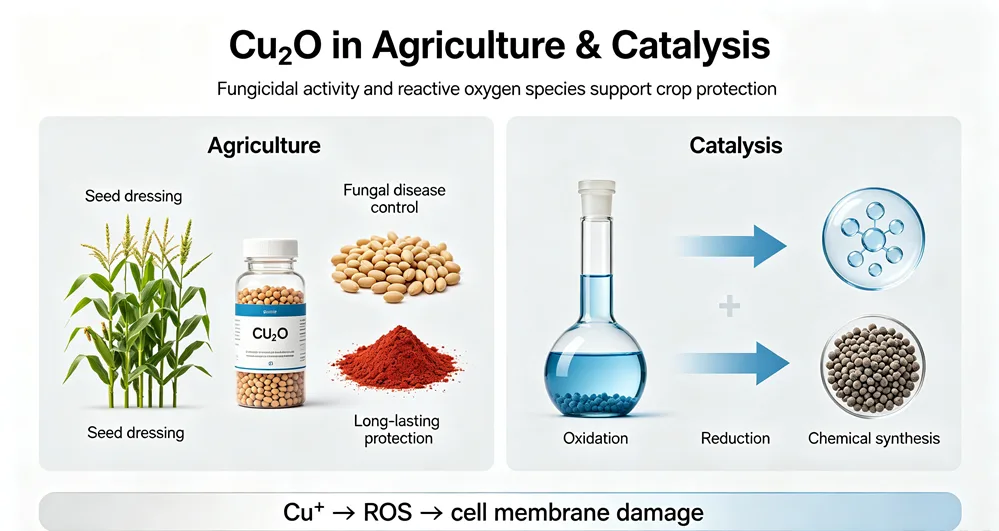
Cu₂O in Agriculture & Catalysis
The price is influenced by many factors including the supply and demand in the market, industry trends, economic activity, market sentiment, and unexpected events.
If you are looking for the latest cuprous oxide powder price, you can send us your inquiry for a quote. (sales3@nanotrun.com)
Cuprous Oxide Supplier
TRUNNANO is a trusted global Cuprous Oxide supplier & manufacturer with over 12-year-experience in providing super high-quality chemicals and nanomaterials including silicon powder, nitride powder, graphite powder, zinc sulfide, calcium nitride, 3D printing powder, etc.
If you are looking for high-quality Cu2O, please feel free to contact us and send an inquiry. (sales3@nanotrun.com)
Tags: Cuprous Oxide, Cu₂O, Antifouling Paint, Fungicide, p-Type Semiconductor, Catalyst