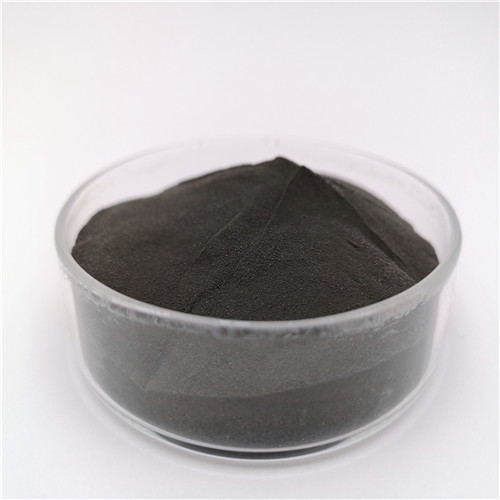
Copper oxide (CuO) is one of the two stable oxides of copper, the other being cuprous oxide (Cu₂O). While CuO contains copper in the +2 oxidation state, Cu₂O contains copper in the +1 state. This difference in oxidation state leads to distinct chemical behaviors: CuO is more reactive and readily dissolves in acids to form copper(II) salts, whereas Cu₂O is less reactive and is often used as a red pigment. CuO is also a p-type semiconductor with a narrow band gap, which underlies many of its advanced optoelectronic applications. As a transition metal oxide, copper oxide exhibits both catalytic activity and antimicrobial properties, contributing to the versatility of this compound across numerous industrial sectors. The black color and high stability of CuO make it a valuable pigment and industrial intermediate. The global demand for copper oxide is driven by its widespread applications in ceramics, batteries, catalysts, and electronic materials. Recent research has focused on the development of nanostructured CuO for enhanced performance in energy storage, sensing, and environmental remediation applications. The ability of this compound to undergo reversible redox reactions, with copper cycling between Cu(II) and Cu(I) oxidation states, is key to the catalytic and electrochemical performance of copper oxide. The low cost and abundance of copper make CuO an economically attractive material for large-scale industrial applications. The environmental and health considerations associated with copper compounds have led to the development of safer handling and processing methods for copper oxide, ensuring the continued sustainable use of this important material.
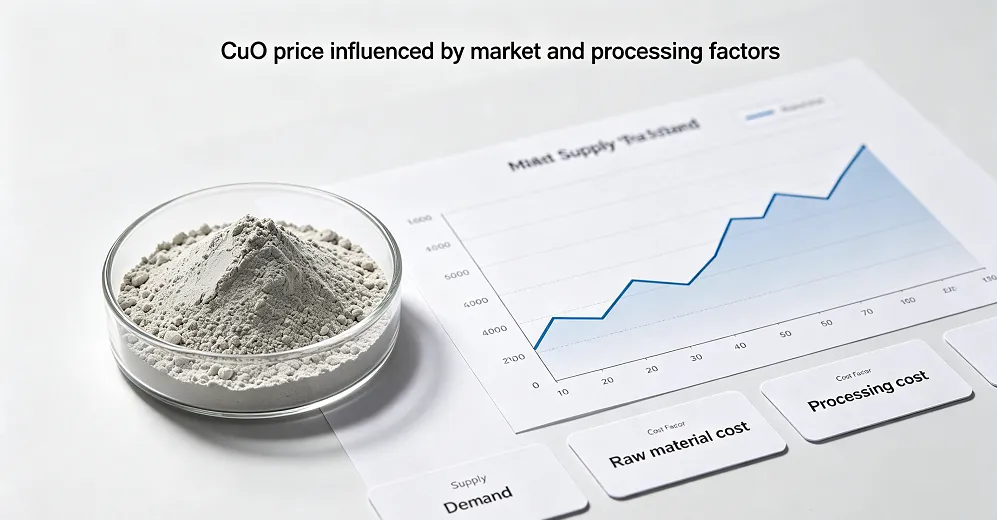
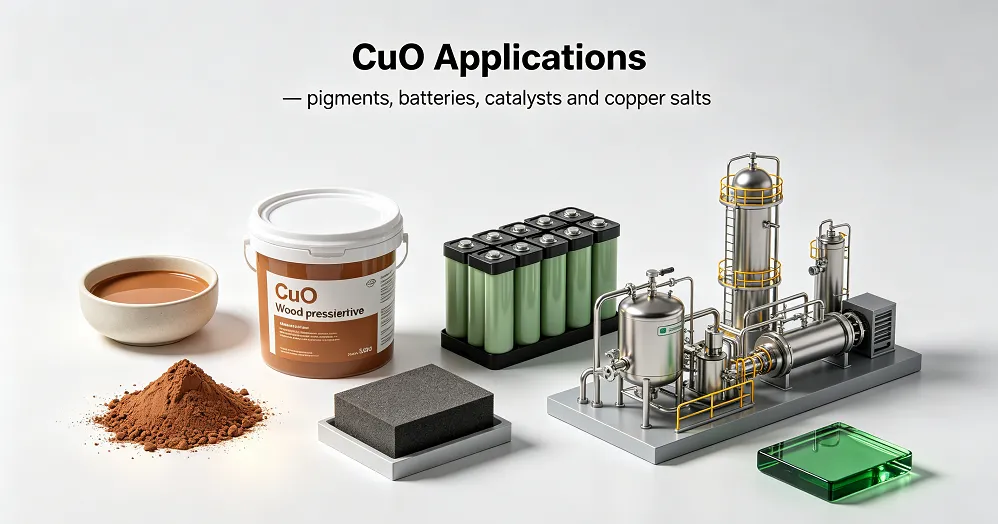
As an essential product of copper mining, copper oxide (II) is the starting point for producing other copper salts. For example, many wood preservatives are made from copper oxide.
Copper oxide is used as a pigment in ceramics to produce blue, red, and green, and sometimes grey, pink, or black glazes.
CuO is mistakenly used as a dietary supplement in animal feed. Due to low bioactivity, the absorbed copper is negligible.
Copper oxide is used for welding with copper alloy.
Copper oxide electrodes formed part of an early battery type called the Edison-Lalande cell. Copper oxide is also used in lithium battery types.
CuO is used as a medium blue colorant in blue flame compositions containing additional chlorine donors and oxidants such as chlorates and perchlorates. When oxygen is supplied, copper oxide can be used as a glitter oxidizer with metallic fuels such as magnesium, aluminum or magnesium powder. Copper oxide is sometimes used as a crackling star effect in stroboscopic effects and thermite compositions.
The role of copper oxide as a precursor for other copper compounds is fundamental to the copper value chain. Copper oxide reacts with various acids to produce copper salts such as copper sulfate, copper chloride, copper nitrate, and copper acetate. These copper salts are essential raw materials for a wide range of industries, including agriculture (fungicides and pesticides), wood preservation, water treatment, and electroplating. The production of copper-based wood preservatives, such as copper chromated arsenate (CCA) and copper azole, relies on copper oxide as a starting material. These preservatives protect wood from decay, fungi, and insect attack, extending the service life of timber products used in construction, fencing, and utility poles. The use of copper-based preservatives has been instrumental in reducing the demand for tropical hardwoods and promoting sustainable forestry practices. The production of copper salts from copper oxide involves controlled reactions with acids under specific conditions to achieve the desired purity and product quality. The efficiency of these reactions depends on factors such as particle size, reaction temperature, and acid concentration, which must be optimized for each specific application. The copper salt industry is a significant consumer of copper oxide, and the demand for copper salts in agriculture and industry continues to drive the production of high-quality copper oxide. The development of new copper-based compounds for emerging applications, such as antimicrobial coatings and advanced catalysts, is expected to create additional demand for copper oxide in the future. The recycling of copper from waste materials, including the recovery of copper oxide from industrial waste streams, is an important aspect of the circular economy and contributes to the sustainability of the copper industry.
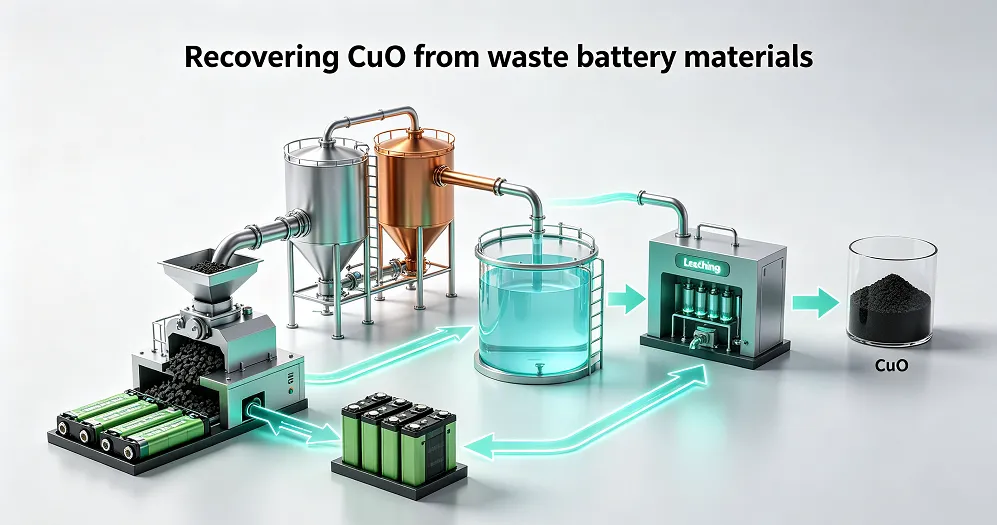
Graphite can be separated from copper in lithium battery anode material, and copper oxide can be obtained after processing.
After the waste battery is discharged, open the battery case, deal with the battery core with the method of alkali leaching pretreatment, then put the battery core after pretreatment with mill for grinding, crushing equipment will be large copper foil in the process of the feed screw exported, graphite and copper foil no separate parts into the crushing chamber, the fineness of crushed to the required, Particles reaching the fineness requirements enter the chamber of the classifier, and under the action of gravity and centrifugal force, the graphite and copper are sorted into different silos to be collected. We added the collected copper to water and stirred it, and then easy alkali leaching, and then copper extraction, and then added PH adjustment solution to the solution for PH adjustment, so as to obtain copper oxide solution. Finally, the copper oxide solution is heated and dried, and the black material is copper oxide.
The recovery of copper oxide from waste lithium-ion batteries is an important aspect of the circular economy and contributes to the sustainable management of electronic waste. The increasing demand for lithium-ion batteries in electric vehicles, portable electronics, and energy storage systems has led to a growing need for efficient recycling processes to recover valuable materials such as copper, lithium, and cobalt. The process described above represents a systematic approach to recovering copper oxide from battery waste, starting with the discharge and dismantling of the battery to ensure safe handling. The pretreatment with alkali leaching removes electrolyte and other soluble components, preparing the battery core for mechanical processing. The grinding and crushing step liberates the copper foil and other metal components from the graphite and other materials. The separation of graphite and copper using air classification takes advantage of the different particle sizes and densities of the materials. The recovery of copper from the classified material involves dissolution and precipitation steps to produce high-purity copper oxide. The quality of the recovered copper oxide depends on the efficiency of the separation and purification processes. The development of efficient recycling processes is essential for reducing the environmental impact of battery disposal and for securing a stable supply of critical materials. The recovered copper oxide can be used as a raw material for the production of new batteries, pigments, catalysts, or other copper-based products. The economic viability of battery recycling depends on the cost-effectiveness of the processes and the market value of the recovered materials. The growing regulatory pressure to recycle batteries and the increasing awareness of the environmental impact of electronic waste are driving investment in recycling infrastructure and technology. The advancement of recycling technologies is expected to improve the efficiency and cost-effectiveness of copper oxide recovery from battery waste, contributing to a more sustainable and circular economy. The development of closed-loop recycling processes, where the recovered materials are used to produce new batteries, represents the ultimate goal of sustainable battery management.
Comparison Table: Copper Oxide (CuO) vs. Cuprous Oxide (Cu₂O)
|
Feature |
Copper Oxide (CuO) |
Cuprous Oxide (Cu₂O) |
|---|---|---|
|
Chemical Formula |
CuO |
Cu₂O |
|
Oxidation State of Copper |
+2 (copper II) |
+1 (copper I) |
|
Color |
Black |
Red (used as a red pigment) |
|
Reactivity |
More reactive, readily dissolves in acids |
Less reactive |
|
Common Applications |
Ceramics, batteries, catalysts, pigments, wood preservatives, petroleum desulfurizer |
Red pigment, antifouling paints, glass colorant, semiconductor |
|
Semiconductor Type |
p-type semiconductor |
p-type semiconductor |
FAQ: Frequently Asked Questions About Copper Oxide (CuO)
Q: What is the formula for copper oxide?
A: The chemical formula for copper oxide is CuO. This compound is also referred to as copper(II) oxide. The question "What is the formula for copper(ii) oxide? " is frequently searched, and the answer is CuO. If you are looking for cuprous oxide (copper(I) oxide), the formula is Cu₂O.
Q: What is the formula for copper(II) oxide?
A: The formula for copper(II) oxide is CuO. This compound contains copper in the +2 oxidation state. If you see "copper oxide" used generally, it most often refers to CuO, the black oxide of copper.
Q: What is the difference between copper oxide and cuprous oxide?
A: Copper oxide (CuO) contains copper in the +2 oxidation state and appears as a black powder. Cuprous oxide (Cu₂O) contains copper in the +1 oxidation state and appears as a red powder. CuO is more reactive and readily dissolves in acids, while Cu₂O is less reactive and often used as a red pigment. The question "copper oxide vs cuprous oxide" is common among chemistry students and industry professionals.
Q: Does copper oxidize?
A: Yes, copper does oxidize over time when exposed to air and moisture. The question "Does copper oxidize? " is very common. Copper forms a green patina (copper carbonate) or copper oxide depending on the conditions. When copper is heated in air, it forms black copper oxide (CuO). The oxidation of copper is a gradual process, and the rate depends on temperature, humidity, and the presence of other chemicals such as acids or sulfur compounds. In industrial settings, copper is often intentionally oxidized to produce copper oxide for use in catalysts, pigments, and other applications.
Q: How to oxidize copper?
A: Copper can be oxidized by exposing it to air and moisture over time, or by heating it in the presence of oxygen. The question "How to oxidize copper " is frequently asked by DIY enthusiasts and artists. To speed up copper oxidation, you can apply heat (using a torch or oven), use chemical solutions like vinegar and salt, or use commercial patinating agents. When copper is heated in air, black copper oxide (CuO) forms. The process of copper oxidation is used in the production of copper oxide for various industrial applications. If you are looking for green copper oxidation (patina), this typically requires exposure to sulfur compounds, moisture, and time, forming copper carbonate and copper sulfate compounds rather than pure copper oxide.
Q: How to oxidize copper in Minecraft?
A: In Minecraft, copper blocks will naturally oxidize over time when placed in the world. The question "How to oxidize copper minecraft " is searched by many gamers. Copper oxidation in Minecraft has four stages: copper block → exposed copper → weathered copper → oxidized copper. This process takes approximately 50-82 in-game days to complete. The oxidation can be slowed by waxing copper blocks with honeycomb. In Minecraft, copper oxidation refers to the formation of a green patina, which is similar to how real copper oxidizes to form copper carbonate, not pure copper oxide.
Q: How long does it take for copper to oxidize?
A: The time for copper to oxidize depends on environmental conditions. The question "How long does it take for copper to oxidize? " is common among DIY and construction professionals. In dry indoor air, the oxidation of copper to form copper oxide can take years. In humid or salty air (coastal areas), copper oxidation occurs much faster, taking only months to develop a visible patina. In industrial settings, copper can be oxidized rapidly by heating in an oxygen-containing atmosphere, producing copper oxide in minutes. In Minecraft, full copper oxidation takes about 50-82 in-game days.
Q: How to oxidize copper with vinegar?
A: The question "How to oxidize copper with vinegar " is frequently searched by DIY enthusiasts and artists. Vinegar (acetic acid) can accelerate the oxidation of copper when combined with salt and exposure to air. The process involves cleaning the copper surface, then applying a mixture of vinegar, salt, and sometimes hydrogen peroxide. Over time, this solution causes the copper to react and form a green patina (copper acetate and copper carbonate). For producing pure copper oxide, however, heating copper in air or using stronger acids is typically required.
Q: How to oxidize copper green?
A: The question "How to oxidize copper green " is common among artists and decorators. To make copper turn green, you need to expose it to air, moisture, and sulfur compounds over time. The green patina that forms on copper is primarily composed of copper carbonate and copper sulfate, not pure copper oxide. The green color is different from the black copper oxide that forms when copper is heated in air. You can speed up green patina formation using commercial patinating solutions containing salts, acids, and sulfur compounds. The green patina is a distinct copper compound, different from copper oxide.
Q: What is copper oxide used for?
A: The question "What is copper oxide used for? " is one of the most frequently asked about this compound. Copper oxide (CuO) has many applications across multiple industries:
Ceramics and Pigments: Used as a colorant to produce blue, red, green, grey, pink, or black glazes
Batteries: Used in lithium battery types and Edison-Lalande cells
Catalysts: Used in hydrogen production and various chemical reactions
Wood Preservatives: Starting material for copper-based wood preservatives
Welding: Used for welding with copper alloy
Agriculture: Used in fungicides and pesticides (as copper salts)
Rayon Manufacturing: Used as a raw material
Petroleum Industry: Used as a desulfurizer
Electronics: Used as a p-type semiconductor material