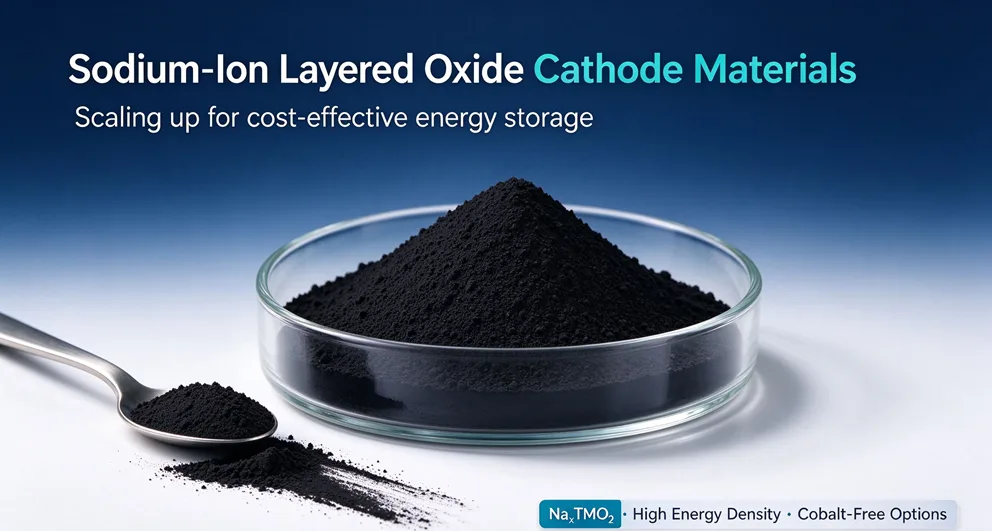
Sodium-Ion Layered Oxide Cathode Materials — scaling up for cost-effective energy storage.
1. Introduction to Sodium-Ion Layered Oxide Cathodes
1.1 The Shift Toward Sodium-Ion
The global energy storage market is expanding rapidly, driven by the integration of renewable energy sources and the growth of electric mobility. While lithium-ion batteries have dominated this space, concerns over lithium supply, cost volatility, and resource concentration have accelerated the development of alternative chemistries. Sodium-ion batteries have emerged as a highly promising solution, offering abundant raw materials, enhanced safety, and competitive performance.
1.2 The Role of Cathode Materials
In a sodium-ion battery, the cathode is a critical component that determines the energy density, cost, and overall performance of the cell. Among the various cathode chemistries—such as polyanionic compounds and Prussian blue materials—Layered Oxide Cathode Materials stand out for their high energy density, excellent rate capability, and compatibility with existing lithium-ion manufacturing infrastructure.
1.3 The Challenge of Scaling Up
To transition sodium-ion batteries from the laboratory to commercial deployment, the industry must scale up production of cathode materials. Sodium-Ion Layered Oxide Cathode Materials are uniquely positioned for this challenge, as they can be synthesized using mature, cost-effective processes. Understanding how these materials are scaling up is key to unlocking their full potential in the energy storage market.
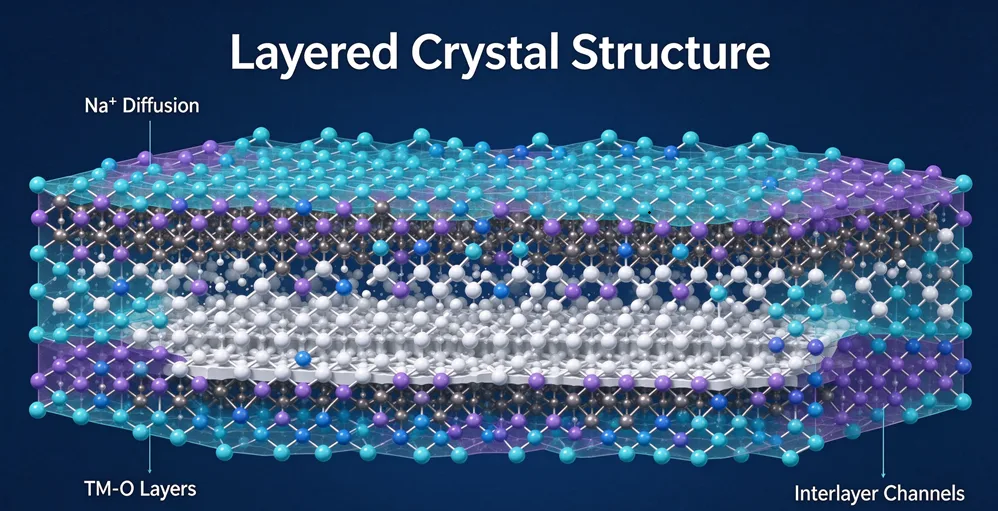 Layered structure — enabling efficient sodium-ion storage and fast charging.
2. Understanding the Basics of Sodium-Ion Layered Oxide Cathode Materials
2.1 Chemical Composition and Structure
Sodium-Ion Layered Oxide Cathode Materials typically have the general formula NaₓTMO₂, where TM represents transition metals such as iron, manganese, nickel, or copper. They crystallize in distinct phases, primarily classified as O3-type (octahedral sodium coordination) and P2-type (prismatic sodium coordination).
O3-type materials offer high initial capacity but can suffer from complex phase transitions. P2-type materials provide better structural stability and rate performance. Biphasic designs (P2/O3) combine the advantages of both, offering a balanced profile for diverse applications.
2.2 Key Properties of Sodium-Ion Layered Oxide Cathode Materials
High Energy Density: Compared to polyanionic cathodes, layered oxides offer higher operating voltages and specific capacities.
Excellent Rate Capability: The 2D layered structure allows for rapid sodium-ion diffusion, enabling fast charging and high power output.
Cobalt-Free Options: Many formulations (like those based on iron and manganese) eliminate the need for cobalt, significantly reducing costs.
Manufacturing Compatibility: Layered oxides can be produced using standard solid-state synthesis methods and integrated into existing lithium-ion production lines.
2.3 Comparison with Other Sodium-Ion Cathodes
| Property |
Layered Oxides |
Polyanionic Compounds |
Prussian Blue Materials |
| Energy Density |
High |
Moderate |
Moderate to High |
| Rate Capability |
Excellent |
Good |
Good |
| Cycle Life |
Good to Excellent |
Excellent |
Fair (moisture sensitivity) |
| Cost |
Low to Moderate |
Moderate |
Low |
| Manufacturing Maturity |
High |
High |
Moderate |
3. Why Scaling Up Matters for the Energy Storage Market
3.1 The Cost Factor
For grid-scale energy storage and low-speed electric vehicles, cost per kilowatt-hour (kWh) is the dominant metric. Sodium-Ion Layered Oxide Cathode Materials can be synthesized from inexpensive precursors like iron and manganese. As production scales up, economies of scale will further drive down costs, making sodium-ion batteries highly competitive with lithium iron phosphate (LFP).
3.2 Supply Chain Resilience
Lithium and cobalt supply chains are geographically concentrated and subject to geopolitical and market volatility. By utilizing widely available sodium and transition metals, Sodium-Ion Layered Oxide Cathode Materials offer a more resilient and stable supply chain, essential for large-scale energy storage deployment.
3.3 Infrastructure Compatibility
One of the biggest hurdles for new battery chemistries is retooling manufacturing lines. Because Sodium-Ion Layered Oxide Cathode Materials are compatible with existing cathode manufacturing processes, battery manufacturers can scale up production more quickly and with less capital investment.
4. How Sodium-Ion Layered Oxide Cathode Materials Enable Cost-Effective Storage
4.1 Continuous Process Optimization
The industry is rapidly optimizing the synthesis of Sodium-Ion Layered Oxide Cathode Materials. Techniques such as spray drying, co-precipitation, and optimized solid-state sintering are being refined to ensure homogeneous mixing and uniform particle size, which are critical for consistent battery performance.
4.2 Surface Modification and Doping
To address challenges like air sensitivity and structural degradation, manufacturers are applying advanced strategies. Elemental doping (e.g., with titanium, magnesium, or aluminum) stabilizes the crystal lattice. Surface coatings protect the material from moisture and unwanted side reactions with the electrolyte, extending cycle life.
4.3 Moving to Ton-Scale Production
Leading material suppliers have successfully transitioned from pilot-scale to ton-scale production of Sodium-Ion Layered Oxide Cathode Materials. By implementing rigorous quality control and high-volume manufacturing processes, the industry is proving that these materials can be delivered reliably and consistently.
4.4 Tailoring for Specific Applications
Different energy storage applications require different performance profiles. Sodium-Ion Layered Oxide Cathode Materials can be engineered for specific needs: high-capacity variants for energy-dense applications, long-cycle-life variants for stationary storage, and high-rate variants for fast-charging scenarios.
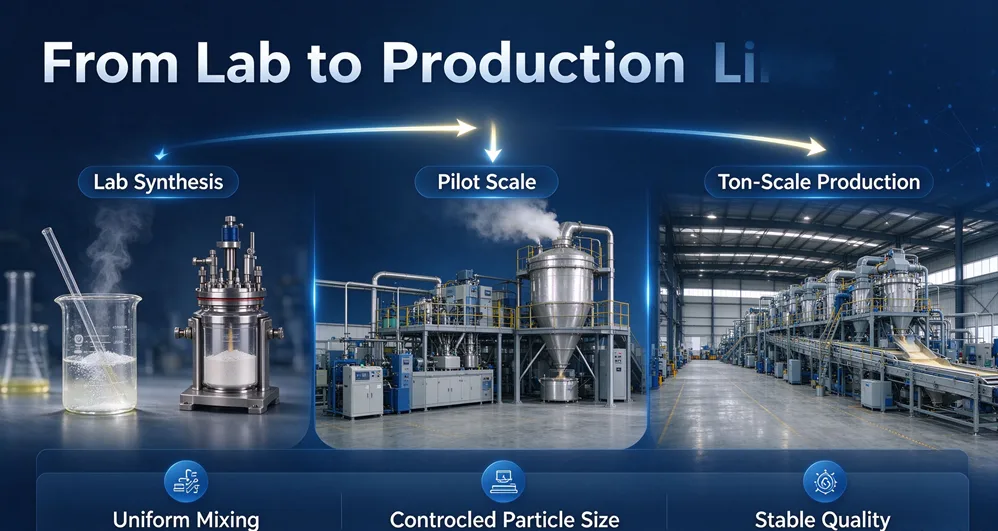 From lab to production line — scaling up sodium-ion layered oxide cathodes.
5. Key Technical Specifications
| Property |
Specification |
| Chemical Formula |
NaₓTMO₂ (TM = Fe, Mn, Ni, etc.) |
| Crystal Structure |
O3-type, P2-type, or Biphasic |
| Operating Voltage |
2.0 V – 4.2 V (varies by composition) |
| Specific Capacity |
Moderate to High (depends on specific formulation) |
| Rate Capability |
Excellent (suitable for fast charging) |
| Air Stability |
Varies by composition (surface modification applied as needed) |
| Cost |
Low (cobalt-free options available) |
6. Matching Sodium-Ion Layered Oxide Cathode Materials to Your Application
6.1 Grid-Scale Energy Storage
For stationary storage systems that require long duration and high safety, cobalt-free and nickel-free formulations of Sodium-Ion Layered Oxide Cathode Materials offer an ideal combination of cost-effectiveness and cycle stability.
6.2 Low-Speed Electric Vehicles (EVs)
For two-wheelers, three-wheelers, and low-speed four-wheel EVs, layered oxides provide the necessary energy density and rate capability, allowing for adequate driving range and fast charging without the high cost of lithium-ion batteries.
6.3 Home Energy Storage
Residential battery systems benefit from the safety and cost advantages of Sodium-Ion Layered Oxide Cathode Materials. They provide a reliable backup power source while avoiding the thermal runaway risks associated with some lithium chemistries.
6.4 Fast-Charging Applications
Because of the 2D sodium-ion diffusion pathways, certain formulations of Sodium-Ion Layered Oxide Cathode Materials excel in high-power applications, such as power tools or regenerative braking systems in electric vehicles.
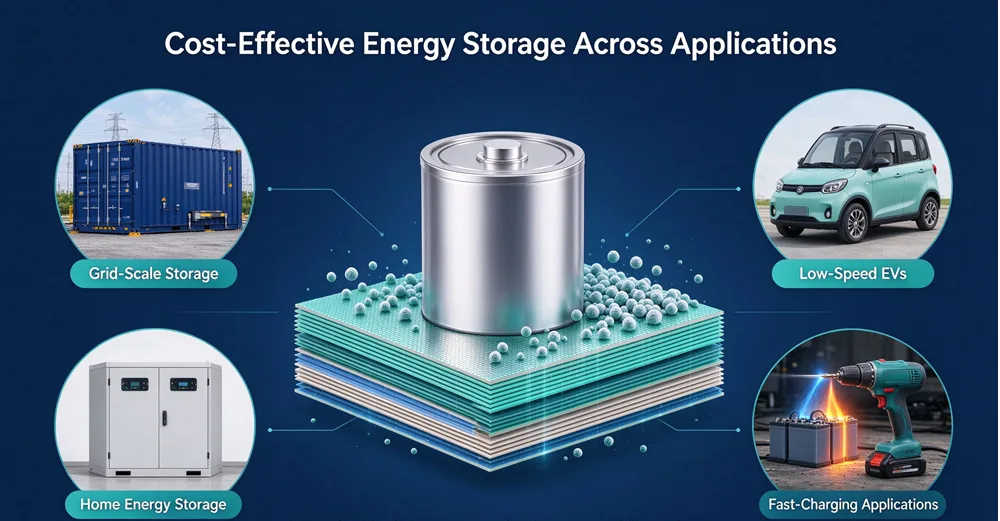
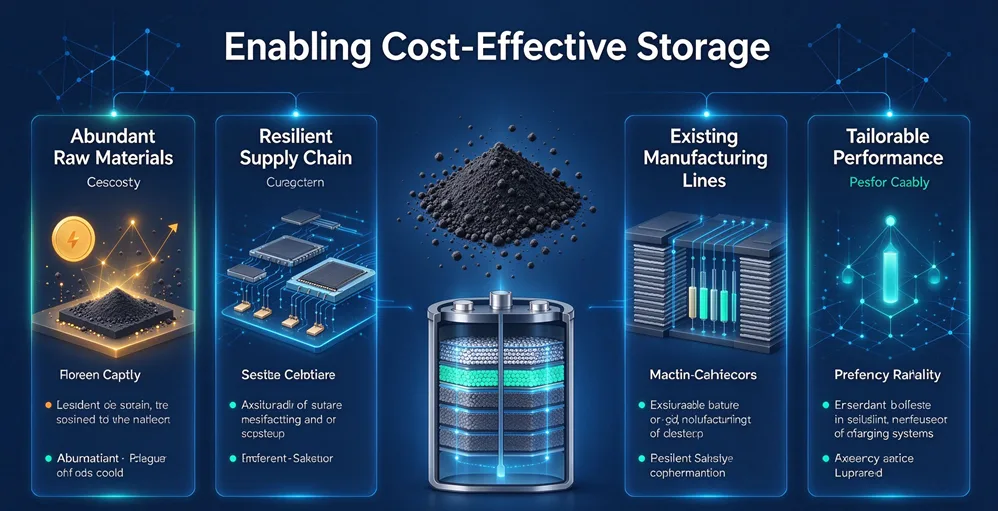
Cost-effective storage — sodium-ion layered oxides across multiple applications.
7. Common Misconceptions About Sodium-Ion Layered Oxides
7.1 “Sodium-Ion Layered Oxides Are Not Stable Enough for Commercial Use”
Early formulations suffered from structural instability. However, through advanced doping and biphasic designs, modern Sodium-Ion Layered Oxide Cathode Materials exhibit excellent cycle life and stability, making them commercially viable.
7.2 “They Cannot Compete with Lithium-Ion on Energy Density”
While sodium-ion batteries generally have lower energy density than high-nickel lithium-ion chemistries, they are not intended to replace them in all markets. For stationary storage and low-speed vehicles, where cost and safety matter more than absolute energy density, Sodium-Ion Layered Oxide Cathode Materials are highly competitive.
7.3 “Scaling Up Will Face Supply Chain Bottlenecks”
Unlike lithium, sodium is abundant and inexpensive. The transition metals used in layered oxides are also widely available. Therefore, scaling up production of Sodium-Ion Layered Oxide Cathode Materials is not constrained by the raw material bottlenecks that plague lithium-ion and cobalt-based chemistries.
7.4 “Layered Oxides Are Hard to Manufacture at Scale”
Sodium-Ion Layered Oxide Cathode Materials can be synthesized using conventional solid-state processes. As the industry matures, manufacturing yields and quality consistency are improving rapidly, enabling efficient scale-up.
8. Quick Evaluation Checklist
Before selecting Sodium-Ion Layered Oxide Cathode Materials for your energy storage project, verify:
Required energy density and capacity
Operating voltage and rate requirements
Cycle life expectations for your application
Air stability and handling requirements
Cost targets and raw material availability
Compatibility with your existing manufacturing processes
Supplier production capacity and quality consistency
9. Real-World Application Scenarios
9.1 Large-Scale Grid Storage Pilot
A pilot project for renewable energy integration utilized Sodium-Ion Layered Oxide Cathode Materials in a containerized energy storage system. The material’s low cost, good rate capability, and stable cycling performance demonstrated the viability of sodium-ion technology for balancing grid demand.
9.2 Low-Speed EV Battery Packs
An electric two-wheeler manufacturer adopted Sodium-Ion Layered Oxide Cathode Materials for its battery packs. The batteries provided adequate range, supported fast charging, and significantly lowered the BOM cost compared to equivalent LFP packs, while maintaining a safe operating profile.
Nanotrun Sodium-Ion Layered Oxide Cathode Materials — scaling up for a sustainable energy future.
10. Frequently Asked Questions (FAQs)
Q1: What are Sodium-Ion Layered Oxide Cathode Materials?
They are a class of cathode materials with a layered structure (NaₓTMO₂), characterized by high energy density, excellent rate capability, and the potential for low-cost production.
Q2: Why are they considered cost-effective?
Sodium-Ion Layered Oxide Cathode Materials utilize abundant and inexpensive raw materials like sodium, iron, and manganese. They can also be produced using existing lithium-ion manufacturing infrastructure, reducing capital expenditure.
Q3: Are they safe?
Yes. Sodium-ion batteries generally offer better thermal stability and safety compared to lithium-ion batteries. The layered oxides do not suffer from the same oxygen release issues as high-nickel lithium cathodes.
Q4: How do they compare to polyanionic cathodes?
Layered oxides generally offer higher energy density and better rate capability than polyanionic compounds like LFP. However, polyanionics may have a slight edge in cycle life and structural stability.
Q5: Can they be recycled?
Yes, the recycling processes for Sodium-Ion Layered Oxide Cathode Materials are similar to those for lithium-ion cathodes, allowing for the recovery of valuable transition metals.
Q6: What is the current state of commercialization?
The industry has successfully moved past laboratory testing. Multiple suppliers are now producing Sodium-Ion Layered Oxide Cathode Materials at ton-scale, with commercial batteries already entering the market for specific applications like grid storage and light electric vehicles.
11. What Scaling Up Sodium-Ion Layered Oxides Means for the Industry
The transition of Sodium-Ion Layered Oxide Cathode Materials from the lab to large-scale production is a pivotal moment for the energy storage industry. By offering a cost-effective, safe, and sustainable alternative to lithium-ion chemistries, these materials are unlocking new possibilities for grid storage and electric mobility.
As manufacturing processes mature and production volumes increase, the cost of Sodium-Ion Layered Oxide Cathode Materials will continue to drop, making sodium-ion batteries an increasingly attractive option. The industry is no longer asking if sodium-ion will succeed, but rather how fast it can scale to meet global demand.
Supplier
TRUNNANO is a globally recognized Sodium-Ion Layered Oxide Cathode Materials manufacturer and supplier with more than 12 years of experience in high-quality battery materials, nanomaterials, and advanced ceramics. The company has a professional technical department and quality supervision department, a well-equipped laboratory with advanced testing equipment, and a dedicated after-sales customer service center. Nanotrun’s Sodium-Ion Layered Oxide Cathode Materials are available in various formulations (O3, P2, biphasic) and can be customized to meet specific energy, power, and cycle life requirements. The company serves clients across more than 50 countries and offers comprehensive technical support, from material selection to application guidance. If you are looking for high-quality Sodium-Ion Layered Oxide Cathode Materials for cost-effective energy storage, please feel free to contact us.
Tags: sodium-ion battery, layered oxide cathode, Na-ion cathode, energy storage, battery materials