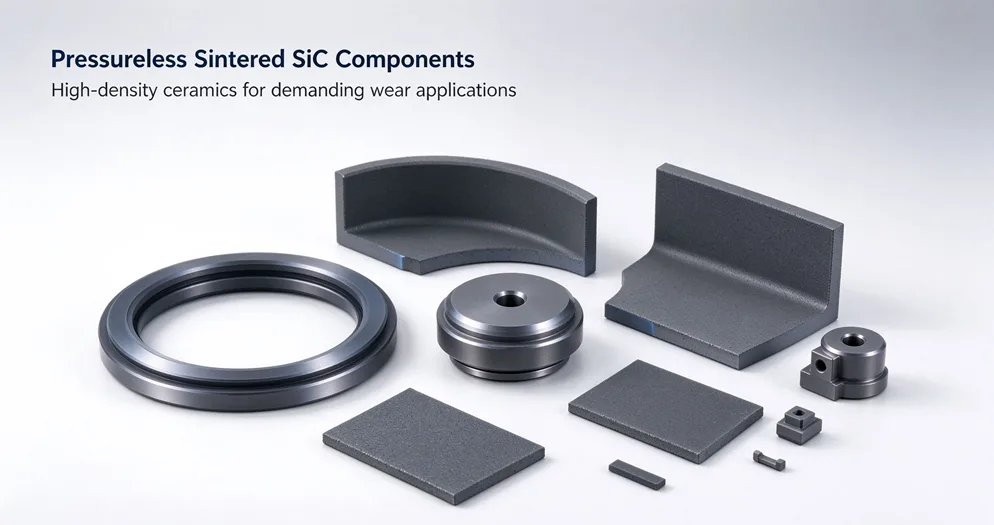
Pressureless Sintered Silicon Carbide (PSC) Ceramic — high-density ceramics for demanding wear applications.
1. Introduction to Pressureless Sintered Silicon Carbide (PSC) Ceramic
1.1 The Need for High-Density Wear-Resistant Ceramics
In industries ranging from chemical processing to mechanical engineering, components are constantly subjected to severe abrasive wear, high temperatures, and corrosive environments. While traditional ceramics offer good hardness, their porosity often limits their mechanical strength and chemical resistance. To survive in these demanding conditions, materials must be highly dense and flawlessly engineered.
1.2 What Is Pressureless Sintered Silicon Carbide (PSC) Ceramic?
Pressureless Sintered Silicon Carbide (PSC) Ceramic is a high-performance advanced structural ceramic manufactured by shaping high-purity silicon carbide powder and densifying it at elevated temperatures without applying external mechanical pressure. This process allows for the production of custom shapes with excellent dimensional stability.
1.3 Why Pressureless Sintered Silicon Carbide (PSC) Ceramic Stands Out
Unlike reaction-bonded silicon carbide, Pressureless Sintered Silicon Carbide (PSC) Ceramic achieves its mechanical integrity through solid-state sintering and controlled grain growth. This results in a material with near-theoretical density, very low open porosity, and exceptional hardness. It is the ultimate choice for demanding wear applications where dimensional accuracy and long-term reliability are non-negotiable.
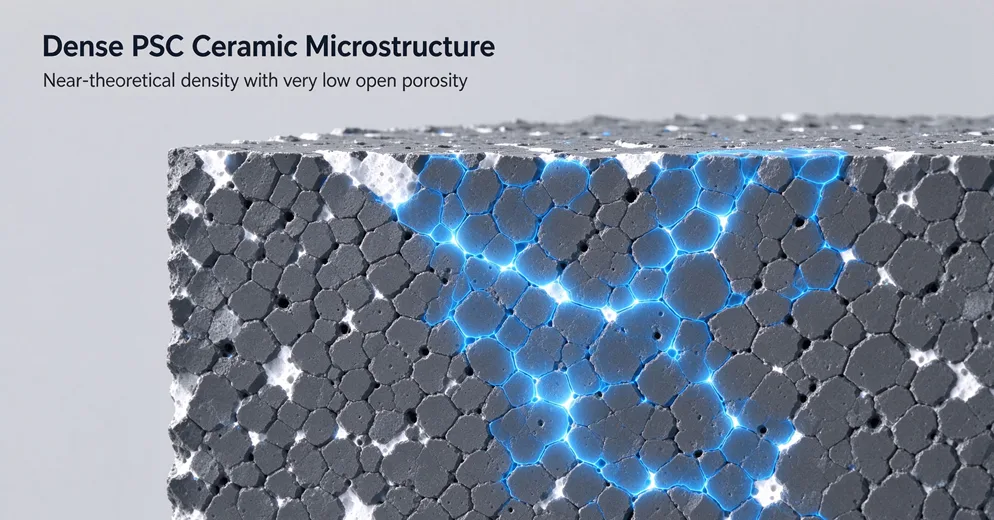
Pressureless Sintered Silicon Carbide (PSC) Ceramic ensures maximum wear resistance.
2. Understanding the Basics of Pressureless Sintered Silicon Carbide (PSC) Ceramic
2.1 Chemical Composition and Manufacturing Process
Pressureless Sintered Silicon Carbide (PSC) Ceramic is composed of high-purity silicon carbide with carefully selected sintering additives (such as boron and carbon) that promote grain boundary formation and reduce residual porosity. The green body is formed and then fired in a controlled atmosphere (such as argon or vacuum) at very high temperatures.
2.2 Key Properties of Pressureless Sintered Silicon Carbide (PSC) Ceramic
High Density and Low Open Porosity: Typically achieves a density above 3.10 g/cm³ with near-zero open porosity, significantly reducing pathways for gas, liquid, and corrosive media.
Excellent High-Temperature Stability: Maintains high strength and hardness at elevated temperatures.
Exceptional Hardness and Abrasion Resistance: Extremely high Mohs hardness, providing strong resistance to abrasive wear, erosion, and particle impact.
High Thermal Conductivity: Promotes uniform heat distribution and efficient thermal management.
Strong Chemical Inertness: Resists attack from many acids, alkalis, and molten materials.
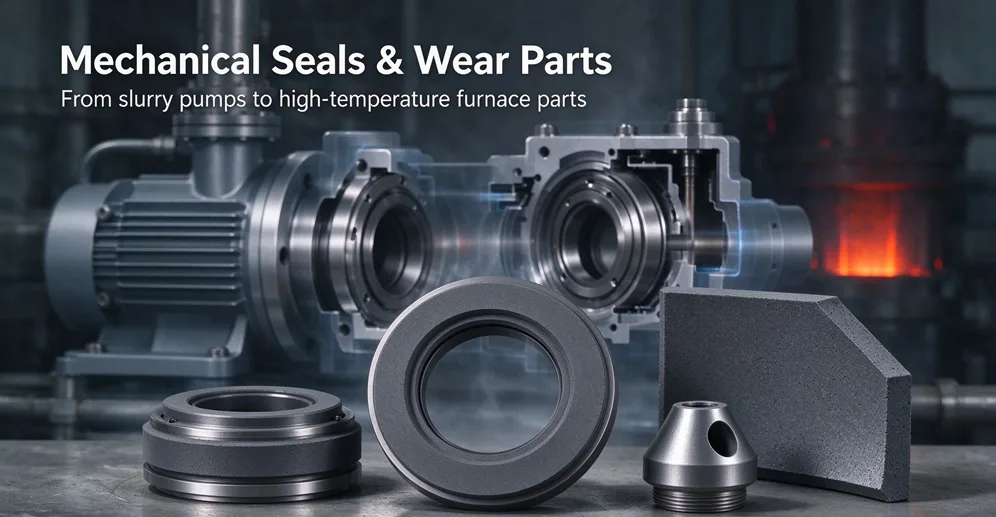
Pressureless Sintered Silicon Carbide (PSC) Ceramic in demanding environments.
3. Why High Density and Wear Resistance Matter
3.1 The Impact of Porosity
In ceramic materials, porosity is the enemy of mechanical strength and chemical resistance. Pores act as stress concentrators, leading to crack initiation and premature failure. Furthermore, open pores allow corrosive fluids to penetrate the material, accelerating degradation. Pressureless Sintered Silicon Carbide (PSC) Ceramic minimizes porosity, creating a nearly flawless material that resists both mechanical wear and chemical attack.
3.2 The Need for Wear Resistance
In applications like slurry pumps, cyclones, and mechanical seals, components must withstand continuous abrasive action. The extreme hardness of Pressureless Sintered Silicon Carbide (PSC) Ceramic ensures that these components maintain their dimensional accuracy over long periods, reducing downtime and maintenance costs.
4. How Pressureless Sintered Silicon Carbide (PSC) Ceramic Achieves High Density
4.1 Solid-State Sintering Mechanism
During the sintering process of Pressureless Sintered Silicon Carbide (PSC) Ceramic, the sintering additives react with the surface oxides on the silicon carbide particles. This promotes solid-state diffusion, allowing the particles to bond together and eliminate pores without the need for external pressure.
4.2 Controlled Grain Growth
The manufacturing process is carefully controlled to limit grain growth. Fine-grained microstructures in Pressureless Sintered Silicon Carbide (PSC) Ceramic result in higher mechanical strength and better wear resistance compared to coarse-grained materials.
4.3 Advanced Shaping Capabilities
Because Pressureless Sintered Silicon Carbide (PSC) Ceramic does not require pressure during densification, it can be formed into near-net shapes using standard ceramic forming techniques before sintering. This allows for the creation of intricate components like seal rings and nozzles that would be difficult or impossible to produce with hot-pressing methods.
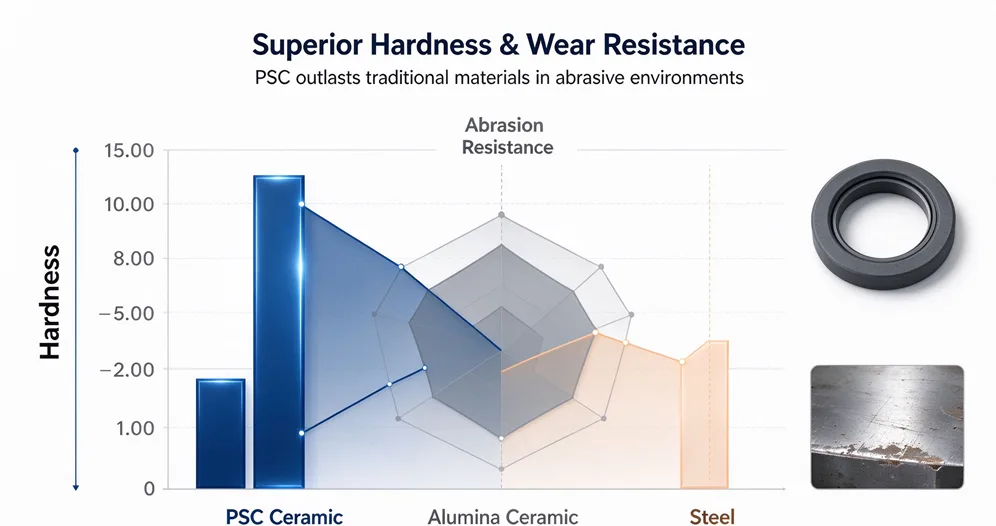
Superior hardness — why Pressureless Sintered Silicon Carbide (PSC) Ceramic outlasts traditional materials.
5. Key Technical Specifications of Pressureless Sintered Silicon Carbide (PSC) Ceramic
| Parameter |
Typical Value |
| Material |
Silicon Carbide (SiC) |
| Density |
> 3.10 g/cm³ |
| Open Porosity |
< 0.1% |
| Hardness |
Very High (Mohs ~9+) |
| Flexural Strength |
High |
| Thermal Conductivity |
High |
| Chemical Resistance |
Excellent (resists acids, alkalis, molten metals) |
6. Matching Pressureless Sintered Silicon Carbide (PSC) Ceramic to Your Application
6.1 Mechanical Seals and Bearings
For mechanical seals used in pumps handling abrasive or corrosive fluids, Pressureless Sintered Silicon Carbide (PSC) Ceramic is an ideal material. Its high density prevents fluid penetration, while its extreme hardness ensures long service life.
6.2 Wear-Resistant Components
Pressureless Sintered Silicon Carbide (PSC) Ceramic is widely used for slurry pump liners, hydrocyclones, nozzles, and wear plates. It significantly outperforms metals and traditional ceramics in high-wear environments.
6.3 High-Temperature Furnace Parts
Because of its excellent high-temperature stability and thermal shock resistance, Pressureless Sintered Silicon Carbide (PSC) Ceramic is used for kiln furniture, setter plates, radiant tubes, and high-temperature structural components.
6.4 Semiconductor and Chemical Processing
Pressureless Sintered Silicon Carbide (PSC) Ceramic is used in heat exchanger tubes, reaction-system components, and semiconductor process fixtures, where high purity and chemical inertness are critical.
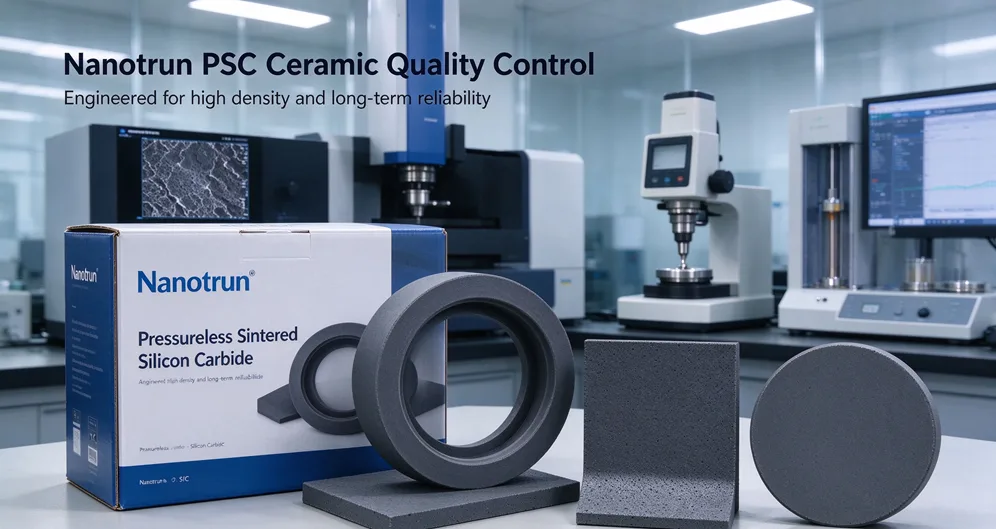
Nanotrun Pressureless Sintered Silicon Carbide (PSC) Ceramic
7. Common Misconceptions About Pressureless Sintered Silicon Carbide
7.1 "Pressureless Sintering Means Lower Quality"
This is a common misconception. In fact, Pressureless Sintered Silicon Carbide (PSC) Ceramic can achieve densities and mechanical properties that rival or exceed pressure-assisted ceramics. The absence of pressure allows for greater design flexibility and complex shapes without sacrificing performance.
7.2 "All Silicon Carbide Ceramics Are the Same"
Pressureless Sintered Silicon Carbide (PSC) Ceramic is fundamentally different from reaction-bonded SiC. PSC contains no free silicon, offering superior high-temperature stability, higher mechanical strength, and better chemical resistance.
7.3 "SiC Is Too Brittle for Structural Use"
While ceramics are inherently brittle, the fine-grained microstructure and high density of Pressureless Sintered Silicon Carbide (PSC) Ceramic provide excellent fracture toughness and flexural strength, making it suitable for demanding structural applications.
8. Quick Evaluation Checklist
Before selecting Pressureless Sintered Silicon Carbide (PSC) Ceramic for your application, verify:
Required density and wear resistance
Operating temperature and thermal cycling profile
Chemical exposure (acids, alkalis, or molten materials)
Required mechanical strength and load-bearing capacity
Component shape requirements and dimensional tolerances
Surface finish requirements
9. Real-World Application Scenarios
9.1 Slurry Pump Mechanical Seals
A mining operation utilized Pressureless Sintered Silicon Carbide (PSC) Ceramic mechanical seals in their slurry pumps. The seals demonstrated exceptional resistance to abrasive wear and outlasted traditional metal seals by a significant margin, dramatically reducing maintenance downtime.
9.2 High-Temperature Kiln Furniture
A ceramics manufacturer used Pressureless Sintered Silicon Carbide (PSC) Ceramic for kiln setters and beams. The material's high density and thermal stability allowed for rapid firing cycles without deformation or cracking, improving overall production efficiency.
10. Frequently Asked Questions (FAQs)
Q1: What is Pressureless Sintered Silicon Carbide (PSC) Ceramic?
Pressureless Sintered Silicon Carbide (PSC) Ceramic is an advanced structural ceramic manufactured by densifying high-purity SiC powder at high temperatures without external pressure. It offers high density, exceptional hardness, and excellent chemical resistance.
Q2: How does PSC differ from reaction-bonded silicon carbide (RBSC)?
Unlike RBSC, Pressureless Sintered Silicon Carbide (PSC) Ceramic does not contain free silicon. This results in superior high-temperature stability, higher mechanical strength, and better chemical resistance.
Q3: What are the main applications of PSC?
Pressureless Sintered Silicon Carbide (PSC) Ceramic is widely used for mechanical seals, wear-resistant components (like nozzles and liners), high-temperature furnace parts, and chemical processing equipment.
Q4: Is PSC Ceramic suitable for high-temperature environments?
Yes. Pressureless Sintered Silicon Carbide (PSC) Ceramic maintains its high strength and hardness at elevated temperatures, making it ideal for kiln furniture and other high-temperature components.
Q5: Does PSC Ceramic have good chemical resistance?
Yes, Pressureless Sintered Silicon Carbide (PSC) Ceramic is highly resistant to most acids, alkalis, and molten materials. Its low open porosity prevents corrosive fluids from penetrating the material.
11. What Pressureless Sintered Silicon Carbide (PSC) Ceramic Means for Advanced Manufacturing
Pressureless Sintered Silicon Carbide (PSC) Ceramic represents a major advancement in advanced ceramic technology. By combining high density, extreme hardness, and excellent chemical resistance, it provides a reliable solution for the most demanding wear applications. As industries continue to push the limits of performance and efficiency, Pressureless Sintered Silicon Carbide (PSC) Ceramic will remain a critical material for advanced manufacturing.
Supplier
TRUNNANO is a globally recognized Pressureless Sintered Silicon Carbide (PSC) Ceramic manufacturer and supplier with more than 12 years of experience in high-quality advanced ceramic materials and high-purity chemicals. The company has a professional technical department and quality supervision department, a well-equipped laboratory with advanced testing equipment, and a dedicated after-sales customer service center. Nanotrun supplies Pressureless Sintered Silicon Carbide (PSC) Ceramic worldwide, suitable for mechanical seals, wear-resistant components, high-temperature furnace parts, and chemical processing equipment. The company offers comprehensive technical support, from product selection to application guidance. If you are looking for high-quality Pressureless Sintered Silicon Carbide (PSC) Ceramic for demanding wear applications, please feel free to contact us.
Tags: Pressureless Sintered Silicon Carbide, PSC ceramic, high-density ceramics, wear resistance, advanced ceramics