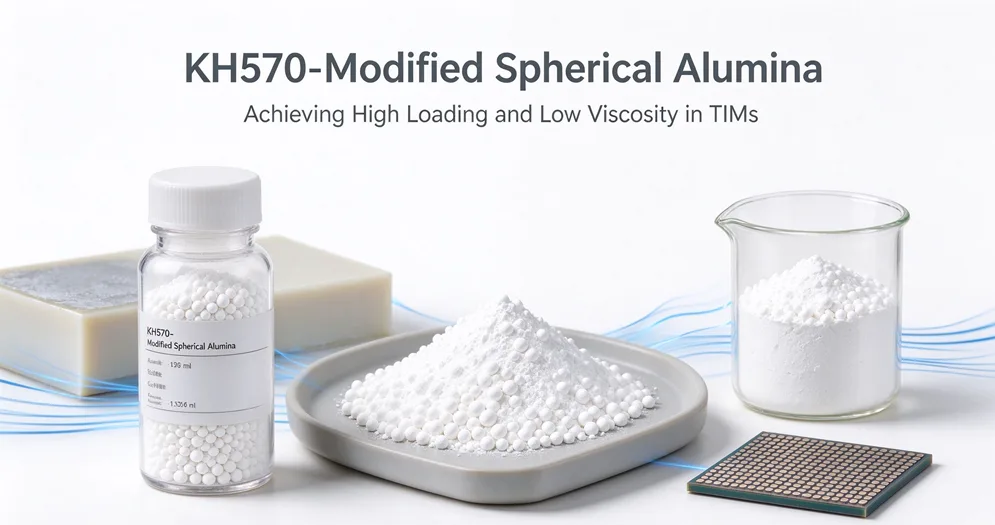
KH570-Modified Spherical Alumina
1. Introduction to Thermal Interface Materials (TIM)
1.1 The Heat Dissipation Bottleneck
As electronic devices—from 5G base stations to electric vehicle power modules and high-performance AI chips—become more powerful and compact, heat dissipation has become a critical bottleneck. Even microscopic air gaps between a heat-generating chip and its heat sink can act as thermal insulators, causing overheating and reducing device lifespan.
Thermal Interface Materials (TIM) are used to fill these microscopic gaps, providing an efficient pathway for heat to transfer from the device to the cooler. To achieve high thermal conductivity, TIMs are typically filled with highly conductive ceramic powders.
1.2 Why Spherical Alumina is the Standard
Spherical Alumina is the most widely used filler in TIMs due to its excellent electrical insulation, moderate thermal conductivity, and cost-effectiveness. However, formulators constantly face a fundamental trade-off: to increase thermal conductivity, you must add more filler (high loading). But high filler loading drastically increases the viscosity of the polymer matrix, making the TIM difficult to process, dispense, or conform to surfaces.
1.3 The Role of KH570-Modified Spherical Alumina
KH570-Modified Spherical Alumina is engineered to break this trade-off. By chemically grafting a KH570 silane coupling agent onto the surface of high-purity spherical alumina, the filler’s surface energy is dramatically reduced. This modification allows manufacturers to achieve exceptionally high filler loadings while maintaining low viscosity, unlocking the next level of thermal performance.
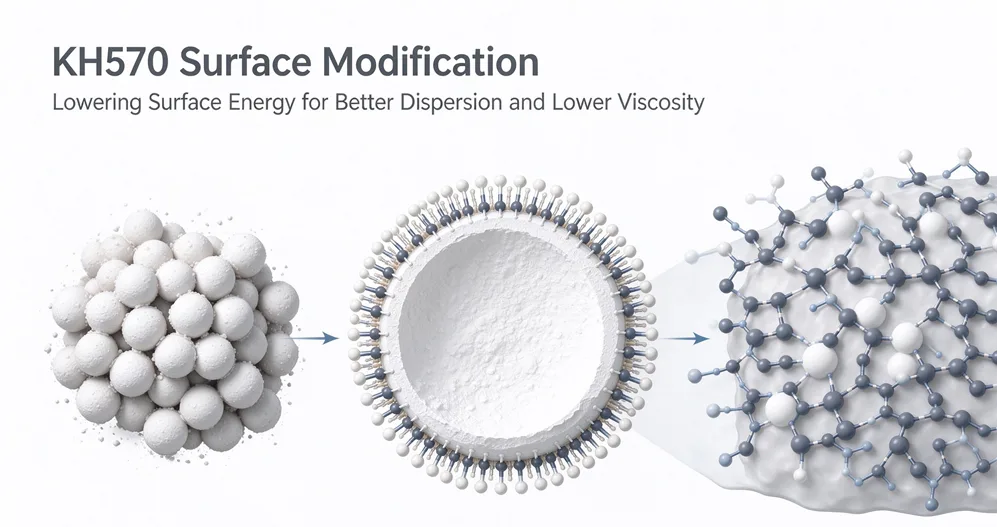
KH570 surface modification — lowering surface energy for better dispersion and lower viscosity.
2. Understanding the Basics of KH570-Modified Spherical Alumina
2.1 What Is KH570 Modification?
KH570 is a silane coupling agent containing vinyl reactive functional groups. During the manufacturing process, the KH570 molecules chemically bond to the hydroxyl groups on the surface of the alumina particles, forming a dense, stable organic coating.
This organic layer acts as a "molecular bridge" between the inorganic alumina and the organic polymer resin (such as silicone, epoxy, or polyurethane).
2.2 Key Properties of KH570-Modified Spherical Alumina
High Sphericity: The perfectly round shape allows particles to roll over each other easily, reducing internal friction.
Reduced Surface Energy: The KH570 coating prevents the particles from agglomerating (sticking together).
Low Oil Absorption: The modified surface repels the polymer resin, meaning less resin is trapped on the surface, leaving more resin free to flow.
Chemical Compatibility: The vinyl groups react with the resin during curing, forming strong covalent bonds that enhance mechanical strength.
3. The Challenge: High Loading vs. High Viscosity
3.1 The Viscosity Wall
In thermal management, "more filler equals more conductivity" is generally true. However, as you increase the volume of solid particles in a liquid resin, the mixture begins to behave like a thick paste. Eventually, it hits a "viscosity wall" where it can no longer be pumped, dispensed, or applied effectively.
Unmodified angular alumina or poorly treated spherical alumina absorbs the liquid resin, causing the viscosity to spike rapidly at high loadings.
3.2 Agglomeration and Thermal Resistance
If the filler particles are not compatible with the resin, they tend to agglomerate. These clumps create localized areas of high thermal resistance and can also introduce air voids into the TIM, which severely degrade thermal performance.
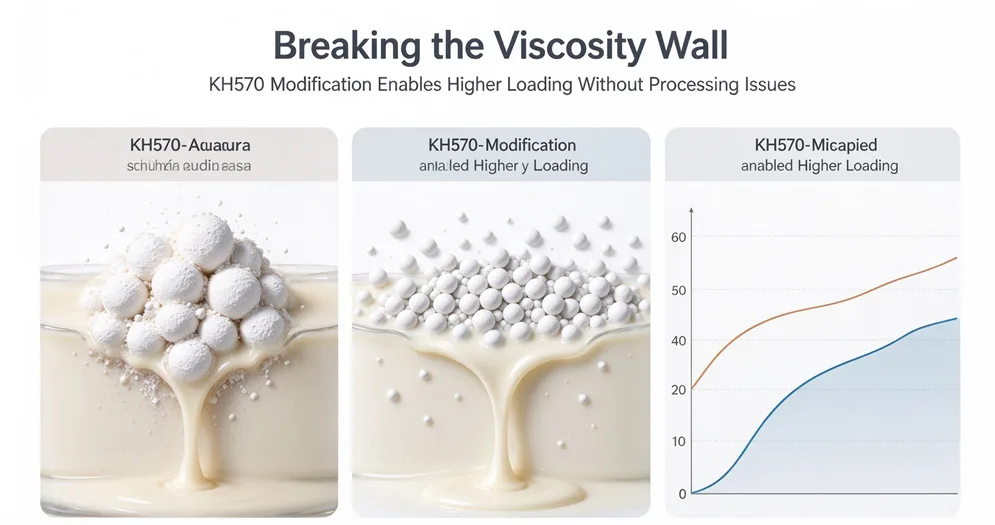 Breaking the viscosity wall — KH570 modification allows higher loading without processing issues.
4. How KH570-Modified Spherical Alumina Solves the Viscosity Paradox
4.1 Excellent Dispersibility
Because of the KH570 organic coating, the KH570-Modified Spherical Alumina particles do not stick to each other. They disperse evenly throughout the resin, preventing the formation of agglomerates and ensuring a homogeneous mixture.
4.2 Lower Viscosity at High Loading
The low oil absorption value means the resin is not trapped on the particle surfaces. The spherical shape reduces inter-particle friction. As a result, formulators can push the filler loading to extremely high levels while keeping the viscosity within the working range of dispensing equipment.
4.3 Enhanced Thermal Conductivity Efficiency
By allowing higher loading without processing issues, the particles are packed tightly together. This creates more continuous "thermal pathways" through the material, directly improving the thermal conductivity of the final TIM.
4.4 Reduced Equipment Wear
The spherical shape of the modified alumina significantly reduces abrasion on mixing equipment, dispensing needles, and molds compared to irregular fillers.
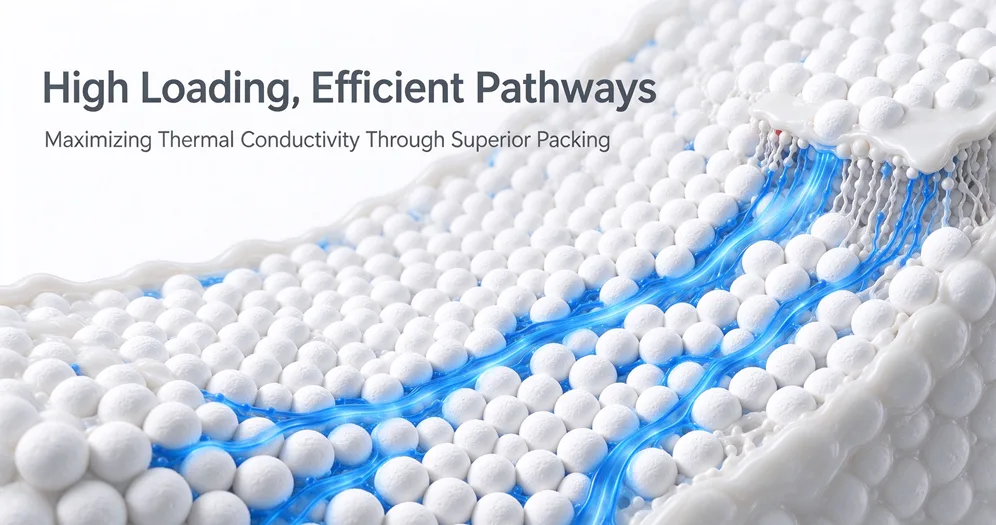
High loading, efficient pathways — maximizing thermal conductivity through superior packing.
5. Key Technical Specifications
| Parameter |
Specification |
| Alumina Content |
≥ 99.5% |
| Particle Size (D50) |
Customizable (e.g., 1 – 100 μm) |
| Silane Treatment Agent |
KH570 |
| Shape |
Spherical |
| Oil Absorption |
Extremely low |
| Electrical Insulation |
High |
| Compatibility |
Excellent with silicone, epoxy, and polyurethane systems |
6. Matching KH570-Modified Spherical Alumina to Your Application
6.1 Thermally Conductive Gels and Greases
In thermal gels and greases, low viscosity is critical for dispensing and surface wetting. KH570-Modified Spherical Alumina allows for high filler loading to achieve high thermal conductivity, while maintaining the flowability needed for automated dispensing.
6.2 Potting Compounds for Power Modules
For potting materials used in electric vehicle power modules or high-voltage electronics, KH570-Modified Spherical Alumina provides the necessary electrical insulation and thermal dissipation. The low viscosity ensures the potting compound can completely fill complex geometries and void spaces.
6.3 High-Performance Thermal Pads
In the manufacturing of thermal pads, the modified filler allows for high density packing, leading to better mechanical strength and higher thermal conductivity in the cured pad.
6.4 Electronic Encapsulation
For semiconductor encapsulation, KH570-Modified Spherical Alumina provides reliable thermal management and excellent compatibility with the epoxy molding compounds, ensuring long-term reliability of the electronic components.
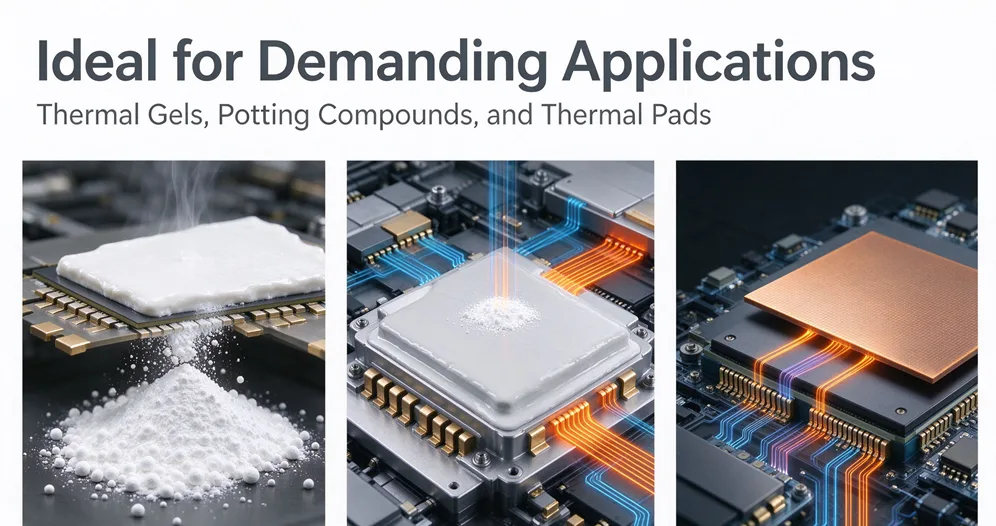
Ideal for demanding applications — thermal gels, potting compounds, and thermal pads.
7. Common Misconceptions About Thermal Fillers
7.1 “Any Alumina Will Work”
Unmodified alumina has high surface polarity, poor compatibility with organic resins, and a strong tendency to agglomerate. This results in high viscosity and poor thermal performance. KH570-Modified Spherical Alumina is specifically engineered to overcome these limitations.
7.2 “Higher Loading Always Means Higher Conductivity”
While higher loading generally increases conductivity, if it causes the material to crack, dry out, or become unprocessable due to high viscosity, the final product will fail. The key is achieving the highest possible loading while maintaining processability. This is the exact advantage of KH570-Modified Spherical Alumina.
7.3 “Surface Modification Is Just a Marketing Term”
KH570 modification is a genuine chemical reaction. The silane coupling agent covalently bonds to the filler, changing its surface properties entirely. This chemical change is what allows for the dramatic reduction in viscosity at high loadings.
8. Quick Evaluation Checklist
Before selecting KH570-Modified Spherical Alumina, verify:
Required thermal conductivity target
Maximum allowable viscosity for your processing equipment
Resin system (silicone, epoxy, polyurethane, etc.)
Required particle size distribution
Electrical insulation requirements
Dispensing or application method
Supplier's quality consistency and technical support
9. Real-World Application Scenarios
9.1 High-Power EV Battery Potting
A manufacturer of electric vehicle power modules utilized KH570-Modified Spherical Alumina in their silicone potting compound. The modified filler allowed them to increase the ceramic loading significantly, improving the thermal conductivity of the module. Simultaneously, the low viscosity ensured the material could completely fill the intricate spaces around the battery cells during the potting process.
9.2 5G Communication Base Station Thermal Gel
A formulator of thermal interface materials for 5G equipment incorporated KH570-Modified Spherical Alumina into a thermal gel. The result was a highly conductive gel that remained easily dispensable, ensuring efficient heat transfer from the high-power chips to the cooling housing.
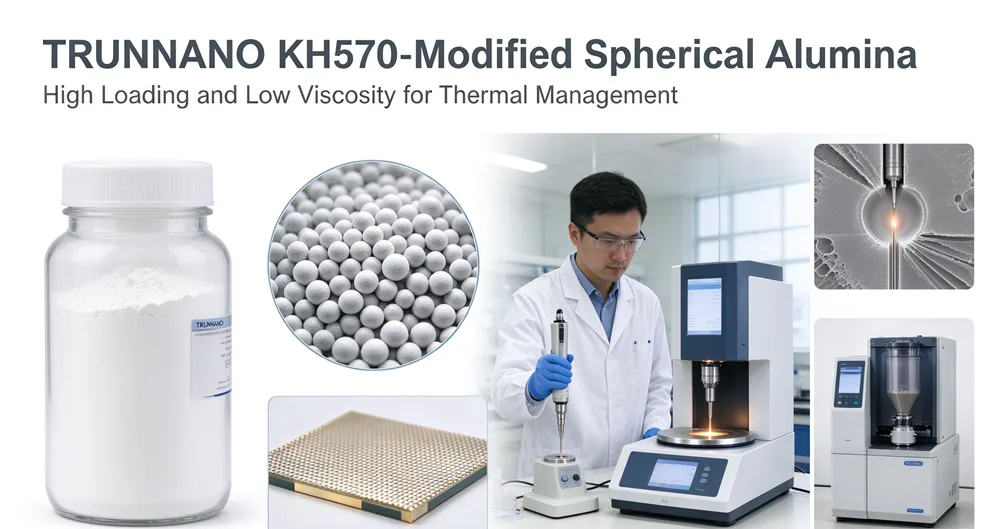
TRUNNANO KH570-Modified Spherical Alumina — achieving high loading and low viscosity for thermal management.
10. Frequently Asked Questions (FAQs)
Q1: Why does KH570 modification reduce viscosity?
The KH570 coating lowers the surface energy of the alumina particles, preventing them from agglomerating and reducing the amount of resin absorbed onto the particle surface. The spherical shape further reduces inter-particle friction.
Q2: What is the typical loading level achieved with KH570-Modified Spherical Alumina?
The exact loading depends on the resin system and the particle size distribution. However, KH570-Modified Spherical Alumina typically allows for significantly higher loading (often exceeding 80-90% by weight) compared to unmodified fillers, while still maintaining workable viscosity.
Q3: Can this product be used in silicone systems?
Yes, KH570-Modified Spherical Alumina is highly compatible with silicone systems. The vinyl groups in the KH570 silane can participate in the hydrosilylation curing reaction of silicones, forming a strong bond between the filler and the silicone matrix.
Q4: Does the modified layer degrade over time?
No. The KH570 silane is chemically bonded to the alumina surface, forming a stable, permanent coating. It does not easily wash off, peel, or degrade under normal processing and use conditions.
Q5: Is KH570-Modified Spherical Alumina safe to handle?
Yes, it is generally safe to handle when standard industrial hygiene practices are followed. As with any fine powder, inhalation of dust should be avoided.
11. What KH570-Modified Spherical Alumina Means for Thermal Management
KH570-Modified Spherical Alumina is a critical enabler for next-generation thermal interface materials. By solving the paradox of high loading and low viscosity, it allows engineers to push the boundaries of thermal conductivity without compromising processability.
As electronics continue to shrink and power densities increase, materials like KH570-Modified Spherical Alumina will be at the forefront of thermal management, ensuring that high-performance devices operate reliably and efficiently.
Supplier
TRUNNANO is a globally recognized KH570-Modified Spherical Alumina manufacturer and supplier with more than 12 years of experience in high-quality nanomaterials, advanced ceramic materials, and high-purity chemicals. The company has a professional technical department and quality supervision department, a well-equipped laboratory with advanced testing equipment, and a dedicated after-sales customer service center. TRUNNANO’s KH570-Modified Spherical Alumina is available in customizable particle sizes with high purity and excellent surface modification consistency, suitable for thermal interface materials, potting compounds, thermal pads, and electronic packaging. The company serves clients across more than 50 countries and offers comprehensive technical support, from material selection to application guidance. If you are looking for high-quality KH570-Modified Spherical Alumina for thermal management applications, please feel free to contact us.
Tags: KH570 modified spherical alumina, thermal interface materials, spherical alumina, high thermal conductivity