1. Introduction: The Interfacial Compatibility Challenge in Thermal Management
1.1 What Is KH570-Modified Spherical Alumina?
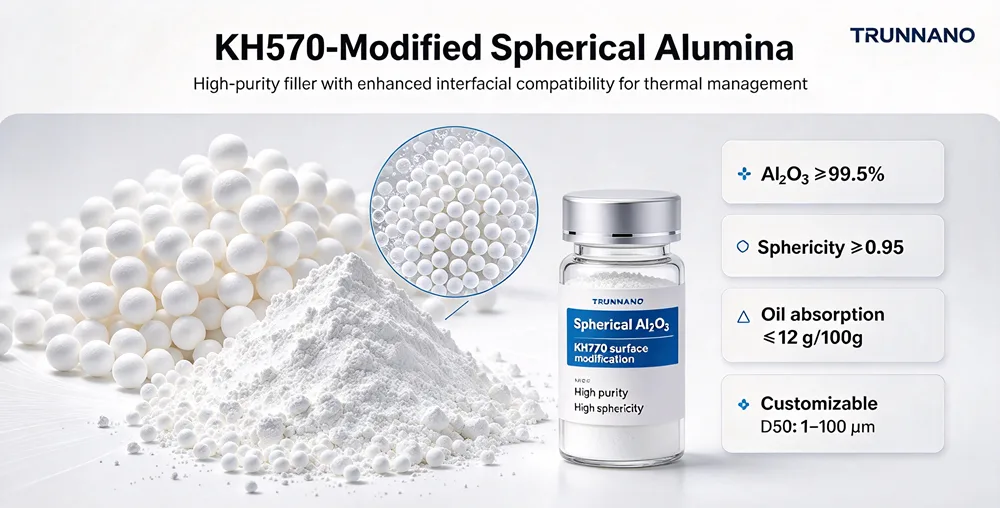
KH570-Modified Spherical Alumina is a high-performance functional filler developed by TRUNNANO. The product uses high-purity spherical alumina as the base material and undergoes surface chemical modification with KH570 silane coupling agent. This process forms a uniform and dense organic functional group coating layer on the surface of the alumina particles.
The KH570 silane coupling agent contains vinyl reactive functional groups, which can undergo chemical reactions or physical entanglement with various organic resins such as epoxy resin, silicone resin, and polyurethane. This establishes a stable “molecular bridge” between the inorganic filler and the organic matrix. The modified spherical alumina retains the original advantages of high thermal conductivity, high filler loading, and low wear while significantly improving dispersibility, compatibility, and processability in organic systems.
KH570-Modified Spherical Alumina effectively solves common issues associated with traditional inorganic fillers, such as agglomeration and sharp increases in system viscosity at high filler loadings. It is widely used in thermal interface materials (TIM), thermally conductive potting compounds, thermally conductive gels, thermally conductive plastics, copper-clad laminates (CCL), and high-end electronic packaging materials.
KH570-Modified Spherical Alumina
1.2 The Cost of Poor Interfacial Compatibility
In thermal management materials, the filler and the matrix must work together to conduct heat efficiently. However, inorganic fillers like alumina have high surface polarity and poor compatibility with organic resins. This incompatibility leads to several problems: agglomeration, poor dispersion, high interfacial thermal resistance, and increased viscosity at high filler loadings.
The consequences are significant. Agglomeration creates localized regions of high and low filler concentration, leading to inconsistent thermal conductivity. Poor wetting increases interfacial thermal resistance, reducing the overall thermal conductivity of the composite. High viscosity at high filler loadings makes processing difficult and limits the maximum filler content. Over time, the filler-matrix interface can degrade under thermal and humidity exposure, reducing long-term reliability.
KH570-Modified Spherical Alumina addresses these issues by improving dispersibility, reducing viscosity, and enhancing interfacial bonding. The result is higher thermal conductivity at the same filler loading, better processing characteristics, and improved long-term reliability.
1.3 Why Surface Modification Is Essential
Traditional approaches to improving compatibility include adding dispersants or coupling agents during processing. However, these methods often provide inconsistent results and can introduce processing complexity. KH570-Modified Spherical Alumina addresses the compatibility issue at the source by chemically grafting the coupling agent onto the filler surface, ensuring uniform and stable modification.
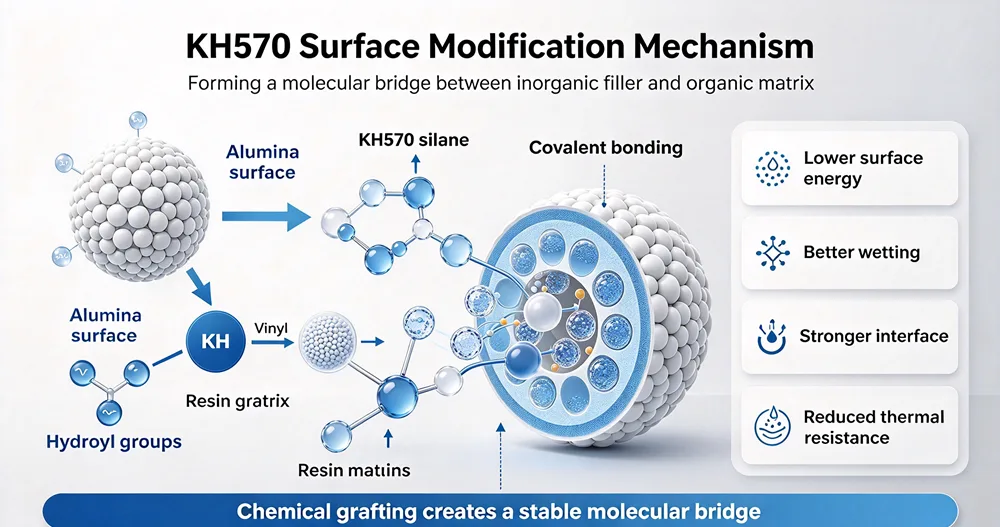
The modification process involves chemically grafting KH570 silane coupling agent onto the alumina surface. The silane molecule has two functional ends: one end reacts with the hydroxyl groups on the alumina surface, forming a stable chemical bond; the other end contains vinyl groups that can react with or entangle with the polymer chains of the resin matrix. This dual functionality creates a stable “molecular bridge” between the inorganic filler and the organic matrix.
KH570 Surface Modification Mechanism
2. Understanding KH570 Surface Modification
2.1 What Is KH570 Silane?
KH570 is a widely used silane coupling agent with vinyl reactive functional groups. The vinyl groups can undergo chemical reactions or physical entanglement with various organic resins, establishing a stable “molecular bridge” between the inorganic filler and the organic matrix. This makes KH570 particularly suitable for thermosetting resin systems such as epoxy, silicone, and polyurethane.
Other silane coupling agents, such as KH550 (amino-functional) or KH560 (epoxy-functional), are also used for surface modification. The choice of silane depends on the specific resin system and the required compatibility. KH570 is preferred for vinyl-containing resins and for systems where vinyl reactivity is desired.
2.2 How Surface Modification Works
The modification process begins with the hydrolysis of the silane coupling agent, which produces silanol groups. These silanol groups then react with the hydroxyl groups on the alumina surface, forming stable siloxane bonds. The organic functional groups (vinyl groups in the case of KH570) extend outward from the particle surface, creating a dense monolayer coating.
This coating reduces the surface energy of the filler, making it more compatible with organic resins. The vinyl groups can react with the resin during curing, forming covalent bonds between the filler and the matrix. This chemical bonding is stronger and more stable than physical adsorption, ensuring long-term performance.
2.3 Key Properties of KH570-Modified Spherical Alumina
KH570-Modified Spherical Alumina offers a combination of properties that make it suitable for demanding thermal management applications.
High purity and high sphericity: Alumina content ≥99.5%, sphericity ≥0.95, smooth particle surface, concentrated particle size distribution, facilitating the construction of efficient thermal conduction networks.
Uniform chemical bonding: KH570 silane is uniformly grafted onto the particle surface through chemical bonding, forming a dense monolayer coating with high stability and no shedding.
Excellent dispersibility: Significantly reduced surface energy, easy dispersion in organic matrices, effectively preventing agglomeration and reducing the risk of filter clogging during processing.
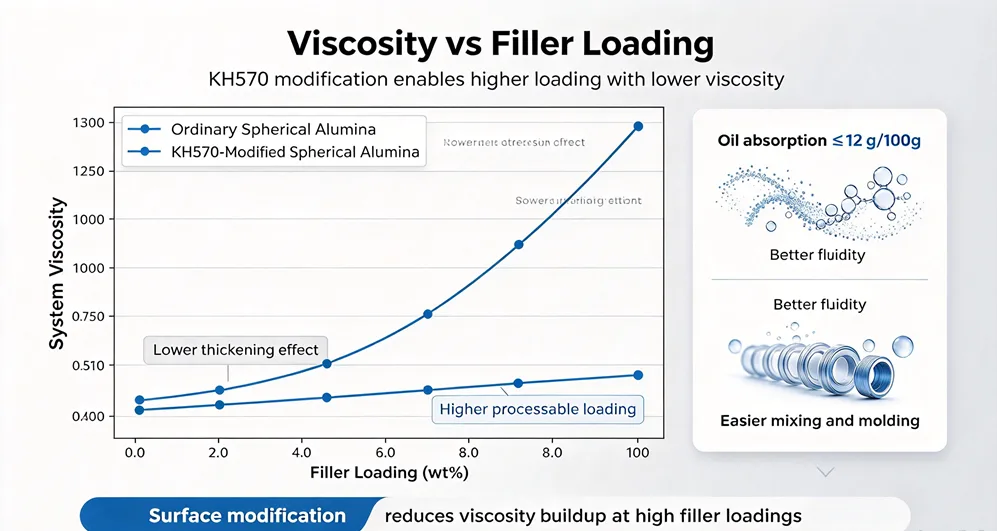
Low oil absorption and low thickening effect: Oil absorption value ≤12 g/100g, maintaining good fluidity even at high filler loadings, significantly reducing system viscosity.
Enhanced thermal conductivity efficiency: Improved interfacial bonding between filler and matrix, reduced interfacial thermal resistance, achieving over 30% improvement in thermal conductivity at the same filler loading.
Good weather resistance and electrical insulation: Stable modified layer, resistant to high temperature and high humidity environments, high volume resistivity, meeting stringent requirements of the electronics industry.
Customizable particle size: D50 can be precisely adjusted within the range of 1–100 μm to meet particle size distribution requirements of different applications.
2.4 Advantages Over Ordinary Spherical Alumina
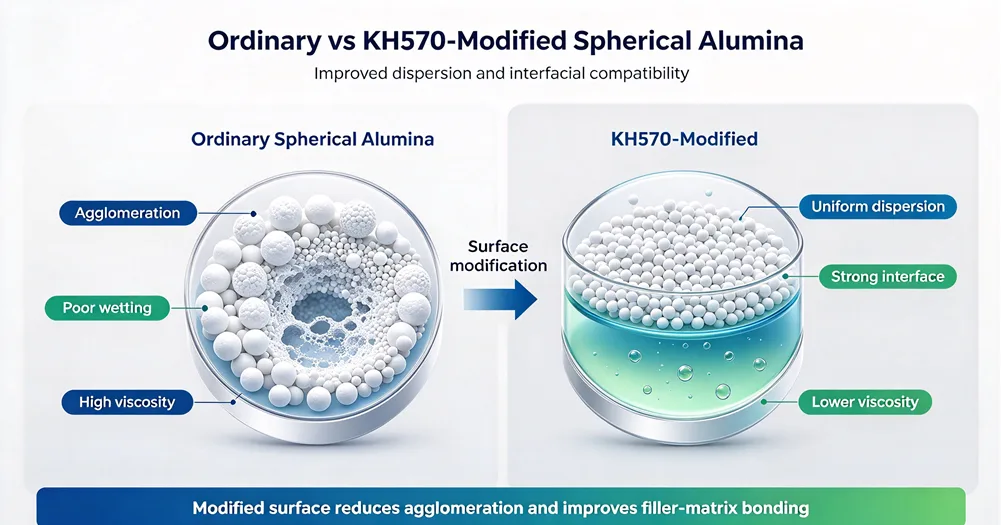
Compared to ordinary spherical alumina, KH570-Modified Spherical Alumina offers significant advantages in dispersibility, compatibility, and processability.
Lower surface energy: The organic functional groups on the surface reduce the surface energy, making the filler more compatible with organic resins.
Better dispersibility: The modified filler disperses more easily in the resin matrix, preventing agglomeration and ensuring uniform distribution.
Lower viscosity: At the same filler loading, the modified filler produces lower system viscosity, allowing higher filler loadings and better processing.
Higher thermal conductivity: Improved interfacial bonding reduces interfacial thermal resistance, resulting in higher thermal conductivity at the same filler loading.
Better long-term reliability: The stable modified layer resists degradation under high temperature and humidity conditions, ensuring long-term performance.
Ordinary vs KH570-Modified Spherical Alumina
3. Why Interfacial Compatibility Matters
3.1 Thermal Conductivity and Interfacial Thermal Resistance
The thermal conductivity of a filled composite depends not only on the intrinsic thermal conductivity of the filler but also on the interfacial thermal resistance between the filler and the matrix. Poor interfacial bonding creates a barrier to heat flow, reducing the effective thermal conductivity of the composite. KH570-Modified Spherical Alumina improves interfacial bonding, reducing interfacial thermal resistance and achieving over 30% improvement in thermal conductivity at the same filler loading.
3.2 Viscosity and Filler Loading
The viscosity of the filled resin system affects processing characteristics such as mixing, casting, and molding. Ordinary spherical alumina produces high viscosity at high filler loadings due to agglomeration and poor wetting. KH570-Modified Spherical Alumina produces lower viscosity at the same filler loading, allowing higher filler loadings and better processing.
3.3 Dispersion and Long-Term Reliability
Poor dispersion leads to agglomeration, which creates localized weak spots and inconsistent performance. Over time, the filler-matrix interface can degrade under thermal and humidity exposure, reducing long-term reliability. KH570-Modified Spherical Alumina forms a stable chemical bond with the resin matrix, ensuring that the interface remains intact and the performance remains consistent over time.
4. Selecting the Right Particle Size and Distribution
4.1 Particle Size Selection
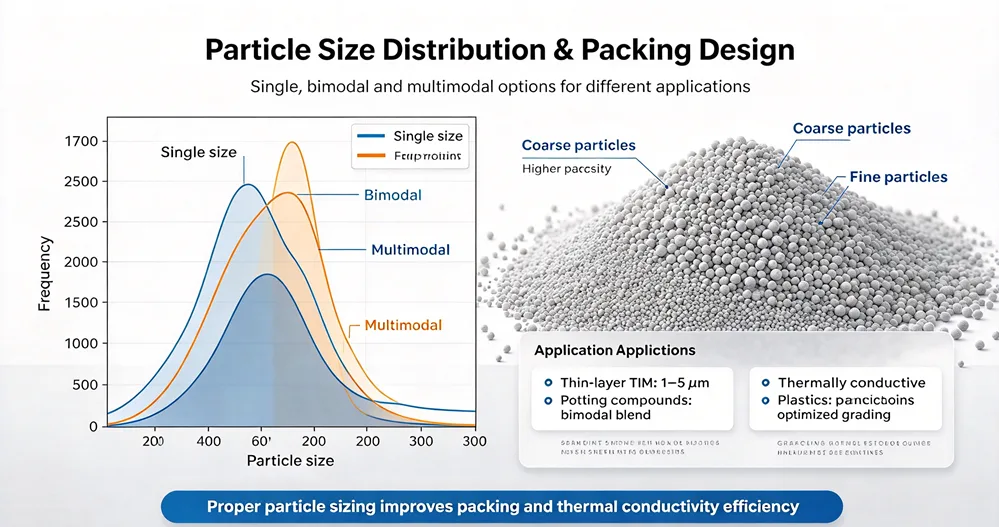
Particle size selection depends on the application scenario and processing technology. For thin-layer thermal interface materials such as thermal pads and thermal greases, smaller particle sizes (e.g., 1–5 μm) are recommended to achieve thinner filler layers. For thermally conductive potting compounds and thermally conductive plastics, a bimodal or multimodal particle size distribution is recommended to achieve higher packing density and thermal conductivity efficiency.
4.2 Bimodal and Multimodal Distribution
A bimodal or multimodal particle size distribution allows smaller particles to fill the gaps between larger particles, increasing packing density and improving thermal conductivity. KH570-Modified Spherical Alumina is available in a range of particle sizes that can be blended to achieve the desired distribution.
4.3 Customization
TRUNNANO offers particle size customization and blending recommendations. The D50 can be precisely adjusted within the range of 1–100 μm to meet particle size distribution requirements of different applications.
Particle Size Distribution & Packing Design
5. Evaluating Dispersion and Viscosity Performance
5.1 Dispersion Quality
The dispersion quality of the filler in the resin matrix directly affects the thermal conductivity and mechanical properties of the final composite. KH570-Modified Spherical Alumina disperses easily in organic matrices due to its reduced surface energy and improved compatibility. This reduces the risk of agglomeration and ensures uniform distribution.
5.2 Viscosity Behavior
The viscosity of the filled resin system affects processing characteristics. KH570-Modified Spherical Alumina produces lower viscosity at the same filler loading compared to ordinary spherical alumina. This allows higher filler loadings and better processing. The low oil absorption value (≤12 g/100g) contributes to the low thickening effect.
5.3 Processing Recommendations
For optimal dispersion and viscosity performance, the filler should be added gradually to the resin under adequate mixing. High-shear mixing may be required for high filler loadings. The addition of dispersants is generally not necessary with KH570-Modified Spherical Alumina because the surface modification already provides good compatibility.
Viscosity vs Filler Loading
6. Matching KH570-Modified Spherical Alumina to Your Application
6.1 Thermal Interface Materials (TIM)
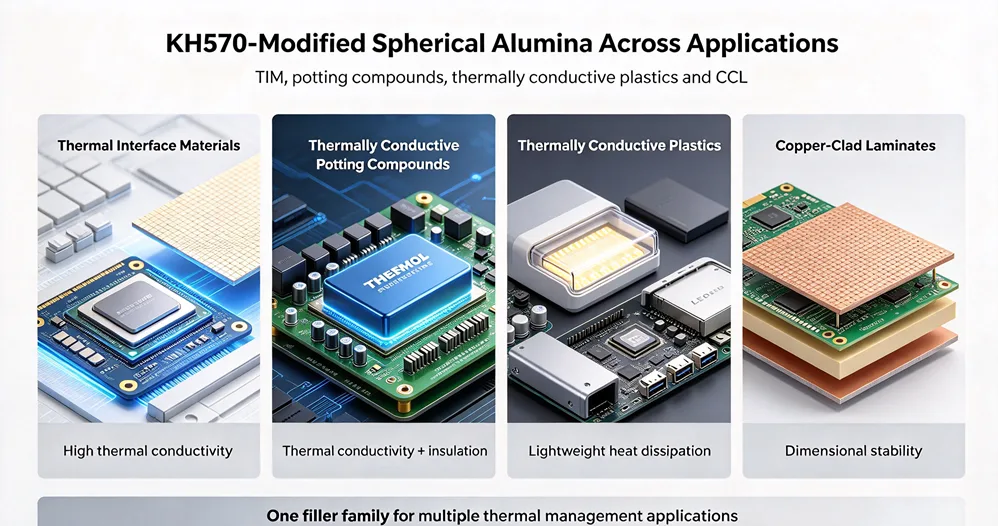
Thermal interface materials are used to fill the microscopic gaps between heat-generating components and heat sinks. They require high thermal conductivity, low thermal resistance, and good conformability. KH570-Modified Spherical Alumina is used in thermally conductive greases, thermally conductive pads, and phase change materials to build efficient thermal conduction pathways and reduce contact thermal resistance.
6.2 Thermally Conductive Potting Compounds and Gels
Potting compounds and gels are used to protect electronic components from moisture, dust, and mechanical damage while providing thermal conductivity. KH570-Modified Spherical Alumina is used for potting protection of new energy vehicle battery modules, power modules, and power adapters, combining thermal conductivity with insulation.
6.3 Thermally Conductive Plastics and Coatings
Thermally conductive plastics and coatings are used for LED lamp housings, electronic enclosures, and heat dissipation structural components. KH570-Modified Spherical Alumina enables lightweight design with efficient heat dissipation, allowing metal parts to be replaced with thermally conductive plastics.
6.4 Copper-Clad Laminates (CCL) and High-End PCBs
Copper-clad laminates and high-end printed circuit boards require ceramic fillers to enhance thermal conductivity and dimensional stability. KH570-Modified Spherical Alumina is used as a ceramic filler in resin systems to improve thermal conductivity and dimensional stability of circuit boards.
6.5 High-End Electronic Packaging Materials
High-end electronic packaging materials require high thermal conductivity, high electrical insulation, and low dielectric constant. KH570-Modified Spherical Alumina is used in semiconductor packaging and chip bonding materials to meet heat dissipation requirements of high-power density devices.
KH570-Modified Spherical Alumina Across Applications
7. Common Selection Mistakes to Avoid
7.1 Using Ordinary Spherical Alumina Without Surface Modification
Ordinary spherical alumina has poor compatibility with organic resins, leading to agglomeration and high viscosity. Using KH570-Modified Spherical Alumina addresses these issues at the source.
7.2 Choosing the Wrong Particle Size
Particle size selection depends on the application and processing technology. Using particles that are too large or too small can result in suboptimal performance. The optimal particle size should be determined based on the application requirements.
7.3 Neglecting Particle Size Distribution
A single particle size may not achieve the highest packing density. A bimodal or multimodal distribution is often needed to maximize packing density and thermal conductivity. KH570-Modified Spherical Alumina can be blended to achieve the desired distribution.
7.4 Overlooking Dispersion Quality
Dispersion quality directly affects thermal conductivity and mechanical properties. Poor dispersion can negate the benefits of surface modification. Proper mixing procedures should be followed to ensure uniform dispersion.
7.5 Choosing Based on Price Alone
While cost is an important consideration, selecting KH570-Modified Spherical Alumina based solely on price can lead to suboptimal performance. Quality, consistency, and technical support are equally important.
8. Quick Selection Checklist
Before selecting KH570-Modified Spherical Alumina for your thermal management application, verify the following key parameters:
Thermal conductivity target
Viscosity and processing requirements
Electrical insulation requirements
Long-term reliability requirements
Particle size and distribution requirements
Resin system compatibility
Filler loading requirements
Dispersion and mixing requirements
Storage and shelf life requirements
Supplier quality and technical support
9. Real-World Application Scenarios
9.1 Thermal Interface Materials for 5G Communications
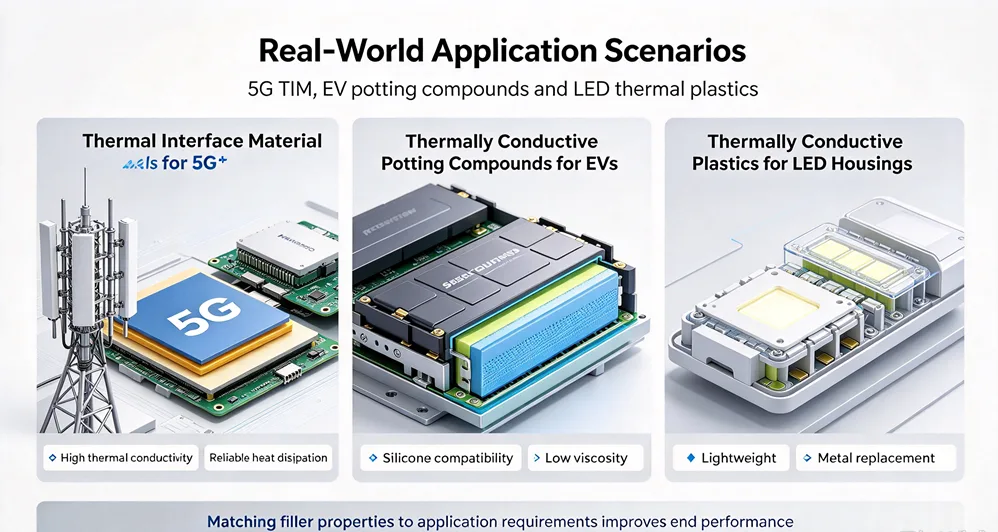
A manufacturer of thermal interface materials for 5G communication equipment selected KH570-Modified Spherical Alumina for its thermally conductive pads. The modified filler provided excellent dispersion and low viscosity, allowing high filler loading and high thermal conductivity. The thermal pads met the demanding thermal management requirements of 5G base stations.
9.2 Thermally Conductive Potting Compounds for New Energy Vehicles
A producer of thermally conductive potting compounds for new energy vehicle battery modules used KH570-Modified Spherical Alumina as the filler. The modified filler provided good compatibility with the silicone resin, low viscosity for easy potting, and high thermal conductivity for efficient heat dissipation. The potting compounds met the safety and reliability requirements of electric vehicle battery systems.
9.3 Thermally Conductive Plastics for LED Housings
A manufacturer of LED lamp housings used KH570-Modified Spherical Alumina in thermally conductive plastics. The modified filler enabled high filler loading and good processability, allowing the production of lightweight, heat-dissipating housings that replaced metal components.
Real-World Application Scenarios
10. Frequently Asked Questions (FAQs)
Q1: What is the difference between KH570-modified spherical alumina and ordinary spherical alumina?
Ordinary spherical alumina has high surface polarity, poor compatibility with organic resins, and tends to agglomerate, causing a significant increase in system viscosity at high filler loadings. KH570-Modified Spherical Alumina