1. Introduction to Reaction-Bonded Silicon Carbide
1.1 What Is Reaction-Bonded Silicon Carbide?
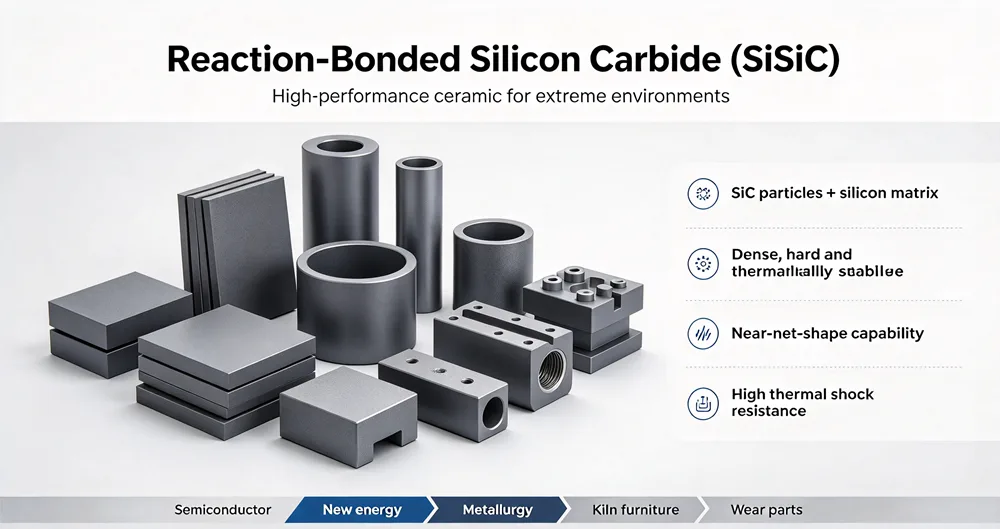
Reaction-bonded silicon carbide (SiSiC), also known as silicon-infiltrated silicon carbide, is a high-performance ceramic composite material composed of silicon carbide (SiC) particles bonded together by a silicon matrix. It is produced by infiltrating molten silicon into a porous carbon-containing SiC preform, where the silicon reacts with carbon to form additional SiC that bonds the structure together. The result is a dense, hard, and thermally stable ceramic with a unique combination of properties that make it suitable for demanding industrial applications.
Reaction-bonded silicon carbide (SiSiC) is one of the most widely used advanced ceramics in industries ranging from semiconductor manufacturing to metallurgy and power generation. Its popularity stems from a balance of performance, cost, and manufacturability that few other ceramic materials can match.
Reaction-Bonded Silicon Carbide (SiSiC)
1.2 Why SiSiC Matters in Modern Industry
The demand for high-performance materials capable of operating under extreme conditions continues to grow. Industries such as semiconductor manufacturing, new energy, aerospace, and non-ferrous metallurgy require materials that can withstand high temperatures, corrosive environments, and mechanical stress without failure. Reaction-bonded silicon carbide (SiSiC) addresses these needs with a combination of properties that include high thermal conductivity, low thermal expansion, excellent thermal shock resistance, and exceptional wear resistance.
In semiconductor manufacturing, reaction-bonded silicon carbide (SiSiC) components are used in wafer processing equipment where purity and dimensional stability are critical. In the new energy sector, reaction-bonded silicon carbide (SiSiC) crucibles and kiln furniture support the high-temperature sintering of lithium battery cathode materials. In metallurgy, reaction-bonded silicon carbide (SiSiC) linings and components resist attack from molten metals and slags. The versatility of reaction-bonded silicon carbide (SiSiC) makes it a key enabling material across multiple industries.
1.3 The Cost of Choosing the Wrong Ceramic Material
Selecting the wrong ceramic material for a high-temperature application can lead to premature failure, equipment downtime, and significant financial losses. A material that lacks sufficient thermal shock resistance may crack under rapid temperature changes. A material with insufficient chemical inertness may react with the process material, contaminating the product. A material with inadequate mechanical strength may fail under load.
Reaction-bonded silicon carbide (SiSiC) is not a universal solution — it has specific strengths and limitations that must be matched to the application. Understanding these characteristics is essential for making an informed selection. This guide provides a step-by-step framework for evaluating reaction-bonded silicon carbide (SiSiC) and determining whether it is the right material for a given application.
2. Understanding the Basics of SiSiC
2.1 Chemical Composition and Microstructure
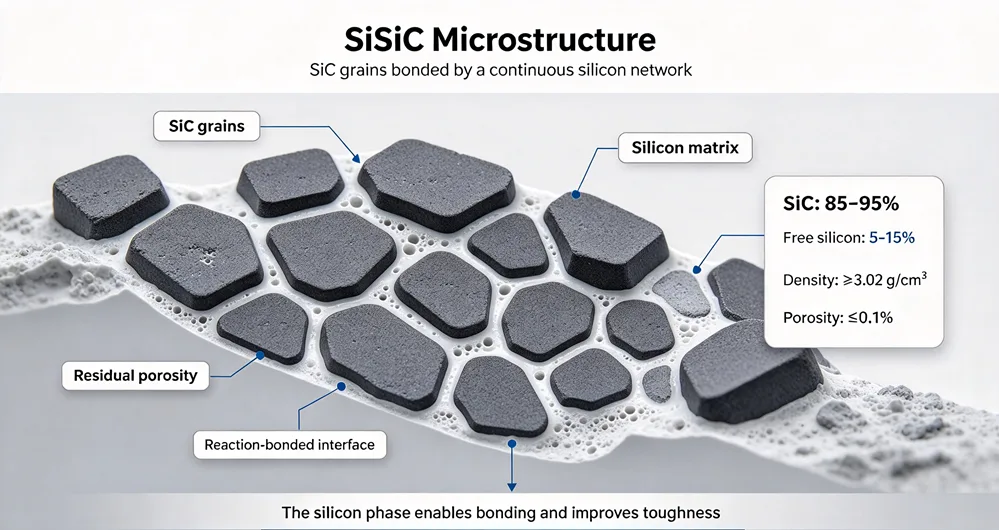
Reaction-bonded silicon carbide (SiSiC) is a composite material consisting of silicon carbide (SiC) particles bonded by a silicon phase. The typical composition includes 85–95% SiC and 5–15% free silicon, depending on the manufacturing process and intended application. The microstructure consists of SiC grains surrounded by a continuous silicon network, with some residual porosity.
The presence of free silicon has a significant influence on the material's properties. Silicon has a lower melting point than SiC and can limit the maximum operating temperature of reaction-bonded silicon carbide (SiSiC) in certain environments. However, the silicon phase also contributes to the material's toughness and enables the reaction bonding process that gives reaction-bonded silicon carbide (SiSiC) its characteristic near-net-shape capability.
2.2 Key Properties of SiSiC
Reaction-bonded silicon carbide (SiSiC) offers a combination of properties that make it suitable for high-temperature and wear-resistant applications.
High thermal conductivity: Reaction-bonded silicon carbide (SiSiC) exhibits thermal conductivity of approximately 120 W/m·K at 20°C, enabling efficient heat transfer and uniform temperature distribution.
Low thermal expansion: The coefficient of thermal expansion is approximately 4.5 × 10⁻⁶/K, providing excellent thermal shock resistance.
High hardness: With a Mohs hardness of 9.5, reaction-bonded silicon carbide (SiSiC) resists abrasion and wear.
High mechanical strength: Flexural strength reaches approximately 250 MPa at 20°C and 280 MPa at 1200°C, making reaction-bonded silicon carbide (SiSiC) suitable for load-bearing applications.
Chemical inertness: Reaction-bonded silicon carbide (SiSiC) resists attack from most acids, alkalis, and molten metals, although it can be degraded by certain highly oxidizing environments.
Low porosity: Porosity is typically ≤0.1%, contributing to chemical inertness and preventing penetration by molten materials.
2.3 Advantages Over Other Ceramic Materials
Reaction-bonded silicon carbide (SiSiC) offers several advantages over other advanced ceramics such as alumina, silicon nitride, and recrystallized silicon carbide.
Near-net-shape forming: Reaction-bonded silicon carbide (SiSiC) can be produced in complex shapes with minimal dimensional change during processing, reducing the need for costly machining.
Excellent thermal shock resistance: The combination of high thermal conductivity and low thermal expansion allows reaction-bonded silicon carbide (SiSiC) to withstand rapid temperature changes without cracking.
High-temperature strength retention: Unlike many ceramics that lose strength at elevated temperatures, reaction-bonded silicon carbide (SiSiC) maintains a significant portion of its room-temperature strength at temperatures up to 1200°C and beyond.
Cost-effectiveness: Compared to other high-performance ceramics such as silicon nitride or boron carbide, reaction-bonded silicon carbide (SiSiC) offers a favorable balance of performance and cost.
Reaction-Bonded Silicon Carbide (SiSiC)
3. Step 1: Understand the Manufacturing Process
3.1 Reaction Bonding Process
The reaction bonding process begins with the preparation of a porous preform containing SiC particles and carbon. The preform is shaped using conventional ceramic forming techniques such as slip casting, pressing, or extrusion. The shaped preform is then heated in a furnace and infiltrated with molten silicon. The molten silicon reacts with the carbon in the preform to form additional SiC, which bonds the original SiC particles together. The result is a dense, strong ceramic body with minimal dimensional change.
3.2 Key Process Parameters
Several process parameters influence the properties of the final reaction-bonded silicon carbide (SiSiC) product.
SiC particle size and distribution: The particle size of the starting SiC powder affects the microstructure and mechanical properties of the final product.
Carbon content: The amount and distribution of carbon in the preform determine the extent of the reaction bonding and the final silicon content.
Infiltration temperature: The temperature at which molten silicon is infiltrated affects the reaction kinetics and the uniformity of the silicon distribution.
Cooling rate: Controlled cooling is necessary to minimize residual stresses and prevent cracking.
3.3 Near-Net-Shape Capability
One of the key advantages of reaction-bonded silicon carbide (SiSiC) is its near-net-shape capability. Because the reaction bonding process occurs with minimal dimensional change, complex shapes can be produced with high precision. This reduces the need for diamond grinding and other costly machining operations, making reaction-bonded silicon carbide (SiSiC) a cost-effective choice for complex components.
4. Step 2: Evaluate Key Performance Properties
4.1 Thermal Properties
Reaction-bonded silicon carbide (SiSiC) offers excellent thermal properties that make it suitable for high-temperature applications. The high thermal conductivity of reaction-bonded silicon carbide (SiSiC) enables efficient heat transfer, reducing thermal gradients and thermal stress. The low coefficient of thermal expansion provides excellent thermal shock resistance, allowing reaction-bonded silicon carbide (SiSiC) to withstand rapid heating and cooling without cracking.
| Property |
Value |
| Thermal conductivity (20°C) |
120 W/m·K |
| Thermal conductivity (1200°C) |
45 W/m·K |
| Coefficient of thermal expansion (20–1200°C) |
4.5 × 10⁻⁶/K |
| Maximum operating temperature (air) |
1380°C |
4.2 Mechanical Properties
Reaction-bonded silicon carbide (SiSiC) exhibits high hardness and mechanical strength, making it suitable for wear-resistant and load-bearing applications. The material maintains a significant portion of its strength at elevated temperatures, which is important for high-temperature structural applications.
| Property |
Value |
| Density |
≥ 3.02 g/cm³ |
| Porosity |
≤ 0.1% |
| Flexural strength (20°C) |
250 MPa |
| Flexural strength (1200°C) |
280 MPa |
| Elastic modulus |
330 GPa |
| Fracture toughness |
3.3 MPa·m¹/² |
| Mohs hardness |
9.5 |
4.3 Chemical Properties
Reaction-bonded silicon carbide (SiSiC) is chemically inert to most acids, alkalis, and molten metals. However, it can be attacked by certain highly oxidizing environments, particularly at elevated temperatures. The free silicon phase in reaction-bonded silicon carbide (SiSiC) can also react with certain chemicals, so the material is not suitable for all corrosive environments.
4.4 Electrical Properties
Reaction-bonded silicon carbide (SiSiC) exhibits semiconductor behavior at elevated temperatures, with electrical resistivity varying depending on the temperature and the amount of free silicon. This property makes reaction-bonded silicon carbide (SiSiC) suitable for certain electronic applications but limits its use as an electrical insulator.
5. Step 3: Compare SiSiC with Other Silicon Carbide Grades
5.1 SiSiC vs. SSiC (Pressureless Sintered Silicon Carbide)
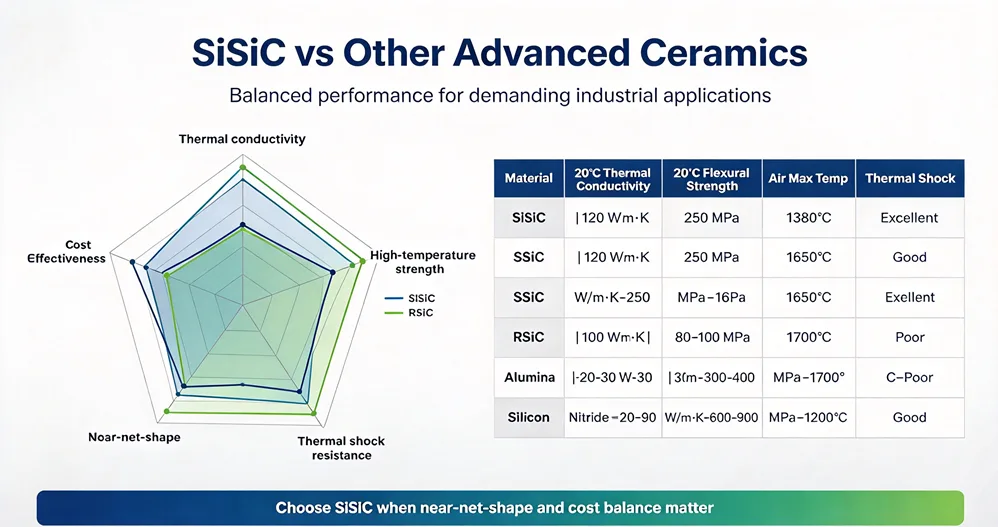
Pressureless sintered silicon carbide (SSiC) is a high-purity SiC material with no free silicon phase. Pressureless sintered silicon carbide (SSiC) offers higher maximum operating temperature and better chemical resistance than reaction-bonded silicon carbide (SiSiC) but is more expensive and more difficult to form into complex shapes. Reaction-bonded silicon carbide (SiSiC) is preferred when near-net-shape capability and cost-effectiveness are important.
5.2 SiSiC vs. RSiC (Recrystallized Silicon Carbide)
Recrystallized silicon carbide (RSiC) is a high-purity SiC material with a coarse-grained microstructure and high porosity. Recrystallized silicon carbide (RSiC) offers excellent thermal shock resistance and high maximum operating temperature but lower mechanical strength than reaction-bonded silicon carbide (SiSiC). Reaction-bonded silicon carbide (SiSiC) is preferred when mechanical strength and wear resistance are important.
5.3 SiSiC vs. Alumina and Silicon Nitride
Compared to alumina and silicon nitride, reaction-bonded silicon carbide (SiSiC) offers higher thermal conductivity, better thermal shock resistance, and higher maximum operating temperature. Alumina is more cost-effective for general applications but lacks the thermal and mechanical performance of reaction-bonded silicon carbide (SiSiC). Silicon nitride offers higher fracture toughness but lower thermal conductivity.
| Property |
SiSiC |
SSiC |
RSiC |
Alumina |
Silicon Nitride |
| Thermal conductivity (20°C) |
120 |
120 |
100 |
20–30 |
20–90 |
| Flexural strength (20°C) |
250 |
250 |
80–100 |
300–400 |
600–900 |
| Maximum temperature (air) |
1380 |
1650 |
1650 |
1700 |
1200 |
| Thermal shock resistance |
Excellent |
Good |
Excellent |
Poor |
Good |
| Near-net-shape capability |
Excellent |
Limited |
Good |
Good |
Limited |
SiSiC vs Other Advanced Ceramics
6. Step 4: Match SiSiC to Your Application
6.1 Semiconductor Manufacturing
In the semiconductor industry, reaction-bonded silicon carbide (SiSiC) components are used in wafer processing equipment, including susceptors, carriers, and process chambers. The high purity, thermal stability, and chemical inertness of reaction-bonded silicon carbide (SiSiC) make it suitable for these demanding applications. Reaction-bonded silicon carbide (SiSiC) components resist attack from plasma and corrosive gases, ensuring long service life and consistent process performance.
6.2 New Energy and Battery Materials
Reaction-bonded silicon carbide (SiSiC) crucibles and kiln furniture are used in the high-temperature sintering of lithium battery cathode materials. The high thermal conductivity of reaction-bonded silicon carbide (SiSiC) ensures uniform temperature distribution, while the chemical inertness prevents contamination of the battery materials. Reaction-bonded silicon carbide (SiSiC) is also used in the production of solid oxide fuel cells and other energy-related applications.
6.3 Metallurgy and Metal Processing
Reaction-bonded silicon carbide (SiSiC) components are used in metallurgical applications including blast furnace linings, aluminum reduction cell linings, and zinc distillation retorts. The material's resistance to molten metals and slags, combined with its thermal shock resistance, makes it suitable for these harsh environments. Reaction-bonded silicon carbide (SiSiC) is particularly effective in aluminum processing, where it resists attack from molten aluminum and cryolite.
6.4 Kiln Furniture and Ceramic Manufacturing
Reaction-bonded silicon carbide (SiSiC) kiln furniture, including setters, beams, and pusher plates, is used in the firing of ceramic and glass products. The high thermal conductivity of reaction-bonded silicon carbide (SiSiC) ensures uniform heat distribution, while the thermal shock resistance allows rapid heating and cooling cycles. The low mass of reaction-bonded silicon carbide (SiSiC) kiln furniture also reduces energy consumption compared to traditional refractory materials.
6.5 Wear-Resistant Components
Reaction-bonded silicon carbide (SiSiC) is used in wear-resistant components such as nozzles, slurry pump liners, and cyclones. The high hardness and wear resistance of reaction-bonded silicon carbide (SiSiC) extend component life and reduce maintenance costs in abrasive environments.
6.6 Environmental and Energy Applications
Reaction-bonded silicon carbide (SiSiC) components are used in waste incinerators, coal gasification systems, and other environmental applications where high temperature and corrosion resistance are required. The material's ability to withstand aggressive environments makes it suitable for these demanding applications.
7. Step 5: Consider Design and Fabrication Factors
7.1 Shape and Size Limitations
Reaction-bonded silicon carbide (SiSiC) can be produced in a wide range of shapes and sizes, from small components to large structural parts. The near-net-shape capability of reaction-bonded silicon carbide (SiSiC) allows complex geometries to be produced with minimal machining. However, there are practical limits to the size and complexity of reaction-bonded silicon carbide (SiSiC) components, and consultation with the supplier is recommended for large or complex parts.
7.2 Joining and Assembly
Reaction-bonded silicon carbide (SiSiC) components can be joined using various techniques, including mechanical fastening, adhesive bonding, and diffusion bonding. The choice of joining method depends on the application requirements, including temperature, load, and chemical exposure.
7.3 Surface Finishing
Reaction-bonded silicon carbide (SiSiC) components can be machined using diamond tooling to achieve tight tolerances and smooth surface finishes. However, machining is costly and should be minimized through near-net-shape forming. Surface finishing options include grinding, lapping, and polishing, depending on the required surface quality.
7.4 Quality Control and Inspection
Quality control is essential for reaction-bonded silicon carbide (SiSiC) components, particularly for critical applications in semiconductor and energy industries. Inspection methods include dimensional measurement, density and porosity testing, and non-destructive evaluation techniques such as ultrasonic testing and X-ray inspection.
8. Step 6: Factor in Cost and Supplier Selection
8.1 Initial Cost vs. Lifetime Cost
The initial cost of reaction-bonded silicon carbide (SiSiC) components is higher than that of traditional refractory materials such as alumina or fireclay. However, the longer service life, reduced maintenance requirements, and improved process efficiency of reaction-bonded silicon carbide (SiSiC) often result in lower total cost of ownership. When evaluating reaction-bonded silicon carbide (SiSiC), it is important to consider the full lifecycle cost rather than just the purchase price.
8.2 Supplier Selection Criteria
When selecting a reaction-bonded silicon carbide (SiSiC) supplier, consider the following factors:
Material quality: Purity, density, and microstructure consistency
Manufacturing capability<