Overview of Silicon Carbide Bonded Silicon Nitride Ceramic Ring
The Silicon Carbide Bonded Silicon Nitride Ceramic Ring is a high-performance composite ceramic seal ring and wear ring, featuring a silicon carbide (SiC) skeleton bonded by in-situ formed silicon nitride (Si₃N₄). This SiC-Bonded Si₃N₄ Ceramic Ring is produced through a reaction sintering process in which SiC particles and silicon powder are formed in one step under high-temperature nitrogen atmosphere. The Silicon Carbide Bonded Silicon Nitride Ceramic Ring combines the high hardness and excellent thermal conductivity of SiC with the outstanding fracture toughness and thermal shock resistance of Si₃N₄. Compared with single-phase SiC ceramics, this SiC-Bonded Si₃N₄ Ceramic Ring significantly reduces the risk of brittle fracture while maintaining high wear resistance, making it suitable for rotary seals and sliding bearings under high-speed, high-pressure, highly corrosive, and severe temperature-fluctuation conditions.
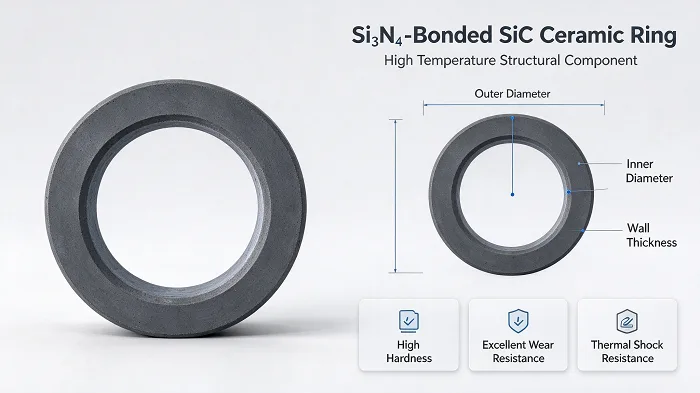
Advantages of Silicon Carbide Bonded Silicon Nitride Ceramic Ring
Features and Advantages of Silicon Carbide Bonded Silicon Nitride Ceramic Ring
1. Balanced Toughness and Hardness
The Si₃N₄ bonding phase grows in situ between SiC particles, forming an interpenetrating network structure that effectively deflects cracks and dissipates stress. The Silicon Carbide Bonded Silicon Nitride Ceramic Ring offers better fracture toughness than reaction-bonded SiC while maintaining a Mohs hardness of around 9, second only to diamond.
2. Excellent Thermal Shock Resistance
The SiC-Bonded Si₃N₄ Ceramic Ring has a low thermal expansion coefficient, and the presence of the Si₃N₄ phase relieves thermal stress concentration. This Silicon Carbide Bonded Silicon Nitride Ceramic Ring can remain crack-free under rapid heating and cooling, making it ideal for frequent start-stop or temperature-cycling conditions.
3. Good High-Temperature Strength Retention
The SiC-Bonded Si₃N₄ Ceramic Ring maintains strength and hardness at 1200–1400°C comparable to room-temperature levels, far superior to most metal alloys and some oxide ceramics.
4. Corrosion and Oxidation Resistance
The Silicon Carbide Bonded Silicon Nitride Ceramic Ring offers good resistance to acids, alkalis, and molten non-ferrous metals (such as aluminum, zinc, and copper melts), with outstanding high-temperature oxidation resistance, suitable for chemical pumps and die-casting equipment.
5. Self-Lubrication and Low Friction
During friction, the surface of the SiC-Bonded Si₃N₄ Ceramic Ring can form a silicon oxide-based passive film, achieving stable low-wear operation under certain conditions and extending the service life of the seal ring.
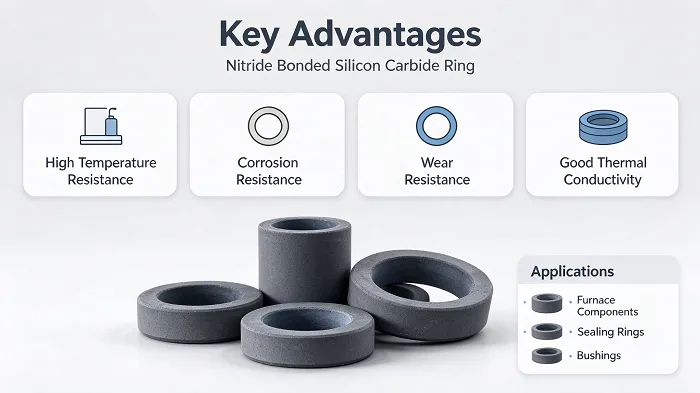
Advantages of Silicon Carbide Bonded Silicon Nitride Ceramic Ring
Application Areas of Silicon Carbide Bonded Silicon Nitride Ceramic Ring
Mechanical Seal Rings: Used for shaft seals in centrifugal pumps, agitators, and compressors, especially suitable for fluid sealing with solid particles or corrosive media. The Silicon Carbide Bonded Silicon Nitride Ceramic Ring performs reliably in these demanding environments.
Die-Casting Machine Shot Sleeve and Plunger Rings: Ring-shaped components resistant to aluminum melt erosion and thermal shock in high-pressure aluminum die casting. The SiC-Bonded Si₃N₄ Ceramic Ring is well suited for this application.
Sliding Bearings and Thrust Rings: Replacing metal bearings in high-temperature, lubrication-free, or highly corrosive environments. The Silicon Carbide Bonded Silicon Nitride Ceramic Ring provides long service life.
Chemical Process Pumps: Serving as wear-resistant and corrosion-resistant sealing pairs when handling acids, alkalis, and organic solvents. The SiC-Bonded Si₃N₄ Ceramic Ring is a preferred choice.
High-Temperature Kiln Roller Rings: Used for transmission components in high-temperature sections of ceramic kilns and waste incinerators. The Silicon Carbide Bonded Silicon Nitride Ceramic Ring withstands harsh thermal conditions.

Applications of SiC-Bonded Si₃N₄ Ceramic Ring
Production Process of Silicon Carbide Bonded Silicon Nitride Ceramic Ring
The Silicon Carbide Bonded Silicon Nitride Ceramic Ring is manufactured using the reaction sintering (nitriding bonding) process:
1. Raw Material Preparation: High-purity SiC particles (graded particle size) mixed with metallic silicon powder (typically 10–20 wt%), with temporary binders and sintering aids (such as Al₂O₃, Y₂O₃) added.
2. Forming: The SiC-Bonded Si₃N₄ Ceramic Ring is shaped into a ring body through dry pressing, isostatic pressing, or slip casting.
3. Nitriding Sintering: The green body is placed in a nitriding furnace with high-purity nitrogen gas and held at 1380–1450°C. Silicon powder reacts with N₂ to form Si₃N₄ in situ, firmly bonding the SiC particles. This step is critical for the Silicon Carbide Bonded Silicon Nitride Ceramic Ring.
4. Precision Machining: After sintering, the SiC-Bonded Si₃N₄ Ceramic Ring is diamond-ground and lapped to the required dimensions and surface roughness (sealing surface Ra ≤ 0.4–0.8 μm).
Technical Parameters Table of Silicon Carbide Bonded Silicon Nitride Ceramic Ring
|
Parameter |
Unit |
Typical Value |
|---|---|---|
|
Density |
g/cm³ |
2.6–2.8 |
|
Apparent Porosity |
% |
12–18 |
|
Flexural Strength (RT) |
MPa |
≥ 80 |
|
Elastic Modulus |
GPa |
150–200 |
|
Mohs Hardness |
— |
~9 |
|
Max Service Temperature |
°C |
1400 |
|
Thermal Expansion Coefficient (RT–1000°C) |
×10⁻⁶/K |
4.5–5.0 |
|
Thermal Conductivity (RT) |
W/(m·K) |
15–25 |
|
Acid/Alkali Resistance |
— |
Excellent |
Note: The above are typical ranges for the Silicon Carbide Bonded Silicon Nitride Ceramic Ring, and specific values vary with SiC particle grading and Si content.
Comparison of Other Materials Table
|
Property |
SiC-Bonded Si₃N₄ |
Reaction-Bonded SiC (RBSiC) |
Pressureless Sintered SiC (SSiC) |
Silicon Nitride (Si₃N₄) |
|---|---|---|---|---|
|
Flexural Strength (MPa) |
~80–120 |
250–380 |
400–490 |
700–1000 |
|
Fracture Toughness (MPa·m¹ᐟ²) |
Medium |
2.8–3.0 |
3.0–4.0 |
6–7 |
|
Thermal Shock Resistance |
Excellent |
Good |
Medium |
Excellent |
|
Max Service Temperature (°C) |
1400 |
1380–1700 |
1600 |
1200–1500 |
|
Wear Resistance |
Good |
Excellent |
Excellent |
Good |
|
Cost |
Low–Medium |
Low |
High |
High |
|
Application |
Seals/wear rings with frequent thermal shock |
General wear/corrosion parts |
High-hardness seals |
High-toughness bearings/seals |
The SiC-Bonded Si₃N₄ Ceramic Ring offers a balanced combination of thermal shock resistance, wear resistance, and cost.

Storage Conditions of Silicon Carbide Bonded Silicon Nitride Ceramic Ring
Store the Silicon Carbide Bonded Silicon Nitride Ceramic Ring in a dry, ventilated indoor environment at 15–30°C and relative humidity ≤ 60%.
Avoid direct contact with acids, alkalis, and organic solvents during storage.
The SiC-Bonded Si₃N₄ Ceramic Ring should be placed flat or fixed with dedicated supports to avoid stacking and edge chipping.
Wear clean gloves during handling to prevent surface oil contamination that may affect sealing performance.
Company Profile
Luoyang Tongrun Nano Technology Co. Ltd. (TRUNNANO) is a trusted global chemical material supplier & manufacturer with over 12-year-experience in providing super high-quality chemicals and nanomaterials, including boride powder, nitride powder, oxide powder, concrete admixtures and ceramic products, etc.
The company has a professional technical department and Quality Supervision Department, a well-equipped laboratory, and equipped with advanced testing equipment and after-sales customer service center.
If you are looking for high-quality Ceramic Ring and relative products please feel free to contact us or click on the needed products to send an inquiry.
Payment Term
T/T, Western Union, Paypal, Credit Card etc.
Shipment Term
By air, by sea, by express, as customers request.
FAQs of Silicon Carbide Bonded Silicon Nitride Ceramic Ring
Q1: What are the main advantages of the Silicon Carbide Bonded Silicon Nitride Ceramic Ring compared with pure silicon carbide rings?
A: The main advantages are thermal shock resistance and toughness. Pure SiC rings are brittle and prone to cracking under rapid temperature changes or impact loads. The Si₃N₄ bonding phase in the SiC-Bonded Si₃N₄ Ceramic Ring acts as a "buffer," enabling the Silicon Carbide Bonded Silicon Nitride Ceramic Ring to withstand more severe thermal cycling and mechanical vibration while maintaining surface wear resistance.
Q2: Is this ceramic ring suitable for slurry sealing with solid particles?
A: Yes. The Silicon Carbide Bonded Silicon Nitride Ceramic Ring has high hardness, and the Si₃N₄ bonding phase provides certain self-lubricating characteristics, reducing adhesive wear in slurry media. However, service life should be evaluated based on particle hardness and size; in extremely coarse-particle conditions, flushing solutions are still recommended. The SiC-Bonded Si₃N₄ Ceramic Ring performs well in most slurry applications.
Q3: What is the maximum service temperature? Will it oxidize at high temperatures?
A: The recommended long-term safe service temperature for the SiC-Bonded Si₃N₄ Ceramic Ring is up to 1400°C. In oxidizing atmospheres, the Si₃N₄ bonding phase forms a dense SiO₂ protective film on the surface, inhibiting further oxidation. However, atmosphere compatibility should be confirmed for reducing or vacuum high-temperature environments. The Silicon Carbide Bonded Silicon Nitride Ceramic Ring is designed for demanding high-temperature applications.
Q4: Can non-standard sizes and grooved structures be customized?
A: Yes. The Silicon Carbide Bonded Silicon Nitride Ceramic Ring can be customized according to drawings for inner/outer diameter, thickness, end-face grooves, and positioning notches. Sealing surfaces can be lapped to Ra 0.4 μm, with dimensional tolerances controlled within ±0.02–0.05 mm (depending on the specific structure).
Q5: When running against a metal ring, what material should be selected as the mating pair?
A: Gray cast iron or silicon carbide/tungsten carbide mating pairs are recommended. Studies show that Si₃N₄-based ceramics paired with gray cast iron can form a protective oxide film in oxidizing media, resulting in a low wear coefficient and good sealing effect. Self-pairing (ceramic against ceramic) of the SiC-Bonded Si₃N₄ Ceramic Ring may cause abrasive wear under high pressure and high speed, so working conditions should be carefully evaluated.