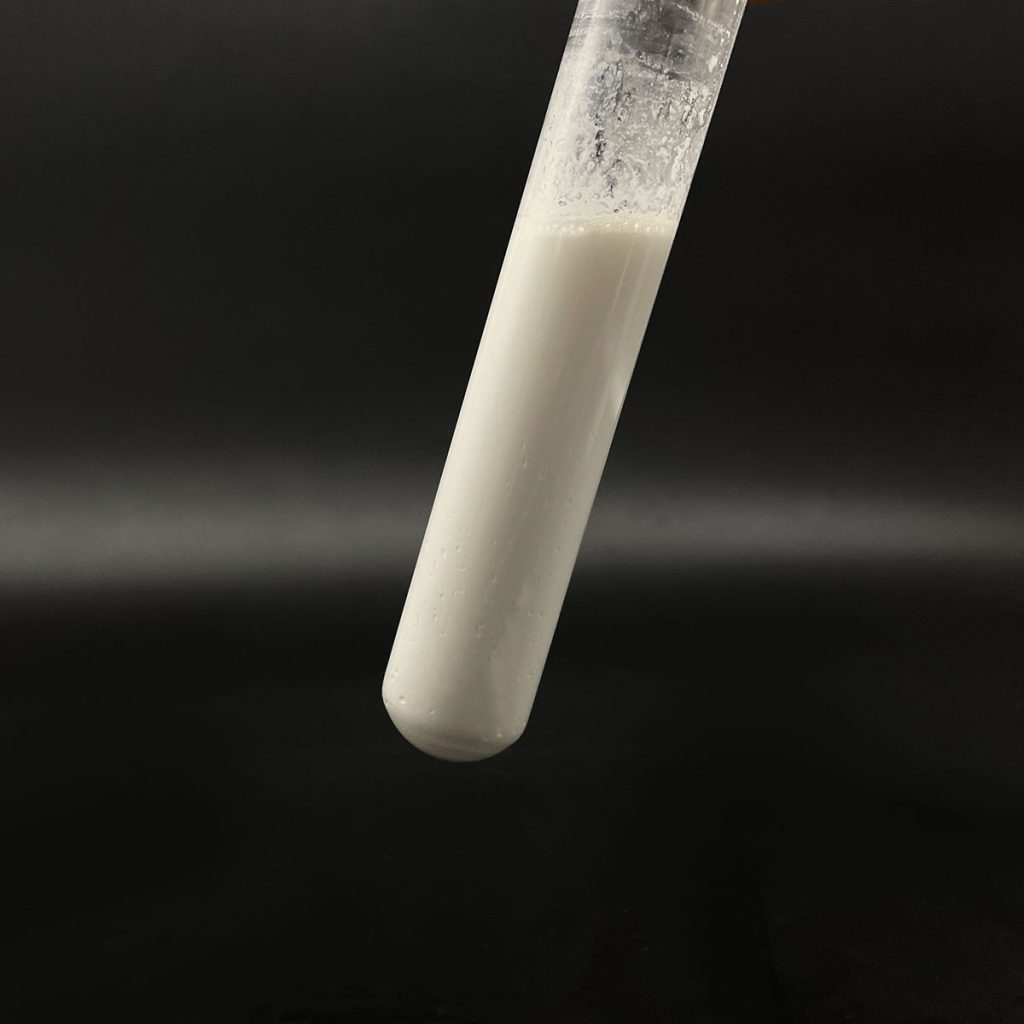
Calcium Stearate Emulsion: Bridging the Gap Between Science and Industry
Views : 948
Author : Vincy
Update time : 2025-08-26 10:55:42
In the realm of industrial chemistry, few materials demonstrate the versatility and adaptability of calcium stearate emulsion. This water-based formulation of calcium stearate—a metallic soap derived from stearic acid—has quietly become a cornerstone of modern manufacturing. Its ability to reconcile hydrophobic and hydrophilic properties, coupled with its environmental compatibility, makes it indispensable in sectors ranging from plastics and coatings to food packaging and pharmaceuticals. This article explores the molecular intricacies, production methodologies, and transformative applications of calcium stearate emulsion, revealing why it is both a scientific marvel and an industrial workhorse.
Calcium Stearate Emulsion
1. Molecular Foundations: The Dual Nature of Calcium Stearate
1.1 Amphiphilic Architecture: A Molecular Paradox
Calcium stearate’s unique structure arises from its amphiphilic nature—simultaneously possessing hydrophobic and hydrophilic regions. This duality is rooted in its molecular composition: 1.1.1Hydrophobic Tail The 18-carbon alkyl chain of stearic acid, derived from renewable resources like palm oil or tallow, repels water. This segment anchors the molecule to nonpolar surfaces such as plastics, oils, or waxes, reducing interfacial tension. 1.1.2Hydrophilic Head The calcium-carboxylate group (-COO⁻Ca²⁺) forms polar bonds with water or ionic substrates. This headgroup enables dispersion in aqueous systems, making calcium stearate water-processable despite its inherent waxy nature.
1.2 Emulsification: Transforming Solids into Stable Fluids
To harness calcium stearate’s properties in water-based systems, it must be converted into an emulsion—a suspension of micron-sized particles in water. This process involves: 1.2.1Surfactant-Mediated Stabilization Nonionic surfactants like polyethylene glycol esters adsorb onto calcium stearate particles, creating steric barriers that prevent aggregation. 1.2.2Particle Size Engineering High-shear mixers or homogenizers reduce particle size to 0.1–10 micrometers, balancing stability and functionality. Smaller particles enhance surface coverage but require more surfactant to maintain dispersion.
1.3 Rheological and Thermal Behavior
Calcium stearate emulsion exhibits pseudoplastic flow—viscosity decreases under shear stress (e.g., during pumping) but recovers at rest. This property, combined with a melting point of 150–160°C, enables applications requiring controlled release or thermal resistance.
2. Production Technologies: From Raw Materials to Finished Emulsion
2.1 Raw Material Selection
The quality of calcium stearate emulsion hinges on precise raw material control: 2.1.1Stearic Acid Purity Industrial-grade stearic acid must contain ≥95% C18 chains. Trace impurities like palmitic acid (C16) are removed via distillation to prevent emulsion instability. 2.1.2Calcium Source Calcium hydroxide is preferred over oxide for slower reaction kinetics, minimizing calcium carbonate byproducts. Stoichiometric ratios (1:1 molar ratio of calcium to stearate) ensure complete reaction. 2.1.3Emulsifier Systems Nonionic surfactants (e.g., polyoxyethylene sorbitan monooleate) dominate due to their pH tolerance. Anionic surfactants (e.g., sodium lauryl sulfate) offer cost advantages but require pH control to prevent precipitation.
2.2 Emulsification Processes
Three primary methods dominate industrial production: 2.2.1High-Shear Mixing Rotor-stator mixers apply shear rates of 5,000–20,000 s⁻¹, breaking aggregates into submicron particles. This method suits water-in-oil emulsions but requires cooling to prevent premature melting. 2.2.2High-Pressure Homogenization Multi-stage homogenizers (500 bar followed by 200 bar) produce particles <200 nm, enhancing stability. This technique is energy-intensive but critical for transparent formulations. 2.2.3Phase Inversion Temperature (PIT) Method Heating above the surfactant’s PIT (40–70°C for polyoxyethylene surfactants) induces temporary phase inversion. Rapid cooling locks in small particles, achieving narrow size distributions.
2.3 Stability Enhancement Strategies
To ensure long-term performance, manufacturers employ: 2.3.1Electrostatic Stabilization Anionic surfactants impart negative charges, with zeta potentials >±30 mV preventing flocculation. 2.3.2Steric Hindrance Polymeric stabilizers like hydroxyethyl cellulose form physical barriers, blocking particle aggregation even under high ionic strength. 2.3.3Rheological Modifiers Thickening agents (e.g., xanthan gum) increase viscosity, reducing sedimentation in concentrated emulsions.
3. Functional Applications: Where Science Meets Industry
3.1 Plastics and Polymers: Enhancing Processability
Calcium stearate emulsion is a linchpin in polymer processing: 3.1.1Internal Lubrication Reduces melt viscosity by 20–30%, lowering energy consumption in extrusion and injection molding. 3.1.2Mold Release Agent Forms a 0.5–2 μm film on mold surfaces, preventing adhesion and extending tool lifespan by 30–50%. 3.1.3Acid Scavenger Neutralizes residual hydrochloric acid in PVC processing, preventing degradation-induced discoloration.
3.2 Coatings and Adhesives: Balancing Performance and Aesthetics
In water-based coatings, calcium stearate emulsion serves multiple roles: 3.2.1Rheology Modifier Improves pigment dispersion and prevents settling, ensuring uniform film formation. 3.2.2Anti-Corrosion Barrier Forms hydrophobic layers on metal substrates, reducing rust formation in automotive and industrial coatings. 3.2.3Scratch Resistance Enhancer Increases the scrub resistance of architectural paints by 50%, maintaining appearance after repeated cleaning.
3.3 Food and Pharmaceuticals: Safety and Functionality
Regulatory-compliant emulsions (FDA/EFSA-approved) are critical in sensitive applications: 3.3.1Food Packaging Acts as a grease and water barrier in paperboard, preventing oil penetration and extending shelf life. 3.3.2Tablet Lubrication Reduces ejection forces in pharmaceutical manufacturing by 40%, minimizing tool wear and ensuring consistent dosage. 3.3.3Cosmetic Texturizer Provides a silky feel in creams and lotions while stabilizing emulsions to prevent phase separation.
3.4 Construction Materials: Durability Through Innovation
3.4.1Concrete Waterproofing Reduces water absorption by 50–70%, enhancing freeze-thaw resistance and concrete lifespan. 3.4.2Gypsum Board Coating Improves surface smoothness (Ra <1 μm) and prevents paper-to-core delamination during cutting. 3.4.3Asphalt Modification Increases elasticity and rutting resistance in bitumen, extending pavement lifespan by 20–30%.
Calcium Stearate Emulsion
4. Sustainability and Future Directions
4.1 Bio-Based Feedstocks
Advances in fermentation technology enable stearic acid production from algae or agricultural waste, reducing reliance on palm oil.
4.2 Nanotechnology Integration
Research into sub-100 nm particles aims to create transparent emulsions for high-performance coatings and personal care products.
4.3 Smart Release Systems
Stimuli-responsive emulsions (e.g., pH- or temperature-triggered release) could optimize resource use in agriculture and pharmaceuticals.
5. Conclusion: The Unsung Hero of Modern Manufacturing
Calcium stearate emulsion exemplifies the power of materials science to solve complex industrial challenges. By transforming a simple fatty acid into a multifunctional fluid, it enables efficiency, durability, and sustainability across sectors. Its story underscores a broader truth: innovation often lies not in radical breakthroughs but in the elegant refinement of fundamental principles. As industries prioritize circularity and performance, calcium stearate emulsion will remain a quiet yet indispensable force, shaping the products and infrastructure of tomorrow.
6. Supplier
TRUNNANOis a globally recognized Calcium Stearate Emulsion manufacturer and supplier of compounds with more than 12 years of expertise in the highest quality nanomaterials and other chemicals. The company develops a variety of powder materials and chemicals. Provide OEM service. If you need high quality Calcium Stearate Emulsion, please feel free to contact us. You can click on the product to contact us. (sales5@nanotrun.com) Tags: Calcium Stearate Emulsion, Calcium Stearate, Ca Stearate