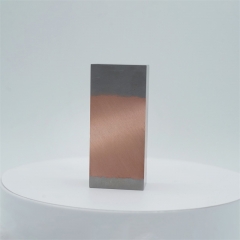


What is Ti/Cu Clad Rod copper cladding titanium-copper composite rod copper and clad:
Ti/Cu composite rod is a composite material of titanium and copper with excellent mechanical properties and corrosion resistance. Titanium is a high-strength, low-density metal with excellent corrosion resistance. At the same time, copper is a metal with high electrical and thermal conductivity, which can improve the electrical and thermal conductivity of the material. Therefore, the Ti/Cu composite rod is a material with a high application value.

titanium-copper composite rod
The advantages of Ti/Cu composite rods include:
High strength: The yield strength and shear strength of Ti/Cu composite rods can reach 135Mpa and 180MPa, which are higher than pure titanium alloys and copper alloys and can meet applications with higher strength requirements.
Good corrosion resistance: the outer layer of the Ti/Cu composite rod is stainless steel, which has excellent corrosion resistance, can resist seawater, nitric acid, sulfuric acid, and other corrosive media, and has a long service life.
Good processing performance: Ti/Cu composite rods can be manufactured into products of various shapes and sizes through various processing methods, such as rods, plates, wires, etc., with high production efficiency.
Low cost: The production cost of Ti/Cu composite rods is relatively low. Compared with pure titanium alloy and copper alloy, it can reduce production costs and improve the market competitiveness of products.
Environmental protection benefits: Ti/Cu composite rods will not produce toxic and harmful substances and will not pollute the environment, which aligns with the production concept of green and environmental protection.
Specification of titanium-copper composite rod:
|
Property |
Specification |
|
Composition |
Ti-Cu alloy (typically 85-95% Ti, 5-15% Cu) |
|
Density |
4.8-5.2 g/cm³ |
|
Tensile Strength |
800-950 MPa |
|
Yield Strength |
700-850 MPa |
|
Elastic Modulus |
105-120 GPa |
|
Hardness |
35-42 HRC |
|
Thermal Conductivity |
18-25 W/m·K |
|
Electrical Resistivity |
82-90 μΩ·cm |
|
Corrosion Resistance |
Excellent (Grade 8-9/10) |
|
Temperature Range |
-50°C to 400°C |
|
Surface Finish |
Ra 0.8-1.6 μm |
|
Standard Lengths |
1-6 meters |
|
Standard Diameters |
10-100 mm |
Application of Ti/Cu Clad Rod copper cladding titanium-copper composite rod copper and clad:
Ti/Cu composite rods are used in many fields, such as aerospace, electric energy, medical equipment, transportation, and aerospace etc.
In the field of aerospace, Ti/Cu composite rods are used to manufacture structural parts and components such as aircraft fuselages, wing spars, and landing gears, which have high strength and corrosion resistance.
In the field of electric energy, Ti/Cu composite rods are used to manufacture transformers, electrolyzers, and other equipment, which can improve the transmission efficiency of electric energy and reduce energy consumption.
In the field of medical devices, Ti/Cu composite rods are used to manufacture medical devices, such as oxygen generators, lung washing machines, etc., which can improve medical efficiency and quality.
In the field of transportation, Ti/Cu composite rods are used to make chassis, body, frame and other components of automobiles, trains, airplanes and other vehicles, and are used in transportation, transportation and other fields.
In the field of aerospace, Ti/Cu composite rods are also used to make rocket launchers and spacecraft structural parts, etc., and are used in aviation, aerospace and other fields.

Ti/Cu Clad Rod copper cladding titanium-copper composite rod copper and clad
Grade of Ti/Cu Clad Rod titanium-copper composite rod:
The grade of Ti/Cu Clad Rod titanium-copper composite rod is Ti&Ti alloy / Cu&Cu alloy.
Standard of Ti/Cu Clad Rod titanium-copper composite rod:
GB/T12769
Package of Ti/Cu Clad Rod titanium-copper composite rod:
According to product characteristics and customer needs.
Remark of Ti/Cu Clad Rod titanium-copper composite rod:
Please provide detailed technical requirements to facilitate communication and determine the solution.
TRUNNANO-Ti/Cu clad rod titanium-copper composite rod supplier:
Luoyang Tongrun Nano Technology Co. Ltd. (TRUNNANO) is a trusted global chemical material supplier & manufacturer with over 12 years of experience in providing super high-quality clad plates, clad rods, clad tubes, etc.
If you are looking for a high-quality Ti/Cu Clad Rod titanium-copper composite rod, please feel free to contact us and send an inquiry.
FAQs of Ti/Cu Clad Rod titanium-copper composite rod:
Can Copper and Titanium Be Used Together?
Yes, copper and titanium can be used together in various applications. They are often combined to leverage the unique properties of each material. For example, titanium is known for its high strength-to-weight ratio, corrosion resistance, and biocompatibility, while copper is valued for its excellent electrical and thermal conductivity. These materials can be used together in composite structures, layered materials, or as components in the same system.
What Is Titanium Copper Alloy Used For?
Titanium copper alloys are used in a variety of high-performance applications where both the mechanical properties of titanium and the electrical conductivity of copper are beneficial. Some common uses include:
Aerospace: Components in aircraft and spacecraft where high strength, low weight, and good electrical conductivity are required.
Medical Devices: Implants and surgical instruments that benefit from the biocompatibility of titanium and the conductivity of copper.
Electronics: Heat sinks, connectors, and other components that require both thermal management and structural integrity.
Marine Engineering: Parts that need to withstand corrosive marine environments while maintaining electrical conductivity.
Can You Copper Plate Titanium?
Yes, it is possible to copper plate titanium, although the process can be more challenging compared to plating other metals due to titanium's oxide layer and its reactivity. The general steps involve:
1. Surface Preparation: Cleaning and etching the titanium surface to remove the oxide layer and ensure good adhesion.
2. Activation: Using a palla dium-based activator to make the surface catalytic for electroless plating.
3. Electroless Plating: Applying a thin layer of copper through an electroless plating process.
4. Electroplating: Optionally, using electroplating to build up a thicker copper layer.
Which Is Stronger: Titanium or Copper?
Titanium is generally stronger than copper. Here are some key differences:
Strength: Titanium has a much higher tensile strength compared to copper. It can withstand greater forces without deforming or breaking.
Density: Titanium is much lighter than copper, giving it a higher strength-to-weight ratio, which is particularly important in applications like aerospace and automotive.
Corrosion Resistance: Titanium is highly resistant to corrosion, whereas copper can corrode in certain environments, though it does form a protective patina.
Conductivity: Copper is significantly better at conducting electricity and heat compared to titanium, which is why it is often used in electrical and thermal applications.