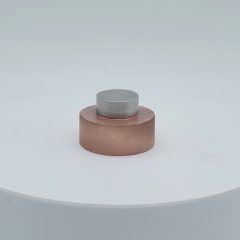

What is a Stainless steel/ Cu Cu-clad rod Stainless steel-copper composite rod:
Stainless steel/copper composite rod is a composite material composed of stainless steel and copper, with excellent mechanical properties and corrosion resistance. Stainless steel is a high-strength, medium-density metal with high hardness, high strength, and good corrosion resistance, while copper has good electrical conductivity and high wear resistance, which can improve the composite rod's electrical conductivity and wear resistance.

TRUNNANO stainless steel/copper composite rods
Advantages of stainless steel/copper composite rods include:
Good electrical conductivity: Titanium and copper in the stainless steel/copper composite rod are good conductors, and the electrical conductivity can reach more than 90%, which is suitable for electrochemistry and electronic device manufacturing.
Low cost: The production cost of stainless steel/copper composite rods is relatively low. Compared with pure titanium alloy and copper alloy, it can reduce production costs and improve the market competitiveness of products.
Easy to weld: Stainless steel/copper composite rods can be used for various welding operations, such as fusion welding, electric welding, etc., which is convenient for the assembly and maintenance of the production line.
Specification of stainless steel/copper composite rods
| Parameter | Specification |
| Material Composition | |
| Core Material | AISI 304 Stainless Steel |
| Cladding Material | C11000 ETP Copper |
| Bond Type | Metallurgical bonding |
| Dimensions | |
| Total Diameter | 25.4 mm (1 inch) |
| Core Diameter | 19.05 mm (0.75 inch) |
| Copper Layer Thickness | 3.175 mm (0.125 inch) |
| Standard Length | 3000 mm (118 inches) |
| Length Tolerance | ±2.0 mm |
| Diameter Tolerance | ±0.127 mm (±0.005 inch) |
| Mechanical Properties | |
| Tensile Strength | ≥ 480 MPa |
| Yield Strength | ≥ 270 MPa |
| Elongation | ≥ 30% |
| Hardness (Core) | 150-170 HV |
| Hardness (Cladding) | 90-110 HV |
| Bond Strength | ≥ 200 MPa |
| Physical Properties | |
| Thermal Conductivity | 180-200 W/m·K |
| Electrical Conductivity | ≥ 40% IACS |
| Density | 8.2-8.4 g/cm³ |
| Surface Finish | |
| Surface Roughness | Ra ≤ 1.6 μm |
| Surface Defects | Free from cracks, seams, and inclusions |
| Quality Control | |
| Ultrasonic Testing | 100% volumetric inspection |
| Bond Integrity | No delamination allowed |
| Straightness | ≤ 1.0 mm/m |
| Certifications Required | |
| Material Certification | EN 10204 3.1 |
| RoHS Compliance | Required |
| Packaging | |
| Protection | Individual plastic sleeve |
| Bundle Size | Maximum 500 kg |
| Marking | Heat number, size, grade clearly visible |
| Storage | |
| Environment | Indoor storage in dry conditions |
| Temperature | 10-30°C |
| Humidity | < 60% RH |
Application of Stainless steel/ Cu Clad Rod Stainless steel-copper composite rod:
Stainless steel/copper composite rods are widely used in many fields, including:
Power industry: Stainless steel/copper composite rods are often used to manufacture power equipment such as transformers, cables, switches, etc., because of their high conductivity and corrosion resistance.
Petrochemical industry: Stainless steel/copper composite rods are commonly used in the petrochemical industry to manufacture pipes, valves, pumps and other equipment because they are resistant to corrosion by acids, alkalis, salts and other chemicals.
Chlor-alkali industry: equipment for industrial processes that produce chemicals such as sodium hydroxide and hydrochloric acid.
Machinery manufacturing industry: Stainless steel/copper composite rods are commonly used in the machinery manufacturing industry to manufacture precision parts such as gears, bearings, cams, seals, etc., because of their high precision, high strength and high wear resistance.
Automotive industry: Stainless steel/copper composite rods are commonly used in the automotive industry to manufacture components such as exhaust systems, engines, transmission systems, etc., due to their high wear and corrosion resistance.
Medical device industry: Stainless steel/copper composite rods are commonly used in the medical device industry to manufacture handles, handwheels, pipes and other parts of medical devices because of their high strength, high corrosion resistance and high thermal conductivity.

Medical device industry
Grade of Stainless steel/ Cu Clad Rod Stainless steel-copper composite rod:
The grade of Stainless steel/ Cu Clad Rod Stainless steel-copper composite rod is SS/Cu &Cu alloy.
Standard of Stainless steel/ Cu Clad Rod Stainless steel-copper composite rod:
GB/T12769.
Package of Stainless steel/ Cu Clad Rod Stainless steel-copper composite rod:
According to product characteristics and customer needs.
Remark of Stainless steel/ Cu Clad Rod Stainless steel-copper composite rod:
Please provide detailed technical requirements to facilitate communication and determine the solution.
Stainless steel/ Cu Clad Rod Stainless steel-copper composite rod supplier-TRUNNANO:
Luoyang Tongrun Nano Technology Co. Ltd. (TRUNNANO) is a trusted global chemical material supplier & manufacturer with over 12 years of experience providing super high-quality clad plates, clad rods, clad tubes, etc. If you are looking for a high-quality Stainless steel/ Cu Clad Rod Stainless steel-copper composite rod, please feel free to contact us and send an inquiry.
FAQs of Stainless steel/ Cu Clad Rod Stainless steel-copper composite rod:
Why Use Copper Over Stainless Steel?
1. Electrical Conductivity: Copper is one of the best conductors of electricity, making it ideal for electrical wiring, motors, and electronic components. Stainless steel, while conductive, does not match copper's electrical properties.
2. Thermal Conductivity: Copper has excellent thermal conductivity, which is crucial in applications like heat exchangers, cookware, and cooling systems. Stainless steel has lower thermal conductivity.
3. Corrosion Resistance: While stainless steel is highly resistant to corrosion, copper also offers good resistance, especially in marine environments where it forms a protective patina.
4. Weight: Copper is generally lighter than stainless steel, which can be advantageous in applications where weight is a critical factor.
5. Appearance: Copper has a distinctive and often desirable aesthetic, which is why it is used in decorative and architectural applications. Stainless steel has a more modern, sleek look.
6. Cost: Copper can be less expensive than stainless steel in certain applications, although prices can fluctuate based on market conditions.
Which Is More Durable: Copper or Stainless Steel?
1. Strength: Stainless steel is generally stronger and more durable than copper. It has higher tensile strength and can withstand more stress and strain without deforming or breaking.
2. Corrosion Resistance: Both materials offer good corrosion resistance, but stainless steel is superior in harsher environments and is less likely to corrode under most conditions.
3. Wear and Tear: Stainless steel is more resistant to wear and tear, making it suitable for applications that require long-term durability and minimal maintenance.
4. Temperature Resistance: Stainless steel can handle higher temperatures without losing its structural integrity, making it better for high-temperature applications.
Is Stainless Steel Rod Strong?
Yes, stainless steel rods are very strong and are used in a variety of applications due to their excellent mechanical properties:
1. Tensile Strength: Stainless steel rods have high tensile strength, meaning they can withstand significant pulling or stretching forces without breaking.
2. Yield Strength: They have a high yield strength, which means they can deform under stress without fracturing.
3. Durability: Stainless steel rods are highly durable and resistant to wear, tear, and corrosion, making them suitable for long-term use in various environments.
4. Versatility: Stainless steel rods are available in different grades (e.g., 304, 316), each with specific properties tailored to different applications. For example, 316 stainless steel is particularly resistant to chloride corrosion, making it ideal for marine and chemical environments.
5. Formability: Stainless steel rods can be easily formed and machined, allowing for customization to fit specific needs.