Overview of Silicon Carbide Bonded Silicon Nitride Ceramic Rod
Silicon Carbide Bonded Silicon Nitride Ceramic Rod (SCBSN Rod) is a high-performance composite ceramic material that uses silicon carbide particles as the skeleton and reaction-formed silicon nitride as the bonding phase. This Silicon Carbide Bonded Silicon Nitride Ceramic Rod was first industrialized in 1948 and has gradually replaced traditional glass-bonded silicon carbide materials in refractories and wear-resistant ceramics thanks to its low manufacturing cost and excellent overall performance. As a structural ceramic rod, the Silicon Carbide Bonded Silicon Nitride Ceramic Rod combines the high hardness and high thermal conductivity of silicon carbide with the oxidation resistance and thermal shock resistance of silicon nitride, delivering a service life far exceeding ordinary refractories under high-temperature, wear and corrosive conditions. Its room-temperature flexural strength actually increases rather than decreases with rising temperature, and at 1400°C it still maintains room-temperature levels—a characteristic that makes the Silicon Carbide Bonded Silicon Nitride Ceramic Rod an ideal choice for high-temperature structural parts and kiln furniture.
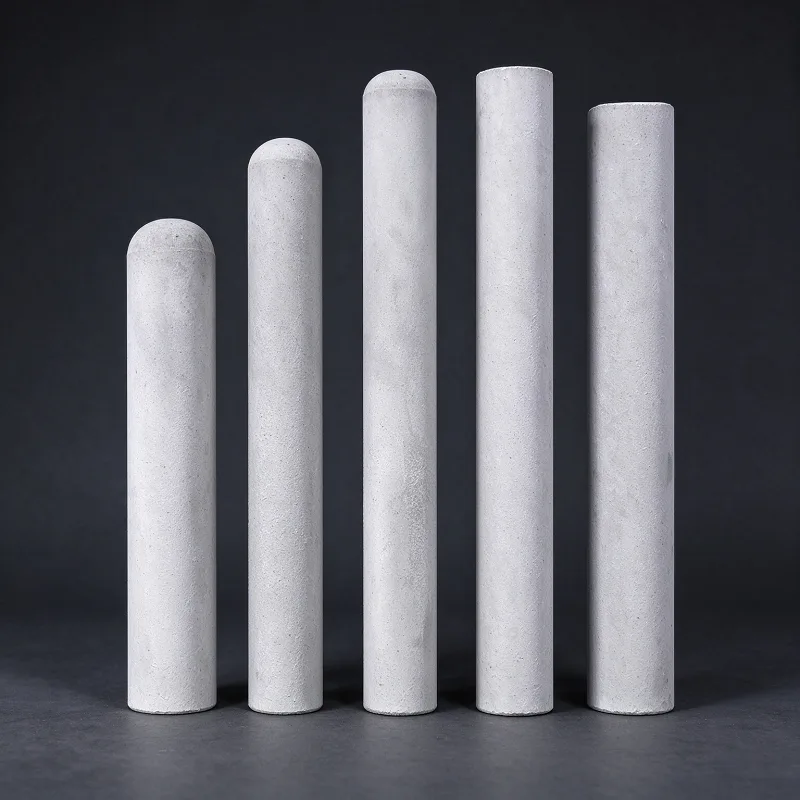
Silicon Carbide Bonded Silicon Nitride Ceramic Rod
Features and Advantages of Carbide Bonded Silicon Nitride Ceramic Rod
Excellent High-Temperature Mechanical Performance
The high-temperature flexural strength of the Silicon Carbide Bonded Silicon Nitride Ceramic Rod is 4 to 8 times that of ordinary refractories. In the 1200–1400°C range, its strength is almost equal to room-temperature values; even at 1500°C, it still retains its room-temperature flexural strength rating. The Silicon Carbide Bonded Silicon Nitride Ceramic Rod remains structurally stable in the 1650–1750°C range, with a safe service temperature far higher than most metals and ordinary ceramics.
Outstanding Thermal Shock Resistance
The thermal expansion coefficient of the Silicon Carbide Bonded Silicon Nitride Ceramic Rod is only about half that of high-alumina refractories. Combined with a thermal conductivity about 7–8 times that of general refractories, the Silicon Carbide Bonded Silicon Nitride Ceramic Rod resists thermal stress cracking during rapid heating and cooling cycles. This property is critical for kiln rollers, thermocouple protection tubes and other applications involving frequent temperature swings.
High Hardness and Wear Resistance
With a Mohs hardness of about 9, the Silicon Carbide Bonded Silicon Nitride Ceramic Rod ranks among the hardest non-metallic materials, second only to diamond. Under solid-particle fluid erosion and mechanical friction, the Silicon Carbide Bonded Silicon Nitride Ceramic Rod shows significantly lower wear rates than alumina ceramics and metals.
Corrosion Resistance and Non-Wetting
The Silicon Carbide Bonded Silicon Nitride Ceramic Rod does not wet non-ferrous metal melts such as aluminum, copper and magnesium alloys, and resists metal vapor attack and acid/alkali corrosion. This makes the Silicon Carbide Bonded Silicon Nitride Ceramic Rod suitable for direct contact with molten metals or corrosive atmospheres.
Cost-Effectiveness
Compared with hot-pressed silicon nitride or pressureless-sintered silicon carbide, the Silicon Carbide Bonded Silicon Nitride Ceramic Rod uses reaction bonding, with lower-cost silicon powder raw materials and a relatively moderate firing temperature. The Silicon Carbide Bonded Silicon Nitride Ceramic Rod maintains key performance while greatly reducing manufacturing cost, making it suitable for large-scale industrial applications.
Application Areas of Silicon Carbide Bonded Silicon Nitride Ceramic Rod
Non-Ferrous Metal Melting and Casting
The Silicon Carbide Bonded Silicon Nitride Ceramic Rod is used for aluminum, copper and magnesium melt-contact components such as melt transfer tubes, riser tubes and thermocouple protection sleeves. The Silicon Carbide Bonded Silicon Nitride Ceramic Rod is not wetted by non-ferrous melts, effectively preventing aluminum sticking and melt contamination.
Steel and Metallurgy
The Silicon Carbide Bonded Silicon Nitride Ceramic Rod serves as blast furnace lining support rods, companion rods for electrolytic aluminum cell sidewall bricks, and corrosion-resistant parts for zinc smelting. In aluminum electrolysis, the Silicon Carbide Bonded Silicon Nitride Ceramic Rod resists fluoride salt corrosion and oxidation better than cathode carbon blocks.
Industrial Kilns and Ceramic Firing
The Silicon Carbide Bonded Silicon Nitride Ceramic Rod is used for kiln furniture rollers, pusher plate support rods and saggar posts. With high hot strength and good thermal shock resistance, the Silicon Carbide Bonded Silicon Nitride Ceramic Rod suits load-bearing and transmission parts that frequently enter and exit kilns.
Wear and Fluid Control
The Silicon Carbide Bonded Silicon Nitride Ceramic Rod is applied in desulfurization nozzles, cyclone liner rods and wear-resistant pipe liners, suitable for power plant desulfurization, mine slurry transport and similar solid-particle erosion environments.
Chemical and Environmental Protection
The Silicon Carbide Bonded Silicon Nitride Ceramic Rod serves as acid-resistant stirring rods, heat exchanger supports and heat-resistant components in incinerators.

Applications of Silicon Carbide Bonded Silicon Nitride Ceramic Rod
Production Process of Silicon Carbide Bonded Silicon Nitride Ceramic Rod
The Silicon Carbide Bonded Silicon Nitride Ceramic Rod is manufactured by reaction bonding (nitride firing). The core process is as follows:
1. Raw Material Preparation: Silicon carbide sand (aggregate) and silicon powder (bonding phase precursor) are precisely weighed, mixed with temporary binders and additives in a high-efficiency mixer for 15–20 minutes, sieved and aged for more than 24 hours.
2. Forming: Depending on rod size and shape, extrusion (long rods, tubes), pressing (short rods, blocks) or slip casting (special shapes) can be selected. Extrusion compounds require additional plasticizers and vacuum pugging.
3. Drying: Green bodies are slowly dried in a 100–120°C hot-air drying room for about 3 days, with strictly controlled heating rates to prevent deformation and cracking; residual moisture must drop below 0.5%.
4. Nitride Firing: Dried bodies are loaded into a vacuum nitriding furnace and reaction-bonded at 700–1450°C with high-purity nitrogen (≥99.9%). Holding times are extended at the two reaction peaks of 1180°C and 1280°C to avoid molten silicon loss ("silicon runoff"). Silicon powder reacts with nitrogen to form the silicon nitride bonding phase, firmly bridging the silicon carbide particles.
5. Finishing and Inspection: Fired rods are diamond-ground to target dimensions and inspected for appearance, density, strength and dimensional accuracy.
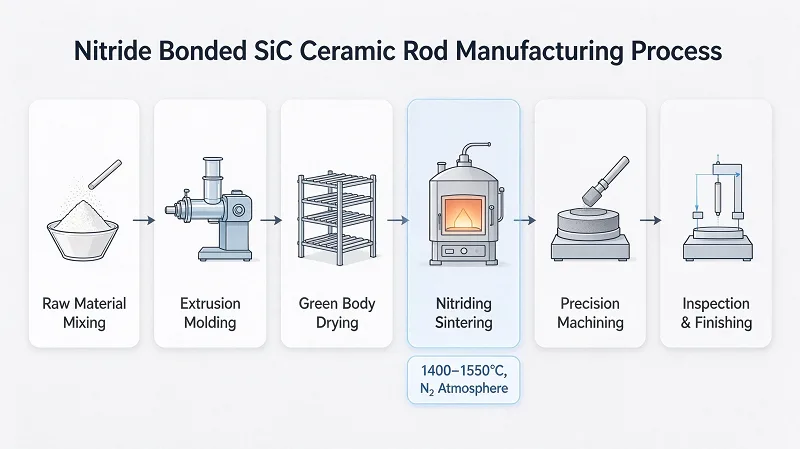
Production Procee of Silicon Carbide Bonded Silicon Nitride Ceramic Rod
Technical Parameters Table of Silicon Carbide Bonded Silicon Nitride Ceramic Rod
|
Property |
Unit |
Typical Value |
Standard/Remarks |
|---|---|---|---|
|
Bulk density |
g/cm³ |
≥2.65 |
— |
|
Apparent porosity |
% |
≤10.7 |
Reaction-bonded typical 12–30% |
|
Room-temperature flexural strength |
MPa |
≥30 (typical 30–50) |
Three-point bending |
|
High-temperature flexural strength (1400°C) |
MPa |
≥30 (retains RT level) |
4–8× ordinary refractories |
|
Room-temperature compressive strength |
MPa |
≥170 |
— |
|
Mohs hardness |
— |
~9 |
Second only to diamond |
|
Thermal expansion coefficient (RT–1000°C) |
×10⁻⁶/°C |
2.5–3.5 |
About half of high-alumina refractories |
|
Thermal conductivity (RT) |
W/(m·K) |
15–25 |
Slightly decreases with temperature |
|
SiC content |
% |
≥60 |
— |
|
Si₃N₄ content |
% |
≥37 |
Bonding phase |
|
Free silicon (FSi) |
% |
≤1.0 |
— |
|
Maximum safe service temperature |
°C |
1650–1750 (oxidizing) |
Depends on conditions |
|
Standard rod diameter range |
mm |
5–80 (customizable) |
— |
|
Standard rod length range |
mm |
50–2000 (customizable) |
— |
Note: Values are typical references; actual properties vary by grade, size and process parameters. Customization per customer drawings is available.
Comparison of Other Materials Table
|
Property |
SCBSN (This Product) |
Reaction-Bonded Si₃N₄ (RBSN) |
Pressureless-Sintered SiC (SSiC) |
Alumina (99% Al₂O₃) |
|---|---|---|---|---|
|
Bulk density (g/cm³) |
2.6–2.7 |
2.4–2.6 |
3.1–3.2 |
3.8–3.9 |
|
RT flexural strength (MPa) |
30–50 |
30–40 |
350–450 |
300–400 |
|
High-temperature strength retention |
Excellent (no decay at 1400°C) |
Moderate |
Good |
Poor (sharp drop >1000°C) |
|
Thermal shock resistance |
Excellent |
Good |
Good |
Poor |
|
Thermal conductivity (W/m·K) |
15–25 |
10–20 |
80–120 |
20–30 |
|
Resistance to metal melt wetting |
Excellent (Al/Cu/Mg) |
Good |
Good |
Poor (reacts with Al) |
|
Wear resistance |
Excellent |
Good |
Excellent |
Moderate |
|
Relative cost |
Low |
Medium |
High |
Low–Medium |
|
Formability (rods) |
Extrusion/pressing, flexible |
Complex |
Requires diamond machining |
Relatively easy |
The Silicon Carbide Bonded Silicon Nitride Ceramic Rod is positioned to provide high-temperature strength, thermal shock resistance and metal non-wetting far superior to alumina at a cost lower than dense SiC/Si₃N₄—especially suited to high-volume industrial consumable applications.

Storage Conditions of Silicon Carbide Bonded Silicon Nitride Ceramic Rod
Environment: Store indoors in a dry, ventilated warehouse; avoid open-air stacking. Relative humidity below 70% is recommended.
Packaging Protection: The Silicon Carbide Bonded Silicon Nitride Ceramic Rod is packed with foam or pearl cotton separators, reinforced with wooden or carton boxes to prevent mechanical impact during transport and handling. Long thin rods should be stored horizontally to avoid bending.
Avoid Contamination: Keep away from oils, acid/alkali chemicals and dust sources. For non-ferrous metal melting applications, avoid bare-hand contact with the Silicon Carbide Bonded Silicon Nitride Ceramic Rod surface after unboxing to prevent grease residue from affecting wettability.
Long-Term Storage: For storage exceeding 6 months, spot-check appearance and dimensions; the ceramic material itself does not age, but degraded packaging may reduce protection.
Company Profile
Luoyang Tongrun Nano Technology Co. Ltd. (TRUNNANO) is a trusted global chemical material supplier & manufacturer with over 12-year-experience in providing super high-quality chemicals and nanomaterials, including boride powder, nitride powder, oxide powder, concrete admixtures and ceramic products, etc.
The company has a professional technical department and Quality Supervision Department, a well-equipped laboratory, and equipped with advanced testing equipment and after-sales customer service center.
If you are looking for high-quality Ceramic Rods and relative products please feel free to contact us or click on the needed products to send an inquiry.
Payment Term
T/T, Western Union, Paypal, Credit Card etc.
Shipment Term
By air, by sea, by express, as customers request.
FAQs of Silicon Carbide Bonded Silicon Nitride Ceramic Rod
Q1: What is the difference between the Silicon Carbide Bonded Silicon Nitride Ceramic Rod and a pure silicon carbide rod?
Pure silicon carbide (such as reaction-bonded SiC or pressureless-sintered SiC) requires higher purity and more complex sintering, with significantly higher cost. The Silicon Carbide Bonded Silicon Nitride Ceramic Rod uses silicon nitride as the bonding phase, retaining the hardness and thermal conductivity advantages of silicon carbide while improving thermal shock resistance and oxidation resistance through the nitride bond—at lower manufacturing cost, making the Silicon Carbide Bonded Silicon Nitride Ceramic Rod suitable for cost-sensitive, high-volume industrial applications.
Q2: Can this rod directly contact molten aluminum?
Yes. The Silicon Carbide Bonded Silicon Nitride Ceramic Rod is not wetted by aluminum, copper or magnesium melts and is a proven choice for riser tubes and protection tubes in aluminum casting. Note: preheat new rods before first use to avoid local thermal stress from rapid heating/cooling.
Q3: What is the maximum service temperature, and how does it differ between oxidizing and reducing atmospheres?
In oxidizing atmospheres, the recommended long-term safe service temperature for the Silicon Carbide Bonded Silicon Nitride Ceramic Rod is up to 1650°C; in reducing or inert atmospheres it can reach about 1750°C. Above 1400°C, a protective oxide layer forms on the surface, but prolonged overheating accelerates oxidation of the bonding phase and shortens life.
Q4: Can the rod be customized to non-standard sizes or with holes?
Yes. The Silicon Carbide Bonded Silicon Nitride Ceramic Rod supports custom diameters, lengths and end shapes (threads, slots, holes). Due to ceramic brittleness, complex profiles are best formed during shaping (e.g., slip casting) rather than after firing. Post-fire diamond grinding meets tolerance requirements, but deep holes and sharp-cornered slots require feasibility assessment in advance.
Q5: How are breakages during transport handled?
Although the Silicon Carbide Bonded Silicon Nitride Ceramic Rod has high strength, it remains a brittle material. Inspect immediately upon receipt; if breakage is found, keep the original packaging and photos of damaged parts and contact the seller within 48 hours of delivery. Always support rods with both hands when handling—never lift by one end.