Introduction of Silica Dispersion
Aqueous silica dispersion is a solution in which silica (SiO₂) nanoparticles are uniformly dispersed in water. This dispersion usually has good stability and can maintain uniform distribution of particles for a long time without precipitation or aggregation. Silica is a common inorganic non-metallic material with excellent physical and chemical properties, such as high thermal stability, chemical inertness, transparency and good biocompatibility.
CAS No.: 7631-86-9
Molecular formula: SiO2
Molecular weight: 60
Appearance: Transparent
Morphology: Dispersion of different solvents Solid content: 20~30%
Particle size: 10nm~100nm (customizable) Crystallinity: Amorphous
Safety: Non-toxic, has a certain acidity and alkalinity, avoid direct contact with skin
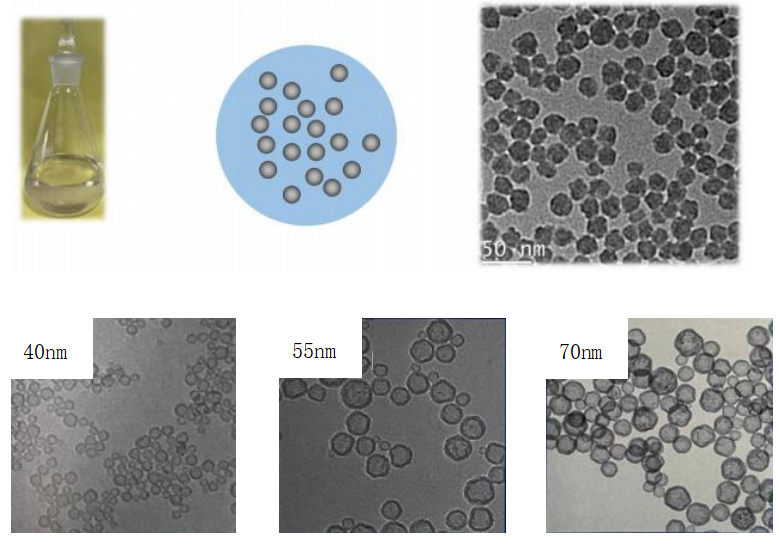
Particle Size of Silica Dispersion
Characteristics and Properties of Silica Dispersion
1. Good sphericity and monodispersity;
2. Inorganic particles have high hardness, and the particle size and wall thickness are adjustable;
3. Surface modification can be flexibly selected;
4. Can be dispersed in different solvent systems and can be used in oily heat-curing or light-curing coatings.
Parameters of Silica Dispersion
|
Product Name |
Product Brand |
Product Specification |
Packaging Specification |
|
Solid silica dispersion |
TRWSiOT10 |
10-20 nanometers, dispersed in aqueous solution, solid content 30%, acidic pH 2-4 |
1Kg |
|
TRWSiOT20 |
20-30 nanometers, dispersed in aqueous solution, solid content 30%, acidic pH 2-4 |
1Kg |
|
|
TRWSiOT10 |
10-20 nanometers, dispersed in aqueous solution, solid content 30%,,Alkaline PH 9-11 |
1Kg |
|
|
TRPMSiOT10 |
10-25 nanometers, dispersed in propylene glycol methyl ether solvent, solid content 10% |
1Kg |
|
|
TRPMSiOT30 |
30-50 nanometers, dispersed in propylene glycol methyl ether solvent, solid content 10% |
1Kg |
|
|
TRMIBKSiOT10 |
10-25 nanometers, dispersed in butanone solvent, solid content 10% |
1Kg |
|
|
TRMIBKSiOT30 |
30-50 nanometers, dispersed in butanone solvent, solid content 10% |
1Kg |
|
|
Hollow silica dispersion |
TRWHSiOT40 |
40 nm, wall thickness 5 nm, dispersed in aqueous solution, solid content 20% |
500g |
|
TRWHSiOT50 |
50 nm, wall thickness 5.5 nm, dispersed in aqueous solution, solid content 20% |
500g |
|
|
TRWHSiOT60 |
60 nanometers, wall thickness 6nm, dispersed in aqueous solution, solid content 20% |
500g |
|
|
TRWHSiOT70 |
70 nm, wall thickness 6.5 nm, dispersed in aqueous solution, solid content 20% |
500g |
|
|
TRPMSiOT40 |
40 nanometers, wall thickness 5nm, dispersed in propylene glycol methyl ether solvent, solid content 20%, surface chemically modified, containing acrylic acid type double bonds or other groups |
500g |
|
|
TRPMSiOT50 |
50 nanometers, wall thickness 5.5nm, dispersed in propylene glycol methyl ether solvent, solid content 20%, surface chemically modified, containing acrylic acid type double bonds or other groups |
500g |
|
|
TRPMSiOT60 |
60 nanometers, wall thickness 6nm, dispersed in propylene glycol methyl ether solvent, solid content 20%, surface chemically modified, containing acrylic acid type double bonds or other groups |
500g |
|
|
TRPMSiOT70 |
70 nanometers, wall thickness 6.5nm, dispersed in propylene glycol methyl ether solvent, solid content 20%, surface chemically modified, containing acrylic acid type double bonds or other groups |
500g |
|
|
TRIPASiOT40 |
40 nanometers, wall thickness 5nm, dispersed in isopropanol solvent, solid content 20%, surface chemically modified, containing acrylic type double bonds or other groups |
500g |
|
|
TRIPASiOT50 |
50 nm, wall thickness 5.5 nm, dispersed in isopropanol solvent, solid content 20%, surface chemically modified, containing acrylic type double bonds or other groups |
500g |
|
|
TRIPASiOT60 |
60 nanometers, wall thickness 6nm, dispersed in isopropanol solvent, solid content 20%, surface chemically modified, containing acrylic type double bonds or other groups |
500g |
|
|
TRIPASiOT70 |
70 nm, wall thickness 6.5 nm, dispersed in isopropanol solvent, solid content 20%, surface chemically modified, containing acrylic type double bonds or other groups |
500g |
|
|
TREASiOT40 |
40 nm, wall thickness 5 nm, dispersed in ethyl acetate solvent, solid content 20%, surface chemically modified, containing acrylic type double bonds or other groups |
500g |
|
|
TREASiOT50 |
50 nm, wall thickness 5.5 nm, dispersed in ethyl acetate solvent, solid content 20%, surface chemically modified, containing acrylic acid type double bonds or other groups |
500g |
|
|
TREASiOT60 |
60 nanometers, wall thickness 6nm, dispersed in ethyl acetate solvent, solid content 20%, surface chemically modified, containing acrylic type double bonds or other groups |
500g |
|
|
TREASiOT70 |
70 nm, wall thickness 6.5 nm, dispersed in ethyl acetate solvent, solid content 20%, surface chemically modified, containing acrylic acid type double bonds or other groups |
500g |
Application Areas of Silica Dispersion
Hardened coatings
Automobile coatings;
Furniture coatings;
Anti-reflective coatings for photovoltaic glass;
Packaging and Storage of Silica Dispersion
This product should be stored in a dry, airtight environment and not exposed to volatile substances.

Company Profile
Luoyang Tongrun Nano Technology Co. Ltd. (TRUNNANO) is a trusted global chemical material supplier & manufacturer with over 12-year-experience in providing super high-quality chemicals and nanomaterials, including boride powder, nitride powder, graphite powder, sulfide powder, 3D printing powder, etc.
The company has a professional technical department and Quality Supervision Department, a well-equipped laboratory, and equipped with advanced testing equipment and after-sales customer service center.
If you are looking for high-quality Silica Dispersion, please feel free to contact us or click on the needed products to send an inquiry.
Payment Term
T/T, Western Union, Paypal, Credit Card etc.
Shipment Term
By air, by sea, by express, as customers request.

FAQs of Silica Dispersion
Q: Can having mineral silica in a highly dispersed colloidal form be harmful?
Answer: Mineral silica, when present in a highly dispersed colloidal form, can pose health risks, particularly if it is inhaled. Fine particles can enter the lungs and cause respiratory issues. However, in most applications, such as in water-based dispersions used for industrial purposes, the risk is minimal as long as proper safety measures are followed.
Q: Can having mineral silica in a highly dispersed form be harmful taken on a regular basis?
Answer: Consuming highly dispersed mineral silica on a regular basis could potentially be harmful, especially if it is in a respirable form that can be inhaled. Ingestion of silica in food or supplements is generally considered safe in moderate amounts, but inhalation of fine particles over time can lead to health problems like silicosis, a lung disease caused by inhaling crystalline silica dust.
Q: Which of these elements acts as a particle dispersing agent? Iron Calcium Sodium Silica
Answer: None of these elements (iron, calcium, sodium) directly act as particle dispersing agents. Silica itself, when used in the form of a surface-active compound or in combination with surfactants, can help disperse other particles. However, iron, calcium, and sodium are not typically used as dispersing agents; instead, they might be part of compounds that can act as dispersants or stabilizers.
Is silica dispersion or dipole-dipole?
Answer: The term "silica dispersion" refers to the distribution of silica particles within a medium, such as a liquid. It does not refer to a dipole-dipole interaction, which is a type of intermolecular force between polar molecules. Silica dispersion describes the state of the silica particles being evenly distributed, while dipole-dipole interactions pertain to how polar molecules attract each other.
Q: What happens if silica fume is not well dispersed in concrete?
Answer: If silica fume is not well dispersed in concrete, several negative effects can occur:
Reduced Strength: Poor dispersion can lead to uneven strengthening of the concrete, reducing its overall strength.
Decreased Durability: Uneven distribution can result in areas of lower durability, making the concrete more susceptible to cracking and wear.
Poor Workability: Agglomeration of silica fume particles can make the concrete mixture harder to work with, affecting the placement and finishing processes.
Increased Risk of Defects: Clumps of undispersed silica fume can create voids or weak spots in the hardened concrete, leading to potential structural defects.