Overview of Alumina Ceramic Structural Parts
Alumina ceramic structural parts are made of ceramic materials with alumina (Al₂O₃) as the main component. It has excellent properties, such as high strength, high hardness and good abrasion resistance, and can maintain a stable shape and size under complex working conditions; chemical properties, strong corrosion resistance, and not easily eroded by a variety of chemical substances. Alumina ceramic structural components are widely used in electronics, machinery, chemical industry and other fields to provide reliable protection for equipment operation to meet the demand for high-performance components for industrial production.
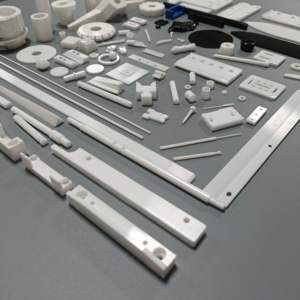
alumina ceramic structural parts
Strength: Flexural strength is as high as 500-700 MPa, compressive strength is 3000-4000 MPa, strong bearing capacity and not easy to deform.
High-temperature resistance: melting point up to 2050 ℃, can be continuously used in 1000 ℃ environment, intermittent temperature resistance up to 1500 ℃, low coefficient of thermal expansion (7-8 × 10-⁶ / K), excellent thermal shock resistance.
Electrical insulation: volume resistivity exceeds 10¹⁴Ω・cm, dielectric strength > 15 kV/mm, effectively preventing current leakage and safeguarding equipment safety.
Corrosion resistance: excellent corrosion resistance to most chemical media such as acid, alkali, salt, etc., and remains stable in strong acid environments such as sulfuric acid, hydrochloric acid and nitric acid.
Lightweight and biocompatibility:Density is only 3.5-3.9 g/cm³ (about half of the steel), which can reduce the weight of the equipment; good biocompatibility, non-toxic and non-irritant, suitable for the medical field.
High dimensional stability: not easy to age, long service life, in most cases without secondary processing, can be used directly, especially suitable for high-precision ceramic electronic devices.
Alumina ceramic structural parts specification table
| Property |
Specification |
| Material |
High-purity Alumina (Al₂O₃) |
| Purity |
99.5% - 99.9% (depending on grade) |
| Hardness |
Mohs hardness: 9
Vickers hardness: 2000-2200 HV |
| Density |
3.5-3.9 g/cm³ |
| Mechanical Properties |
- Compressive strength: 3000-4000 MPa
- Flexural strength: 500-700 MPa
- Tensile strength: 200-300 MPa |
| Thermal Properties |
- Melting point: 2050°C
- Thermal conductivity: 20-30 W/m·K
- Coefficient of thermal expansion: 7-8 x 10⁻⁶/K |
| Electrical Properties |
- Volume resistivity: >10¹⁴ Ω·cm
- Dielectric strength: >15 kV/mm
- Dielectric constant: 10-12 (at 1 MHz) |
| Chemical Resistance |
Excellent resistance to acids, alkalis, and salts |
| Dimensional Stability |
High precision, low thermal expansion, minimal deformation over time |
| Surface Finish |
Standard: Matte
Optional: Polished, coated |
| Operating Temperature |
- Continuous: Up to 1000°C
- Intermittent: Up to 1500°C |
| Applications |
Electronics, mechanical components, chemical processing, medical devices |
| Customization |
Available in various shapes and sizes, custom designs possible |
|
Applications of Alumina Ceramic Structural Parts
Mechanical field: Used to make bearings, seals and other wear-resistant parts, alumina ceramic structural parts extend the service life of equipment by utilizing high hardness and wear resistance.
Electronic field: the production of insulators, substrates and other components. Alumina ceramic structural parts rely on excellent insulation and high-temperature resistance to ensure the stable operation of equipment.
Chemical industry: the production of pipes, valves and other corrosion-resistant components, alumina ceramic structural components for strong acid and alkali environment of the medium transport and control.
High-end manufacturing: in aerospace and automotive manufacturing, alumina ceramic structural parts are used in engine components, brake discs, etc., to meet high temperature, high pressure and other special performance requirements.
Medical field: based on biocompatibility and corrosion resistance, alumina ceramic structural components are used in the manufacture of medical devices, artificial joints, etc., to help the development of medical technology.
Company Profile
Luoyang Tongrun Nano Technology Co. Ltd. (TRUNNANO) is a trusted global chemical material supplier & manufacturer with over 12-year-experience in providing super high-quality chemicals and nanomaterials, including boride powder, nitride powder, graphite powder, ceramic products, 3D printing powder, etc.
The company has a professional technical department and Quality Supervision Department, a well-equipped laboratory, and equipped with advanced testing equipment and after-sales customer service center.
If you are looking for high-quality Ceramic Products please feel free to contact us or click on the needed products to send an inquiry.

Applications of Ceramic Products
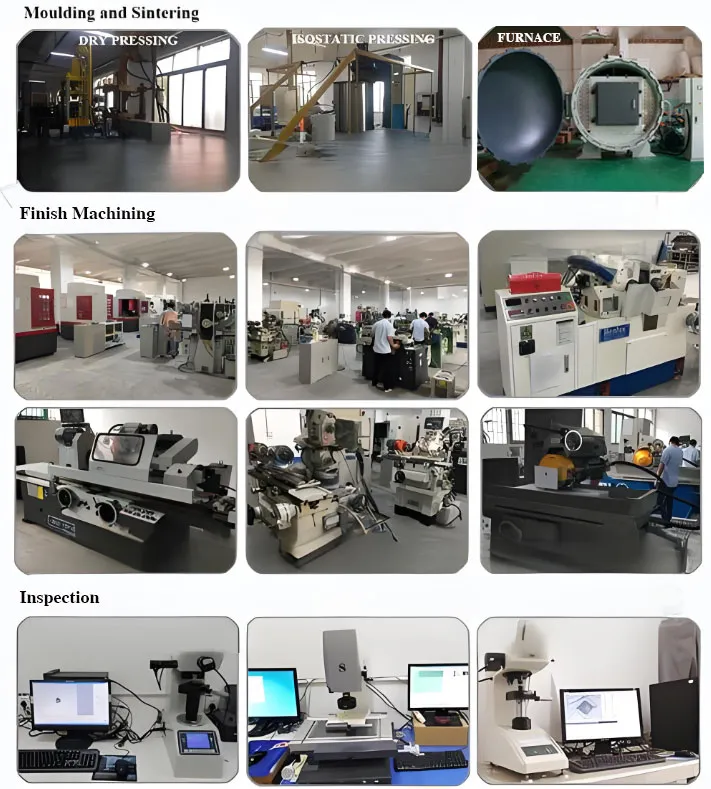
Process of Ceramic Products
Payment Term
T/T, Western Union, Paypal, Credit Card etc.
Shipment Term
By air, by sea, by express, as customers request.

5 Frequently Asked Questions about Alumina Ceramic Structural Parts
Q1: What are the processing techniques for alumina ceramic structural parts?
Mainly includes high-purity powder preparation, ultra-fine grinding, and spray granulation of alumina powder. Molding process: dry press molding, slurry molding, cast molding, etc. Sintering process: atmospheric pressure sintering, hot isostatic pressure sintering and so on.
Q2: How difficult is it to process alumina ceramic structural parts?
The processing difficulty is high. Because the hardness is second only to diamond, it is necessary to use super-hard tools (e.g., diamond cutting tools) and numerical control technology (CNC), combined with laser machining, EDM, and other processes, to achieve high-precision, high-surface finish machining.
Q3: What are the specific applications in the semiconductor industry?
Insulation components: insulators, insulating tubes, insulating plates, etc.; heat dissipation components: heat sinks, heat pipes, etc.; structure and packaging: brackets, substrates, semiconductor device packaging materials.
Q4:What is the electrical insulation performance of alumina ceramic structural parts?
It has high resistivity, which can reach 10¹⁵Ω・cm at room temperature, and insulation strength is above 15kV/mm. It is an ideal electrical insulation material and is often used in the electronic and electrical fields. It can effectively prevent current leakage and ensure the safe operation of equipment.
Q5: Why does alumina ceramic have high hardness and strength?
Its main component is Al₂O₃, which forms a stable α-Al₂O₃ structure internally: the oxygen ions are densely packed in a hexagonal pattern, while the aluminum ions fill the octahedral gaps by two-thirds, and this close arrangement gives the material extremely high hardness and strength.