Nickel ferrite (NiFe₂O₄) is a soft magnetic ferrite material with an inverse spinel structure, composed of nanoscale particles. In this structure, Ni²⁺ ions occupy octahedral sites, while Fe³⁺ ions are distributed over both tetrahedral and octahedral positions. Nanoscale nickel ferrite offers a high specific surface area, abundant active sites, and shortened ion diffusion pathways. It exhibits excellent soft magnetic properties—low coercivity and high saturation magnetization—alongside outstanding electrochemical performance, making it suitable for catalytic applications and lithium-ion battery electrodes.
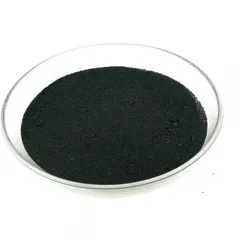
NiFe₂O₄
Technical Specifications
|
Parameter |
Typical Value |
Test Method |
|---|---|---|
|
Primary Particle Size |
20 – 50 nm (customizable from 5 to 100 nm) |
TEM / SEM / XRD |
|
Morphology |
Near-spherical, spherical |
TEM / SEM |
|
Specific Surface Area (BET) |
40 – 65 m²/g (varies by model) |
BET |
|
Tap Density |
0.60 – 0.90 g/cm³ |
Tap density tester |
|
True Density |
5.368 g/cm³ |
Pycnometer |
|
Color |
Dark red, brown, or black-brown |
Visual |
|
Curie Temperature (Tc) |
~854 K (~581 °C) |
VSM / DSC |
Chemical Composition
|
Component |
Content Standard |
Typical Value |
|---|---|---|
|
Fe₂NiO₄ |
99.5 – 99.99% |
Per purity grade |
|
Total Impurities |
≤0.5 – 0.01% |
Depends on purity level |
Electrochemical Performance
Thanks to its spinel structure, which allows reversible Li⁺ intercalation/deintercalation, nickel ferrite demonstrates a significantly higher theoretical specific capacity than graphite when used as an anode material for lithium-ion batteries.
Carbon-Enhanced Performance
Combining NiFe₂O₄ with carbon-based materials—such as MWCNTs, carbon nanotubes, or activated carbon—further improves its electrochemical properties. For example, NiFe₂O₄/MWCNT integrated materials exhibit higher specific capacity and superior rate performance. Core-shell nanocapsules of nickel ferrite combined with onion-like carbon maintain a stable specific capacity of 914 mAh/g after 500 cycles at 0.1 C.
Key Features
|
Feature |
Description |
|---|---|
|
Spinel Structure |
Inverse spinel (Ni²⁺ on octahedral sites, Fe³⁺ on both tetrahedral and octahedral sites) with high structural stability. |
|
Excellent Magnetic Properties |
High saturation magnetization (typical 35–65 emu/g), low coercivity, high permeability, and high Curie temperature (~854 K). |
|
Ultra-High Surface Area |
BET specific surface area up to 40–65 m²/g, providing abundant active sites. |
|
High Electrochemical Capacity |
Theoretical capacity of ~915 mAh/g for LIB anodes—nearly 2.5× that of commercial graphite (372 mAh/g). |
|
Good Chemical Stability |
Resistant to oxidation and acidic environments; stable operation. |
|
High Thermal Stability |
Maintains structural and performance integrity at elevated temperatures. |
|
Multifunctionality |
Combines magnetic, electrochemical, and catalytic properties for cross-disciplinary applications. |
|
Doping Modifiable |
Can be doped with Co, Bi, Gd, Nd, etc., to tailor magnetic and electrochemical performance. |
|
Compatibility with Other Materials |
Compatible with MWCNTs, graphene, polymers, and other materials for advanced combined applications. |
Applications
Leveraging its superior magnetic, electrochemical, and catalytic properties, nickel ferrite nanoparticles are widely used in the following fields:
Anode Materials for Lithium-Ion Batteries
With a theoretical capacity of ~915 mAh/g (~2.5× that of graphite), ideal for high-performance LIB anodes, thin-film batteries, and microbatteries.
Magnetic Materials
As a soft ferrite with low coercivity and high saturation magnetization, used in magnetic recording media, magnetostrictive materials, high-density recording, magnetic fluids (seals, brakes, sensors), inductive components, magnetic refrigeration, and microelectronic devices.
Microwave Absorbing & EMI Shielding
Excellent electromagnetic loss properties; combined with carbon materials for lightweight absorbers, radar-absorbing materials, EMI shielding, and anechoic chambers.
Catalysis
High catalytic activity and selectivity for CO₂ decomposition (notably used onboard the Shenzhou-6 spacecraft for cabin CO₂ removal), gas conversion reactions, electrochemical catalysis, and environmental purification.
Supercapacitor Electrode Materials
Pristine and doped NiFe₂O₄ (e.g., Co-doped Ni₀.₅Co₀.₅Fe₂O₄) in KOH electrolyte deliver a pseudocapacitance of ~15.3 F/g (CV). Co-doped samples reach 398 C/g at 10 A/g with 95% capacitance retention after 5,000 cycles.
Biomedical Applications
Biocompatible, with ongoing research into MRI contrast enhancement, targeted drug delivery, and magnetic hyperthermia.
Multi-Component Material Systems
Can be integrated with polymers and carbon materials to impart magnetic, conductive, and mechanical reinforcement properties.
About Us
TRUNNANO is a leading supplier of high-performance battery materials for lithium-ion and sodium-ion batteries. Our portfolio includes nano cathodes, silicon-carbon anodes, hard carbon, and specialty additives. With strict quality control and consistent purity, we deliver reliable solutions for 3C electronics, power tools, and energy storage systems. Committed to innovation, TRUNNANO drives the future of energy storage with cutting-edge materials and dedicated customer support.
Packaging: Customized per customer requirements.
Frequently Asked Questions (FAQ)
Q1: What is the theoretical specific capacity of NiFe₂O₄ for lithium-ion battery anodes?
A1: The theoretical capacity is approximately 915 mAh/g, which is about 2.5 times higher than that of commercial graphite (372 mAh/g).
Q2: Can the particle size be customized?
A2: Yes, the primary particle size can be tailored from 5 nm to 100 nm to meet specific application requirements.
Q3: How does NiFe₂O₄ compare to other transition-metal oxides for energy storage?
A3: It offers a good balance of high capacity, stable cycling performance (especially with carbon integration), low cost, and environmental friendliness, along with additional magnetic functionality.
Q4: Is the material stable in air and during storage?
A4: Yes, nickel ferrite is chemically stable and oxidation-resistant. Store in a sealed container in a cool, dry place to maintain optimal performance.
Q5: Can I get pre-formulated combinations with graphene or MWCNTs?
A5: Yes, we offer custom processing and can provide NiFe₂O₄ pre-mixed or integrated with carbon nanomaterials, polymers, or other matrices upon request.
Q6: What purity grades are available?
A6: We offer purity levels ranging from 99.5% up to 99.99%, with impurity content controlled as low as 0.01% depending on the grade.
Q7: Is this product suitable for biomedical applications?
A7: While still in the research stage, NiFe₂O₄ shows good biocompatibility and is being explored for MRI, drug delivery, and hyperthermia. We recommend further in-vitro testing for specific biomedical uses.
Q8: What is the recommended dispersion method?
A8: Ultrasonication in suitable solvents (e.g., water, ethanol, or NMP) with mild surfactants is typically recommended for uniform dispersion.