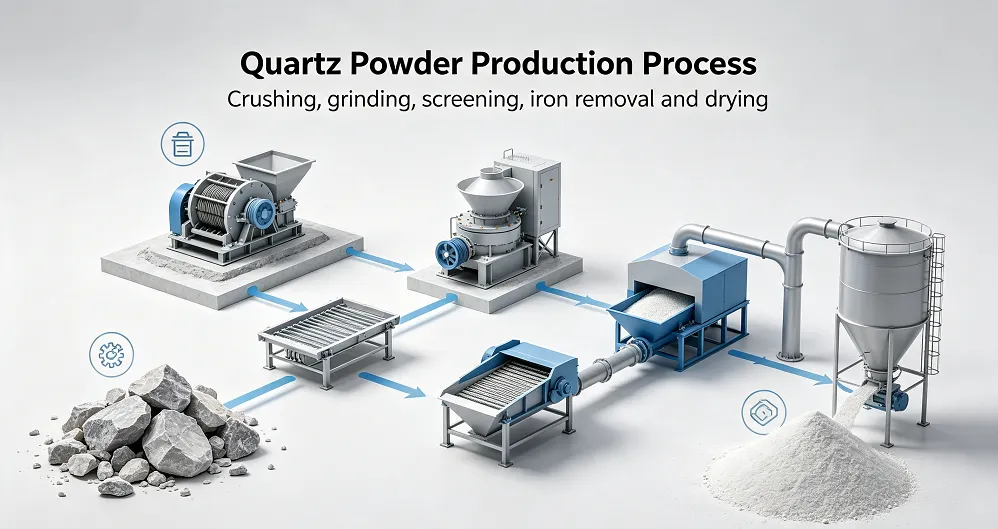
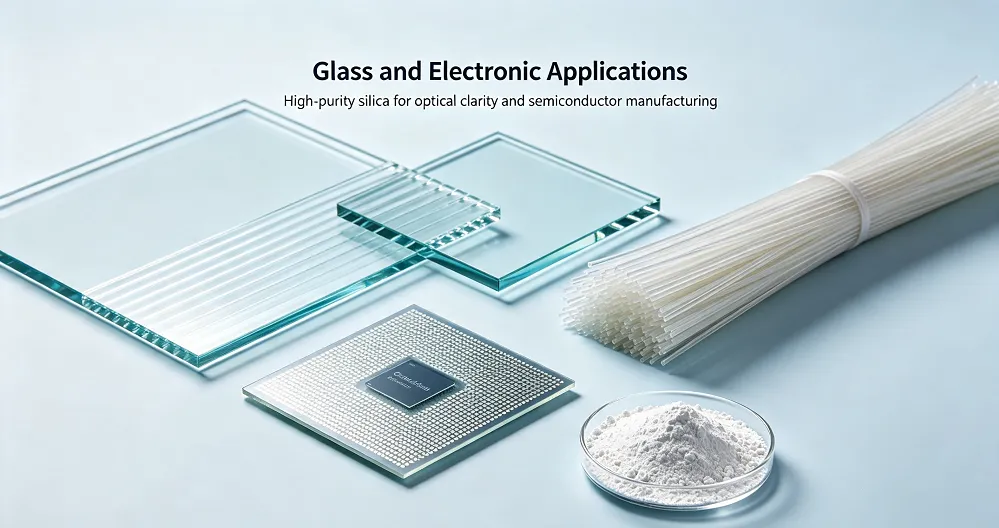
The glass industry is one of the largest consumers of quartz powder. High-purity quartz sand provides the essential SiO₂ content for producing various types of glass. For instrumentation glass and specialty glass, the purity requirements are particularly stringent, with silica content typically exceeding 99.5%. The low iron content in high-quality quartz powder is crucial for achieving optical clarity in glass products, as even trace amounts of iron can cause discoloration. Fiberglass manufacturing relies on quartz powder as the primary raw material for producing glass fibers used in composite materials, insulation, and reinforcement applications. The electronics industry uses quartz powder for manufacturing semiconductor components and optical fibers, where purity levels of 99.99% or higher are often required to prevent signal loss and contamination.
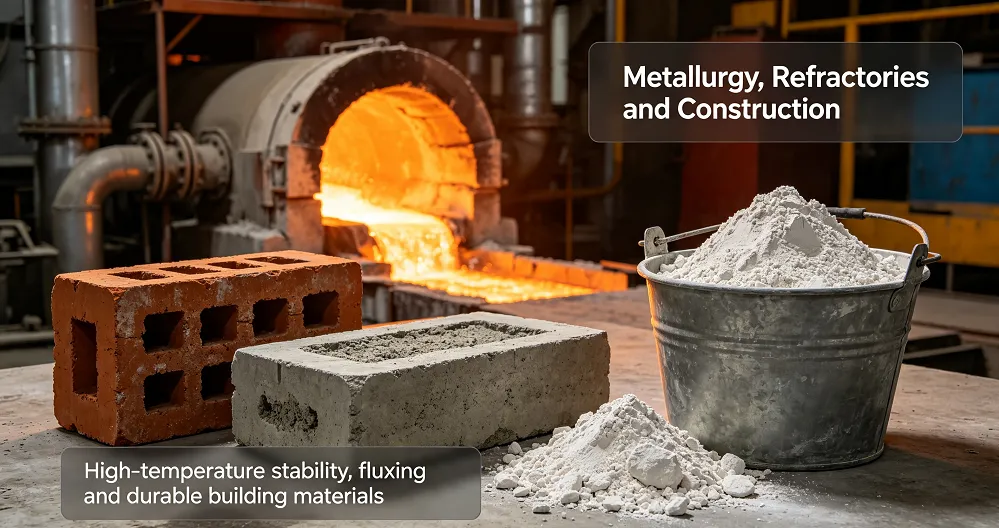
In the metallurgical industry, quartz powder serves as a fluxing agent that helps lower the melting temperature of ores and facilitates the removal of impurities during smelting. It is essential in the production of ferrosilicon alloys, where it provides the silicon content required for steelmaking and semiconductor manufacturing. The refractory industry utilizes quartz powder in the production of kiln bricks, high-temperature bricks, and other refractory materials that must withstand extreme heat without deformation or degradation.
In the cement and construction industry, quartz powder is used as an aggregate in concrete and mortar formulations, improving the strength, durability, and wear resistance of building materials. The addition of quartz powder to aerated concrete enhances its thermal insulation properties and dimensional stability. In the chemical industry, quartz powder is the raw material for producing water glass (sodium silicate), silica gel, and various desiccants. It is also used as a catalyst carrier in petroleum refining processes, where its high surface area and chemical stability provide an effective support for catalytic reactions. In coatings and paints, quartz powder improves the abrasion resistance, weather resistance, and hardness of exterior wall coatings and road marking paints. The versatility of quartz powder in these diverse applications is a testament to its unique combination of physical and chemical properties.
Quality Specifications of Quartz Powder
The quality of quartz powder is determined by several key parameters that influence its performance in different applications:
High-purity quartz powder typically contains more than 99.0% SiO₂, with iron oxide content often controlled below 0.02% for applications requiring color purity and optical clarity. The presence of impurities such as aluminum oxide, titanium oxide, and alkali metal oxides can affect thermal properties and electrical insulation characteristics.Chemical Composition: High-purity quartz powder typically contains more than 99.0% SiO₂, with iron oxide content often controlled below 0.02% for applications requiring color purity and optical clarity. The presence of impurities such as aluminum oxide, titanium oxide, and alkali metal oxides can affect thermal properties and electrical
Particle Size Distribution: Quartz powder is available in a wide range of particle sizes, from coarse grains to ultra-fine powder with particle diameters of several micrometers. The particle size distribution affects flowability, packing density, surface area, and reactivity. Common D50 values range from 2 to 50 micrometers depending on the application.
Physical Properties: Quartz powder has a Mohs hardness of 7, a density of approximately 2.65 g/cm³, and a melting point of 1650°C. The material exhibits excellent thermal stability, low thermal expansion, and high electrical resistance, making it suitable for high-temperature and electrical insulation applications.
Whiteness and Purity: For applications in paints, coatings, and engineered stone, the whiteness of quartz powder is an important quality indicator. High-purity quartz powder can achieve whiteness values above 90%, with some grades exceeding 94% whiteness.
Acid Resistance: Quartz powder is insoluble in most acids, providing excellent chemical stability in corrosive environments. This property is particularly valuable for applications in chemical processing equipment and acid-resistant coatings.
Application-Specific Requirements: Different applications require different quality specifications. Electronic-grade quartz powder requires extremely high purity (SiO₂ > 99.9%) and controlled particle size. Ceramic-grade powder may have higher tolerance for impurities. Paint and coating applications prioritize whiteness and particle size distribution. Engineered stone applications require consistent color and particle packing characteristics.