What is Silicon dioxide?
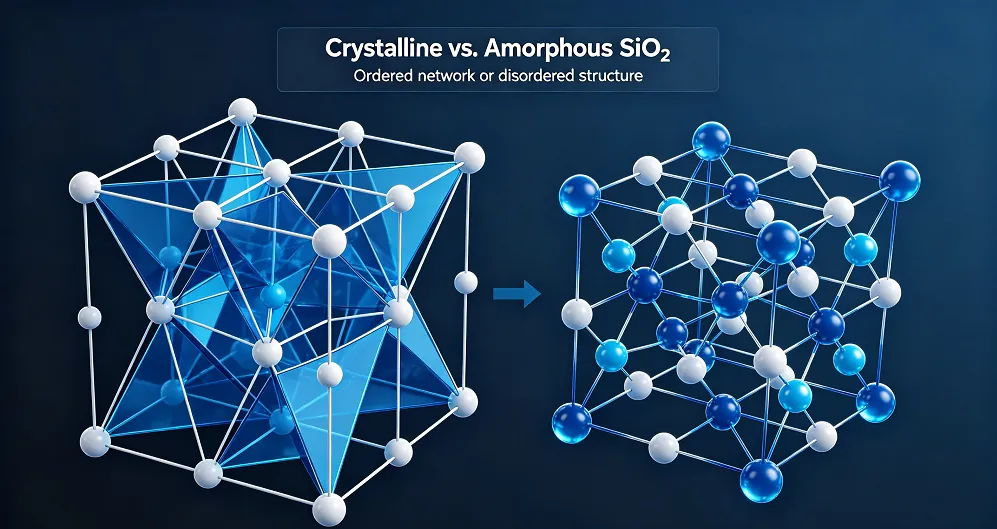
Silica is an inorganic compound with the chemical formula of SiO2. Silicon and oxygen atoms are arranged in long-range order to form crystalline silica and short-range order or long-range disorder arrangement to form amorphous silica. In silicon dioxide crystal, a silicon atom is located in the center of a regular tetrahedron, and four oxygen atoms are located at the four corners of the regular tetrahedron. Many of these tetrahedrons are connected by oxygen atoms at the corners, and each oxygen atom is shared by two tetrahedrons; that is, each oxygen atom is combined with two silicon atoms.
The simplest form of silicon dioxide is SiO2, but SiO2 does not represent a simple molecule (it only represents the ratio of the number of atoms of silicon and oxygen in the silicon dioxide crystal). Pure natural silica crystal is a hard, brittle, insoluble, colorless, and transparent solid which is often used to manufacture optical instruments.
Silicon dioxide
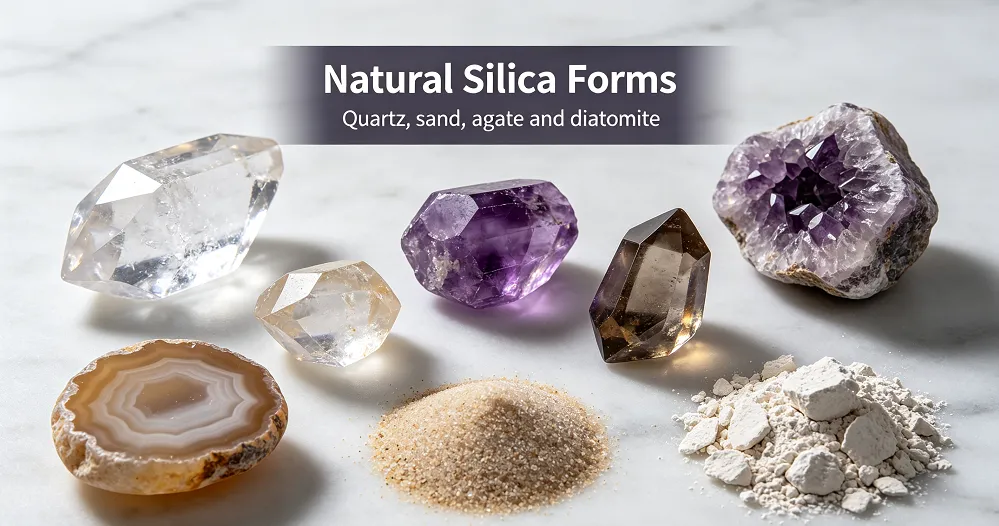
The chemical formula of silicon dioxide is SiO2. Silicon dioxide has two forms: crystalline and amorphous. Silica existing in nature, such as Shi Ying and quartz sand, is collectively referred to as silica. Pure Shi Ying is a colorless crystal, large and transparent prismatic Shi Ying crystal is called crystal; purple crystal with trace impurities is called amethyst; and light yellow, golden and brown crystal is called smoky crystal. Chalcedony, agate, and jasper are colored Shi Ying crystals containing impurities. Sand is Shi Ying's fine particles mixed with impurities. Opal and diatomite are amorphous silica. Silicon dioxide has a wide range of uses, mainly used to make glass, water glass, pottery, enamel, refractory, aerogel felt, ferrosilicon, molding sand, elemental silicon, cement, etc. In ancient times, silicon dioxide was also used to make glaze and carcass of porcelain. General stones are mainly composed of silicon dioxide and calcium carbonate.
More about Silicon dioxide
Chemical formula: SiO2
Molecular weight: 60.084
CAS:14808-60-7
Melting point: 1723℃
Boiling point 2230℃
Water solubility: insoluble
The high melting and boiling points of silicon dioxide reflect the strong covalent bonds in its three-dimensional network structure. The insolubility of SiO₂ in water is due to the strength of the Si-O bonds and the stability of the crystal lattice. The melting and boiling points of SiO₂ are significantly higher than those of CO₂, which exists as a molecular crystal, due to the different bonding and structure of the two compounds. The high melting point of SiO₂ makes it suitable for high-temperature applications, such as refractories and furnace components. The chemical stability of SiO₂ in most environments, including acidic and neutral conditions, contributes to its durability and longevity in various applications. The insolubility of SiO₂ in water is also important for its use in water treatment and filtration applications. The high thermal stability of SiO₂ ensures that it maintains its structural integrity at elevated temperatures, making it suitable for applications in the glass, ceramics, and metallurgical industries. The ability of SiO₂ to form glasses with controlled properties through the addition of other metal oxides is the basis for the glass industry. The optical properties of SiO₂, including its transparency in the visible and ultraviolet regions, make it valuable for optical applications such as lenses and fibers.

Crystalline vs. Amorphous SiO₂
Material structure of Silicon dioxide powder
The properties of silicon and carbon are similar, but the properties of their oxides are quite different. CO2 is a molecular crystal, while SiO2 is an atomic crystal. SiO2 _ 2 is a three-dimensional network structure with a silicon-oxygen tetrahedron as the basic structure. In the crystal structure, four valence electrons of silicon atoms form four covalent bonds with four oxygen atoms, with Si atoms at the center of the regular tetrahedron and O atoms at the vertices of the tetrahedron.
Each silicon atom is connected to four oxygen atoms, and each oxygen atom is connected to two silicon atoms. The smallest ring in the crystal consists of 12 atoms (6 silicon atoms and 6 oxygen atoms), each silicon is shared by 6 rings, and the number ratio of silicon and oxygen atoms in the crystal is 1:2.
The three-dimensional network structure of silicon dioxide is fundamental to understanding its properties and applications. The tetrahedral arrangement of silicon and oxygen atoms provides a rigid framework that gives SiO₂ its hardness and strength. The sharing of oxygen atoms between silicon atoms creates a continuous network of Si-O-Si bonds that extends throughout the crystal. This network structure is responsible for the high melting point and chemical stability of SiO₂. The structure of SiO₂ can be modified by the presence of other elements, which can substitute for silicon or oxygen in the lattice, creating materials with different properties. The incorporation of boron, aluminum, or phosphorus into the SiO₂ structure can create glasses and ceramics with specialized properties for specific applications. The structural differences between crystalline and amorphous SiO₂ result in different physical and chemical properties, with crystalline SiO₂ being more ordered and having higher density than amorphous SiO₂. The structural properties of SiO₂ are also important for its use as a catalyst support, where the surface properties and porosity of the material can be tailored for specific applications. The understanding of the SiO₂ structure has enabled the development of advanced materials, including mesoporous silica, zeolites, and silica-based composites, with applications in catalysis, separation, and drug delivery. The study of SiO₂ structure continues to be an important area of research in materials science, with new discoveries leading to innovative applications and improved performance of existing materials. The relationship between the structure of SiO₂ and its properties is key to its widespread use in industrial applications and the development of new materials.

Natural Silica Forms
Uses of Silicon dioxide powder
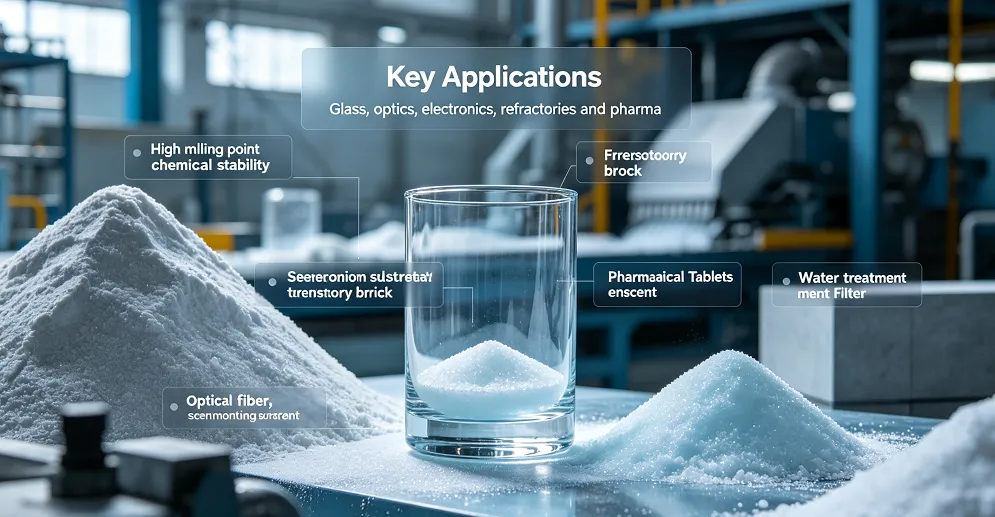
Silicon dioxide is the raw material for making glass, Shi Ying glass, water glass, optical fiber, important parts of the electronic industry, optical instruments, handicrafts, and refractories, and it is also an important material for scientific research.
The glass industry is one of the largest consumers of silicon dioxide. High-purity quartz sand provides the essential SiO₂ content for producing various types of glass, including flat glass, container glass, specialty glass, and fiberglass. The purity of the SiO₂ used in glassmaking is critical for achieving the desired optical and mechanical properties. Low iron content is particularly important for producing colorless glass, as iron impurities can cause undesirable green or yellow discoloration. In the electronics industry, high-purity SiO₂ is used as a substrate for semiconductor devices and as a dielectric material in integrated circuits. The thermal expansion coefficient of SiO₂ is well-matched to that of silicon, making it an ideal material for semiconductor applications. In the optical industry, SiO₂ is used to produce lenses, prisms, and other optical components due to its high transparency and low coefficient of thermal expansion. The telecommunications industry relies on silica-based optical fibers for high-speed data transmission, where the purity of the silica glass determines the clarity of the signal and the distance it can travel without amplification. The use of SiO₂ in refractories takes advantage of its high melting point and chemical stability, making it suitable for lining furnaces and kilns. The versatility of SiO₂ in these diverse applications is a testament to its unique combination of physical and chemical properties. The development of new processing techniques and the exploration of new applications for SiO₂ continue to drive research and development in the field.
In addition, silicon dioxide can also be used as a lubricant, which is an excellent flow promoter, mainly used as a lubricant, anti-sticking agent, and flow aid. It is especially suitable for the granulation of oil and extracts drugs, and the prepared granules have good fluidity and compressibility. It can also be used as a glidant in direct tablets. As a disintegrant, it can greatly improve the fluidity of particles, increase the bulk density, increase the hardness of the prepared tablets, shorten the disintegration time and improve the dissolution rate of drugs. It can be used as an internal desiccant in the manufacture of granules to enhance the stability of drugs. It can also be used as a filter aid, clarifier, defoamer and suspending agent, and thickener for liquid preparation.
The use of silicon dioxide as a pharmaceutical excipient is one of its most important applications in the healthcare industry. The material's high surface area and porosity make it an excellent flow promoter and anti-caking agent for powders and granules. In tablet manufacturing, SiO₂ improves the flowability of the powder blend, ensuring consistent tablet weight and content uniformity. The use of SiO₂ as a glidant in direct compression tablet formulations is well-established, with the material being added at concentrations typically ranging from 0.1% to 1% by weight. The ability of SiO₂ to improve the compressibility of pharmaceutical powders is attributed to its ability to reduce interparticle friction and prevent sticking to the tablet press tooling. As a disintegrant, SiO₂ facilitates the rapid break-up of tablets in the gastrointestinal tract, promoting drug dissolution and absorption. The use of SiO₂ as a desiccant in granulation processes helps to maintain the stability of moisture-sensitive drugs by absorbing trace amounts of water. In liquid formulations, SiO₂ is used as a suspending agent and thickener, improving the viscosity and stability of suspensions and emulsions. The use of SiO₂ as a filter aid and clarifier in pharmaceutical processing helps to remove impurities and improve product clarity. The safety and biocompatibility of SiO₂ have been extensively studied, and it is generally recognized as safe for use in pharmaceutical and food products. The development of new pharmaceutical formulations incorporating SiO₂ continues to expand the range of applications for this versatile material. The regulatory approval of SiO₂ for use in pharmaceuticals and food products reflects its safety and efficacy in these applications.

Key Applications
Price of Silicon dioxide powder
Silicon dioxide powder particle size and purity will affect the product's price, and the purchase volume can also affect the cost of Silicon dioxide powder. A large amount of large amount will be lower. The price of Silicon dioxide powder can be found on our company's official website.
Silicon dioxide powder supplier
Luoyang Tongrun Nano Technology Co. Ltd. (TRUNNANO) Luoyang City, Henan Province, China, is a reliable and high-quality global chemical material supplier and manufacturer. It has more than 12 years of experience providing ultra-high quality chemicals and nanotechnology materials, including Silicon dioxide powder, nitride powder, Silicon dioxide powder, sulfide powder, and 3D printing powder. If you are looking for high-quality and cost-effective Silicon dioxide powder, you are welcome to contact us or inquire any time.