Concrete floors in industrial and commercial settings face a persistent challenge: dusting, sanding, poor wear resistance, and susceptibility to chemical attack. Traditional surface treatments like epoxy coatings provide a temporary cover, but they often peel, blister, or wear out over time. Penetrating sealers and hardeners offer a more durable alternative by strengthening the concrete from within. Liquid lithium silicate stands out among these solutions due to its exceptionally small molecular size, which allows it to penetrate deeper than sodium or potassium silicates and react more completely with the free lime in concrete to form a permanent, insoluble silicate gel. TRUNNANO TR-L series liquid lithium silicate (TR-L35, TR-L43, TR-L48) delivers this sealing and hardening performance across industrial floors, commercial buildings, and public facilities, providing a long-lasting solution that becomes an integral part of the concrete itself rather than a surface coating that can fail. This article explores how liquid lithium silicate works as a concrete densifier and hardener, its key advantages over traditional silicate treatments, and the practical steps for successful application.
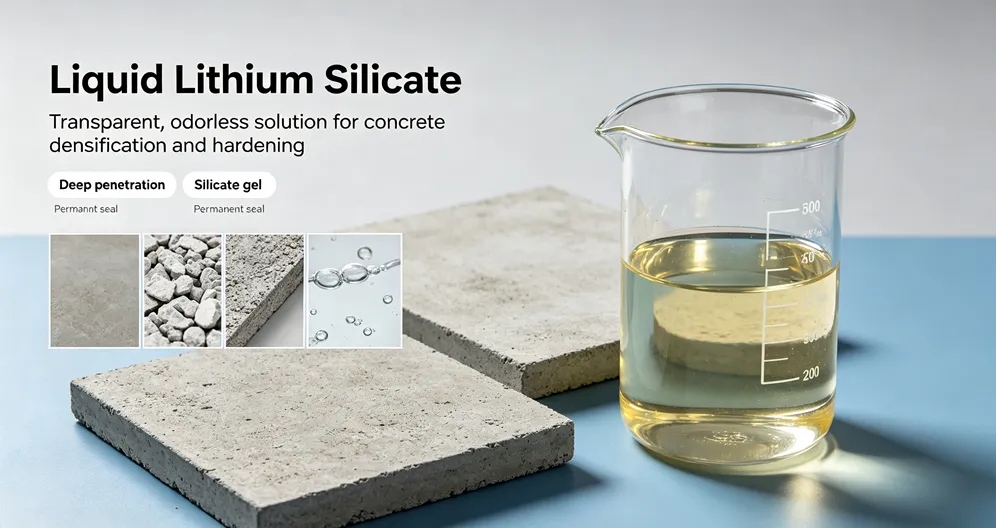
Liquid Lithium Silicate — transparent, odorless, and ready for concrete surface treatment.
Understanding Liquid Lithium Silicate as a Concrete Densifier
Liquid lithium silicate is an aqueous solution of lithium silicate, appearing as a colorless to slightly yellow, transparent or translucent liquid. It is odorless, weakly alkaline, and has a relative density of approximately 1.16–1.20 at 20°C. As a lithium-based concrete densifier, the product is soluble in water and alkaline solutions, but insoluble in alcohol and organic solvents. When in contact with acids, it forms a gel, which is the basis for its sealing and hardening mechanism in concrete.
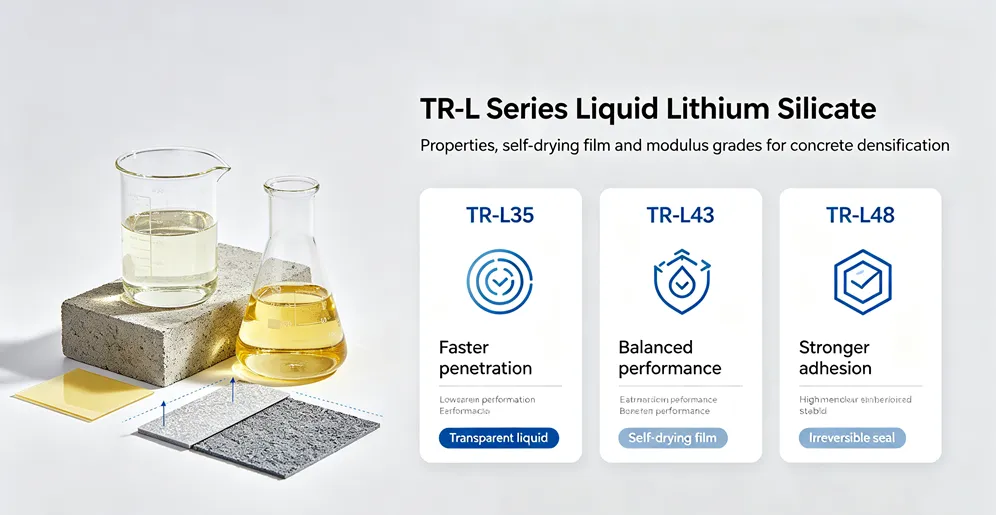
One of the key properties of liquid lithium silicate is its self-drying characteristic. As the solution water evaporates, it generates a dry film that is insoluble in water, with irreversible properties. This means that once the film is formed, it cannot be redissolved, providing a permanent seal that lasts for the lifetime of the concrete surface.
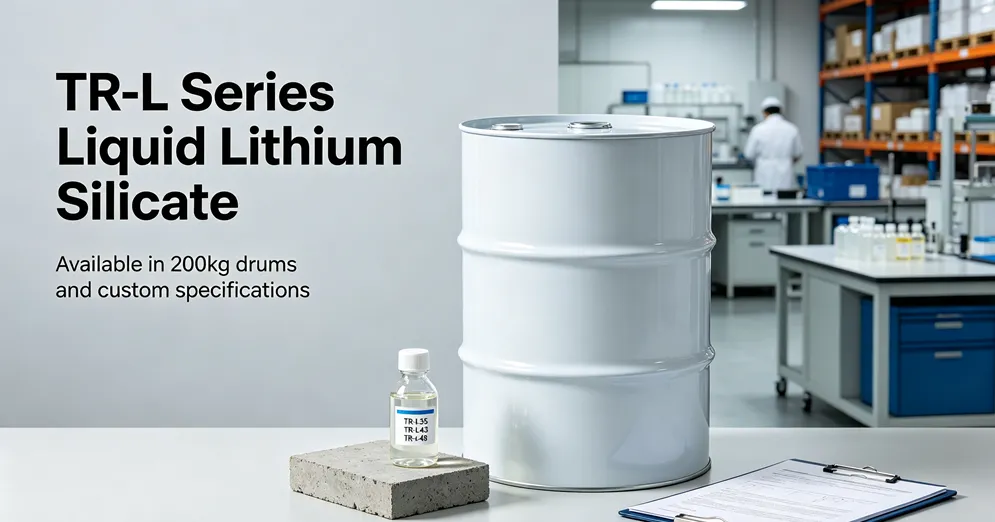
TRUNNANO offers three TR-L series liquid lithium silicate models with different modulus grades to suit various concrete surface hardening requirements:
TR-L35 — Lower modulus, faster penetration, suitable for more porous concrete surfaces
TR-L43 — Medium modulus, balanced performance for general applications
TR-L48 — Higher modulus, stronger adhesion and better stability for dense, high-strength concrete
The appropriate choice depends on concrete density, surface condition, and performance targets. In practical terms, a high-modulus lithium silicate is often selected for denser, high-strength concrete surfaces where maximum hardness is the primary objective, while lower-modulus grades are better suited for more porous concrete or when rapid penetration is desired. TRUNNANO's technical team can provide guidance on product selection based on the specific characteristics of each project, ensuring that the concrete densifier delivers optimal results for every application.
TR-L Series Liquid Lithium Silicate
Liquid Lithium Silicate vs. Traditional Silicate Treatments
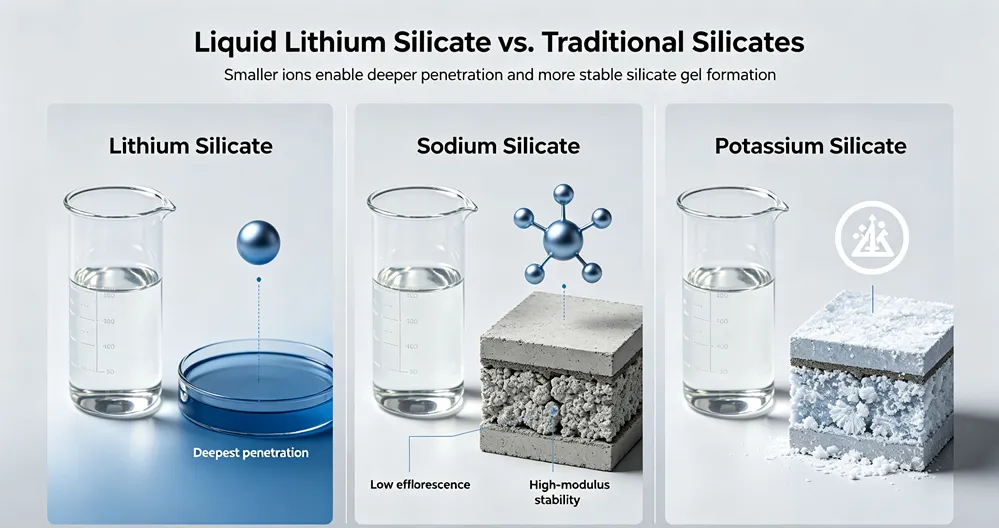
All three alkali metal silicates — lithium, sodium, and potassium — work on the same basic principle: penetrating concrete and reacting with free lime to form silicate gels. However, liquid lithium silicate offers distinct advantages due to its chemical properties. Understanding these differences is essential for selecting the right concrete hardener for your project.
| Comparison Dimension |
Lithium Silicate |
Sodium Silicate |
Potassium Silicate |
| Cation Radius |
Smallest (Li⁺) |
Larger (Na⁺) |
Medium (K⁺) |
| Penetration Depth |
Deepest |
Shallower |
Medium |
| High-Modulus Stability |
Stable |
Prone to gelling |
Relatively stable |
| Efflorescence Risk |
Very low |
Higher |
Medium |
| Surface Hardness Improvement |
High |
Low to medium |
Medium |
Lithium ions have the smallest radius among alkali metals, which enables deeper penetration into dense concrete. Sodium silicate tends to become unstable and form gels at higher modulus values, while lithium silicate maintains its stability even under challenging conditions. The smaller lithium ions also reduce the transport of soluble salts to the surface, minimizing the white residue formation known as efflorescence, which is a common problem with sodium and potassium silicate treatments.
Furthermore, liquid lithium silicate forms a harder, more durable surface layer without the tackiness sometimes seen with sodium or potassium silicate treatments. This means that surfaces treated with lithium silicate are ready for foot traffic and equipment use sooner, with less risk of sticky residue interfering with subsequent operations. The enhanced hardness and abrasion resistance provided by liquid lithium silicate make it particularly valuable in high-traffic industrial environments where concrete surfaces are subject to constant wear from forklifts, heavy equipment, and foot traffic. The result is a harder, more abrasion-resistant surface with reduced dusting and improved chemical resistance, making lithium silicate concrete densifier the preferred choice for demanding applications where durability matters most.
Liquid Lithium Silicate vs. Traditional Silicates
How Liquid Lithium Silicate Works as a Concrete Hardener
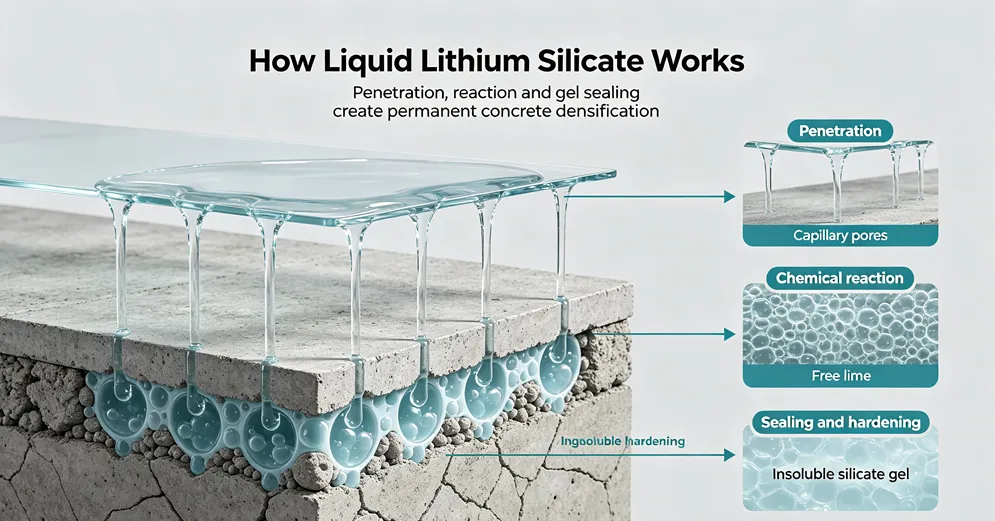
The mechanism of liquid lithium silicate in concrete involves three interconnected stages: penetration, chemical reaction, and sealing. Understanding this process is key to appreciating why lithium silicate outperforms traditional concrete hardeners.
1. Penetration
Because lithium ions are the smallest among alkali metals, the liquid lithium silicate solution penetrates deeper into the concrete matrix than sodium or potassium silicates. The actual penetration depth depends on the concrete's density and porosity — more porous surfaces allow deeper penetration, while denser surfaces may require multiple applications to achieve the desired effect. This deeper penetration is what gives lithium silicate its superior performance, as it reaches further into the concrete structure to create a more thorough and durable seal. When used as a concrete densifier, this deep penetration ensures that the hardening effect extends well below the surface, creating a strong, wear-resistant layer that withstands heavy traffic and mechanical stress.
2. Chemical Reaction
Once inside the concrete, liquid lithium silicate reacts with free calcium hydroxide (Ca(OH)₂) generated during cement hydration. This chemical reaction produces insoluble lithium-calcium silicate gel that fills capillary pores and micro-cracks near the surface. The reaction continues over time as the lithium silicate penetrates deeper into the concrete, gradually building up the gel structure and creating an increasingly dense and impermeable surface layer. This gradual reaction ensures that the sealing effect continues to develop even after the initial treatment, providing ongoing improvement in surface properties over time. This is what makes lithium silicate particularly effective as a concrete hardener — the reaction continues to strengthen the surface long after application.
3. Sealing and Hardening
The gel structure created by this reaction effectively seals the concrete surface, resulting in:
Increased surface hardness and abrasion resistance
Reduced permeability and improved water resistance
Elimination of dusting and sanding issues
Enhanced resistance to chemical attack and freeze-thaw damage
Unlike surface coatings that sit on top of the concrete and can be worn away or peeled off, the lithium silicate gel becomes an integral part of the concrete itself. This integration means that the hardening and sealing effects are permanent and will not degrade over time, even under heavy traffic or harsh environmental conditions. As a result, liquid lithium silicate provides a long-term solution for concrete surface hardening that maintains its effectiveness for the life of the concrete.
How Liquid Lithium Silicate Works
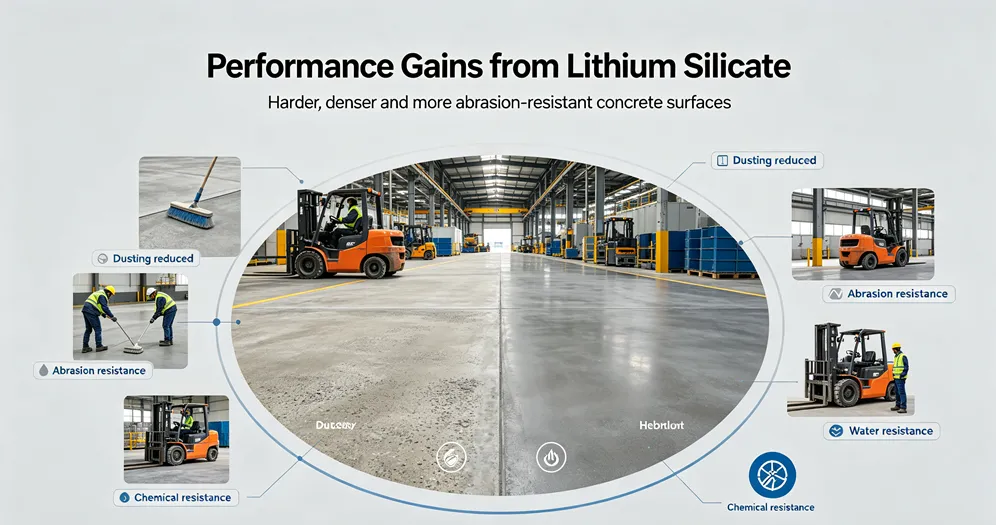
Performance Gains from Lithium Silicate Concrete Densifier
Concrete treated with liquid lithium silicate achieves measurable improvements across multiple performance dimensions. The silicate gel fills capillary pores, significantly increasing surface hardness and resistance to scratching. Densified surfaces resist wear from foot traffic, forklifts, and mechanical equipment, extending floor service life. Pore filling blocks the penetration pathways for water, oils, and chemicals, making spills easier to clean and less damaging. Sealing the surface pores eliminates the dusting and sanding issues common on untreated concrete, while reduced moisture penetration minimizes freeze-thaw damage in cold climates. The combination of these improvements makes lithium silicate concrete densifier a comprehensive solution for enhancing the performance and longevity of concrete surfaces.
In practical terms, the improvements translate to a floor that is easier to clean and maintain, with better resistance to stains and chemical damage. The elimination of dusting also means a cleaner work environment, which is particularly important in food processing facilities, pharmaceutical manufacturing, and other settings where dust contamination is a concern. The enhanced abrasion resistance reduces the need for frequent resurfacing or repairs, lowering the total cost of ownership over the life of the floor. For facility managers and contractors, this translates to longer intervals between maintenance, reduced repair costs, and a better-looking floor that stands up to years of heavy use.
Performance Gains from Lithium Silicate
Applications of Liquid Lithium Silicate
These performance enhancements make liquid lithium silicate suitable for a wide range of applications across multiple industries:
Industrial floors — workshops, warehouses, distribution centers, manufacturing plants
Commercial buildings — shopping malls, supermarkets, showrooms, office lobbies
Public facilities — schools, hospitals, airports, stadiums, parking garages
The versatility of liquid lithium silicate means it can be used on both new and existing concrete, making it a cost-effective solution for both new construction and renovation projects where concrete surface hardening is required.
Liquid lithium silicate application on industrial concrete floor
Construction Steps for Lithium Silicate Concrete Hardener
The application of liquid lithium silicate follows a systematic process that, when properly executed, delivers consistent and reliable results.
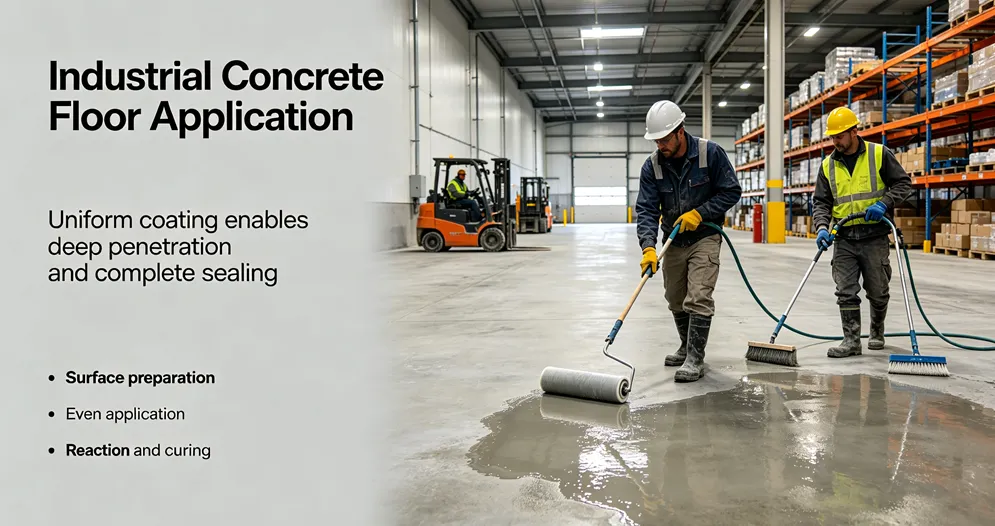
1. Surface Preparation
Remove dust, oil stains, old coatings, and loose material from the concrete surface. The surface must be clean, dry, and structurally sound before application. Any existing coatings or sealers must be completely removed, as they can block the penetration of the lithium silicate and prevent it from reaching the concrete surface. Similarly, oil stains or chemical residues should be thoroughly cleaned to ensure that the reaction with the concrete is not inhibited.
2. Surface Wetting
Thoroughly wet the concrete with water, keeping it moist without standing water. This prevents the liquid lithium silicate from being absorbed too quickly and ensures even penetration across the entire surface. The concrete should be allowed to absorb water until it is saturated to the point where water no longer beads up on the surface. This step is critical for achieving uniform penetration and consistent results when using lithium silicate as a concrete densifier.
3. Material Application
Apply liquid lithium silicate evenly using brushes, rollers, or low-pressure spray equipment. Uniform coverage is essential for consistent results, and the lithium silicate should be applied in a systematic pattern to avoid missing any areas.
4. Penetration and Reaction
Allow the lithium silicate to penetrate and react with the concrete. The surface should be kept moist during this period to maximize the chemical reaction, typically for 30 to 60 minutes depending on the temperature and humidity conditions.
5. Surface Rinsing
Rinse the surface with clean water to remove any excess, unreacted material that could leave a sticky residue.
6. Drying and Curing
Allow the surface to dry naturally. Complete curing of the silicate gel typically requires several hours depending on ambient conditions, with the surface reaching its full hardness and abrasion resistance within a few days.
Construction Precautions for Lithium Silicate Treatment
The condition of the concrete surface has a direct impact on the effectiveness of liquid lithium silicate treatment:
For clean, intact concrete, lithium silicate delivers optimal hardening results with uniform penetration
If the surface already has oil stains, existing coatings, sealers, or severe damage, repair or thorough cleaning must be completed before treatment
In some cases, mechanical preparation such as grinding or shot blasting may be necessary to open up the surface pores and allow the lithium silicate to penetrate effectively
Different modulus products vary in penetration speed and reaction time — select the right lithium silicate model for the specific application
A small-area test should always be performed before full-scale application to verify compatibility and performance on the actual surface. This test will help determine the appropriate application rate and the optimal timing for each step of the process, ensuring that the full-scale application achieves the best possible results for concrete surface hardening.
TR-L series liquid lithium silicate packaging
Supplier