Surface-Modified Spherical Alumina Solves Viscosity Spike and Interfacial Bonding Challenges in Highly Filled Thermal Potting Compounds
A Formulation Guide for High-Loading Thermally Conductive Potting Compounds
Thermal potting compounds for power electronics, LED modules, and battery packs are caught between two opposing requirements: higher filler loading to achieve thermal conductivity, and lower viscosity to ensure complete cavity filling and void-free encapsulation. Spherical alumina has become the default filler for these formulations because its spherical morphology enables higher loading at lower viscosity than angular or irregular particles. But at loadings above 85 wt%, even spherical alumina reaches a formulation ceiling: viscosity spikes sharply, interfacial bonding weakens, and the compound becomes difficult to process. Surface-modified spherical alumina addresses this ceiling through chemistry rather than geometry. By engineering the particle surface with silane coupling agents or polymer-compatible grafts, formulators can push filler loading higher while maintaining flow and interfacial integrity. This article examines the viscosity and interfacial mechanisms behind this breakthrough and provides practical guidance for evaluating surface-modified spherical alumina in highly filled potting compounds.
1. Why Highly Filled Potting Compounds Hit a Formulation Ceiling
1.1 The Viscosity–Loading Trade-Off
Thermal conductivity in a filled polymer scales with filler loading, but viscosity does not scale linearly. As loading approaches the maximum packing fraction, the amount of polymer available to separate particles diminishes, and particle–particle interactions dominate the rheology. For spherical particles, the theoretical maximum packing fraction for random close packing is approximately 64 vol%. In practice, alumina-filled potting compounds become unprocessable well before this limit because the polymer must wet every particle surface, and the interfacial layer itself contributes to effective viscosity.
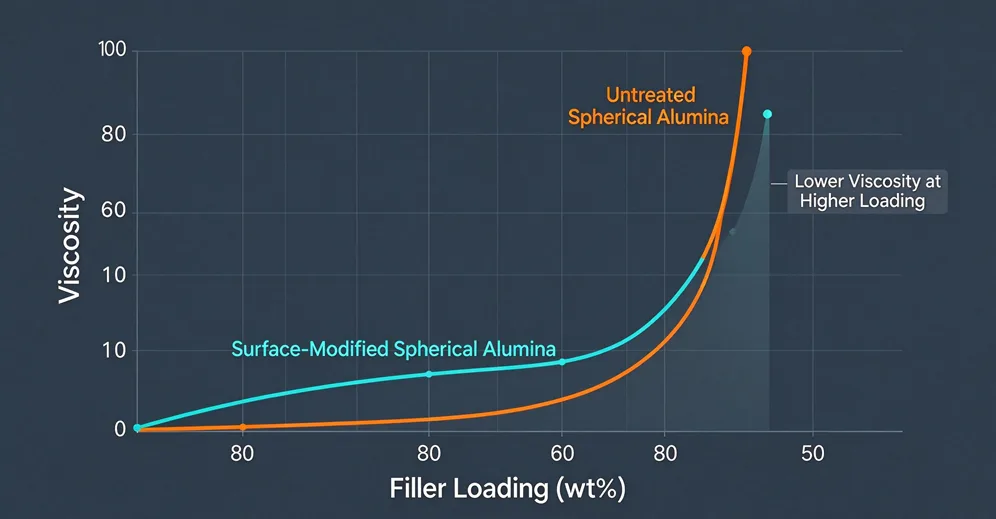
The Viscosity–Loading Trade-Off
1.2 The Interface Is the Bottleneck
Untreated spherical alumina is hydrophilic, with surface hydroxyl groups that attract moisture and create strong hydrogen bonding with polar polymer matrices. In a non-polar or low-polarity matrix such as silicone or polyurethane, the mismatch between the hydrophilic filler surface and the hydrophobic polymer leads to poor wetting, air entrapment, and weak interfacial adhesion. The result is a compound that is both too viscous to process at high loading and mechanically weak at the filler–matrix interface. Surface-modified spherical alumina targets this interface directly.
2. Understanding the Surface Modification Mechanisms
2.1 Silane Coupling Agents: The Workhorse Chemistry
Organofunctional silanes are the most widely used surface modifiers for spherical alumina. The general structure is R–Si(OR′)₃, where the hydrolyzable alkoxy groups react with surface hydroxyls on alumina, and the organofunctional R group provides compatibility with the polymer matrix. For silicone potting compounds, vinyl or alkyl silanes are common; for epoxy systems, epoxy-functional silanes provide covalent bonding to the matrix. The silane layer reduces surface energy, improves wetting, and creates a bridge between filler and polymer.
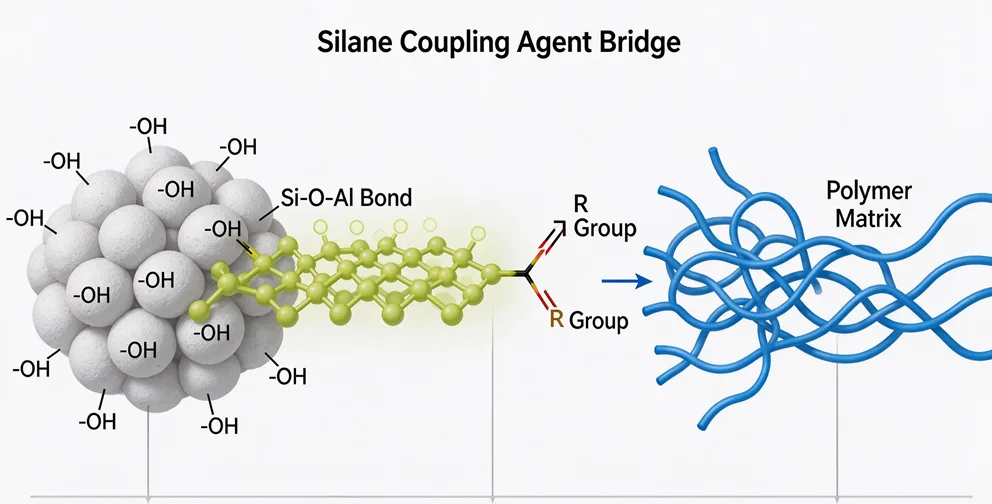
Silane Coupling Agent Bridge
2.2 Polymer Grafting and Physical Adsorption
Beyond silanes, surface modification can involve polymer grafting or the adsorption of polymeric dispersants. Polymer grafting creates a brush layer that provides steric stabilization, preventing particle agglomeration and reducing particle–particle friction. This is particularly effective in highly filled systems where particle contact is frequent. The grafted layer must be tailored to the matrix chemistry: a graft compatible with silicone will not necessarily perform well in an epoxy matrix.
2.3 The Result: Lower Viscosity at Higher Loading
Surface modification reduces viscosity through two mechanisms. First, improved wetting reduces the amount of polymer immobilized at the particle surface, increasing the effective volume of free polymer. Second, steric or electrostatic stabilization reduces particle agglomeration, which otherwise traps polymer in interstitial voids and increases viscosity. The practical outcome is that a surface-modified spherical alumina grade can often achieve 2–5 wt% higher loading than its untreated counterpart at the same viscosity, or a 20–40% viscosity reduction at the same loading.
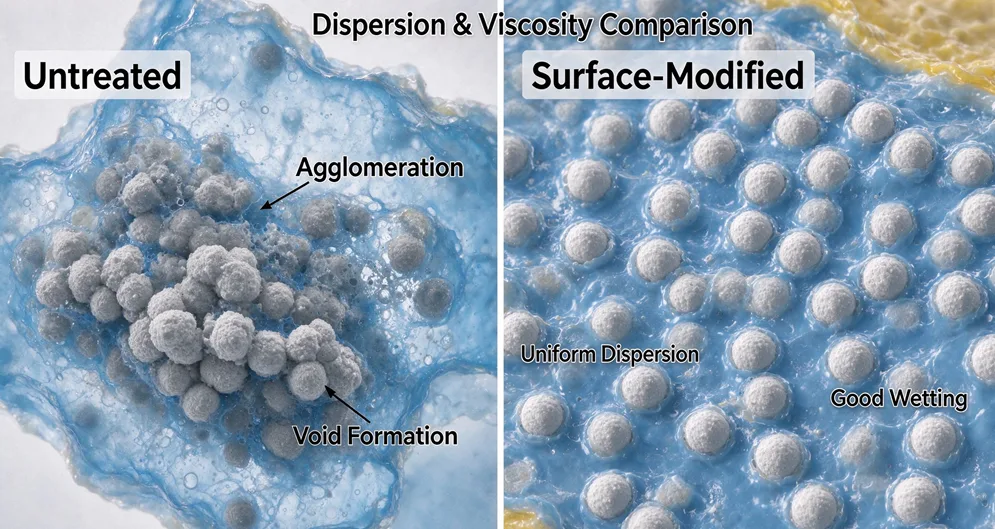
Dispersion & Viscosity Comparison
3. Evaluating Spherical Alumina Grades for High-Loading Applications
3.1 Particle Size Distribution and Packing Efficiency
A broad particle size distribution improves packing efficiency by allowing smaller particles to fill the interstices between larger ones. Bimodal or trimodal blends of spherical alumina can push the effective maximum packing fraction higher than a monomodal distribution. Surface modification becomes even more important in these blends because the smaller particles have a higher specific surface area and thus a greater interfacial contribution to viscosity.
3.2 Sphericity and Surface Smoothness
Sphericity reduces particle–particle friction, and surface smoothness reduces the interfacial area that must be wetted by polymer. High-quality spherical alumina produced by flame spheroidization or spray pyrolysis offers both. Surface modification should not compromise sphericity or introduce roughness; the modifier layer should be thin and uniform.
3.3 Purity and Ionic Content
For electronic potting compounds, ionic contamination (Na⁺, Cl⁻, Fe³⁺) can cause corrosion, leakage current, and dielectric breakdown. High-purity spherical alumina grades with controlled ionic content are essential. Surface modification chemistry must also be evaluated for its own ionic contribution: some silane hydrolysis products can introduce trace ions if not properly removed.
4. Matching Surface Chemistry to the Polymer Matrix
| Matrix Chemistry |
Recommended Surface Modification |
Key Consideration |
| Silicone |
Vinyl or alkyl silane |
Compatibility with hydrosilylation cure; avoid platinum catalyst poisons |
| Epoxy |
Epoxy-functional silane |
Covalent bonding to matrix; cure kinetics may shift |
| Polyurethane |
Amino or isocyanate-functional silane |
Reactivity with isocyanate groups; pot life impact |
| Acrylate |
Methacrylate-functional silane |
Free-radical cure compatibility |
The selection of surface chemistry is not a generic decision. A modifier that performs well in silicone may be ineffective in epoxy, and a modifier optimized for adhesion may increase viscosity if the graft layer is too thick. Formulators should request surface-treated grades with specified modifier chemistry and treat the modifier as a formulation variable, not a fixed attribute.
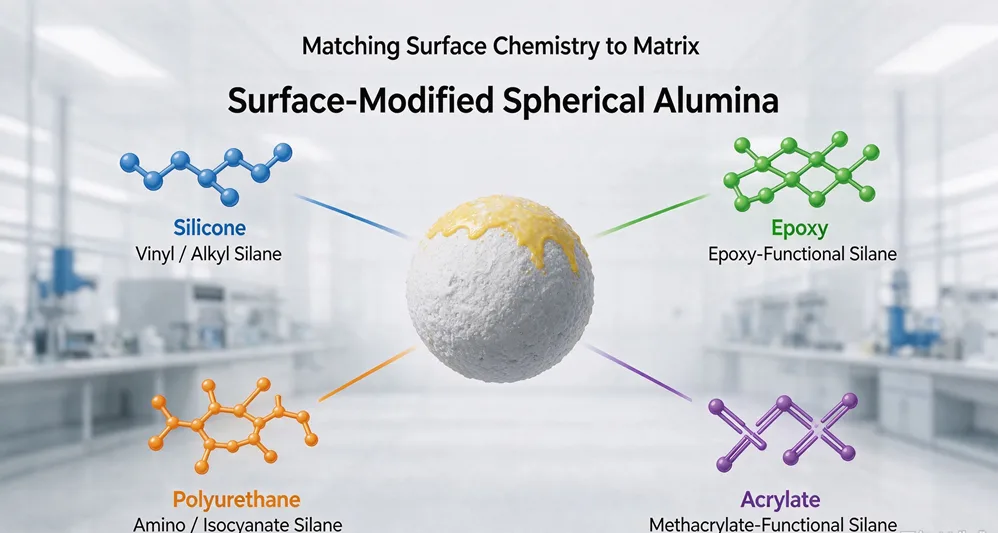
Matching Surface Chemistry to Matrix
5. Key Technical Specifications
| Parameter |
Typical Value for Surface-Modified Spherical Alumina |
| Al₂O₃ content |
≥99.5% |
| Particle size (D50) |
1–100 μm (grade-dependent) |
| Sphericity |
>0.9 |
| Specific surface area |
0.1–2 m²/g (grade-dependent) |
| Surface treatment |
Silane coupling agent (type per matrix) |
| Moisture content |
<0.1% |
| Ionic content (Na⁺, Cl⁻) |
<10 ppm (electronic grade) |
| Thermal conductivity (filler) |
~30 W/m·K (α-alumina) |
Data compiled from supplier technical datasheets; values vary by grade and should be confirmed with the supplier for specific products.
6. Practical Formulation Guidance
Start with a bimodal or trimodal blend. A 10:1 ratio of large to small spherical alumina particles is a common starting point. Surface modification should be applied to both fractions, with the smaller fraction receiving proportionally more modifier due to higher surface area.
Measure viscosity at shear rates relevant to your process. Potting compounds are often processed at low shear (gravity casting) or moderate shear (dispensing). A viscosity reduction observed at high shear may not translate to improved flow in a casting application.
Evaluate interfacial adhesion through mechanical testing. Lap shear strength, tensile strength, and elongation at break of the cured compound provide indirect measures of interfacial quality. A compound with poor interfacial bonding may show brittle fracture and low elongation even if its thermal conductivity is acceptable.
Check thermal cycling stability. The interface is the first location to degrade under thermal cycling. A surface-modified filler that performs well initially may lose adhesion after repeated cycling if the modifier layer is not thermally stable at the maximum service temperature.
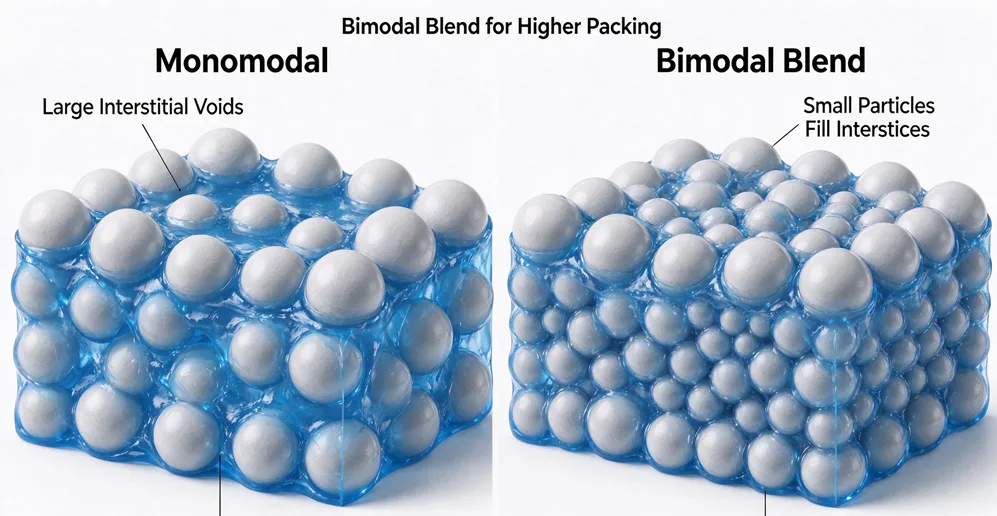
Bimodal Blend for Higher Packing
7. Common Misconceptions and Corrections
Misconception 1: "Any silane treatment will improve performance." Silane chemistry must match the matrix. An amino silane in an epoxy matrix can accelerate cure and shorten pot life; a vinyl silane in a polyurethane matrix may not provide adequate interfacial bonding. The modifier is a formulation variable, not a universal upgrade.
Misconception 2: "Higher loading always means higher thermal conductivity." Beyond a certain loading, the compound becomes unprocessable or develops voids that reduce effective thermal conductivity. The goal is to maximize loading while maintaining processability and void-free encapsulation. Surface-modified spherical alumina enables this balance but does not eliminate the physical limits of packing.
Misconception 3: "Surface modification is a permanent fix for moisture sensitivity." While silane treatment reduces moisture adsorption, it does not eliminate it entirely. Storage conditions and handling procedures still matter, particularly for electronic-grade potting compounds.
8. Quick Evaluation Checklist
Before selecting a surface-modified spherical alumina grade, confirm the following:
Matrix chemistry and cure mechanism
Target filler loading and viscosity limit for the process
Particle size distribution and blend ratio
Surface modifier chemistry and its compatibility with cure catalysts
Ionic content and dielectric requirements
Thermal cycling range and expected service life
Moisture sensitivity and storage requirements
9. Real-World Application Scenarios
Power electronics potting scenario. In IGBT module encapsulation, a silicone potting compound filled with surface-modified spherical alumina achieved 90 wt% loading at a viscosity suitable for gravity casting, compared with 86 wt% for an untreated filler. The cured compound showed improved thermal cycling stability, with no interfacial delamination after 1000 cycles from −40°C to 150°C.
LED module scenario. In LED driver potting, an epoxy-based compound using epoxy-functional silane-modified spherical alumina showed improved adhesion to the housing and reduced void formation compared with an untreated filler. The surface modification also reduced the compound's viscosity at the dispensing shear rate, improving production throughput.
Battery pack scenario. In a polyurethane potting compound for battery modules, an isocyanate-functional silane-modified spherical alumina provided covalent bonding to the matrix, improving mechanical integrity and reducing the risk of filler settling during cure. The modified filler also reduced the compound's viscosity, allowing higher loading and improved thermal conductivity.
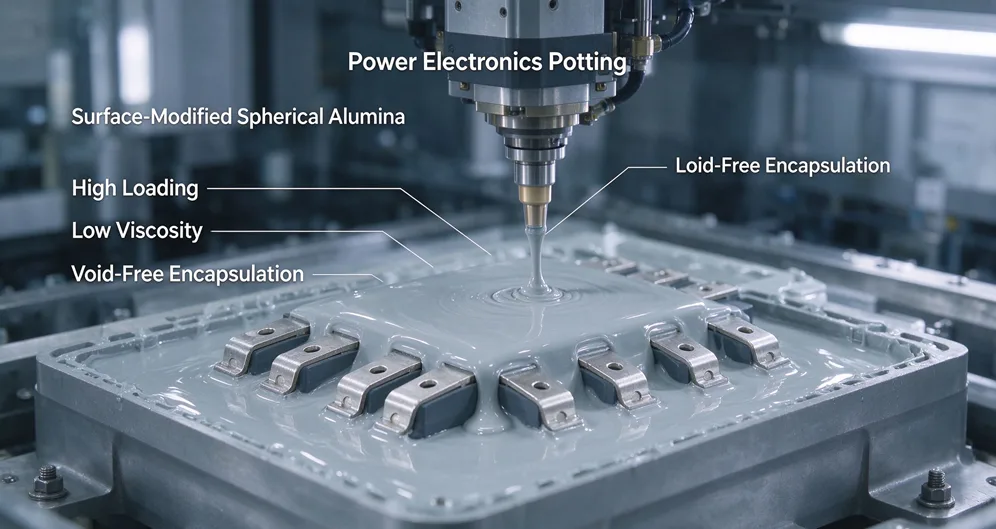
Power Electronics Potting
10. Frequently Asked Questions (FAQs)
Q1: What is surface-modified spherical alumina?
It is spherical alumina powder whose particle surface has been chemically treated, typically with a silane coupling agent, to improve compatibility with a polymer matrix. The modification reduces viscosity at high loading and improves interfacial bonding between filler and polymer.
Q2: How much does surface modification reduce viscosity?
Typical reductions are 20–40% at the same loading, or the ability to increase loading by 2–5 wt% at the same viscosity. The exact benefit depends on the modifier chemistry, the matrix, and the particle size distribution.
Q3: Is surface-modified spherical alumina suitable for all polymer matrices?
No. The modifier chemistry must match the matrix. Silane coupling agents are available with different organofunctional groups for silicone, epoxy, polyurethane, and acrylate systems. Formulators should confirm compatibility with the specific matrix and cure mechanism.
Q4: Does surface modification affect thermal conductivity?
The modifier layer itself has low thermal conductivity, but it is very thin (typically a few nanometers) and its effect on the composite's thermal conductivity is negligible compared with the benefit of higher achievable loading. The net effect is usually an increase in thermal conductivity due to higher filler loading.
Q5: What ionic content should I specify for electronic potting compounds?
Electronic-grade spherical alumina typically specifies Na⁺ and Cl⁻ content below 10 ppm. Higher ionic content can cause corrosion, leakage current, and dielectric breakdown in sensitive electronic assemblies.
11. Conclusion
TRUNNANO's spherical alumina product line (see TRUNNANO technical reports) provides a range of surface-modified grades suited to different polymer matrices and loading requirements, enabling formulators to push filler loading higher without sacrificing processability or interfacial integrity. From vinyl-silane grades for silicone potting compounds, to epoxy-functional grades for power electronics encapsulation, to isocyanate-functional grades for polyurethane battery pack potting, the selection framework presented in this article offers a practical path from matrix chemistry to filler specification for surface-modified spherical alumina.
Surface-modified spherical alumina represents a significant advance in thermal interface materials. By engineering the particle surface to match the polymer matrix, formulators can break through the viscosity–loading ceiling that constrains conventional filled systems. From IGBT module encapsulation to LED driver potting and battery pack thermal management, surface-modified spherical alumina will continue to be an essential filler for demanding thermal potting applications.
Supplier
TRUNNANO is a trusted global chemical material supplier and manufacturer with over 12 years of experience in providing high-quality chemicals and nanomaterials, including boride powder, nitride powder, graphite powder, sulfide powder, and 3D printing powder. The company has a professional technical department and quality supervision department, a well-equipped laboratory with advanced testing equipment, and a dedicated after-sales customer service center. RBOSCHCO supplies spherical alumina powders and surface-modified spherical alumina worldwide, suitable for thermal potting compounds, electronic encapsulation, LED modules, and battery pack thermal management. The company offers comprehensive technical support, from product selection to application guidance. If you are looking for high-quality surface-modified spherical alumina for highly filled thermal potting compounds, please feel free to contact us.