What is Magnesium nitride?
Magnesium nitride is an inorganic compound, the chemical formula is Mg3N2, belongs to the cubic crystal system, at room temperature pure magnesium nitride is yellow-green powder but contains a part of the magnesium oxide impurities magnesium nitride is gray. Magnesium nitride, like many metal nitrides, reacts with water to produce ammonia, which is often used as a catalyst.

Magnesium nitride (Mg₃N₂) is an important inorganic compound belonging to the family of metal nitrides. It has an anti-bixbyite cubic crystal structure in which nitrogen atoms are arranged in a face-centered cubic lattice and magnesium atoms occupy both tetrahedral and octahedral sites. This unique crystal structure contributes to its chemical reactivity and physical properties. The compound is highly reactive with moisture and water, hydrolyzing rapidly to produce ammonia gas. This characteristic makes it valuable for applications requiring controlled ammonia generation but also necessitates careful handling and storage under anhydrous conditions. The color variation from yellow-green to gray-white is a useful visual indicator of purity, with yellow-green typically indicating higher purity and gray-white suggesting the presence of magnesium oxide impurities from surface oxidation or hydrolysis. The compound's sensitivity to air requires that it be handled in inert atmospheres or under conditions that minimize exposure to moisture and oxygen. Its relatively high density (2.71 g/cm³) and thermal stability make it suitable for various high-temperature applications. In recent years, research has increasingly focused on the use of magnesium nitride nanoparticles and nanostructures for enhanced performance in catalytic and composite applications, where the high surface area of nanostructured materials provides improved reactivity and interaction with other materials. The development of new synthesis methods for high-purity, fine-particle-size magnesium nitride continues to be an area of active research.
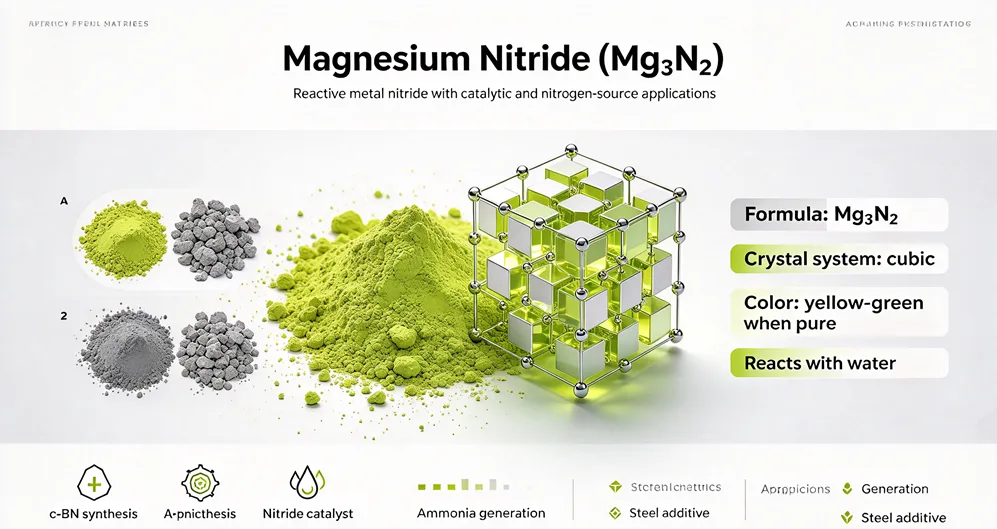
Magnesium Nitride (Mg₃N₂)
Mg₃N₂ Hydrolysis
Magnesium nitride application
Magnesium nitride can be used as a catalyst for the synthesis of cubic boron nitride, which was used in the first successful synthesis.
The catalytic application of magnesium nitride in the synthesis of cubic boron nitride (c-BN) is one of its most important and well-known uses. Cubic boron nitride is a superhard material with properties comparable to diamond, widely used in cutting tools and abrasives. Magnesium nitride acts as an efficient catalyst for the synthesis of c-BN under high-pressure, high-temperature conditions. The catalytic activity of Mg₃N₂ is attributed to its ability to provide active nitrogen species at relatively moderate temperatures. The synthesis of c-BN typically requires high-pressure, high-temperature conditions, and magnesium nitride facilitates the phase transformation from hexagonal to cubic boron nitride by lowering the activation energy and promoting crystal growth. The catalytic mechanism involves the formation of intermediate compounds that facilitate the nucleation and growth of c-BN crystals. This application highlights the importance of magnesium nitride in the production of superhard materials for industrial applications. Beyond c-BN, magnesium nitride has also been employed as a catalyst for the synthesis of other important nitrides, including silicon nitride (Si₃N₄), aluminum nitride (AlN), and transition metal nitrides. The use of magnesium nitride as a catalyst reduces the synthesis temperature and time required for these materials, offering economic benefits and enabling the production of high-quality nitride materials for various industrial applications. The expanding applications of nitride materials in electronics, aerospace, and automotive industries are expected to drive continued demand for high-purity magnesium nitride as a catalyst and nitrogen source.
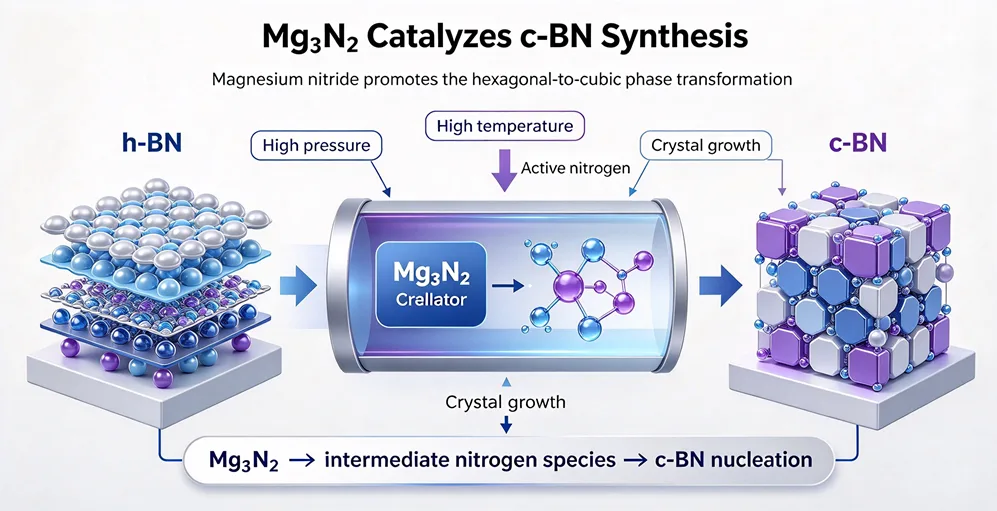
Mg₃N₂ Catalyzes c-BN Synthesis
In 1957, the chemist Robert Wentorf was trying to convert hexagonal boron nitride into cubic boron nitride. He tried heating, pressurizing, using catalysts, and various combinations of the above conditions. He tried all theoretically possible catalysts (such as those used in diamond synthesis), but nothing worked.
Later, out of curiosity and in a desperate venture (the aim, he says, was simply to "increase the number of false attempts"), he applied the same pressure and heat treatment but added magnesium to hexagonal boron nitride. When the magnesium was examined under a microscope, it was found to have tiny dark lumps on it that could create scratches on polished boron carbide, the only substance known to do so at the time was diamond.
Because of the smell of ammonia (produced by the reaction of magnesium nitride with moist air), Wentorf deduced that the reaction of magnesium and boron nitride produced magnesium nitride, which acted as a catalyst to convert hexagonal boron nitride into cubic boron nitride.
The discovery of magnesium nitride's catalytic role in the synthesis of cubic boron nitride by Robert Wentorf in 1957 was a landmark event in materials science. This discovery was particularly significant because it provided a practical route to synthesize c-BN, a material that had been theoretically predicted but not experimentally realized until then. The accidental nature of the discovery—Wentorf added magnesium to the reaction mixture in a desperate attempt to make the synthesis work—highlights the role of serendipity in scientific research. The observation that the dark lumps could scratch polished boron carbide, a material that only diamond could scratch at the time, was a clear indication that a superhard material had been formed. The smell of ammonia, produced by the reaction of magnesium nitride with moisture in the air, provided further confirmation that magnesium nitride was present and had acted as a catalyst. This discovery opened the door to the commercial production of cubic boron nitride, which is now widely used in cutting tools and abrasives for machining ferrous metals. The impact of Wentorf's discovery continues to this day, as c-BN remains one of the most important superhard materials in modern industry.
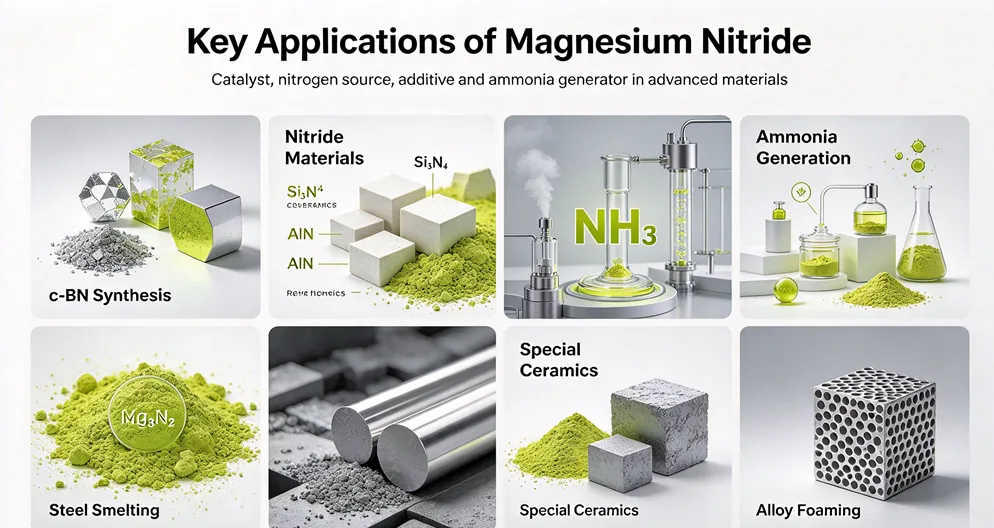
Key Applications of Magnesium Nitride
Key Applications of Magnesium Nitride
| Application |
Function |
Key Benefits |
| Cubic Boron Nitride Synthesis |
Catalyst |
Enables c-BN production at lower pressures and temperatures |
| Nitride Materials Synthesis |
Catalyst and nitrogen source |
Enables production of Si₃N₄, AlN, and other nitrides |
| Ammonia Generation |
Reacts with water to produce ammonia |
On-demand ammonia for laboratory and industrial use |
| High-Strength Steel Smelting |
Additive |
Improves density, strength, and desulfurization |
| Special Ceramics |
Additive |
Enhances thermal conductivity, strength, and toughness |
| Alloy Foaming |
Foaming agent |
Creates lightweight porous metal structures |
| Nuclear Waste Recycling |
Adsorbent |
Captures and stabilizes radioactive species |
TRUNNANO is a trusted global Magnesium nitride supplier & manufacturer with over 12 years of experience in providing super high-quality chemicals and Nanomaterials. Currently, our company has successfully developed a series of materials. The Magnesium nitride produced by our company has high purity, fine particle size, and impurity content. Send us an email or click on the needed products to send an inquiry.
Tags: Magnesium Nitride, Mg₃N₂, Cubic Boron Nitride, Catalyst, Nitride Materials