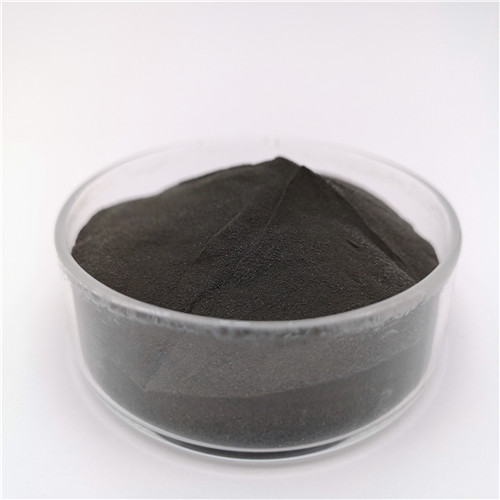
The exceptional energy content of amorphous boron is one of its most significant attributes. The gravimetric heat of combustion of boron is approximately 58.30 MJ·kg⁻¹, while its volumetric heat of combustion reaches approximately 136.44 kJ·cm⁻³. To put this in perspective, boron's volumetric heat of combustion is nearly three times that of conventional hydrocarbon fuels and approximately 1.5 times that of aluminum. This high energy density makes boron the most energy-dense non-metallic fuel available. The irregular shape and large specific surface area of amorphous boron powder significantly reduce its ignition temperature compared to crystalline boron, enhancing its practical applicability in energetic formulations. When incorporated into composite solid propellants, amorphous boron can increase specific impulse by 10-15% compared to aluminum-based propellants. However, the practical use of boron in propellants faces challenges, including the formation of a borosilicate glass layer on particle surfaces during combustion, which can hinder complete oxidation. Research efforts have focused on coating boron particles with materials such as fluoropolymers or titanium to promote more complete combustion and improve ignition characteristics. The development of boron-based composite energetic materials (B-CEMs) that combine boron with reactive additives continues to be an active area of research in the defense and aerospace industries.
Amorphous boron powder is an important energy material. As a solid fuel in composite solid propellant, the calorific value of boron is more than twice that of carbon, about twice that of aluminum and more than twice that of magnesium, and its volumetric calorific value is almost three times that of hydrocarbon fuel. The density of boron is only slightly lower than that of aluminum and this element has the highest volume calorific value. In terms of energy, boron should be the best non-metallic fuel. And the ignition temperature of amorphous boron is greatly reduced because of its irregular shape and large specific surface area.
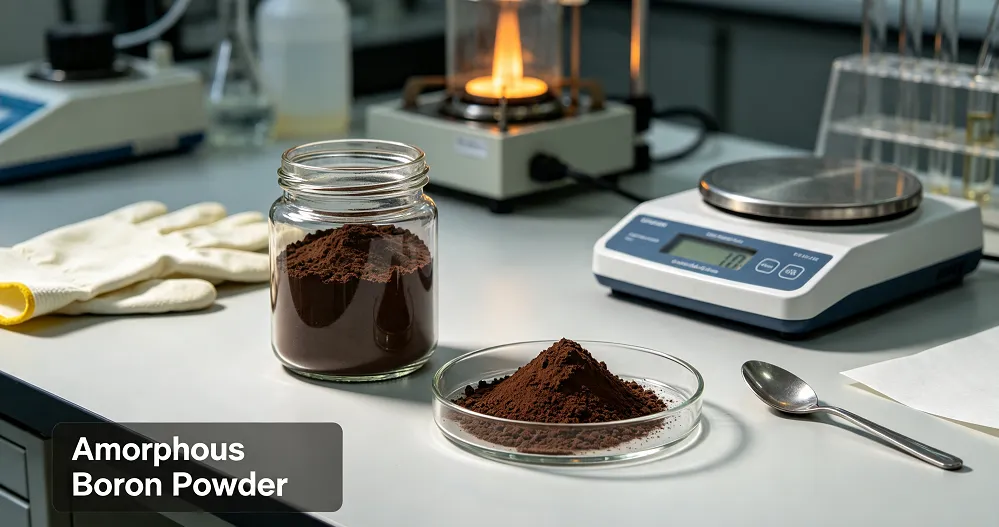
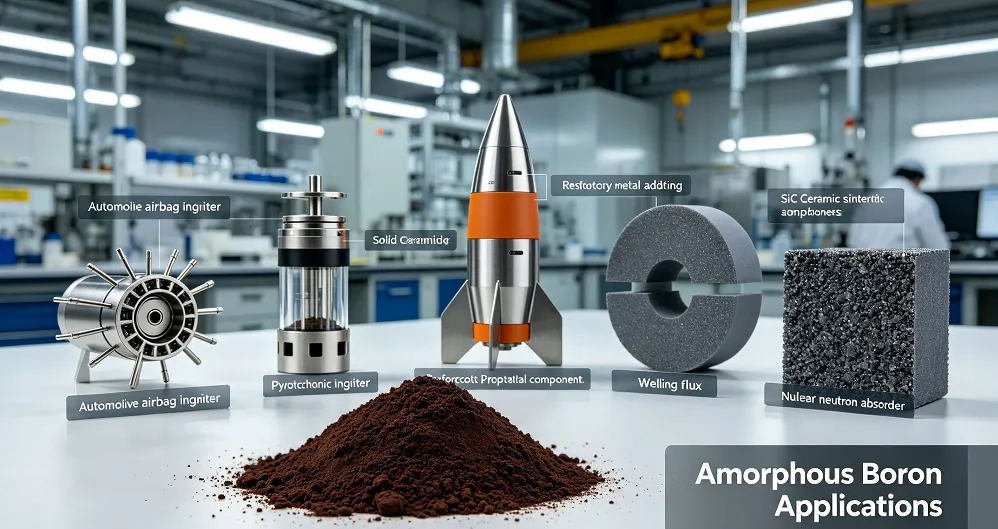
Amorphous boron has a wide range of applications across multiple industries:
Automotive Industry: Used in igniters and seat belt tensioners in airbags, where the rapid and reliable ignition characteristics of boron ensure deployment within milliseconds of a collision event.
Pyrotechnic Mixtures: Added to torches, igniters, and retarders, where the high energy output and consistent burn rate of boron are essential for precision timing devices.
Solid Rocket Propellants: Used as an additive in fuels and explosives, capitalizing on the high energy density of boron, though careful formulation is required to achieve complete combustion.
Refractory Metal Borides: Used in the preparation of refractory metal borides (such as titanium diboride, zirconium diboride, and lanthanum hexaboride), where boron serves as the boron source in high-temperature reactions for extreme environment applications.
Advanced Ceramics: Used as a sintering additive for SiC advanced ceramics, improving densification and mechanical properties of boron-containing materials.
Welding: Used as a reductive additive in flux for welding stainless steel.
Nuclear Technology: Used as a neutron absorber, where the isotope boron-10 (¹⁰B) has a remarkably high neutron capture cross-section, making boron valuable for nuclear reactor control rods and neutron shielding materials.
Superconductors: Amorphous boron reacts with magnesium to form crystalline magnesium boride (MgB₂), which was discovered to be a superconductor with a transition temperature of approximately 39 K (-234°C) in 2001, generating significant research interest in superconducting materials.
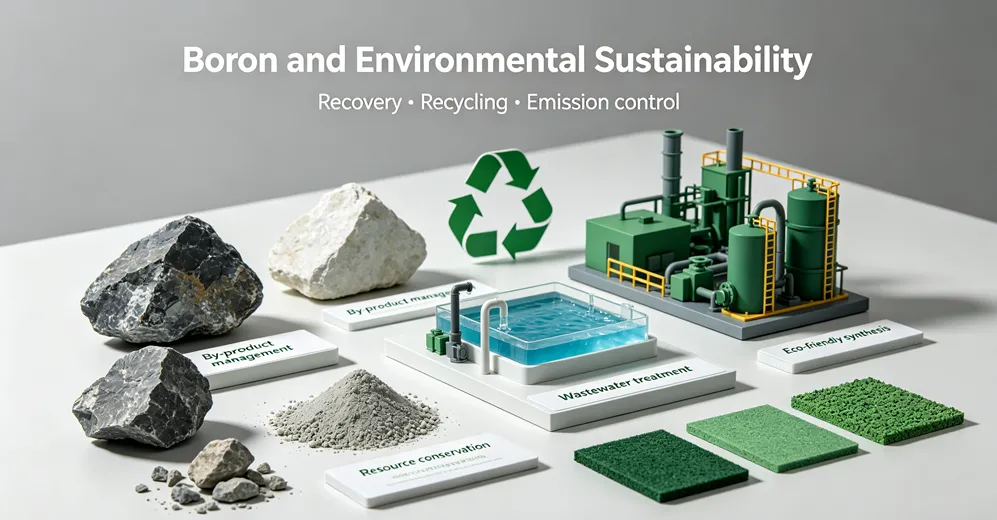
Environmental Impact and Sustainability of Amorphous Boron Powder
As industries increasingly focus on sustainable practices, the environmental considerations associated with amorphous boron production and use are important for both producers and users:
Natural Occurrence: Boron does not occur in elemental form in nature. This element is found as borates in evaporite deposits and volcanic regions, primarily in the form of borax (Na₂B₄O₇·10H₂O) and other borate minerals. The extraction of boron from these sources requires significant energy and chemical processing.
Production Environmental Impact: The production of amorphous boron powder through magnesiothermic reduction generates magnesium oxide as a by-product, which must be managed and disposed of or recycled. The process also consumes significant amounts of energy. The use of acid leaching in purification generates acidic wastewater that must be treated before discharge. Efforts to develop more environmentally friendly synthesis methods for boron, including the recovery and reuse of by-products, are ongoing.
Biodegradability: Elemental boron is not biodegradable but undergoes oxidation in the environment to form borates, which are naturally occurring minerals. Boron compounds are essential micronutrients for plants, and low concentrations of boron in soil and water are generally considered safe. However, high concentrations of boron can be toxic to plants and aquatic organisms.
Recycling and Recovery: The recycling of boron from spent materials is currently limited, though boron can be recovered from some industrial waste streams. The development of efficient recovery processes for boron from end-of-life products and manufacturing scrap would contribute to resource conservation and reduce environmental impact. Research on the extraction of boron from industrial waste, such as glass fibers and ceramics, is ongoing.
Eco-friendly Alternatives: The development of water-based processing methods and alternative synthesis routes for boron that reduce energy consumption and waste generation are active areas of research. The use of biocatalysts and low-temperature synthesis methods is being explored to reduce the environmental footprint of boron production.
Regulatory Status: Boron is not classified as a hazardous substance in all jurisdictions, but some boron compounds may be subject to regulatory restrictions. Users should consult relevant regulatory authorities for specific requirements governing the handling, storage, and disposal of boron powder in their location.
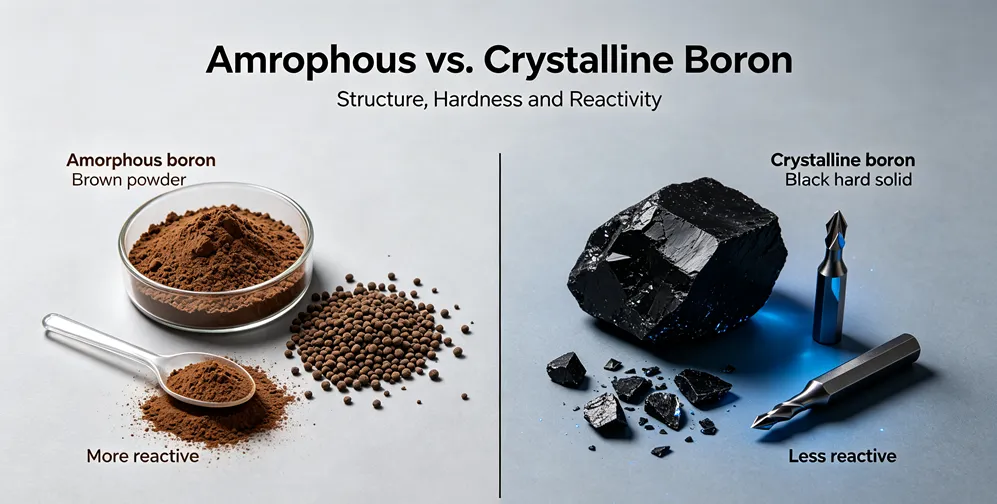
Comparison Table: Amorphous Boron vs. Crystalline Boron
|
Property |
Amorphous Boron |
Crystalline Boron |
|---|---|---|
|
Appearance |
Brown powder |
Black, hard solid |
|
Atomic Arrangement |
Lacks long-range order |
Highly ordered, repeating 3D lattice |
|
Hardness (Mohs) |
Softer, more reactive |
Approximately 9.5 (second only to diamond) |
|
Chemical Reactivity |
More active |
Less active |
|
Ignition Temperature |
Lower (due to irregular shape and large surface area) |
Higher |
|
Common Applications |
Deoxidizer, airbag initiators, rocket fuel, pyrotechnics |
Cutting tools, drills (used instead of diamond) |
|
Electrical Conductivity |
Not specified in text |
Poor conductor at room temperature |
FAQ: Frequently Asked Questions About Boron
Q: Is boron a metal?
A: No, boron is not a metal. This element is classified as a metalloid (or semimetal), meaning boron has properties intermediate between metals and non-metals. The question "Is boron a metal? " is very common because boron is located near the metal-nonmetal boundary on the periodic table. Boron is a poor conductor of electricity at room temperature and is chemically more similar to non-metals.
Q: What is boron?
A: Boron is a chemical element with the symbol B and atomic number 5. This element is a metalloid that can exist in both amorphous and crystalline forms. Boron is unique for its structural versatility and is known for its high hardness in crystalline form (second only to diamond) and high energy content in amorphous form.
Q: How many valence electrons does boron have?
A: Boron has 3 valence electrons. This element has the electron configuration 1s²2s²2p¹, meaning there are three electrons in the outermost shell. The question "How many valence electrons does boron have? " is common in chemistry education, and the answer is three.
Q: What is the atomic number of boron?
A: The atomic number of boron is 5. This means each boron atom has 5 protons in its nucleus. The question "boron atomic number" is frequently searched by students and researchers looking for basic elemental information about boron.
Q: What is the symbol for boron?
A: The symbol for boron is B. This is the one-letter chemical symbol for this element, derived from its English name.
Q: What is boron used for?
A: Boron has many uses. Amorphous boron is used in automobile airbags, pyrotechnics, solid rocket propellants, refractory metal borides, advanced ceramics, and nuclear technology. Crystalline boron is used to make cutting tools and drills due to its extreme hardness. Boron is also used in the production of superconductors and as a neutron absorber. The question "What is boron used for? " is common because of the element's diverse applications.
Q: When was boron discovered?
A: Boron was discovered in 1808 by Sir Humphry Davy in England and independently by Gay-Lussac and Thénard in France.
Q: Where is boron found?
A: Boron does not occur in elemental form in nature. This element is found as borates in evaporite deposits and volcanic regions, primarily in the form of borax (Na₂B₄O₇·10H₂O) and other borate minerals. The question "Where is boron found? " is common because boron is not found freely in nature. Major boron deposits are located in Turkey, the United States, and South America.
Q: Is boron amorphous or crystalline?
A: Boron can exist in both amorphous and crystalline forms. This structural versatility is one of the unique characteristics of this element. Amorphous boron is a brown powder with high reactivity and high energy content, while crystalline boron is black, extremely hard, and less reactive. The difference lies in the arrangement of boron atoms: crystalline boron has an ordered lattice structure while amorphous boron lacks long-range order.
Q: How many valence electrons are in boron?
A: Boron has 3 valence electrons. This is consistent with its position in Group 13 of the periodic table. The question "How many valence electrons are in boron? " is essentially the same as "How many valence electrons does boron have? " and the answer remains three.
Tags:amorphous boron, crystalline boron, boron powder, boron uses, boron supplier