Low-temperature physics is an important subject that helps people understand the macroscopic universe, microscopic particles, and their changes and properties. At temperatures close to absolute zero, matter will exhibit a series of unique properties that cannot be observed at higher temperatures, such as superconductivity and superfluidity; these properties are widely used in quantum computing, quantum simulation, condensed matter physics, and other related fields. Extremely high research and application value. At present, scientific researchers have created ultracold atoms of 38pK under laboratory conditions. But even the most advanced precious metal oxide temperature sensor, the ruthenium oxide sensor, has a temperature measurement limit of only tens of millikelvin. Therefore, further breaking through the limits of low-temperature temperature measurement is of extremely important value to research in fields such as low-temperature physics and quantum physics and the development of corresponding technologies. Diamond is known as the ultimate semiconductor. It has an extremely low thermal expansion coefficient, extremely high hardness, wide band gap, and high hole mobility. It is an ideal material for temperature measurement in extreme environments. However, difficulty in conducting electricity and processing has always been a pain point that has restricted the further industrial application of diamonds, especially under low-temperature conditions.
The design and research of ingredients and phase content is the genetic engineering of materials science. Dual-phase and multi-phase structures have been repeatedly proven to be of great significance in improving many properties of metallic materials. Academician Lu Jian's team has been deeply involved in this for a long time, and it has been applied in many fields. Based on this, the research team designed a composite phase diamond (CPD) with sp2-sp3 dual phases by introducing the sp2 carbon phase into the sp3 hy bridized diamond matrix. This dual-phase structure greatly improves the electrical conductivity and thermal stability of diamonds. It achieves a monotonic increase in resistivity and a relatively low resistance value in an ultra-wide temperature range of 400K-0.001K, successfully breaking through the contact measurement method. Temperature limit. This experimental concept also provides new ideas for the potential applications of diamonds in the electronic field.
In this work, the research team used a simple method to prepare CPD by heat-treating diamonds under atmospheric conditions. CPD has negative temperature coefficient characteristics, and its temperature-resistance (R-T) curve has an extremely high degree of fitting over the entire temperature measurement range. Experimental results show that CPD is a dual mK-level temperature sensing material with a temperature measurement limit as low as 1mK and measurement accuracy as high as 1mK. At the same time, CPD has very low sensitivity to magnetic fields and exhibits linear magnetoresistance, which is conducive to its use in complex environments. In addition, the thermal stability of CPD has also been significantly improved: compared with ordinary synthetic diamond, the initial oxidation temperature of CPD has increased by more than 200K. Not only that, compared to expensive precious metal oxides, the cost of synthetic diamond is dozens to hundreds of times lower. The above characteristics make CPD one of the important candidate materials for the next generation of low-temperature temperature sensors. This progress is also of great significance to low-temperature physics research and will help promote the transition from research to the application of many low-temperature technologies, such as quantum systems and superconductivity.

The relevant research results were published in the top journal "Nature Communications" under the title "Diamond with Sp2-Sp3 Composite Phase for Thermometry at Millikelvin Temperatures." The corresponding author is Academician Lu Jian (City University of Hong Kong). Dr. Yin Jian'an and doctoral student Yan Yang are the co-first authors of the paper.
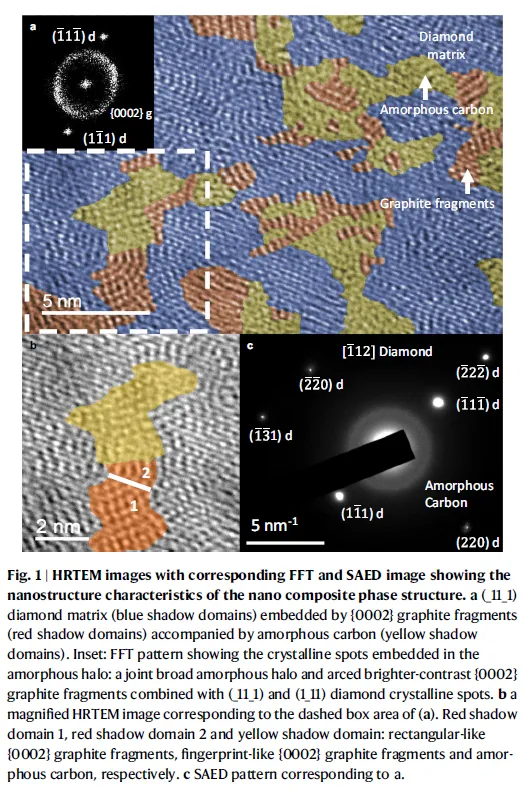
CPD is the result of the graphitization of diamonds. Graphitization of diamonds is generally considered undesirable. Traditional graphitized diamond has obvious boundaries. Although the sp2 carbon layer on the surface can enhance the electrical conductivity of diamonds, the layered structure will damage the mechanical properties and thermal stability of diamonds. CPD has a different structure from traditional graphitized diamonds. TEM (Figure 1a) shows that the sp2-hy bridized carbon phase composed of nano-amorphous carbon (yellow shadow) and graphite fragments (red shadow) is evenly embedded in the diamond matrix (blue shadow). Figure 1b shows a possible phase transition process: carbon atoms directly transform from the (1(_)11(_)) plane of diamond to the {0002} plane of graphite (red shades 1 and 2 in Figure 1b); and the ( The 1(_)11(_)) plane first transforms into the transitional amorphous carbon phase (Figure 1b, yellow shading) and then continues to transform into stable graphite fragments (Figure 1b red shading). The selected area electron diffraction (SAED) image in Figure 1c shows that CPD has both amorphous carbon rings and a diamond lattice lattice.
Conductivity is one of the important indicators of temperature-sensing materials. CPD has an electrical conductivity of up to 1.2 S·cm-1 at room temperature, which is comparable to a doped diamond. Figure 2a shows that the R-T curve of a CPD sample with an initial resistance of 13.13179 Ω at room temperature increases monotonically over the entire test temperature range, exhibiting a negative temperature coefficient (NTC). Normally, when the temperature approaches absolute zero, the resistance value of NTC materials will increase sharply until it is insulated, which is the main factor limiting the temperature measurement of NTC materials at extremely low temperatures. But even at temperatures as low as 40 mK, CPD can maintain very low resistance values (Figure 2c), a property that is very rare among semiconductor materials. The data is fitted by a three-phase exponential decay function (Expdec3) and extrapolated to the 0 - 500 K range (red curve). The corresponding determination coefficient R2 is as high as 0.99999, indicating that CPD is easy to calibrate and has extremely high measurement accuracy. Under the continuous cycle test of 3-5 K (Figure 2b), CPD also showed excellent stability. Figure 2d compares the temperature measurement range of the CPD with other cryogenic thermometers.

The low-temperature temperature measurement process is often accompanied by the influence of magnetic fields, such as nuclear magnetic resonance (NMR) and other application scenarios. The presence of a magnetic field can cause the sensor's resistance value to shift, causing inaccurate temperature readings. Many NTC temperature sensors not only have large resistance value deviations under the influence of magnetic fields but also have irregular deviations, which adds great difficulty to calibration and calibration. Figure 3a and Figure 3b show the resistance changes of CPD in different magnetic field environments. When the temperature is higher than 14 K, the CPD is almost insensitive to magnetic field changes (Figure 3a); when the temperature is lower than 14 K, the magnetoresistance of the CPD changes slightly. At a temperature of 2 K, when an external strong magnetic field of 9 T is applied, the resistance shift rate of CPD is only about 3% (inset of Figure 3a).

Like other sensors, cryogenic temperature sensors also need to be operated or stored at room or high temperatures. However, large temperature difference measurements or rapid temperature rise and fall will cause damage to the low-temperature sensor and cause changes in resistance. The existence of these problems puts higher requirements on the thermal stability of the sensor. The research team first characterized the thermal stability of CPD (Figure 4a) and the change in resistance after thermal cycling (Figures 4c and 4d). The oxidation of diamond in the air usually involves two processes: direct oxidation and graphitization, followed by oxidation. Since graphite and other sp2 hy bridized carbon materials are generally more susceptible to oxidation in the air than sp3 hy bridized diamond, strategies to improve diamond's oxidation resistance often focus on preventing diamond graphitization. Interestingly, in CPD, the introduction of the sp2 carbon phase not only did not reduce the thermal stability of the diamond but increased the initial oxidation temperature of CPD by more than 200 K (Fig. 4a, the initial oxidation temperatures of the original diamond and CPD were 948 K respectively. K and 1163 K; Figure 4b, CPD has better thermal stability than other diamond materials).

The researchers believe that this unusual property is related to the duplex structure itself. In CPD, nano-sp2 carbon phases are evenly distributed in the sp3 hy bridized diamond-based phase. This microstructure avoids the existence of large continuous sp2 carbon bonds. It protects the nano sp2 carbon phase from direct contact with oxygen, thereby inhibiting the rapid oxidation of the sp2 carbon phase at high temperatures. In addition, the thermal expansion coefficient of the sp2 carbon phase is greater than that of diamond. During the heating process, the internal stress experienced by CPD increases, further improving the high-temperature oxidation resistance of diamond. This work is the first to enhance diamond's high-temperature oxidation resistance without using high-pressure treatment. (Fig. 4a, Thermogravimetric (TG) curves and differential scanning calorimetry (DSC) curves of CPD in the air at a heating rate of 5 K·min-1. Fig. 4b, Thermal characteristics of CPD with other diamond and diamond-like materials Stability comparison. Figure 4c, CPD resistance change after ten thermal shocks from 400 to 77 K after being exposed to air for seven days. Figure 4d, CPD cyclic dynamic response test at 3-5 K after thermal shock. )
TRUNNANO is a globally recognized manufacturer and supplier of compounds with more than 12 years of expertise in the highest quality nanomaterials and other chemicals. The company develops a variety of powder materials and chemicals. Provide OEM service. If you need high quality graphene, please feel free to contact us. You can click on the product to contact us.