What is Borides Powder?
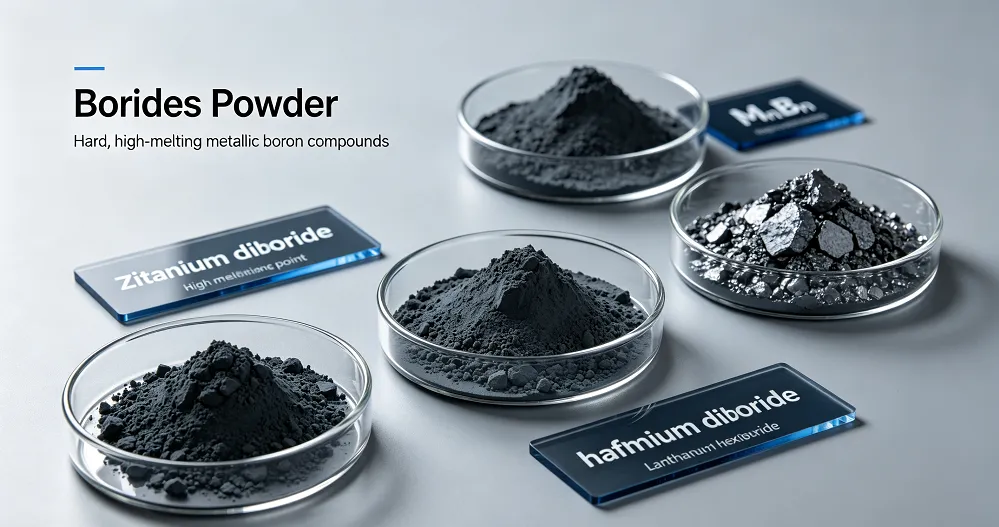
Boride Powder formed by boron and metals and certain non-metals. It can be represented by the general formula MmBn, which is generally a mesenchymal compound and does not follow the valence rules. Except for zinc (Zn), cadmium (Cd), mercury (Hg), gallium (Ga), indium (In), thallium (Tl), germanium (Ge), tin (Sn), lead (Pb), bismuth (Bi).
In addition, other metals can form Borides Powder. They are all crystals with high hardness and melting points. They are chemically stable and cannot be dissolved by hot concentrated nitric acid. They can be directly combined with elements or made by reducing oxides with active metals. They are used as refractory, abrasive, and superconducting materials.
Boron is a light element that forms stable Borides Powder with transition metals, and the compounds with high melting points are compounds formed with elements of group IVA, group VA and group VIA. The crystal structure of boride is determined by the structural characteristics of the boron atom. The chemical stability of Borides Powder gradually decreases from IVA to VIA. The most stable Borides Powder are TiB2, ZrB2, and HfB2.
Borides Powder
In the boride lattice, structural units in the form of single bonds, double bonds, networks, and spatial frameworks are formed between boron atoms. As the relative content of boron in the boride increases, the structural unit becomes more complex.
Generally speaking, the more complex the atomic structure of boron, the less likely it is to be hy-drolyzed, and the stronger the stability against oxidation and nitridation.
In transition metal Borides Powder, the chemical bond between the metal atom and the boron atom is an electronic bond, so that the boron atom is transformed into a positively charged ion or atomic skeleton, and there is also a covalent bond between the boron atoms.

Borides Powder
The crystal structure of borides is largely determined by the arrangement and bonding of boron atoms within the lattice. The boron atoms in borides can form a variety of structural motifs, including isolated boron atoms in metal-rich borides, pairs (B₂) in borides with intermediate boron content, and chains, rings, and three-dimensional networks in boron-rich borides. The complexity of the boron structure increases with the boron content, leading to materials with progressively higher hardness and chemical stability. The presence of covalent bonds between boron atoms contributes to the high hardness and thermal stability of borides, while the metallic bonding between metal and boron atoms provides good electrical conductivity. The crystal structure of borides can be modified by the addition of other elements, creating solid solutions and compounds with tailored properties. The understanding of the crystal structure of borides is essential for predicting and optimizing their properties for specific applications. The development of new boride compounds and the optimization of their processing methods continue to be active areas of research. The unique combination of metallic and covalent bonding in borides makes them valuable materials for demanding applications in high-temperature and high-stress environments.
Preparation method of Borides Powder
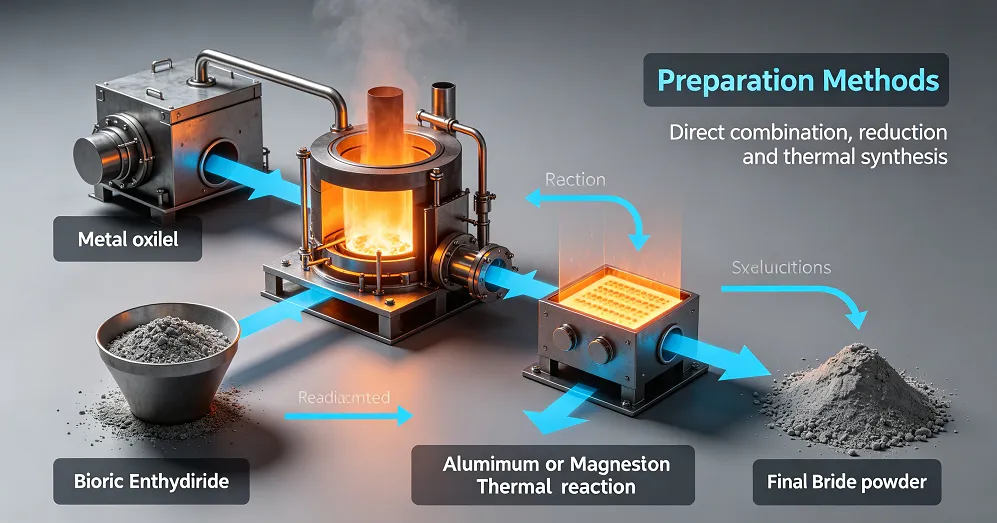
The main method of making refractory metal Borides Powder is
1.The reaction formula of metal and boron directly combined at high temperature is
Me+B----MeB
2.Reducing the mixture of metal oxide and boric anhydride with carbon is
2MeO+B2O3+5C—→2MeB+5CO
3.Aluminum (silicon, magnesium) thermal method, aluminum or silicon, magnesium reduces oxides so that the generated metal and boron further interact as
MeO+B2O3+AI (Si, Mg)—→MeB+Al(Si, Mg) oxide
4.Reducing metal oxides with boron carbide and carbon are
4MeO+B4C+3C—→4MeB+4CO
5.Reducing refractory metal oxides with boron as
xMeO+2xB—→xMeB+(BO)x
Preparation Methods
Boride has the characteristics of high conductivity, high melting point, high hardness, and high stability: Boride has relatively high thermal conductivity and strength, so its thermal stability is relatively good. The oxidation resistance of boride at high temperatures is based on group IVB metals. Boride is the best.
Borides are soluble in molten alkali, rare earth and alkaline earth metal Borides Powder are not corroded by humid air or dilute hy-drochloric acid but are soluble in nitric acid. Almost all Borides Powder have the appearance and properties of metals, with high conductivity and positive temperature coefficient of resistance. The Borides Powder of Ti, Zr, and Hf have better conductivity than their metals.
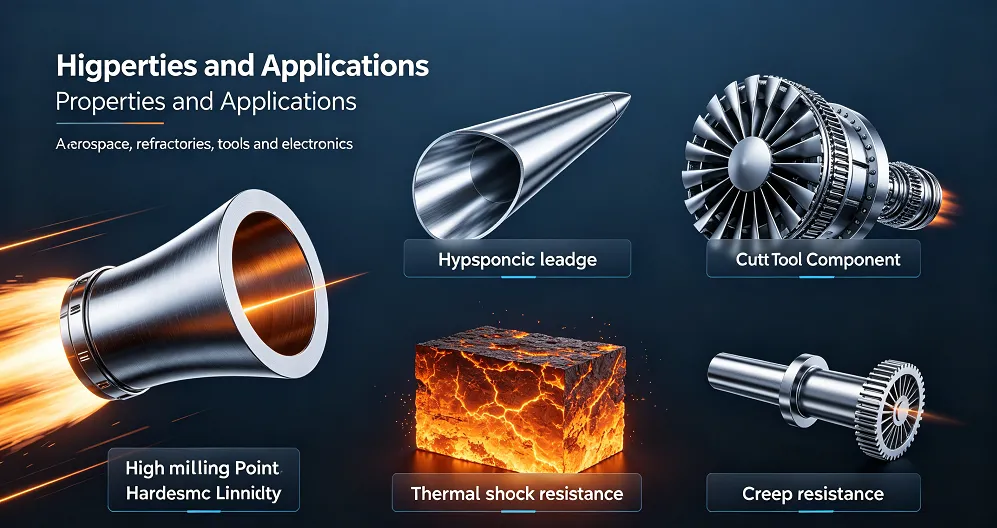
The creep resistance of boride is very good, which is very important for gas turbines and rockets that require materials to work at high temperatures for a long time, and can maintain strength, resist deformation, resist corrosion, and heat shock. Various alloys or cermets based on Borides Powder, carbides, and nitrides can be used to manufacture rocket structural components, aviation equipment components, turbine components, sample holders for high-temperature material testing machines and instrument components, bearings, and measuring high-temperature Cone head for hardness, and some structural parts of nuclear energy device, etc.
The exceptional properties of borides make them indispensable materials for a wide range of demanding applications in various industries. In the aerospace industry, borides are used in the manufacture of rocket nozzles, leading edges of hypersonic vehicles, and thermal protection systems, where their ability to withstand extreme temperatures and thermal shock is essential. The high thermal conductivity of borides helps to dissipate heat efficiently, preventing localized overheating and thermal stress. In the automotive industry, borides are used in the production of wear-resistant components, such as bearings, seals, and brake pads, where their hardness and resistance to wear provide extended service life. In the metallurgical industry, borides are used in the production of refractory linings for furnaces and kilns, where their high melting point and chemical stability are essential. In the electronics industry, borides such as lanthanum hexaboride (LaB₆) are used as thermionic emitters in electron microscopes and cathode ray tubes, where their low work function and high emission current density provide excellent performance. In the nuclear industry, borides are used as neutron absorbers in control rods and shielding materials, where their high neutron absorption cross-section is essential for controlling nuclear reactions. The development of new boride-based materials for advanced applications continues to be an area of active research, with efforts focused on improving the processing, performance, and cost-effectiveness of these materials. The combination of high hardness, thermal stability, electrical conductivity, and chemical resistance makes borides valuable materials for a wide range of industrial applications. The ongoing research on borides is expected to lead to new discoveries and expanded applications in various fields.
Properties and Applications
Applications of Representative Borides
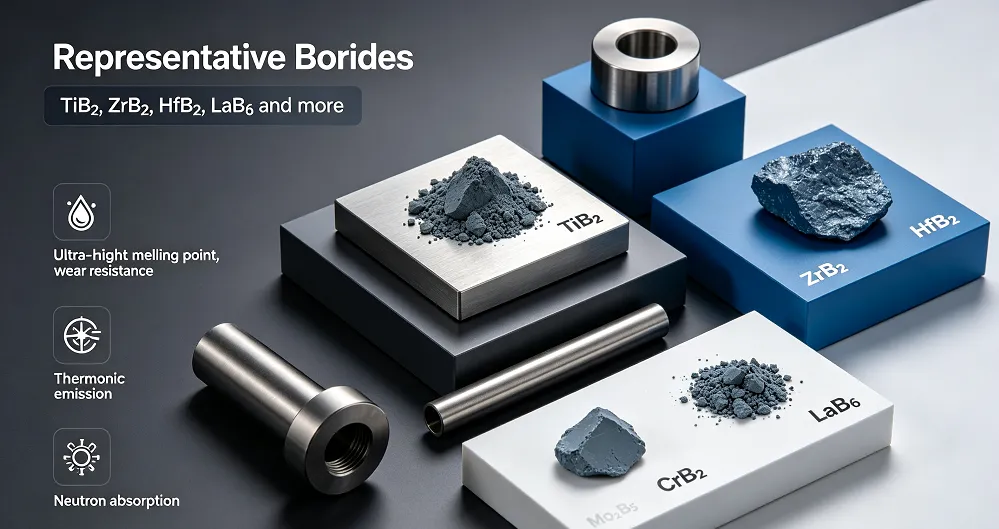
Titanium Diboride (TiB₂): Titanium diboride is one of the most widely studied and applied borides due to its exceptional combination of properties, including high hardness (Vickers hardness ~3400 HV), high melting point (3220°C), excellent electrical conductivity, and good oxidation resistance. TiB₂ is used in the production of cutting tools, wear-resistant coatings, and armor materials. It is also used as a cathode material in aluminum smelting, where it provides excellent resistance to molten aluminum corrosion.
Zirconium Diboride (ZrB₂): Zirconium diboride is characterized by its high melting point (3246°C), high thermal conductivity, and excellent oxidation resistance up to 1400°C. ZrB₂ is used in the manufacture of ultra-high-temperature ceramics for aerospace applications, including leading edges of hypersonic vehicles, rocket nozzles, and thermal protection systems. It is also used in the production of refractory materials for high-temperature furnaces.
Hafnium Diboride (HfB₂): Hafnium diboride is one of the most refractory compounds known, with a melting point of approximately 3380°C. It is used in the manufacture of ultra-high-temperature structural components and as a protective coating for nuclear reactor components. The high melting point and thermal stability of HfB₂ make it suitable for the most demanding high-temperature applications.
Lanthanum Hexaboride (LaB₆): Lanthanum hexaboride is a well-known thermionic emitter material, characterized by its low work function (2.5-2.7 eV) and high electron emission current density. LaB₆ is used in electron microscopes, cathode ray tubes, and plasma sources. The high stability and performance of LaB₆ emitters make them essential components in various scientific and industrial instruments.
Chromium Diboride (CrB₂): Chromium diboride is used in the production of wear-resistant coatings and cutting tools due to its high hardness and good oxidation resistance. It is also used as an additive in refractory materials to improve their thermal and mechanical properties.
Molybdenum Borides (Mo₂B₅, MoB₂): Molybdenum borides are used in high-temperature structural applications and as additives in the production of advanced ceramics. Their good thermal stability and electrical conductivity make them suitable for use in electrodes and thermocouples.
Representative Borides