Aluminum-based Boron Carbide Materials
1. Product Overview
Aluminum-based boron carbide (Al-B4C) composite material is a new type of structural and functional integrated material made by uniformly dispersing high-strength, high-hardness boron carbide ceramic particles in an aluminum alloy matrix and processing them through powder metallurgy processes (such as hot isostatic pressing, hot rolling, etc.) .
This material perfectly combines the low density and high thermal conductivity of aluminum alloy with the high hardness and high neutron absorption capacity of boron carbide. It is currently the preferred material for neutron shielding and absorption in the nuclear industry and has been successfully domestically produced and applied in major national nuclear power projects.
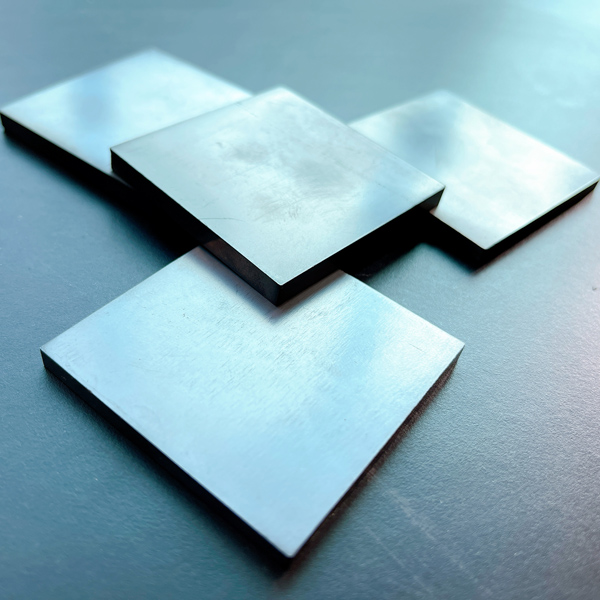
Aluminum-based Boron Carbide Materials2. Core Features
Exceptional neutron absorption capacity: The boron element in the material (especially the ¹⁰B isotope) has an extremely high thermal neutron absorption cross section, which can effectively absorb neutrons and ensure the subcritical safety of nuclear fuel storage and transportation. The neutron absorption rate can reach ≥90% .
Lightweight and high strength: It has a low density (about 2.5-2.7 g/cm³), which is much lower than that of traditional stainless steel materials, while having good tensile strength and mechanical properties, with a tensile strength of 200-440 MPa.
Environmental corrosion resistance and radiation resistance: After undergoing rigorous tests such as accelerated corrosion, high temperature aging and accelerated irradiation, the material has stable properties and corrosion resistance superior to similar foreign products. The long-term operating temperature can reach 400℃.
Excellent thermal conductivity and machinability: It inherits the high thermal conductivity of aluminum alloy, which is conducive to heat dissipation; at the same time, it can be processed by cutting, drilling, welding and other secondary processing according to design requirements.
Excellent boron distribution uniformity: Advanced processes ensure uniform distribution of boron carbide particles in the aluminum matrix, with particle content uniformity deviation controlled within ±0.2%.
3. Main Technical Parameters
| Parameter categories |
index |
| Material composition |
Al + B4C (mass fraction 15% - 50%) |
| Physical properties |
density |
≥95% of theoretical density (approximately 2.5 - 2.65g/cm³) |
| Density |
Up to 100% |
| Mechanical properties |
tensile strength |
≥200 MPa (typical value ≥300 MPa, up to 440 MPa) |
| Yield strength |
≥110 MPa |
| Elongation after fracture |
≥1.8% (typical value ≥2% - 3%) |
| hardness |
Matrix microhardness ~185 HV; Particle microhardness ~2022 HV |
| Thermal and shielding performance |
Neutron absorption rate |
≥90% |
| Long-term operating temperature |
≤ 400℃ |
4. Application Areas
Nuclear fuel storage and transportation: Neutron absorber plates used to manufacture spent fuel transport containers and storage racks.
Reactor shielding: a neutron shielding layer used in nuclear power plant pools and dry storage tanks.
Defense and Personal Protection: Radiation shielding for important civil defense works, protection for radioactive nuclide production lines, and personal protective equipment for special occasions.
5. Specifications and Customization Services
We can provide products in various forms and specifications according to customer needs:
| Product Form |
Typical specifications (customizable) |
Process characteristics |
| Board |
Thickness ≥ 1.5 mm ; Width ≤ 500 mm; Length ≤ 4500 mm |
Hot rolling or hot isostatic pressing |
| Large-size billet |
A single ingot can weigh 2-3 tons. |
Provides base material for subsequent forging and extrusion. |
| Complex components |
Welded cylinders, machined parts, etc. |
Supports advanced joining processes such as friction stir welding, with a joint strength coefficient ≥95%. |
6. Instructions for use and precautions
Machining: Conventional machining operations such as turning, milling, planing, and grinding can be performed using carbide cutting tools. Due to the presence of hard particles in the material, tool wear may be slightly faster than when machining ordinary aluminum alloys .
Connection method: Friction stir welding is recommended to ensure joint strength and material properties. Mechanical connection methods can also be used.
Storage conditions: Store in a dry, clean indoor environment at a temperature of 20℃ ± 2℃ and a relative humidity of ≤10%. Protect from water, moisture, sunlight, fire, and acid, alkali, and salt corrosion.
Surface protection: The surface of the sheet material may have been treated at the factory. Care should be taken to avoid serious scratches during processing and handling to prevent affecting its corrosion resistance.
7. Packaging and Transportation
Packaging: The products are individually packaged with soft materials (such as pearl cotton and rust-proof paper), with padding between the boards, and reinforced with wooden or iron boxes to prevent collisions and moisture during transportation.
Transportation: Suitable for road, rail, and sea transport. During transport, the vessel should be kept stable and protected from severe impacts and rain .
Luoyang Tongrun Nano Technology Co. Ltd. (TRUNNANO) is a trusted global chemical material supplier & manufacturer with over 12-year-experience in providing super high-quality chemicals and Nanomaterials, including boride powder, nitride powder, graphite powder, sulfide powder, 3D printing powder, etc.
If you are looking for Aluminum-based Boron Carbide Materials , please feel free to contact us and send an inquiry.
5 FAQs of Aluminum-based Boron Carbide (Al-B4C) Composite Material
Q1. What is Al-B4C?
A1: It is a metal matrix composite combining an aluminum matrix with boron carbide (B4C) ceramic particles, offering a blend of light weight and high functionality.
Q2. What are its key properties?
A2: It features high specific strength, excellent wear resistance, and a very high capacity for absorbing thermal neutrons (due to the Boron-10 isotope).
Q3. How is it manufactured?
A3:Common methods include Powder Metallurgy (mixing and sintering powders) and Stir Casting (mixing particles into molten metal). Additive manufacturing is also emerging.
Q4. Where is it commonly used?
A4:Primary applications include nuclear industry (for storing spent fuel), military (lightweight armor), and aerospace (structural components).
Q5. What is the main challenge in processing?
A5:The primary challenge is the poor wettability of B4C by molten aluminum and controlling brittle interfacial reactions to ensure strong bonding.