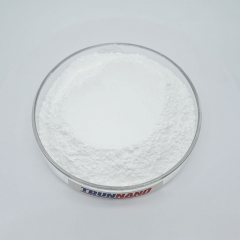


Overview of Trans-1,4-Cyclohexane Diisocyanate
Product Name: Trans-1,4-Cyclohexane Diisocyanate
CAS No: 7517-76-2
Other Name: TRANS-CYCLOHEXANE-1,4-DIISOCYANATE; trans 1,4-cyclohexane diisocyanate; trans-cyclohexane-1; trans-1.4-diisocyanato-cyclohexane
Molecular Weight: 166.18
Formula: C8H10N2O2
Appearance: White/yellow powder/crystalline powder/solid solution
Trans-1,4-cyclohexane diisocyanate ,CAS No: 7517-76-2 can react with hydroxyl and amino groups to form compounds such as polyurethanes or polyvein elastomers, which are twice as reactive as aliphatic diisocyanates such as isophorone diisocyanate (IPDI). This compound is produced from cyclohexane-1,4-carboxylic acid diethylene glycol by ammoniation, chlorination and other reactions.
Trans-1,4-cyclohexane diisocyanate can be used as a raw material for the preparation of polyurethane coatings, synthetic fibers, and polyvein elastomers, making it a versatile chemical.
Please note that exposure to such compounds requires appropriate protective measures, such as wearing gloves and protective eyewear, to prevent harm to the human body.
Properties of Trans-1,4-Cyclohexane Diisocyanate
Density: 1.2265 (rough estimate)
Melting Point: 59-62 ° C (lit.)
Boiling Point: 145-146 ° C 32mm
Flash Point: 145-146 ° C/32mm
Water Solubility: Hydrolyzes in water
Vapour Pressure: <0.02 mm Hg (20 ° C)
Refractive Index: 1.6180 (estimate)
Sensitivity: Moisture Sensitive
Product Performance of Trans-1,4-Cyclohexane Diisocyanate
Trans-1,4-cyclohexyl diisocyanate is a colorless liquid with an irritating odor.
Its density is approximately 1.045 g/cm ³, The boiling point is about 289 ℃ and the flash point is about 121 ℃.
At room temperature, it is relatively insoluble in water, but can be soluble in some organic solvents such as ethanol and ether.
Trans-1,4-cyclohexyl diisocyanate has high molecular weight, low volatility, high weather resistance, and good coating processing performance.
Application of Trans-1,4-Cyclohexane Diisocyanate
Trans-1,4-cyclohexane diisocyanate has applications in chemical reagents, fine chemicals, pharmaceutical intermediates, material intermediates and so on.
Chemical Reagents: Trans-1,4-cyclohexane diisocyanate can be used to synthesize polyurethane materials and other polymer materials. Polyurethane is a high-performance engineering plastic with good mechanical properties, heat resistance and chemical stability. It can be used to prepare a variety of products such as elastomers, coatings, adhesives, etc., and has a wide range of applications in automotive, construction, electronics and other fields.

Chemicals Intermediates: Trans-1,4-cyclohexane diisocyanate can be used to synthesize urea-like compounds. These urea-like compounds have a wide range of pharmaceutical activities and can be used to synthesize antibiotics, antitumor drugs, and other important drugs. For example, it can be reacted with ethylenediamine to produce urea compounds with antibiotic activity.
Pharmaceutical Intermediates: Trans 1,4-cyclohexane diisocyanate can be used to synthesize some important pharmaceutical compositions, such as antibiotics and antitumor drugs.
Material Intermediates: Trans 1,4-cyclohexane diisocyanate can be used to modify other materials, such as polymers and resins. It can be reacted with other monomers to produce polymeric materials with excellent properties.
It is important to note that trans-1,4-cyclohexane diisocyanate is a reactive compound, so extra care and safety procedures need to be followed when using it.

Company Profile
Luoyang Tongrun Nano Technology Co. Ltd. (TRUNNANO) is a trusted global chemical material supplier & manufacturer with over 12-year-experience in providing super high-quality chemicals and nanomaterials, including boride powder, nitride powder, graphite powder, sulfide powder, 3D printing powder, etc.
The company has a professional technical department and Quality Supervision Department, a well-equipped laboratory, and equipped with advanced testing equipment and after-sales customer service center.
If you are looking for high-quality Trans-1,4-Cyclohexane Diisocyanate, please feel free to contact us or click on the needed products to send an inquiry.

Packing of Trans-1,4-Cyclohexane Diisocyanate
100g, 1kg, 10kg, etc.
We have many different kinds of packing which depend on the quantity of trans-1,4-cyclohexane diisocyanate

Payment Methods of Trans-1,4-Cyclohexane Diisocyanate
L/C, T/T, Western Union, Paypal, Credit Card etc.
Shipment of Trans-1,4-Cyclohexane Diisocyanate
By sea, by air, by express as soon as possible once payment receipt.
FAQs of Trans-1,4-Cyclohexane Diisocyanate
Q:What are the main application areas for trans-1,4-cyclohexane diisocyanate?
A:As an important monomer, it is used in the synthesis of polyurethane resins, elastomers and foams. These materials are widely used in the automotive, construction, furniture and packaging industries. Used as a cross-linking agent for coatings and inks to improve the adhesion, weatherability and abrasion resistance of products. Used as high-performance adhesives for bonding of metals, plastics, wood and other materials. Used as sealing material with good sealing and weather resistance. Used as finishing agent for textiles to improve the softness and abrasion resistance of textiles.
Q:What is the method of preparation of trans-1,4-cyclohexane diisocyanate?
A:1,Phosgene method: Prepared by reacting cyclohexanediamine with phosgene (COCl₂). Specific steps include:
Preparation of raw materials: Preparation of cyclohexanediamine and phosgene. Reaction: In the presence of an inert solvent (e.g. methylene chloride) and a catalyst (e.g. triethylamine), cyclohexane diamine reacts with phosgene to form trans-1,4-cyclohexane diisocyanate. Purification: The product is purified by distillation or recrystallisation to remove unreacted raw materials and by-products.
2,Non-photogas method: produced by the reaction of cyclohexane diamine with isocyanate esterification reagent (such as phenyl isocyanate). Specific steps include: raw material preparation: preparation of cyclohexane diamine and phenyl isocyanate. Reaction: In the presence of a suitable solvent and a catalyst (e.g. boron trifluoride ethyl ether complex), cyclohexane diamine reacts with phenyl isocyanate to form trans-1,4-cyclohexane diisocyanate. Purification: the product is purified by methods such as distillation or recrystallisation to remove unreacted raw materials and by-products.
Q:How safe and environmentally friendly is trans-1,4-cyclohexane diisocyanate?
A:trans-1,4-Cyclohexane diisocyanate is irritating and may cause irritation or burns on contact with skin and eyes. Wear protective gloves and goggles when using. Inhalation of vapours or dust of trans-1,4-cyclohexane diisocyanate may cause respiratory distress or allergic reactions. Keep well ventilated during operation. Accidental ingestion of trans-1,4-cyclohexane diisocyanate may cause gastrointestinal irritation or poisoning. If accidentally swallowed, seek medical attention immediately. Discharge of trans-1,4-cyclohexane diisocyanate solution into the environment may affect aquatic ecosystems. Therefore, waste water after use should be properly treated to ensure compliance with environmental standards before discharge. Waste trans-1,4-cyclohexane diisocyanate solids or solutions should be disposed of in accordance with hazardous waste handling regulations to avoid pollution of the environment.
Q:What is the future of trans-1,4-cyclohexane diisocyanate?
A:Develop trans-1,4-cyclohexane diisocyanate derivatives with higher heat resistance, chemical resistance and mechanical strength to meet the needs of high-end applications. Research and develop a more environmentally friendly production process for trans-1,4-cyclohexane diisocyanate to reduce the generation of harmful by-products and improve resource utilisation. Give trans-1,4-cyclohexane diisocyanate more functions, such as electrical conductivity, flame retardancy, etc., through copolymerisation reaction or other modification methods to broaden its application scope. Explore the application of trans-1,4-cyclohexane diisocyanate in the field of biomedicine, such as biologically active materials, drug slow-release materials. To study the application of trans-1,4-cyclohexane diisocyanate in the field of new energy, such as electrolyte for lithium batteries, coating materials for solar cells, etc., in order to provide support for sustainable development.